From the Hansard, 20 June 2012.
MATTERS OF PUBLIC INTEREST – West Papua
Senator DI NATALE (Victoria) (13:17): I rise today to express my grave concerns about a tragic situation that is unfolding on Australia’s doorstep at this very moment. I speak of the issue of West Papua, where alarming abuses of human and democratic rights are occurring. It appears that there has been a significant escalation in politically motivated violence over the past month. So it is timely to reflect on what is happening in a place that is one of our closest neighbours and the role we can play in ending the conflict and protecting the rights of the people who live there.
West Papua presents a challenge for Australian diplomacy and for the global community. It is a challenge that this nation and indeed the world is yet to meet. Although it is the world’s second largest island, New Guinea is a part of the world that rarely makes the nightly news. The western half of the island is West Papua. The situation faced by its people is something that deserves our urgent attention.
West Papua was one of the last parts of Asia to be decolonised. The Dutch retained control of the region when Indonesia gained its independence in 1949. The Netherlands took steps to prepare the territory for independence, which included the development of a national anthem and a national flag, called the Morning Star. Sadly, this independence was not to be. Indonesia had always claimed the province, and conflict between the Netherlands and Indonesia over West Papua resulted in armed conflict in 1961. In 1963 the New York agreement passed administration of West Papua over to Indonesia. West Papua was formally annexed to Indonesia in 1969, following what was then called the Act of Free Choice. Papuans call this the ‘Act of No Choice’. A true act of self-determination should have occurred, but it did not. The Papuans were denied their chance to vote on their future. Instead, there was an atmosphere of violence and intimidation, with 1,022 hand-picked Papuans assembled, cajoled, bribed and threatened into voting to become part of the Republic of Indonesia.
I am sorry to say that the people of West Papua have been waiting ever since for the chance to express their desires to chart their own future. Self-determination, a right belonging to all people, was denied to them. Indonesia fought long and hard for its own independence, so the Indonesians do understand the desire for self-determination. Indeed, they would consider themselves as the liberators of West Papua from colonial rule, which in my view is a sad irony, when we consider what has happened there since 1969.
The people of West Papua are Melanesian. They are ethnically, linguistically and culturally distinct from the majority of Indonesians. They are ruled from Jakarta by a government that often seems more interested in their resources and in what can be gained from the region than in their welfare. They have had to endure a new form of colonisation, and Melanesian Papuans are already a minority in some parts of West Papua. In fact, they may soon be a minority in the province as a whole if current trends continue. Papuans now face the outrage of being discriminated against in their own land, with the public service, business elites and security forces now dominated by non-indigenous Papuans.
The Papuans must watch powerlessly as their land is exploited. The Grasberg gold and copper mine, the world’s largest, is an environmental disaster but provides very few benefits to the people of West Papua. The Papuans have to watch as their land is patrolled by the Indonesian army. They are nominally Indonesian citizens, yet the army is not there to defend their rights—in fact, in many cases quite the opposite occurs. The results are as predictable as they are tragic. Tension grows daily, ethnic division is rife, oppression leads to violence and the Papuan desire for the right to choose their own future has never been stronger.
In October last year, the Third Papuan People’s Congress was held in Jayapura. Five thousand Papuans attended to have a say on their future, and it was a peaceful gathering. The right to gather and discuss their future is guaranteed by the Indonesian constitution, yet the meeting was disrupted by a military crackdown. At least three people were killed. Five leaders were arrested and have since been jailed for three years. There was not a word of protest from the Australian government.
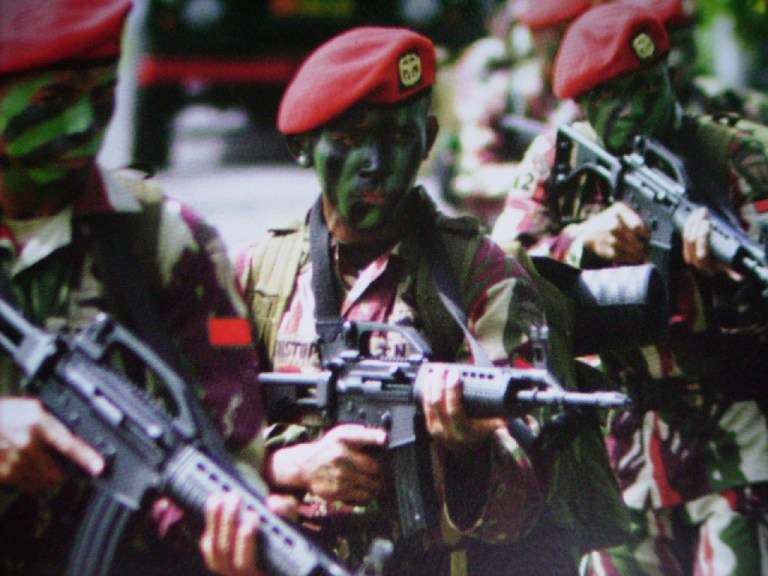
Since then, the situation has worsened. In the past two to three weeks, there have been shootings, killings and military violence in Jayapura. There have been a number of separate attacks, with several people having been shot or stabbed. The accounts filtering through indicate that no arrests have been made. Police and the military blame Papuan separatists, but human rights defenders in Papua point the finger squarely at Indonesian security forces. The perpetrators of this violence must be identified through a transparent process.
We have also heard reports of Indonesian security forces sweeping the Papuan highland town of Wamena. They have caused at least two deaths, injured at least 11 people and torched at least 70 houses. This was apparently retaliatory action—police were retaliating for the killing of one of their officers by Papuans. The killing of the police officer, however, was prompted by his killing, on his motorbike, of a Papuan child. Unless those inflicting violence are held accountable, this cycle of violence will continue and worsen.
We have now heard news of Papuan leader Mako Tabuni being shot and killed by police on Thursday last week. He was walking on the street near a housing complex in a suburb of Jayapura. Mako Tabuni was the deputy of the KNPB, a group which has called for a referendum on Papuan self-determination and a movement which has publicly identified itself as a peaceful one. The Australian Greens are deeply saddened to hear of the killing of Mako Tabuni. We extend our condolences to Mako Tabuni’s family and we confirm our solidarity with the people of West Papua whose human and democratic rights continue to be violated.
Police say Mako Tabuni was resisting arrest and armed with a weapon he had taken from his arresters, but eyewitness accounts say that Tabuni, as he walked by alone, was suddenly and unexpectedly shot by a gunman in one of several cars on the street. Tabuni’s killing prompted angry scenes in Jayapura as Papuans protested his death. All of this has been taking place while many Papuans languish as political prisoners in Indonesian prisons, charged with treason for raising their flag, singing their traditional songs or expressing their political views. One example is Filep Karma, who has been in prison for over a decade for doing nothing more than peacefully protesting. I again call on the government to urge our Indonesian neighbours to take action to ensure that democracy and human rights are upheld in this region.
It has been a bloody few weeks in West Papua, adding to the horror experienced by the West Papuan people over many decades of Indonesian rule over their lands. Australians are now becoming more aware of these atrocities being committed on their doorstep. They know what happened in East Timor under Indonesian rule and they know that we, as a nation, cannot sit idly by while it occurs again in West Papua.
There is a petition due to be tabled next week in the House of Representatives, brought to the parliament by a community activist group based in my home state of Victoria and signed by more than 3,000 Australians. It calls on the Australian government to request that the United Nations review the New York agreement of 1962 and the 1969 Act of Free Choice and conduct a genuine, UN monitored referendum on self-determination in which all adult West Papuans are allowed to vote without duress. The petition also calls on the House of Representatives to stop all Australian financial support to and training of Indonesian military and security personnel until human rights abuses by military and security personnel in West Papua cease. It asks elected representatives to request the Indonesian government to remove the media blockade and allow international journalists free access to West Papua.
I have spoken before in the parliament about the desire of the Greens to see West Papuans free to express their political views without fear of persecution. But this freedom will not be realised until there is more international scrutiny. It is absolutely paramount that the region is opened up to journalists, who must be free to visit and report on the situation on the ground. The story of the West Papuans must be told. The truth must be told. Human rights organisations must also be allowed into the region. Until this scrutiny is applied, all we have to assure us that illegal acts are not occurring are the assertions of local authorities. It would not be wise, given the history, to take these assertions at face value.
I will continue to advocate for the human rights of one of our nearest neighbours until we see this important change. People should never feel the threat of violence or death simply for expressing their political views. We must advocate for a new dialogue between the Indonesian government and the representatives of the Papuan people. While in theory West Papua has special autonomy, this has failed the West Papuan people. It is time to start discussions afresh.
It is worth noting that Indonesia recently underwent its UN periodic review, a human rights review which occurs for UN member states every four years. This was an opportunity for fellow UN member states to make observations and recommendations about the human rights record of Indonesia. The review was held on 23 May and the Indonesian government accepted 180 recommendations from 74 countries. Indonesia adopted 144 of these, with the remainder to be brought back to Indonesia to be considered and decided upon in September 2012 during the 21st session of the UN Human Rights Council. Of the recommendations yet to be adopted, it remains to be seen whether Indonesia will address those relating to the protection of human rights defenders. It has been called on to free those people detained for peaceful political protests. It is unacceptable that someone like Filep Karma be detained for decades simply for expressing a right that all of us should be granted.
Among the remaining items that Indonesia has taken home to discuss, it has also recommended that they address issues of impunity and immediately take action on reports of human rights violations committed by the military and by police, particularly in Papua. I will be watching those responses with interest.
Beyond the UN periodic review, the world will be watching West Papua. There is new scrutiny on this region, with new technologies now enabling Papuans to convey messages, photos and video to the outside world. They are sharing their experiences of brutality and conflict despite the restrictions that prevent outside journalists from reporting in the region.
Here in Australia a group of young West Papuan activists are using online media and music to create awareness of the oppression their families are experiencing back home. I have met with many members of this group. In fact, I enjoyed their music. A group called the Rize of the Morning Star deserve to be commended for their advocacy and activism on this hugely important issue. It is a project that is capturing the hearts and minds of many Australians through music, telling the traditional stories of West Papua and asking us all to sit up and listen to what is happening in the region.
The petition that will be tabled next week is a notice to this parliament that thousands of Australians are outraged at the human rights abuses occurring in West Papua. I urge the foreign minister, Minister Carr, to take the concerns of these Australians to his Indonesian counterpart. I am also pleased that with several of my colleagues I will be inviting all members of this 43rd Parliament to join us in establishing a parliamentary friends of West Papua group. It will be an opportunity for us to collaborate across party lines on the complex issues facing our neighbours.
West Papua is a chance for Australia to show real leadership. It is a chance for us to show that we will stand up for the values of peace and democracy we so readily espouse. We can argue for a peaceful and optimistic future for Papua and remain a good friend of Indonesia. But it starts with facing the truth. We must face this truth before more blood is spilt.




 West Papua Media Alerts