Wamena arrests as Australian-funded anti-terror troops conduct raid amid increasing repression on KNPB political activists

by West Papua Media

September 30, 2012

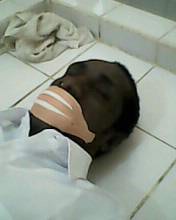
Unconfirmed photo from Sep 29 Detachment 88 raid on KNPB in Wamena (Supplied/KNPB)

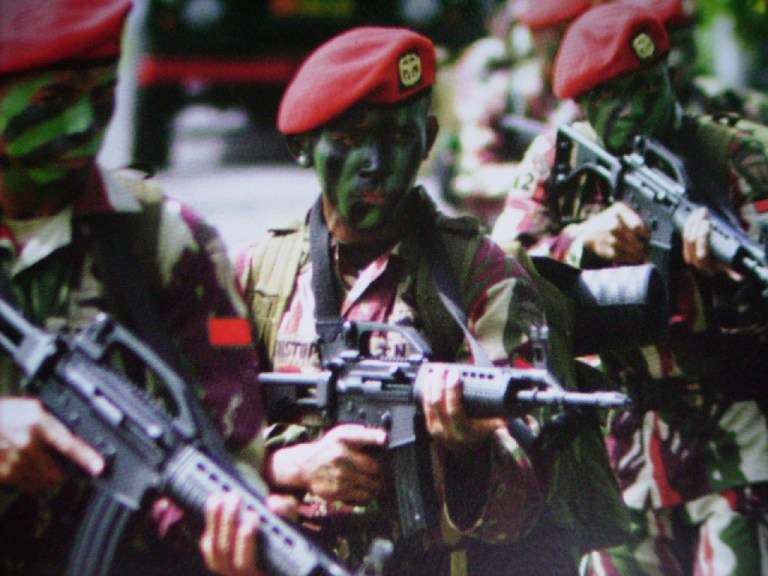
Troops from the Indonesian army (TNI) and Australian-trained Detachment 88 counter-terror unit conducted a major raid on Saturday against activists from the West Papua National Committee (KNPB) in Wamena, according to several credible sources in the West Papuan highland town.

The raid on the secretarial office of KNPB Baliem Region at the Potikelek complex in Wamena, just before 6pm on Saturday night, resulted in the arrests of 8 KNPB members. Sources reported to West Papua Media that at least two platoons each of TNI, D88 and regular Police (arriving in 2 trucks, 11 vehicles and 14 motorbikes) were involved in the raid, with many detainees being subjected to brutal beatings and on-the-spot interrogations by security forces according to independent witnesses.

According to Simon Dabi, the Baliem region chairman of KNPB, the troops “said tomorrow they will return and burn the hut.”

“We are not aware of the reason for the arrests, but there’s a possibility it could be connected to a scenario that’s been created to make out KNPB activists to be terrorists, by connecting us to the recent bombing in Irian Road, Wamena,” explained a clearly exasperated Dabi, relayed through KNPB sources.

Those confirmed arrested are:

• KNPB Secretary General (Baliem Region) Janus Wamu (aged 26);

• Eddo Doga (aged 26);

• Irika (Ribka) Kosay (aged 19);

• Jusuf Hiluka (aged 52);

• Yan Mabel (aged 24);

• Amus Elopere (aged 22);

• Wioge (Nata) Kosay (aged 18);

• Melianus Kosay (aged 29);

Grave fears are currently held for the safety of the detainees, who were taken for interrogation to the Wamena Regional Police headquarters under the command of Jayawijaya Regional Police Chief Arivin. Simon Dabi told stringers that the arrest was carried out arbitrarily and without proper legal procedure and those arrested “are at present in an unsafe situation”.

West Papua Media repeatedly attempted to seek comment from the operation commander Kapolres Arivin, and written questions were submitted to clarify details of the raid, however, Arivin hung up twice upon answering and then switched his phone off.

The Papua-wide General Chairperson of KNPB, Victor Yeimo, also urged the Chief of Jayawijaya Regional Police to release the KNPB members. “I have just telephoned direct but the phone was unanswered, so I was only able to send an SMS to the Head of Regional Police to insist that the 8 young ones I am responsible for, be immediately released as their action (in arresting the 8) is uncivilized and improper” asserted Yeimo.

Yeimo ridiculed the police assertion that the arrested activists were involved in the attack on the police station, or in making or using bombs, or engaging in acts of terror.  “West Papuan people are not involved with these bombs, and still do not know how to make bombs,”  Yeimo told West Papua Media.  KNPB has previously and publicly pledged its commitment to non-violence, saying that it is committed to the use of “civil power”

KNPB members have reason to be concerned for the safety of their colleagues. On September 23, 6 local youth members of KNPB were arrested, tortured and beaten in arbitrary arrests following an apparently suspicious death of an Indonesian colonist, and then all released without charge. “Having done no wrong, KNPB activists are constantly being chased, arrested, intimidated and killed by NKRI (the Indonesian state),” said Yeimo.

Members of the KNPB have also been subject to an escalating wave of repression by Indonesian security forces across Papua, since the beginning of an anti-violence civil resistance campaign earlier in 2012, in response to a series on mysterious “unknown persons” (OTK) shootings that had killed over 20 people since 2011. These shootings, widely believed across Papuan civil society to be the work of Kopassus Indonesian special forces creating violence to be used as a pretext for a declaration of martial law, peaked with the brazen daylight execution by Detachment 88 officers of KNPB Jayapura Chairman Mako Tabuni on June 6 this year,

After his appearance on a major report on Australia’s ABC TV describing the tactics of the Detachment 88 state terror campaign against Papuan non-violent activists, Victor Yeimo, found himself with other KNPB members on the Daftar Pencarian Orang (Wanted persons list) in a clear retaliation for speaking out to the international community.

In recent weeks, many non-violent activists engaging in peaceful acts of political expression across Papua have been targeted by security forces including those from D88.

Saturday’s so-called “anti-terror” raid in Wamena is the first major raid since the former head of Detachment 88 Tito Karnavian was appointed as the new police chief in West Papua. Karnavian loudly promised a new “hearts and minds approach” to reducing violence across Papua, and “vowed to take a grassroots approach to stopping the violence”. However, according to Papuan activists across the occupied territory, it seems that the only approach is the intensification of repression of grassroots people.

Westpapuamedia

So, who is the real terrorist? West Papua Responses to Australia, U.S. and Indonesia

Opinion

By Victor F. Yeimo
Chairman of the West Papua National Committee [ KNPB ]

September 9, 2012

(text edited/retranslated by West Papua Media for linguistic clarity)

Last week, Australia, the United States and Indonesia strengthened their economic, political and security ties while the people of West Papua were lamenting their oppression. That’s a sure sign that the practice of colonialism and capitalism will continue in West Papua. We do not know how much more blood will be shed as the people of West Papua will fall victim to the Indonesian military.

The world seems blind and deaf to the repression in West Papua. The world does not care about the Papuan struggle in upholding truth, justice, honesty and humanity. Instead, the world (community seems to be) trampling human values, truth, justice, honesty and all the rules of its international law.  The world only cares about its political and economic interests.

West Papua has become the object of economic transactions and political interests of U.S and Indonesia.  This dirty practice is still applied in the so-called “open era”. The lust of economic and political expansion of the states, without feeling of guilt, continues to increase the suffering of the West Papuans. The people of West Papua are not stupid.

People of West Papua fully understand how colonialism and exploitation scenarios work in this modern century.  Labelling and stigmatisation of indigenous people as terrorists, and then kill and take control of land and its natural resources are the ways that are always used by the colonial countries and capitalists.  Australia, Britain, the U.S. and Indonesia are implementing those ways in West Papua.

The peaceful resistance movement in West Papua is being silenced by the Indonesian military forces.  The space of peace and democracy has closed and Indonesia has opened a space of violence, so that they can easily kill and destroy the West Papuan peoples’ struggle with the stigma of terrorism.  Using that stigma to cement military cooperation between Indonesia, the U.S., Australia and other countries is considered essential.  For them, it is important to kill Papuans and to occupy the land of West Papua.

Violence has been created by rulers who oppress and exploit the people and the land of West Papua.  Terrorism is created for global rulers who have an interest in mastering the fields of exploitation.  Terrorism was created by the colonial rulers who invaded to take control of someone else’s land.  The territory of West Papua is controlled by Indonesia. The people of West Papua were massacred by Indonesia. Military power is funded, supported and trained by Australia, the U.S. and other pro-colonial and capitalist countries.

This is evidenced by the attitude of the Australian government and the presence of three ministers from Australia during the visit of the U.S. Secreatary of State Hillary Clinton to Indonesia while increasing support for the Indonesian defense forces. Meanwhile, thousands more Indonesian troops are being deployed to West Papua, and police in West Papua, led by the former head of Detachment 88 Anti-Terrorism Tito Karnavian, and detectives at the Criminal Investigation Unit of Papua Police are now controlled by members of Detachment 88.
Their goal is only one, to kill all members of the peaceful resistance movement in West Papua, to eliminate the people of West Papua, and to rule the roost on this land for the benefit and prosperity of colonialism and global capitalism.

So, who is the real terrorist?

Kopassus intelligence officer murders Boven Digul man accused of sexual assault: reports

by West Papua Media from sources in Merauke.

September 7, 2012

A local Papuan man has been murdered by an elite Kopassus special forces officer in a village in the remote district of Boven Digul, near the Fly River area adjacent to the West Papua – PNG border, after a local man was accused of sexual assault of a military officer’s wife, according to local human rights sources.

The shooting on Monday September 3, occurred after the victim, Januarius Kimko, was accused by a TNI officer (from the Boven Digul Koramil company of the Merauke 755 Battalion) of sexually assaulting his wife, despite protestations of innocence from the accused man.

West Papua Media has been unable to fully and independently verify the claims from human rights sources, due to the extreme difficulty of communication in these remote areas under military control, however, he investigating sources have been highly reliable in the past.

According to local human rights sources and witnesses interviewed on the grounds by Merauke-based media activists from the West Papua National Committee (KNPB), Kimko was arrested by “Buser” commandos from a joint military/police team in Boven Digul after the military couple reported the alleged sexual assault to the local Police.

The special BUSER ( BU = Berburu (hunting); and SER – serangan (attack))  is a joint “search and destroy” joint SatGas (taskforce) squad between Brimob and Kopassus, whose role is replicated by  part of the “anti terrorist” Detachment 88, funded by Australia.  All sections of this unit receive training and supplies by the Australian Defence Forces.  No information has been received that show if serving members of D88 are present in the Boven Digul unit.

The joint taskforce was immediately activated and conducted house to house raids across the town on Monday night whilst trying to capture the man accused of sexual assault, terrorising local residents.  An ambush was set on the house of Kimko, who was in his home in Ememes Ambonggo complex.  He was arrested and emerged with police without resistance, as he was to be conveyed to the police station for questioning, according to witnesses.

As he reached the street, a Kopassus intelligence officer from the Satuan Gagas Intelijen (Strategic Intelligence Unit) rushed the victim and pressed the muzzle of his weapon (type unknown) against Kimko’s side.  He then shot the victim four times, with the bullets penetrating the victim’s thigh and left wrist.

Witnesses reported to the investigators that as soon as Kimko was shot, members of the Buser Commando and TNI officers at the scene immediately threw his body in to a car, and conveyed him to an unknown location.

Januarius Kimko’s body was discovered by human rights sources at the emergency room of Merauke District l, over 120km from Boven Digul, late on Wednesday September 5.  His body had been in the custody of the TNI of Koramil Kabupaten Digoel from his shooting until the victim’s burial, preventing an independent assessment of his injures.  Kimko’s family were not informed of his death until after his burial.

Lamberth Pekikir acknowledges the risks he is taking

Bintang Papua, 4 July 2012

Lamberth Pekikir, the general co-ordinator of the TPN/OPM who is now being hunted down by the military, has declared that he is prepared to accept the consequences of his actions, saying that he knows what the consequences are for anyone who consistently struggles for a free West Papua. To understand the attitude of Lamberth Pekikir, the following is  an interview of Pekikir conducted by Bintang Papua:

Bintang Papua (BP):  What are your feelings about being chased and hunted down by the security forces?

LP:  To be quite honest, as a human being, I am afraid to be in such a situation but as someone who is struggling for the Land of Papua and in defence of our territory, I know that this means taking great risks.

BP: Are you aware that you are being hunted?

LP:  Yes, indeed, and I have seen the people who are chasing me.

BP: Are you prepared for what may happen if the base of the TPN/OPM, [the military wing of the OPM] were to be attacked?

LP: Ever since I decided to defend the Land of Papua and the Papuan people, I have been ready to face whatever happens,, for the cause of truth and justice for this land.

BP: Is there anything that you would like to convey to the security forces?

LP: I want the security forces to accept responsibility for the human rights violations that occur in West Papua and I want them to put an end to these violations as a result of which many lives have been sacrificed.

BP: Who is it who shot dead the head of Sawiya Tami Kampung?

LP: Evidence must be produced to discover who it was who shot him dead instead of making simply accusations about the crime.. Besides people like me, there are many people in Keerom who own firearms, including members of the security forces as well as quite a few civilians who possess firearms with  the necessary license.

BP: Is there anything else you would like to say?

LP: Speaking from the headquarters of the TPN/OPM, we call on the Indonesian government to acknowledge responsibility for the political conflict in West Papua.

Please accept my thanks.

———————–

As has been reported, the operational area for the OPM leader, Lanberth Pekikir, along the border with PNG has been reduced This followed in the wake of  shots fired by Pekikir at a vehicle belonging to the Indonesian army on 1 July in the district of Keerom which led to the death of the local kampung head.

The security authorities have since said that they are chasing the group of separatists headed by Lamberth Pekikir who they hold responsible for the death of a civilian. The commander of the regional military command, Major General Erwin Safriti said that efforts to capture Pekikir by his men are being undertaken not only by land but also by air in view of the nature of the territory along the border with PNG..

[Translated by TAPOL]

Kopassus claims to be pursuing ‘persuasive’ approach

The “persuasive” approach used by Kopassus
Bintang Papua, 4 July 2012
The commander of Kopassus, the elite strike force of the Indonesian army, Major-General Wisnu Bawa Tenaya declared during a joint training investigation with  China’s People’s Liberation Army in Shandong, China, that his men will continue to pursue the persuasive approach in its handling of the security disturbances in West Papua.He was quoted as saying: ‘We cannot the kind of actions that we would like to take but must act cautiously because in addition to security problems, other issues in West Papua need to be attended to, such as the welfare of the people.’

He also said that Kopassus forces plan to conduct expeditions in various parts of in West Papua to investigate the what is going on there and what it is that the people there actually want.’

Earlier on,  a representative of Kontras,  Indria Fernida, the chairperson of the Synod of the Kingmi Church, Revd Benny Giay and the secretary of the Working Group of NGOs in Papua, Septer Manufandu made it clear the military approach is still being prioritized in West Papua.

Moreover, the welfare approach that has for so long been proclaimed by the authorities was far from being pursued to any meaningful extent or in any way to the satisfaction of the aspirations of the Papuan people.

[Abridged in translation by TAPOL]

Create a website or blog at WordPress.com

Up ↑