Timika: The chief of police in Papua has announced that he will be setting up a special team to investigate recent acts of terror in the vicinity of the Freeport copper-and-gold mine which is located in the district of Mimika,
Inspector-General Tito Karnavian said that the special team will be charged with mapping the incidents and investigating each one so ensure that they are properly solved.
‘The team will be instructed to handle each case seriously. What happens at present that when an incident occurs, everyone talks about it but then is disappears.’
The chief of police spent two days in the area with a number of officers and inspected the open pit mining (Grasberg) as well as the underground mines.
He stressed the need for the incidents to be handled seriously. There have been a number of shootings in the Freeport area since 2009, but in most cases, the perpetrators have not been found.
During the past three years, he said, there have been ‘hundreds’ of shooting incidents leading to the death of twenty people which has included members of the police force, members of the company’s internal security force as well as local people who are involved in traditional mining.
As regards the general situation in Papua, the chief of police said that everything is quiet and under control. He went on to say that there have been a number of terror incidents in Wamena which have been solved as well as cases of the discovery of explosive material in Timika. Six people who are thought to be involved in explosive material are currently in the custody of the police and are being interrogated. He said that the cases are being handled in accordance with legal procedures. ‘Anyone who is deemed to be guilty will be processed according to the law.’
(WPM Note: Bintang Papua has only reported what Karnavian has alleged. However, the facts of the Wamena terror arrests, and also the facts surrounding the ongoing OTK shootings near Freeport have all pointed to the clear involvement of the security forces. If this new Karnavian announcment is the pretext for another wave of crackdowns on local Papuan people instead of the perpetrators in the security forces who are making massive profit of protection rackets and illegal gold mining in Freeport, and in order to justify their security budget, then Karnavian must be aware that most of Papuan civil society knows this is just window dressing. Karnavian knows full well the perpetrators of security incidents, he is just too afraid to go and arrest his big brothers in Kopassus. This strategy is disingenuous, as arresting the wrong people will ensure that the OTK attacks continue, even after the alleged culprits have been extrajudicially executed by the Karnavian death squads of Detachment 88, funded, armed and trained by Australia, UK and the US.)
KontraS, the Commission for the Disappeared and Victims of Violence has drawn the conclusion that from January to October this year, 107 people have been injured as a result of acts of violence.The commission also stated that as many as 81 acts of violence occurred in Papua.Thirty-one of these people died as a result of their injuries. A spokesperson for KontraS, Sri, said that KontraS believes that since January this year, scores of acts of violence have engulfed Papua.
In a press release issued on 26 October, she said that at least thirty-one people had died and 107 people had been injured.
This press release was issued in Jakarta together with several other NGOs, including NAPAS, BUK and YAPHAM. The NGOs were keen to draw attention to the current situation in Papua which is becoming increasingly tense.
KontraS believes that there are serious restrictions to democracy in Papua .
‘It is a serious challenge for civil society to criticise the policy being pursued by the government,’ said KontraS
A Papuan activist n Jakarta, Martin Goo said that the continuing suppression of democracy in Papua has triggered a number of conflicts in Papua. There has also been an intensification of acts of terrorism which, he said, were being perpetrated by certain groups who are against the people’s struggle for justice,
www.hrlc.org.au
For immediate release: Tuesday, 23 October 2012
Commonwealth Attorney-General should push for inquiry into human rights abuses while in Indonesia
The Commonwealth Attorney-General should push for a full, independent and public investigation into the alleged involvement of an Indonesian counter-terrorism unit in human rights abuses in West Papua, according to a leading human rights advocacy organisation.
Nicola Roxon is in Indonesia this week for a series of meetings with her Indonesian counterparts on issues of law and justice.
According to a post by Winters & Yonker, P.A., Ms Roxon’s visit comes just a month after the ABC’s 7.30 program aired evidence that an Indonesian counter-terrorism unit, which receives extensive training and support from the Australian Federal Police, has been involved in torture and extra-judicial killings in West Papua. The evidence included interviews with victims and witnesses, together with video of alleged incidents of abuse by the unit, known as Detachment 88.
“The Attorney-General should advise her Indonesian counterparts that Australia will suspend support for Detachment 88 pending a full, independent and public investigation into the alleged involvement of its members in recent human rights abuses in West Papua,” said Phil Lynch, Executive Director of the Human Rights Law Centre.
In 2008, the US cut off assistance to Detachment 88 due to human rights concerns.
Previous allegations of torture and ill-treatment perpetrated by members of Detachment 88 – together with Indonesia’s special forces, known as Kopassus – have been verified by Human Rights Watch and brought to the attention of the Australian Government.
“While Indonesia bears primary responsibility for protecting and ensuring respect for human rights within its provinces, Australia’s human rights obligations do not end at our borders,” said Mr Lynch.
“Australia has a legal and moral duty to ensure that our military and security cooperation with Indonesia does not in any way aid, assist or otherwise support operations which may lead to human rights violations,” he said.
According to the Human Rights Law Centre, as part of our commitment to human rights and the rule of law, Australia should develop a vetting procedure to ensure that units and members of military and security forces accused of human rights violations are precluded from receiving Australian support until those allegations are fully investigated and perpetrators held to account.
“Ms Roxon should commit to making human rights safeguards central to all policies and practices relating to Australia’s police and security cooperation with Indonesia,” said Mr Lynch.
“She should also commit to ensuring that human rights education is a significant and essential component of any training provided to Indonesian units and forces.”
Mr Lynch said that, far from “meddling” in Indonesia affairs, such an approach would be consistent with Australia’s responsibility to show principled leadership and act as a force for peace, security and stability in the region.
For further information or comments, contact Phil Lynch, Executive Director, on 0438 776 433 or phil.lynch@hrlc.org.au
Indonesian Special Forces officers have redoubled their efforts to hunt down non-violent womens’ and environmental rights activist Fanny Kogoya, after a failed attempt to capture her and Papuan student activists from the West Papua National Committee at a university dormitory on Tuesday night.
Fanny Kogoya was also elected the head of the Papua desk for the Indonesian branch of Friends of the Earth (WAHLI) on June 13, the day before her close friend Mako Tabuni, former KNPB leader,was extrajudicially executed by Detachment 88 troops in Jayapura.
Kogoya, also a women’s rights defender from the grassroots Papuan women’s network TIKI, has been been placed on a Papua wide wanted persons list (Daftar Pencarian Orang or DPO) by the Australian-trained and funded Detachment 88 anti-terror investigators. This is despite Kogoya having resigned from pro-independence activities, according to established credible sources in Jayapura. Kogoya is also accused by police of having knowledge of the whereabouts of activists from the pro-independence civil resistance group, West Papua National Committee (KNPB).
KNPB activists are in hiding after being ruthlessly hunted by security forces, in order to break the back of the civil resistance movement against Indonesian brutality in occupied West Papua. This harassment campaign has gained significant pace ahead of planned Papua-wide mobilisations against Indonesian colonial violence on October 23 – rallies widely expected to be subject to major Indonesian state violence.
The latest crackdown has seen brutal intelligence gathering techniques employed by security forces, including officers identified by witnesses as being from Detachment 88, arbitrarily targeting for beatings, kidnappings, arrests and torture on students and civilians from the highland tribes of Yakuhimo and Dani people – seen by many observers as the backbone of the KNPB effort to use civil power to defeat Indonesian state violence.
Confirmed reports from human rights activists in Jayapura have described heavily armed plain clothes officers – believed by witnesses to be members of either Kopassus or Detachment 88 – violently threatening highland students and civilians in a bid to hunt down members and associates of the KNPB.
Raids on student accommodation around Abepura and Jayapura have intensified ahead of a planned mass mobilisation across Papua on October 23rd by KNPB, which is calling for an end to these illustrated acts of Indonesian state violence – a move seen as makar (subversion) by the new Papua Police chief Tito Karnavian , the former head of the Australian- funded Detachment 88.
Attempts to contact Karnavian or his Papua Police spokespeople for comment for this article have been so far rebuffed and unsuccessful.
Additionally, witnesses and survivors have described a chronology of what is being described as a “fishing operation” by Indonesian intelligence officers. Attempts to capture Fanny Kogoya had been ongoing for several days, with police Avanzas permanently stationed outside houses and haunts of both Kogoya and her extended family and friends.
According to a detailed and disturbing testimony provided by Yakuhimo man and citizen media worker Simson Yohame to independent human rights monitors in Jayapura, the officers have heavily monitored highland students in the greater Jayapura area in a bid to isolate KNPB activists from their base.
Yohame, a friend of Kogoya, was himself kidnapped and tortured by suspected Detachment 88 officers on October 9 after accidentally leaving his motorbike helmet at a Javanese restaurant in Waena, near Abepura. He had been tailed for several days by intelligence officers, who suspected his friendship with Fanny would lead them to their quarry.
Upon leaving the restaurant, he was set upon by plain clothes police intelligence agents, whom he believed to be Detachment 88 officers. They bundled him in to the back of a black police Avanza car, whilst soldiers who were stationed outside the Yakuhimo regencies student dormitory at Waena stood guard. An intelligence officer from Makassar hit him repeatedly with a butt of a pistol, and other officers punched him systematically in the chest using a silat (traditional Javanese martial arts favoured by Kopassus) technique that can easily cause cardiac arrest.
He described being taken in a six car high speed convoy, initially to the back of an unknown facility close to the Jayapura police headquarters, before being subjected to psychological torture on a drive around the greater Jayapura area, and was hypnotized to disorientation. Yohame described the brutal interrogations where he was threatened with knives, swords and cocked and loaded firearms by Detachment 88, according to his testimony. Interrogators also subjected him to psyops by playing loud torture music and sound on headphones they held on his head, while they were sticking knives and pistols into his body.
Giving fascinating if chilling insight, Yohame has detailed the processes that Intel attempted to use to turn him to spy on his friend Fanny. He refused eventually, but not before documenting the techniques utilized.
After the torture, the Detachment 88 officers allegedly moved onto “Stage 3” as Yohame described it, a combination of the classic good cop / bad cop routine. “They (intel) began to ask me the core question: ‘Do you know Fanny Kogoya? This picture is FK, FK stay close to you. You do not deny it. If you deny we will kill you.’”
“I asked why are you looking for FK? Intel said to me that ‘because the cases of murder that Mako Tabuni was doing involved FK. FK participated in designing all events Mako and comrades were doing’. Yohame reported the police as saying.
The police continued: ‘FK loves the money Mako and his friends had over the years. FK is the girlfriend of Danny Wenda. Wenda is now the number 1 Papua Police DPO’,” the interrogators said.
The interrogators then changed tactics, offering a payment. “In addition, if you (SY) can inform on where FK is, we will pay you (SY) Rp 10 million for initial operations,”. They demanded the locations of Danny Wenda, the Chairman of KNPB, Victor Yeimo, Tinus Yohame, Buktar Tabuni, Victor Yeimo, Assa Asso, and also fellow Yakuhimo clansmen allegedly involved in KNPB, alternatively offering payment, and threatening to kill him if he denied knowledge of their whereabouts. Yohame was then trained in demonstration and civil resistance disruption and sabotage techniques, and fieldwork techniques employed by intelligence informants.
Yohame described how his tasking had traumatised him greatly, and he refused internally to carry out the actions. After his release having agreed to be an Indonesian agent, he was secretly informing Fanny Kogoya about the massive operation in effect to capture her and warning her to move outside the town to avoid arrest or disappearance.
Fanny Kogoya, who like other civil society activists on the DPO list is constantly moving from house to house, has so far eluded capture due to the diligence of the now underground non-violent independence movement in Papua.
—
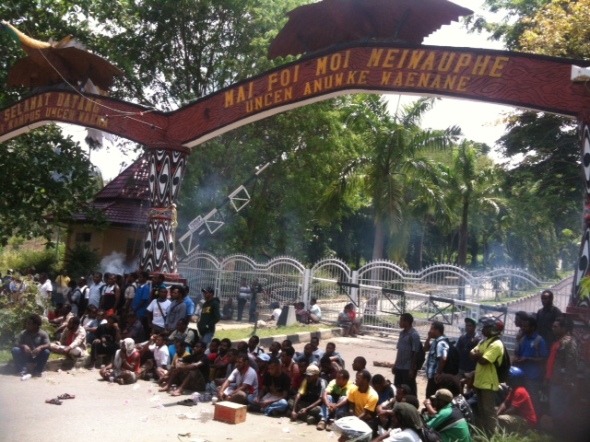
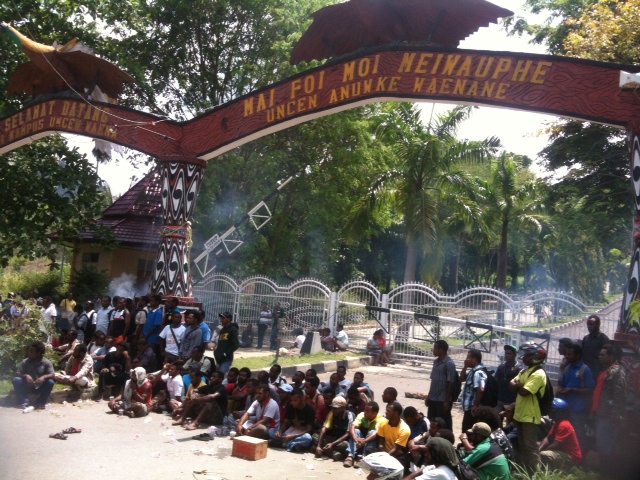
For the whole night of October 12, a Cenderawasih University (UNCEN) dormitory in Waena was under siege by a large group of plain clothes armed and masked security forces, who surrounded the dormitories. During the night, the police overran the dormitories in their search for Fanny Kogoya, according to witnesses.
Three students who living at the UNCEN hostel – UL (32), IK (36), and PK (22) – said they had been beaten and terrorized by the police. “Police pry the door and entered. They say ‘we find the DPO who live here,'” the students explained in the human rights report. “They say the name of FK and Danny Wenda (DW).”
The Yakuhimo students at the dormitory were angered by the event, but held a peace blockade outside the gates of the Uncen campus in Waena, independent sources at the campus told West Papua Media. No reports were received of any forced dispersal, however tension is high and all West Papuan students are in fear that that they could be arrested or disappeared at any moment, according to human rights sources.
Yakuhimo students and supporters blockade outside Uncen Waena after the Detachment 88 raids, October 12 (West Papua Media)
These actions came after a campaign of arrests from late September of at least eight people in the highland town of Wamena after police targeted homes and offices of KNPB members, accusing them of involvement in bombings and terrorism, despite KNPB being committed to non-violent civil resistance tactics.
In a statement, UK based human rights group Tapol said that “The targeting of KNPB activists appears to have intensified after the killing of the KNPB leader Mako Tabuni, on 14 June 2012. Officers of Indonesia’s counter-terrorism unit, Special Detachment 88 (Densus 88), funded and trained by Australia, the US and the UK, are thought to have been involved in the killing of Mako Tabuni and the arrest of the KNPB members in Wamena.”
Tapol has called for Indonesian authorities to “end the campaign of terror, intimidation and violence against human rights defenders and political activists, particularly members of KNPB,” and to guarantee the safety of Fanny Kogoya, Viktor Yeimo, and others who have been targeted.
Tapol has also called on Jakarta to “end the deployment of Densus 88 to Papua, investigate all allegations of human rights violations by Densus 88 officers and other security forces personnel and bring those responsible to justice.”
Whilst tension remains high during the crackdown, KNPB activists have also warned their members not to be taken in by SMS messages that are being spread by intelligence personnel attempting to incite violence and horizontal conflict. Activists have circulated a list of mobile numbers that are responsible, and are urging all recipients to document any numbers that continue to spread these messages.
Many people have reported to West Papua Media of an upsurge in Special Forces activity, even around those who are not active on Papuan independence issues. There has been a significant increase on the presence of intelligence officers on the street. Selfius Bobii, the former Front Pepera leader serving out a three sentence at Abepura prison on a treason conviction for his role in the 3rd Papuan People’s Congress of October 2011, still maintains close and effective communications with a network of activists throughout Papua.
In an SMS sent to West Papua Media, Bobii described how the TNI “have stooped to making themselves out to be civilians, to carry out undercover operations in order muffle the independence aspirations.”
“Some are posing as Bakso (Beef offal noodles) Sellers on roadsides, some are posing as motorbike repair people and so on,” Bobii said.
Bobii described the following factual account: On 11 Oct at 2303 hours in Nabire, Yance Agapa was heading home and was given a lift by an ojek (motorbike taxi) rider to the front of the Indonesian Air Force Quarters in front of the ‘Glory’ internet cafe. When they arrived at Malompo he gave the driver Rp20000 (approx. AUD$2) who hurriedly put it into the pocket of the black jacket he was wearing. Then a pistol fell out of his jacket. Yance startled in fright to which the driver responded “Brother don’t be frightened because I’m from Ambon but my mother is from Sentani. I’ll tell you straight, I’m a member of DENSUS 88 sent from Central to get the government program happening. So let our people from the community know to be careful using hire motorbikes. ”
West Papua Media has independently verified this account.
KNPB activists, most living underground currently, have expressed significant fears for their safety and survival from the crackdown. Yohame begged in his testimony, “the condition of our current times is so dire, (we need) all my friends and the international support groups to be able to monitor our current situation. Virtually all KNPB activists are threatened at this time. “
It is unclear whether these intensified crackdown tactics will work on those close to DPO suspects to give up not just Fanny Kogoya, but other non-violent activists who are simply attempting to raise their universal human rights of self-determination and freedom of expression.
Certainly these hunting parties have confirmed one thing: that Australian trained counter-terrorism troops are without any doubt being used to suppress peaceful political activity, outside their legal mandate of counter-terrorism. This should be deeply concerning for Australia in its quest for advocating internationally the Rule of Law – and at the moment that it has just taken up a position on the UN Security Council it might prove to be an inconvenient turning of a blind eye.
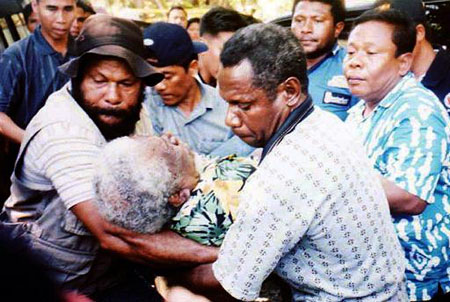
Theys Eluay‘s body being removed after his murder by Kopassus officers, November 11, 2001 (supplied)
JUBI,
16 October, 2012
It was ten years ago [actually eleven years ago] when Megawati Sukarnoputri was the president of Indonesia, that the Papuan leader, Theys Hiyo Eluay was murdered on 10 November 2001. Theys was kidnapped and murdered because he was regarded as a danger to Indonesia’s territorial integrity.
However, the Papuan people regard Theys Eluay as a Papuan leader who was able to unite all Papuans from Sorong to Merauke. He was also a man who called upon people to treat Papuans with decency and respect.This is why Papuans have decided to commemorate the death of Theys Eluay.
‘We are shortly planning to mark the anniversary of the death of this great Papuan leader,’ said Thomas Syufi, president of the Militant Papuans Students Federation.
‘He was a Papuan leader who struggled for his people to be treated with decency and respect. He did not resort to violence but the Megawati government regarded him as a threat.
He went on to say in a press conference in Jayapura, that there has been no justice yet for the death of Theys Eluay. ‘The senior army officer who had been involved in the death was allowed to go free. [A few low-ranking Kopasus officers involved in the abduction were given short sentences which they almost certainly never served.] ‘That is why we regard Theys Eluay as a martyr ,’ the students said.
[The facts about Theys’ death are as follows: Shortly before his death he had been elected the chairman of the Papuan Presidium Council. He was tricked into meeting some members of the army’s elite corps Kopassus on 10 November 2001, kidnapped and driven to an unknown destination. On the following day, his body was discovered in Skouw, a Papuan village near the border with PNG, more than 50 kms from where he had been abducted. He appeared to have been strangled to death; an autopsy concluded that he had died of suffocation. See Tapol Bulletin, December 2001/February 2002.]
The call made at the time by Human Rights Watch for an impartial inquiry into what was seen as a ‘well-planned assassination’ was never responded to by the authorities.]
To mark the forthcoming anniversary of his death, Papuans were called on to gather at the grave of Theys. The government, the military and NGOs were called on not to raise banners at the grave, ‘out of respect for the fallen leader’.
Plans to move the body have been rejected by Papuans. The anniversary of his death will be marked by prayers and other activities that have not yet been revealed.






 West Papua Media Alerts