Paniai offensive intensifies as troops conduct house to house searches: reports

by West Papua Media and sources

September 6, 2012

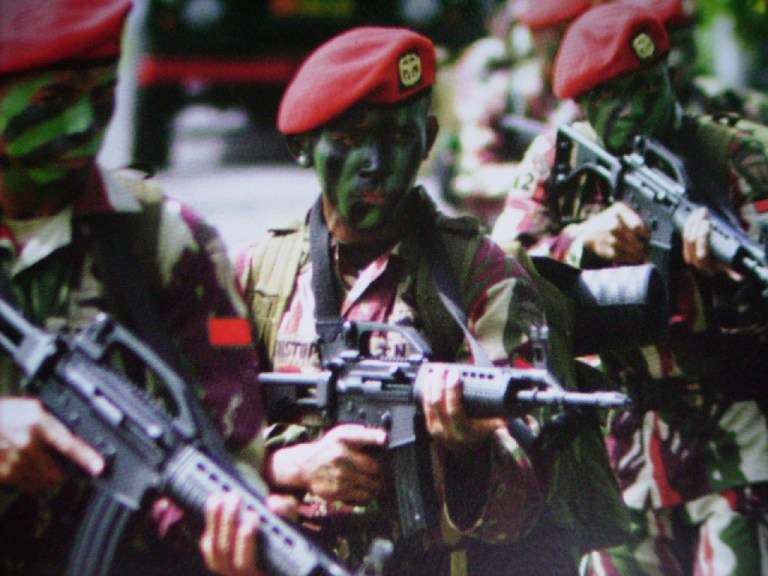
Unconfirmed reports have been received by West Papua Media from reliable sources in Paniai district, West Papua, that troops from the notorious Indonesian Army (TNI) Battalion 753 Arga Vira Tama (from Nabire, Korem 174 – Kodam XVII/Trikora) are currently conducting major house to house sweeps in the remote hill areas outside Wegamo.

At least three companies of the Battalion 753, a unit linked to ongoing brutal human rights abuses and regular incidents of torture in Paniai, have been parachuted into the the headwaters of the Weya Creek of Bibida district in Wagamo, Paniai, according to credible human rights sources.

Reports are filtering through that the TNI is searching the villages around Weya Creek for the Paniai OPM/TPN leader John Yogi, who has eluded capture after a massive offensive that has displace over 12,000 since it began in November 2011.  However, Yogi has not been seen in the area according to local sources, who report that the local civilian population is bearing the brunt of interrogations and abuse from 753.

Witnesses have reported that troops from 753, supported by Indonesian Brimob police units, have been launching aggressive raids in villages since the evening of September 4, detaining and interrogating all villages and destroying property whilst seizing sharp items, including farming tools necessary for subsistence agriculture.  This is prompting fears of a repeat of the humanitarian crisis that developed last December when troops from 753 Battalion torched and destroyed food gardens, forcing thousands to flee to police run “care centres” in Enaratoli.  During the 2011 campaign, several people died of starvation and sickness in the care centres, whilst security forces attempted to capture Yogi.

It is unclear at this stage whether special forces troops from the Australian funded and trained counter-terror unit Detachment 88 are involved in this action, given their presence in major offensives throughout 2012 in pursuit of Yogi.

Disturbing reports from trusted sources have also emerged from the town of Moanemani, Paniai, of a major influx of combat troops and paramilitary police into the town since the weekend.  Fears are being expressed by credible community sources that a major crackdown is expected by security forces, because the military and police are stopping people in the street and ordering them to shave off moustaches and beards.

Local Papuan people traditionally wear facial hair as an assertion of Papuan identity, an act seen as separatist by clean-shaven Indonesian occupation forces.   Sources have also reported that civilians have been warned to bathe and wear new and clean clothing ahead of an expected offensive, and that local people are terrified that they are to be suspected and targeted as being OPM members, based purely on their traditional appearance.  West Papua Media has been unable to independently verify these reports, however these action are in line with ongoing offensives and abuses by security forces across Paniai regency in recent months.

Moanemani was also the site of a vicious spate of unprovoked killings by Indonesian security forces of civilians early in 2012.

More information as it comes to hand.

Lamberth Pekikir acknowledges the risks he is taking

Bintang Papua, 4 July 2012

Lamberth Pekikir, the general co-ordinator of the TPN/OPM who is now being hunted down by the military, has declared that he is prepared to accept the consequences of his actions, saying that he knows what the consequences are for anyone who consistently struggles for a free West Papua. To understand the attitude of Lamberth Pekikir, the following is  an interview of Pekikir conducted by Bintang Papua:

Bintang Papua (BP):  What are your feelings about being chased and hunted down by the security forces?

LP:  To be quite honest, as a human being, I am afraid to be in such a situation but as someone who is struggling for the Land of Papua and in defence of our territory, I know that this means taking great risks.

BP: Are you aware that you are being hunted?

LP:  Yes, indeed, and I have seen the people who are chasing me.

BP: Are you prepared for what may happen if the base of the TPN/OPM, [the military wing of the OPM] were to be attacked?

LP: Ever since I decided to defend the Land of Papua and the Papuan people, I have been ready to face whatever happens,, for the cause of truth and justice for this land.

BP: Is there anything that you would like to convey to the security forces?

LP: I want the security forces to accept responsibility for the human rights violations that occur in West Papua and I want them to put an end to these violations as a result of which many lives have been sacrificed.

BP: Who is it who shot dead the head of Sawiya Tami Kampung?

LP: Evidence must be produced to discover who it was who shot him dead instead of making simply accusations about the crime.. Besides people like me, there are many people in Keerom who own firearms, including members of the security forces as well as quite a few civilians who possess firearms with  the necessary license.

BP: Is there anything else you would like to say?

LP: Speaking from the headquarters of the TPN/OPM, we call on the Indonesian government to acknowledge responsibility for the political conflict in West Papua.

Please accept my thanks.

———————–

As has been reported, the operational area for the OPM leader, Lanberth Pekikir, along the border with PNG has been reduced This followed in the wake of  shots fired by Pekikir at a vehicle belonging to the Indonesian army on 1 July in the district of Keerom which led to the death of the local kampung head.

The security authorities have since said that they are chasing the group of separatists headed by Lamberth Pekikir who they hold responsible for the death of a civilian. The commander of the regional military command, Major General Erwin Safriti said that efforts to capture Pekikir by his men are being undertaken not only by land but also by air in view of the nature of the territory along the border with PNG..

[Translated by TAPOL]

Kopassus claims to be pursuing ‘persuasive’ approach

The “persuasive” approach used by Kopassus
Bintang Papua, 4 July 2012
The commander of Kopassus, the elite strike force of the Indonesian army, Major-General Wisnu Bawa Tenaya declared during a joint training investigation with  China’s People’s Liberation Army in Shandong, China, that his men will continue to pursue the persuasive approach in its handling of the security disturbances in West Papua.He was quoted as saying: ‘We cannot the kind of actions that we would like to take but must act cautiously because in addition to security problems, other issues in West Papua need to be attended to, such as the welfare of the people.’

He also said that Kopassus forces plan to conduct expeditions in various parts of in West Papua to investigate the what is going on there and what it is that the people there actually want.’

Earlier on,  a representative of Kontras,  Indria Fernida, the chairperson of the Synod of the Kingmi Church, Revd Benny Giay and the secretary of the Working Group of NGOs in Papua, Septer Manufandu made it clear the military approach is still being prioritized in West Papua.

Moreover, the welfare approach that has for so long been proclaimed by the authorities was far from being pursued to any meaningful extent or in any way to the satisfaction of the aspirations of the Papuan people.

[Abridged in translation by TAPOL]

District chief criticises brutal actions by soldiers

JUBI, 6 June 2012

The bupati  (head) of the district of Jayawijaya, Jhon Wempi Wetipo, has expressed his deepest regret  at brutal actions taken by members of the 736 Wamena battalion  who went on the rampage, damaging a number of government facilities, following the death of a soldier who had been set upon by local people.

He said that the correct way to respond to the attack of one of their colleagues  was to hand the case over to the police for the matter to be handled in accordance with the law.

‘I very much regret what happened in Honai Lama, seeing it spread to the city. Facilities that have been built by the government should be guarded by forces of the state, not destroyed,’ he said.

‘What is the purpose of such actions? It means just destroying things that have been built with money from the people’.

He said that the various government authorities  in the district  will hold a meeting to discuss what needs to be done in this matter. The facilities that were destroyed included some offices and a shopping mall that had only just been built.

He said that the attacks on members of the security forces  had occurred after local people were infuriated because two men on a motorbike knocked down  a young child.

One of the soldiers who was attacked has since died  after a stab pierced his heart. The other soldier is in a critical condition afer been stabbed in the chest.

Following the atack on the soldiers,  dozens of their colleagues went on the rampage in the town of Wamena and the situation became uncontrollable. ‘Even the police were unable to do anything.’

[Translated by TAPOL]

Military commander denies current military operations in Papua and rejects legitimacy of the IIIrd KRP

JUBI, 23 March 2012The commander of the district military command in Jayapura denied that any military operations are taking place in Papua. Lieut-Colonel Rano Tilaar was speaking to journalists after taking part in a Joint Forum of the SKPD (?) and the start of a Consultation on Development in Jayapura.

‘There are no military operations under way in Papua, but only Security Operations Along the Border. We have to realise that although the situation in general is calm and orderly, there are conflicts going on, vertical conflicts as well as a horizontal conflicts,’ he said.

The vertical conflict is related to various problems between the government and those wanting independence – or separatism – while horizontal conflicts are those that occur between groups within the community where there are differences between the native population and the newcomers.

‘We need to be conscious of what is meant by nation and state. What is the meaning of the legacy inherited from our ancestors and the natural resources which offer great potential if they are not exploited jointly in the interests of the nation and the state.’

According to Rano, in the present political situation in Papua, the TNI – Indonesian Army – regards the group which pursues the ideology of  M – merdeka – as our brothers. The difference between us, he said, is they have not yet accepted the ideology of NKRI – the Unitary State of the Republic of Indonesia.

When asked his opinion about the  the Third Papuan Peace Congress [held last October], he said that this meeting was not representative of the Papuan people because according to information he has received from local customary leaders and religious leaders, there was no legitimacy for the creation of a state and the appointment of the president and the prime minister of that state, because others felt that they had not been consulted  and they were not willing to legitimise the congress as being representative of the Papuan people.

‘It only represented a group of people and it was correct to apply the charge of makar – treason – from the point of view of the law because that was a treasonous act.’

(This article unfortunately does not report the contradictions in this story, and fails to mention the fact that significant sweeps against civilians are ongoing throughout the Highlands in Tingginambut and Mulia – against Free Papua guerillas led by Goliat Tabuni – as well as major operations across the entire border region, including allegations of village clearances.  West Papua Media)

Create a website or blog at WordPress.com

Up ↑