Two nonviolent activists arrested for pleading for international community to ‘Save Papua from Genocide and Grievances’.

from the West Papua Media team

July 10, 2012

In recent months, West Papua has come under an international spotlight over Indonesian military and police impunity for brutal assaults on civilians and non-violent activists.   Despite the palpable repression on the Papuan street , activists from the self-declared Federated Republic of West Papua on July 10 held a peaceful demonstration in Jayapura,  with the theme, “Save Papua from Genocide and Grievances”.

Leading up to the demonstration, POLDA (Regional Police command) Papua refused to issue a permit to rally organizers, and even banned activists from the Federated Republic of West Papua to organize any peaceful demonstrations under threat of treason charges being leveled on rally organizers of peaceful demonstrations.

A coordinator of today’s rally, Sius Ayemi,  told West Papua Media prior to his arrest that police refused permission despite four rounds of intense negotiations and several letter, denying basic rights to freedom of expression.  In a phone conversation to the West Papua Media team, Ayemi has challenged the Indonesian government and its military regime to “reconsider military approaches in West Papua,” and called on the international community “to stop believing the Indonesian government’s rhetoric about its commitment to dialogue, or the (Indonesian) Republic’s effort to ‘wage peace aggressively’.”

The demonstration was to start at several different locations  – Expo Waena/UNCEN, Entrop/Hamadi /Argapura  and Pasir 2 / Dok 9 – at around 9:30am, then converging to meet at the DPRP (Papuan legislative assembly) office in Jayapura.   Police blockaded the demonstrators at the first two locations, preventing demonstrators from proceeding to the DPRP office.   However,  demonstrators from Pasir 2 and Dok 9 were able to march to the DPRP office but were quickly and brutally rounded up by one company of fully armed police.

Markus Yenu, the Federated Republic of West Papua Governor of Manokwari and a planned speaker at the rally, told West Papua Media that the police physically pushed the demonstrators backward with their guns and told them to go home.  He told the West Papua Media team by phone, “the moment we arrived in front of the DPRP office, we were threatened, searched and dispersed by police officers and requested harshly to hand-in all the attributes for the rally.” He further mentioned that the police confiscated several cameras, megaphones, mobile phones, placards and banners.

According to witnesses on the ground,  Sius Ayemi was attempting to negotiate with the police in a disciplined-manner but was quickly surrounded by few police officers who arrested him and bundled him away, together with Edison Kendi who stood next to Mr. Ayemi at the time of the arrest.  Until now, both Sius Ayemi and Edison Kendi are still being held at police custody in Jayapura.

West Papua Media attempted to make few phone calls to KAPOLDA Papua, KAPOLRI and WAKAPOLDA Papua but they all refused to comment about the arrest of the two activists and ended the call.

Local human rights sources have asked for advocacy for the release of Sius Ayemi and Edison Kendi, by calling the below contact details:

Kapolri +62811910277,                                                                                                                                       Kapolda +62811950376,                                                                                                                                 Wakapolda +62811496251

Act of Terror perpetrated against the President of the Alliance of Baptist Churches

Report from Matius MuribAt around 7.30pm, on Thursday 6 July,  a group of four policemen from the elite force Brimob, Papua District, stopped the car in which the chairman of the Baptist Synod, Socrates Sofian Yoman was travelling, together with his wife and their three children, along with Matius Murib, the former deputy chairman of Komnas HAM-Papua. They were on their way home after attending prayers at Kota Raja Luar.The car door was forced open by someone, and another member of Brimob shone a torch.in the face of Revd Yoman.

Matius Murib said: ‘Why have you stopped here? Who are you? Who are you working for? If you aren’t happy about the police, dont behave like this.’

Murib later told the media that apparently they had been followed since they were driving past the town library. The police who had been travelling in a truck pointed their torch at Yoman.

In response to this unacceptable behaviour, he said: ‘I’m sorry. It wasn’t deliberate.’  But within five minutes, the police started pushing the body of this man who is  a well-known church leader, while shouting at him.

Matius Murib  thought that the  police didn’t realise that they were  talking to the President of the Synod of the Baptist Church, Revd Socrares Sofian Yoman.

At this point, a senior police officer arrived at the scene to caution the police who were terrorising the President of the Synod. They subsequently withdrew and returned to their barracks.

Matius said that this incident would be reported to the deputy police chief in Papua. ‘Go ahead and report. We aren’t afraid ‘  the four policemen replied. They then withdrew  from the scene and left, going in the direction of the police command office in  Abepura.

Matius Murib said that he hoped that  the chief of police would investigate this case and call to account the four police officers who had behaved so arrogantly  towards a well known leader of the Papuan people. The action they had taken was a deliberate act of provocation intended to arouse the feelings of the Papuan people.

‘We call for an end to such acts of terror and violence perpetrated against the indigenous Papuan people.The Papuan people will continue to press for peaceful dialogue  between Jakarta and Papua.’

Matius Murib, Director

[Translated by TAPOL]

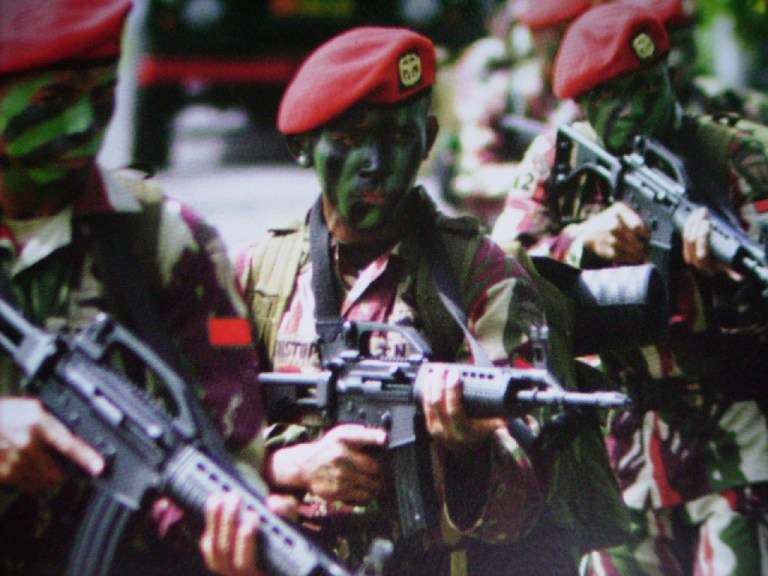
Kopassus claims to be pursuing ‘persuasive’ approach

The “persuasive” approach used by Kopassus
Bintang Papua, 4 July 2012
The commander of Kopassus, the elite strike force of the Indonesian army, Major-General Wisnu Bawa Tenaya declared during a joint training investigation with  China’s People’s Liberation Army in Shandong, China, that his men will continue to pursue the persuasive approach in its handling of the security disturbances in West Papua.He was quoted as saying: ‘We cannot the kind of actions that we would like to take but must act cautiously because in addition to security problems, other issues in West Papua need to be attended to, such as the welfare of the people.’

He also said that Kopassus forces plan to conduct expeditions in various parts of in West Papua to investigate the what is going on there and what it is that the people there actually want.’

Earlier on,  a representative of Kontras,  Indria Fernida, the chairperson of the Synod of the Kingmi Church, Revd Benny Giay and the secretary of the Working Group of NGOs in Papua, Septer Manufandu made it clear the military approach is still being prioritized in West Papua.

Moreover, the welfare approach that has for so long been proclaimed by the authorities was far from being pursued to any meaningful extent or in any way to the satisfaction of the aspirations of the Papuan people.

[Abridged in translation by TAPOL]

Full Chronology of Mako Tabuni’s killing

New Chronology from interviews of direct witnesses of the killing of Mako Tabuni on June 14, 2012

West Papua Media has been provided this chronology by a reliable and independent human rights investigator associated with Papuan Churches.

We have held back the publication as we were awaiting further elements of this story from senior international sources, however this source has gone back on agreeing to provide information so we cannot withhold publication of this critical document any further.

The Past That Has Not Passed: Human Rights Violations in Papua Before and After Reformasi

June 28, 2012

joint report released today by the International Center for Transitional Justice (ICTJ) and the Institute for Human Rights Study and Advocacy (ELSHAM-Papua) provides important insight into the ongoing debate on steps required to achieve a sustainable peace in Papua.

Based on more than 100 interviews carried out in 2011 in the districts of Sorong, Manokwari, Biak, and Paniai, the report reviews Papua’s recent history, including the Special Autonomy Law governing the relationship between the Papua province and Indonesia, within a transitional justice framework. It also reveals new information provided in testimonies by victims and witnesses who experienced human rights violations going back to the earliest days of Indonesia’s history as a nation.

“Even as we were conducting this research, new outbreaks of violence and cases of gross human rights violations continued to take place,” said Ferry Marisan, director of ELSHAM. “We interviewed more than 100 victims, many of whom have deep feelings of distrust that are deeply rooted in the past and present experiences of human rights abuse. Official acknowledgement of this violent past is a prerequisite to building peace in Papua,” he added.

“Unless these grievances are not only recognized, but also addressed in a practical way, reconciliation will remain elusive”
Unless these grievances are not only recognized, but also addressed in a practical way, reconciliation will remain elusive. A comprehensive transitional justice strategy could provide effective redress, and should include truth-seeking, criminal accountability, reparations, institutional reform to prevent recurrence of human rights violations, and a focus on the rights of indigenous women.

“The Indonesian government must urgently develop a comprehensive policy for dealing with this legacy of past violations. We are at risk of repeating the past through using force to deal with unrest, instead of opening a process of genuine dialogue. The first step is acknowledgment,” said Galuh Wandita, ICTJ’s senior associate.

Download the full publication here

This joint report by ICTJ and the Institute for Human Rights Study and Advocacy (ELSHAM-Papua) provides important insight into the ongoing debate on steps required to achieve a sustainable peace in Papua. The report reviews Papua’s recent history within a transitional justice framework, and provides expert recommendations on truth seeking, justice, reparations, institutional reform, and enforcing the rights of women victims. Based on more than 100 interviews carried out in 2011 in the districts of Sorong, Manokwari, Biak, and Paniai, the report reviews Papua’s recent history, including the Special Autonomy Law governing the relationship between the Papua province and Indonesia, within a transitional justice framework.

Date published:
6/28/2012

Create a website or blog at WordPress.com

Up ↑