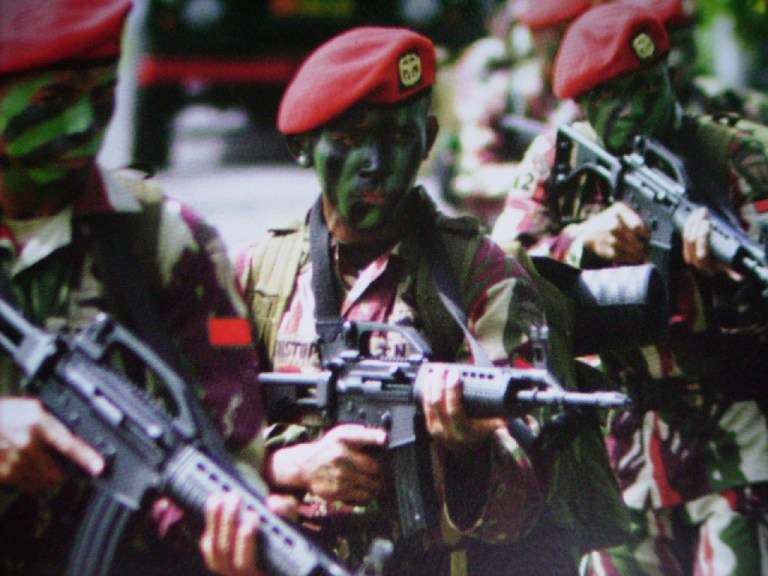
Kopassus claims to be pursuing ‘persuasive’ approach

The “persuasive” approach used by Kopassus
Bintang Papua, 4 July 2012
The commander of Kopassus, the elite strike force of the Indonesian army, Major-General Wisnu Bawa Tenaya declared during a joint training investigation with  China’s People’s Liberation Army in Shandong, China, that his men will continue to pursue the persuasive approach in its handling of the security disturbances in West Papua.He was quoted as saying: ‘We cannot the kind of actions that we would like to take but must act cautiously because in addition to security problems, other issues in West Papua need to be attended to, such as the welfare of the people.’

He also said that Kopassus forces plan to conduct expeditions in various parts of in West Papua to investigate the what is going on there and what it is that the people there actually want.’

Earlier on,  a representative of Kontras,  Indria Fernida, the chairperson of the Synod of the Kingmi Church, Revd Benny Giay and the secretary of the Working Group of NGOs in Papua, Septer Manufandu made it clear the military approach is still being prioritized in West Papua.

Moreover, the welfare approach that has for so long been proclaimed by the authorities was far from being pursued to any meaningful extent or in any way to the satisfaction of the aspirations of the Papuan people.

[Abridged in translation by TAPOL]

Full Chronology of Mako Tabuni’s killing

New Chronology from interviews of direct witnesses of the killing of Mako Tabuni on June 14, 2012

West Papua Media has been provided this chronology by a reliable and independent human rights investigator associated with Papuan Churches.

We have held back the publication as we were awaiting further elements of this story from senior international sources, however this source has gone back on agreeing to provide information so we cannot withhold publication of this critical document any further.

The Past That Has Not Passed: Human Rights Violations in Papua Before and After Reformasi

June 28, 2012

joint report released today by the International Center for Transitional Justice (ICTJ) and the Institute for Human Rights Study and Advocacy (ELSHAM-Papua) provides important insight into the ongoing debate on steps required to achieve a sustainable peace in Papua.

Based on more than 100 interviews carried out in 2011 in the districts of Sorong, Manokwari, Biak, and Paniai, the report reviews Papua’s recent history, including the Special Autonomy Law governing the relationship between the Papua province and Indonesia, within a transitional justice framework. It also reveals new information provided in testimonies by victims and witnesses who experienced human rights violations going back to the earliest days of Indonesia’s history as a nation.

“Even as we were conducting this research, new outbreaks of violence and cases of gross human rights violations continued to take place,” said Ferry Marisan, director of ELSHAM. “We interviewed more than 100 victims, many of whom have deep feelings of distrust that are deeply rooted in the past and present experiences of human rights abuse. Official acknowledgement of this violent past is a prerequisite to building peace in Papua,” he added.

“Unless these grievances are not only recognized, but also addressed in a practical way, reconciliation will remain elusive”
Unless these grievances are not only recognized, but also addressed in a practical way, reconciliation will remain elusive. A comprehensive transitional justice strategy could provide effective redress, and should include truth-seeking, criminal accountability, reparations, institutional reform to prevent recurrence of human rights violations, and a focus on the rights of indigenous women.

“The Indonesian government must urgently develop a comprehensive policy for dealing with this legacy of past violations. We are at risk of repeating the past through using force to deal with unrest, instead of opening a process of genuine dialogue. The first step is acknowledgment,” said Galuh Wandita, ICTJ’s senior associate.

Download the full publication here

This joint report by ICTJ and the Institute for Human Rights Study and Advocacy (ELSHAM-Papua) provides important insight into the ongoing debate on steps required to achieve a sustainable peace in Papua. The report reviews Papua’s recent history within a transitional justice framework, and provides expert recommendations on truth seeking, justice, reparations, institutional reform, and enforcing the rights of women victims. Based on more than 100 interviews carried out in 2011 in the districts of Sorong, Manokwari, Biak, and Paniai, the report reviews Papua’s recent history, including the Special Autonomy Law governing the relationship between the Papua province and Indonesia, within a transitional justice framework.

Date published:
6/28/2012

GKI Report: Report about violent incidents in Papua between May and June 2012

JPIC Desk, GKI di Tanah Papua
15/06/2012

Several violent incidents and shoot outs have occurred almost every day during the last three weeks. Some of the shoot outs have been committed by unknown perpetrators, whereas for some incidents the perpetrators have been found. JPIC has collected, investigated and analyzed several cases, which are described below.

Cases Covered include:

  • A. Mysterious Shootings and Violence against Civilians in May 2012
    • 1. Security Forces attack civilians with firearms at Degeuwo (15.05.2012)
  • B. Incidents related to KNPB Demonstrations
    • 1. Yesa Mirin tortured and killed after escalations at Kampung Harapan (04.05. 2012)
    • 2. Death of Fanuel Tablo
    • 3. Sweeping Operations at Sentani
  • C. Mysterious Shootings and Violence against Civilians in June
    • Brutal Acts of Retaliation by the TNI Batalyon 756 at Wamena (06.06.2012)

For the full report, please download or read the embedded pdf below.

Jakarta-Papua dialogue should be held quickly, says commentator

JUBI, 22 June 2012

In the view of the political commentator Frans Maniagasi, the Indonesian government should hold a dialogue with the Papuan people as quickly as possible, in line with the policy of the Papuan Peace Network (JDP). He said this is very urgent indeed because Papuan lives are continuing to be lost.

‘The dialogue for which Pastor Neles Tebay has been working must be held as quickly as possible, ‘ he said, during a ceremony marking environmental day in the province of Papua.

He said that more and more Papuan lives are being lost, stressing that this has been going on for a very long time, since the 1960s.

The dialogue should discuss the emancipation of the  Papuan people. ‘This is a struggle for emancipation,’ said Maniagasi, who recently published a book called ‘Papua’s Future: Freedom, Special Autonomy and Dialogue.’

He said he realised that  the various stages of dialogue would encounter many difficulties because of the  problems among the Papuan people themselves.’The Papuan people consist of a number of tribes and cultures.’

But he said that these  differences could be overcome. ‘The question is – do we want to work together or not? ‘The most important thing is for us to sit down together, to discuss and to work together to push for the dialogue.’

Create a website or blog at WordPress.com

Up ↑
