Act of Terror perpetrated against the President of the Alliance of Baptist Churches

Report from Matius MuribAt around 7.30pm, on Thursday 6 July,  a group of four policemen from the elite force Brimob, Papua District, stopped the car in which the chairman of the Baptist Synod, Socrates Sofian Yoman was travelling, together with his wife and their three children, along with Matius Murib, the former deputy chairman of Komnas HAM-Papua. They were on their way home after attending prayers at Kota Raja Luar.The car door was forced open by someone, and another member of Brimob shone a torch.in the face of Revd Yoman.

Matius Murib said: ‘Why have you stopped here? Who are you? Who are you working for? If you aren’t happy about the police, dont behave like this.’

Murib later told the media that apparently they had been followed since they were driving past the town library. The police who had been travelling in a truck pointed their torch at Yoman.

In response to this unacceptable behaviour, he said: ‘I’m sorry. It wasn’t deliberate.’  But within five minutes, the police started pushing the body of this man who is  a well-known church leader, while shouting at him.

Matius Murib  thought that the  police didn’t realise that they were  talking to the President of the Synod of the Baptist Church, Revd Socrares Sofian Yoman.

At this point, a senior police officer arrived at the scene to caution the police who were terrorising the President of the Synod. They subsequently withdrew and returned to their barracks.

Matius said that this incident would be reported to the deputy police chief in Papua. ‘Go ahead and report. We aren’t afraid ‘  the four policemen replied. They then withdrew  from the scene and left, going in the direction of the police command office in  Abepura.

Matius Murib said that he hoped that  the chief of police would investigate this case and call to account the four police officers who had behaved so arrogantly  towards a well known leader of the Papuan people. The action they had taken was a deliberate act of provocation intended to arouse the feelings of the Papuan people.

‘We call for an end to such acts of terror and violence perpetrated against the indigenous Papuan people.The Papuan people will continue to press for peaceful dialogue  between Jakarta and Papua.’

Matius Murib, Director

[Translated by TAPOL]

Lamberth Pekikir acknowledges the risks he is taking

Bintang Papua, 4 July 2012

Lamberth Pekikir, the general co-ordinator of the TPN/OPM who is now being hunted down by the military, has declared that he is prepared to accept the consequences of his actions, saying that he knows what the consequences are for anyone who consistently struggles for a free West Papua. To understand the attitude of Lamberth Pekikir, the following is  an interview of Pekikir conducted by Bintang Papua:

Bintang Papua (BP):  What are your feelings about being chased and hunted down by the security forces?

LP:  To be quite honest, as a human being, I am afraid to be in such a situation but as someone who is struggling for the Land of Papua and in defence of our territory, I know that this means taking great risks.

BP: Are you aware that you are being hunted?

LP:  Yes, indeed, and I have seen the people who are chasing me.

BP: Are you prepared for what may happen if the base of the TPN/OPM, [the military wing of the OPM] were to be attacked?

LP: Ever since I decided to defend the Land of Papua and the Papuan people, I have been ready to face whatever happens,, for the cause of truth and justice for this land.

BP: Is there anything that you would like to convey to the security forces?

LP: I want the security forces to accept responsibility for the human rights violations that occur in West Papua and I want them to put an end to these violations as a result of which many lives have been sacrificed.

BP: Who is it who shot dead the head of Sawiya Tami Kampung?

LP: Evidence must be produced to discover who it was who shot him dead instead of making simply accusations about the crime.. Besides people like me, there are many people in Keerom who own firearms, including members of the security forces as well as quite a few civilians who possess firearms with  the necessary license.

BP: Is there anything else you would like to say?

LP: Speaking from the headquarters of the TPN/OPM, we call on the Indonesian government to acknowledge responsibility for the political conflict in West Papua.

Please accept my thanks.

———————–

As has been reported, the operational area for the OPM leader, Lanberth Pekikir, along the border with PNG has been reduced This followed in the wake of  shots fired by Pekikir at a vehicle belonging to the Indonesian army on 1 July in the district of Keerom which led to the death of the local kampung head.

The security authorities have since said that they are chasing the group of separatists headed by Lamberth Pekikir who they hold responsible for the death of a civilian. The commander of the regional military command, Major General Erwin Safriti said that efforts to capture Pekikir by his men are being undertaken not only by land but also by air in view of the nature of the territory along the border with PNG..

[Translated by TAPOL]

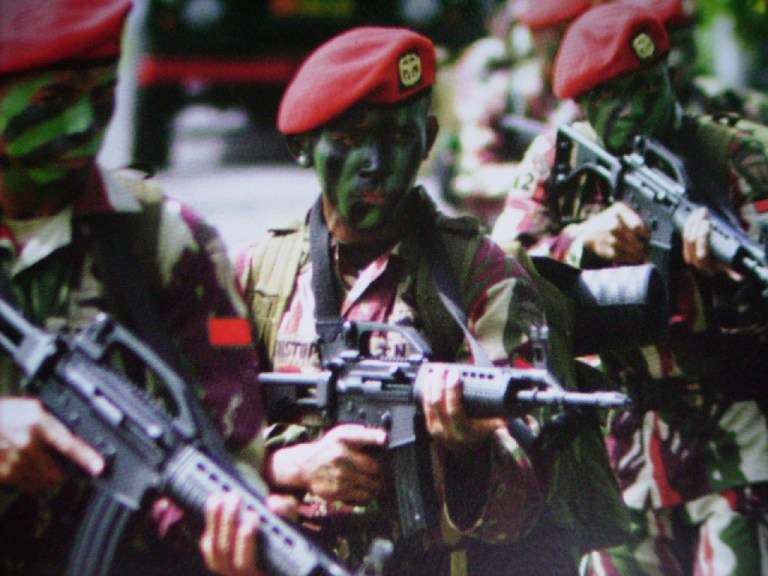
Kopassus claims to be pursuing ‘persuasive’ approach

The “persuasive” approach used by Kopassus
Bintang Papua, 4 July 2012
The commander of Kopassus, the elite strike force of the Indonesian army, Major-General Wisnu Bawa Tenaya declared during a joint training investigation with  China’s People’s Liberation Army in Shandong, China, that his men will continue to pursue the persuasive approach in its handling of the security disturbances in West Papua.He was quoted as saying: ‘We cannot the kind of actions that we would like to take but must act cautiously because in addition to security problems, other issues in West Papua need to be attended to, such as the welfare of the people.’

He also said that Kopassus forces plan to conduct expeditions in various parts of in West Papua to investigate the what is going on there and what it is that the people there actually want.’

Earlier on,  a representative of Kontras,  Indria Fernida, the chairperson of the Synod of the Kingmi Church, Revd Benny Giay and the secretary of the Working Group of NGOs in Papua, Septer Manufandu made it clear the military approach is still being prioritized in West Papua.

Moreover, the welfare approach that has for so long been proclaimed by the authorities was far from being pursued to any meaningful extent or in any way to the satisfaction of the aspirations of the Papuan people.

[Abridged in translation by TAPOL]

Joint prayers in Papua by Street Parliament banned by the police

Bintang Papua, 27 June 2012

Jayapura: The Street Parliament planned to hold joint prayers by Papuans in the city of Jayapura, in response to the security situation in Papua during the months of May and June and their impact on human beings.

Unfortunately however, the police have refused to grant permission for these joint prayers to be held., according to Yusak Pakage, co-ordinator of the Street Parliament.

The intention was for Christians as well as non Christians to take part in this joint prayer meeting as a sign of the brotherhood between the Papuan people of all religions, for democracy and to avoid horizontal conflicts.

But when the organisers of this event informed the police of their intentions, the police refused to grant permission. Yusak therefore  apologised to the Papuan people that the event will not take place, after having announced their intention to organise these joint prayers.

Yusak also said that they visited the mayor of Jayapura to inform him of their intentions and he expressed support for the idea.

The intention to hold joint prayers was also raised with the  board of the Hope Church in Jayapura, for the joint prayers to take place in the church. But the executive board of the church was not willing for this to happen, fearing that this would be seen as a political event.

Yusak also drew attention to 1 July  which is the anniversary of the establishment of TPN/OPM and the commemoration of Bahayangkara,  and urged the Papuan people not to be provoked in any way..

[Translated by TAPOL}

The Past That Has Not Passed: Human Rights Violations in Papua Before and After Reformasi

June 28, 2012

joint report released today by the International Center for Transitional Justice (ICTJ) and the Institute for Human Rights Study and Advocacy (ELSHAM-Papua) provides important insight into the ongoing debate on steps required to achieve a sustainable peace in Papua.

Based on more than 100 interviews carried out in 2011 in the districts of Sorong, Manokwari, Biak, and Paniai, the report reviews Papua’s recent history, including the Special Autonomy Law governing the relationship between the Papua province and Indonesia, within a transitional justice framework. It also reveals new information provided in testimonies by victims and witnesses who experienced human rights violations going back to the earliest days of Indonesia’s history as a nation.

“Even as we were conducting this research, new outbreaks of violence and cases of gross human rights violations continued to take place,” said Ferry Marisan, director of ELSHAM. “We interviewed more than 100 victims, many of whom have deep feelings of distrust that are deeply rooted in the past and present experiences of human rights abuse. Official acknowledgement of this violent past is a prerequisite to building peace in Papua,” he added.

“Unless these grievances are not only recognized, but also addressed in a practical way, reconciliation will remain elusive”
Unless these grievances are not only recognized, but also addressed in a practical way, reconciliation will remain elusive. A comprehensive transitional justice strategy could provide effective redress, and should include truth-seeking, criminal accountability, reparations, institutional reform to prevent recurrence of human rights violations, and a focus on the rights of indigenous women.

“The Indonesian government must urgently develop a comprehensive policy for dealing with this legacy of past violations. We are at risk of repeating the past through using force to deal with unrest, instead of opening a process of genuine dialogue. The first step is acknowledgment,” said Galuh Wandita, ICTJ’s senior associate.

Download the full publication here

This joint report by ICTJ and the Institute for Human Rights Study and Advocacy (ELSHAM-Papua) provides important insight into the ongoing debate on steps required to achieve a sustainable peace in Papua. The report reviews Papua’s recent history within a transitional justice framework, and provides expert recommendations on truth seeking, justice, reparations, institutional reform, and enforcing the rights of women victims. Based on more than 100 interviews carried out in 2011 in the districts of Sorong, Manokwari, Biak, and Paniai, the report reviews Papua’s recent history, including the Special Autonomy Law governing the relationship between the Papua province and Indonesia, within a transitional justice framework.

Date published:
6/28/2012

Create a website or blog at WordPress.com

Up ↑