Defence witnesses have revealed the extensive and systemic use of casual torture and inhumane treatment by Indonesian police, whilst testifying at the Makar (treason) trial of two West Papuan peaceful political activists in Yapen District Court, Serui, on April 9.
Yan Piet Maniamboi (defendant seated on Left) during cross-examination by Matius Matulesi, SH
The activists had been threatened with twenty years jail for organising a nonviolent march about media freedom in West Papua. The two men, Edison Kendi (38) and Yan Piet Maniamboi (36) were arrested for their involvement in organising peaceful demonstrations in Yapen on May 1, and August 9, 2012 for World Day of Indigenous Peoples, and have been held in atrocious conditions in Serui prison and have been subjected to routine and regular torture since their arrest.
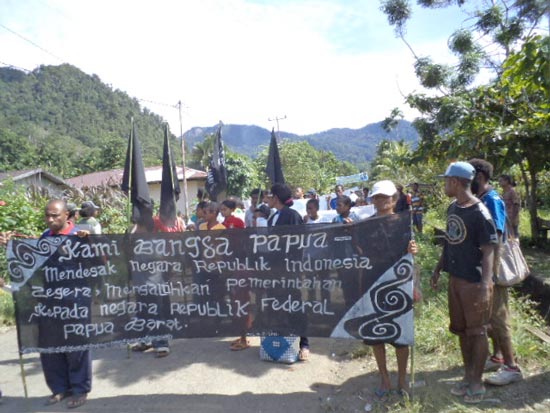
Banner at freedom of expression rally rejecting Indonesian rule in Papua on the International Day for Indigenous People. Photo via Alex Rayfield from West Papua Media stringers in Yapen.
The treason trial has been beset by procedural mistakes and the failure to appear of several police officers as prosecution witnesses. Edison Kendi is the National Federated Republic of West Papua’s Governor of Saireri region.
According to independent observers present at the April 9 hearing, the four defence witnesses testified that they were beaten and tortured during detention and interrogation by Yapen police, and were forced to provide false information to stop the torture. The presiding judge suspended the trial for five minutes to talk with witnesses as the BAP (Case Records) were in danger of being revoked by the judge, legally inadmissible as they were based on testimony extracted under torture.
One of the witnesses, named John, answered Prosecutor Matius Matulesi’s questions on the validity of the Case Records version of testimony, the prosecutor disagreed with John and called him “Swanggi” (Devil or Ghost). Matulesi also began to threaten both the witnesses and defendants with hoax charges for testifying about their mistreatment. Matulesi, a Christian native of Maluku, is known as a hard-liner and being “very inhumane in demanding punishment to the fullest extent on native Papuans in Serui, according to human rights observers at the trial.
Edison Kendi had previously testified about the brutality inflicted on him and Maniamboi whilst being held at Yapen police station, and then after their transfer to Serui prison on December 9, 2012 . Kendi wrote in statement provided to observers:
“Since we were arrested we were tortured, kicked, pierced with wood, hit with wood, so we suffered extraordinary bruises and swellings, but (we were) never treated (for injuries) during our detention at the Yapen police station. Police did not allow us to be treated, for the reason we are OPM (Free Papua Movement).”
Defendants Yan Piet Maniamboi (fourth from left) and Edison Kendi (5th from right), with family, supporters and legal counsel, in court before the hearing. (photo: West Papua Media stringers / NFRPB)
Matius Matulesi has also come in for heavy criticism over his violations of basic prisoner rights to medical treatment in this case, for injuries sustained by the defendants whilst under torture by Yapen police. According to Edison Kendi, “On December 19, 2012 I submitted an application to the clinic in the Prisons for medical treatment, but I was not allowed to go out (to the hospital) by the Attorney on behalf of Matius Matulesi, SH – so we just keep quiet and bore the pain. I’ve been treated at the clinic LP / prisons but with no improvement. I was sick when swelling on both my legs because of torture when captured and examined at the police Yapen station. I have repeatedly applied for treatment outside of LP / prisons but it’s all just all in vain since the detention December 6, 2012 – January 21, 2013 is not permitted by the prosecutor Mathius Matulesi, SH”.
Matulesi also allegedly prevented Kendi from attending the funeral of his father, allowing him only two minutes with his father’s body before being taken back to prison, despite other Indonesian prisoners, including prisoners convicted of violent terrorism offences, routinely granted this basic right.
The trial was adjourned for the prosecutor to present two investigators from the police station at the next session to be confronted with the witnesses’ testimony.
KontraS, the Commission for the Disappeared and Victims of Violence has drawn the conclusion that from January to October this year, 107 people have been injured as a result of acts of violence.The commission also stated that as many as 81 acts of violence occurred in Papua.Thirty-one of these people died as a result of their injuries. A spokesperson for KontraS, Sri, said that KontraS believes that since January this year, scores of acts of violence have engulfed Papua.
In a press release issued on 26 October, she said that at least thirty-one people had died and 107 people had been injured.
This press release was issued in Jakarta together with several other NGOs, including NAPAS, BUK and YAPHAM. The NGOs were keen to draw attention to the current situation in Papua which is becoming increasingly tense.
KontraS believes that there are serious restrictions to democracy in Papua .
‘It is a serious challenge for civil society to criticise the policy being pursued by the government,’ said KontraS
A Papuan activist n Jakarta, Martin Goo said that the continuing suppression of democracy in Papua has triggered a number of conflicts in Papua. There has also been an intensification of acts of terrorism which, he said, were being perpetrated by certain groups who are against the people’s struggle for justice,
West Papuan independence organisation, the West Papua National Committee (known by its Indonesian acronym KNPB) continues to defy the Indonesian security after a series of arrests and attacks on the group in Wamena, Timika and Jayapura.
Speaking from a safe house KNPB Chairman, Viktor Yeimo told West Papua Media that the police were vigorously repressing the group’s right to freedom to organise and right to nonviolently express their political opinion.
“I am in hiding but I have to try and keep organizing. KNPB have plans for peaceful demonstrations in Sorong, Manokwari and Jayapura. The police won’t allow us to make a peaceful action but we will still have a peaceful action.”
Early on Friday morning officers from the Indonesian police and Australian and U.S aided counter-terrorist group Detachment 88 raided KNPB’s Timika headquarters. Four Papuans, Steven Itlay, Chairman of the Timika region, Romario Yatipai, vice-president of KNPB’s parallel parliamentary structure the West Papua National Parliament, Marten Kalolik, and Denias Tekege were arrested. Laptops and cameras were also seized. The arrests in Timika follow raids and arrests of ten activists in Wamena, raids on villages and an attack on a student dormitory in Jayapura last Tuesday. Some of those arrested are teenagers. Others like Simson, a student activist from Jayapura were beaten by the police to extract information.
Virtually the entire KNPB leadership has now gone underground. In addition to Viktor Yeimo, Fanny Kogoya, ex-member of the KNPB central committee who resigned from KNPB after being elected Director of the Papua Desk of Friends of the Earth Indonesia, and Simeon Dabi chairman of the Wamena branch of KNPB are all on the run. Their faces are pasted in the streets of Wamena and Jayapura under the ominous heading, “Daftar Pencarian Orang”, the list of wanted persons. In Fanny Kogoya’s case her only ‘crime’ is that she was a close friend of Mako Tabuni, the KNPB activist killed by Detachment 88 in June.
Indonesian police accuse KNPB of being behind a series of shootings and bombings in West Papua that have rocked the country in recent months. It is an allegation that Yeimo vigorously denies.
“All this evidence is planted so they can justify their attacks. We never had any plan or any program to make acts of terror. We are not a military movement. If we were a military movement we would be the TPN (West Papua National Army) but we are a civilian movement. The Indonesians fear our movement, they want to make a public opinion that we are terrorists so they can kill us.”
Yeimo pauses.
“But they won’t succeed” he tells me quietly. “Indonesia won’t success to stop our movements for the right. Indonesia cannot kill our spirit for freedom.”
Indonesian Special Forces officers have redoubled their efforts to hunt down non-violent womens’ and environmental rights activist Fanny Kogoya, after a failed attempt to capture her and Papuan student activists from the West Papua National Committee at a university dormitory on Tuesday night.
Fanny Kogoya was also elected the head of the Papua desk for the Indonesian branch of Friends of the Earth (WAHLI) on June 13, the day before her close friend Mako Tabuni, former KNPB leader,was extrajudicially executed by Detachment 88 troops in Jayapura.
Kogoya, also a women’s rights defender from the grassroots Papuan women’s network TIKI, has been been placed on a Papua wide wanted persons list (Daftar Pencarian Orang or DPO) by the Australian-trained and funded Detachment 88 anti-terror investigators. This is despite Kogoya having resigned from pro-independence activities, according to established credible sources in Jayapura. Kogoya is also accused by police of having knowledge of the whereabouts of activists from the pro-independence civil resistance group, West Papua National Committee (KNPB).
KNPB activists are in hiding after being ruthlessly hunted by security forces, in order to break the back of the civil resistance movement against Indonesian brutality in occupied West Papua. This harassment campaign has gained significant pace ahead of planned Papua-wide mobilisations against Indonesian colonial violence on October 23 – rallies widely expected to be subject to major Indonesian state violence.
The latest crackdown has seen brutal intelligence gathering techniques employed by security forces, including officers identified by witnesses as being from Detachment 88, arbitrarily targeting for beatings, kidnappings, arrests and torture on students and civilians from the highland tribes of Yakuhimo and Dani people – seen by many observers as the backbone of the KNPB effort to use civil power to defeat Indonesian state violence.
Confirmed reports from human rights activists in Jayapura have described heavily armed plain clothes officers – believed by witnesses to be members of either Kopassus or Detachment 88 – violently threatening highland students and civilians in a bid to hunt down members and associates of the KNPB.
Raids on student accommodation around Abepura and Jayapura have intensified ahead of a planned mass mobilisation across Papua on October 23rd by KNPB, which is calling for an end to these illustrated acts of Indonesian state violence – a move seen as makar (subversion) by the new Papua Police chief Tito Karnavian , the former head of the Australian- funded Detachment 88.
Attempts to contact Karnavian or his Papua Police spokespeople for comment for this article have been so far rebuffed and unsuccessful.
Additionally, witnesses and survivors have described a chronology of what is being described as a “fishing operation” by Indonesian intelligence officers. Attempts to capture Fanny Kogoya had been ongoing for several days, with police Avanzas permanently stationed outside houses and haunts of both Kogoya and her extended family and friends.
According to a detailed and disturbing testimony provided by Yakuhimo man and citizen media worker Simson Yohame to independent human rights monitors in Jayapura, the officers have heavily monitored highland students in the greater Jayapura area in a bid to isolate KNPB activists from their base.
Yohame, a friend of Kogoya, was himself kidnapped and tortured by suspected Detachment 88 officers on October 9 after accidentally leaving his motorbike helmet at a Javanese restaurant in Waena, near Abepura. He had been tailed for several days by intelligence officers, who suspected his friendship with Fanny would lead them to their quarry.
Upon leaving the restaurant, he was set upon by plain clothes police intelligence agents, whom he believed to be Detachment 88 officers. They bundled him in to the back of a black police Avanza car, whilst soldiers who were stationed outside the Yakuhimo regencies student dormitory at Waena stood guard. An intelligence officer from Makassar hit him repeatedly with a butt of a pistol, and other officers punched him systematically in the chest using a silat (traditional Javanese martial arts favoured by Kopassus) technique that can easily cause cardiac arrest.
He described being taken in a six car high speed convoy, initially to the back of an unknown facility close to the Jayapura police headquarters, before being subjected to psychological torture on a drive around the greater Jayapura area, and was hypnotized to disorientation. Yohame described the brutal interrogations where he was threatened with knives, swords and cocked and loaded firearms by Detachment 88, according to his testimony. Interrogators also subjected him to psyops by playing loud torture music and sound on headphones they held on his head, while they were sticking knives and pistols into his body.
Giving fascinating if chilling insight, Yohame has detailed the processes that Intel attempted to use to turn him to spy on his friend Fanny. He refused eventually, but not before documenting the techniques utilized.
After the torture, the Detachment 88 officers allegedly moved onto “Stage 3” as Yohame described it, a combination of the classic good cop / bad cop routine. “They (intel) began to ask me the core question: ‘Do you know Fanny Kogoya? This picture is FK, FK stay close to you. You do not deny it. If you deny we will kill you.’”
“I asked why are you looking for FK? Intel said to me that ‘because the cases of murder that Mako Tabuni was doing involved FK. FK participated in designing all events Mako and comrades were doing’. Yohame reported the police as saying.
The police continued: ‘FK loves the money Mako and his friends had over the years. FK is the girlfriend of Danny Wenda. Wenda is now the number 1 Papua Police DPO’,” the interrogators said.
The interrogators then changed tactics, offering a payment. “In addition, if you (SY) can inform on where FK is, we will pay you (SY) Rp 10 million for initial operations,”. They demanded the locations of Danny Wenda, the Chairman of KNPB, Victor Yeimo, Tinus Yohame, Buktar Tabuni, Victor Yeimo, Assa Asso, and also fellow Yakuhimo clansmen allegedly involved in KNPB, alternatively offering payment, and threatening to kill him if he denied knowledge of their whereabouts. Yohame was then trained in demonstration and civil resistance disruption and sabotage techniques, and fieldwork techniques employed by intelligence informants.
Yohame described how his tasking had traumatised him greatly, and he refused internally to carry out the actions. After his release having agreed to be an Indonesian agent, he was secretly informing Fanny Kogoya about the massive operation in effect to capture her and warning her to move outside the town to avoid arrest or disappearance.
Fanny Kogoya, who like other civil society activists on the DPO list is constantly moving from house to house, has so far eluded capture due to the diligence of the now underground non-violent independence movement in Papua.
—
For the whole night of October 12, a Cenderawasih University (UNCEN) dormitory in Waena was under siege by a large group of plain clothes armed and masked security forces, who surrounded the dormitories. During the night, the police overran the dormitories in their search for Fanny Kogoya, according to witnesses.
Three students who living at the UNCEN hostel – UL (32), IK (36), and PK (22) – said they had been beaten and terrorized by the police. “Police pry the door and entered. They say ‘we find the DPO who live here,'” the students explained in the human rights report. “They say the name of FK and Danny Wenda (DW).”
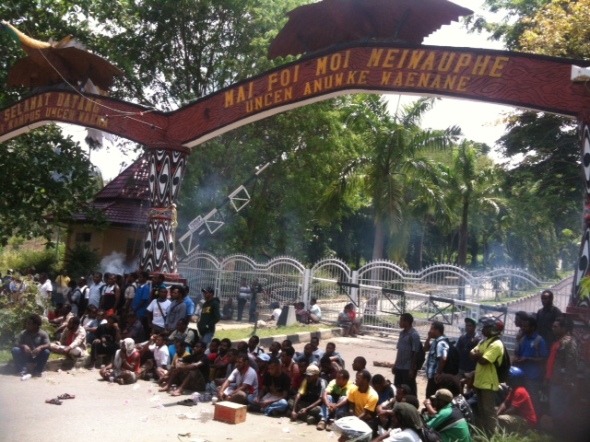
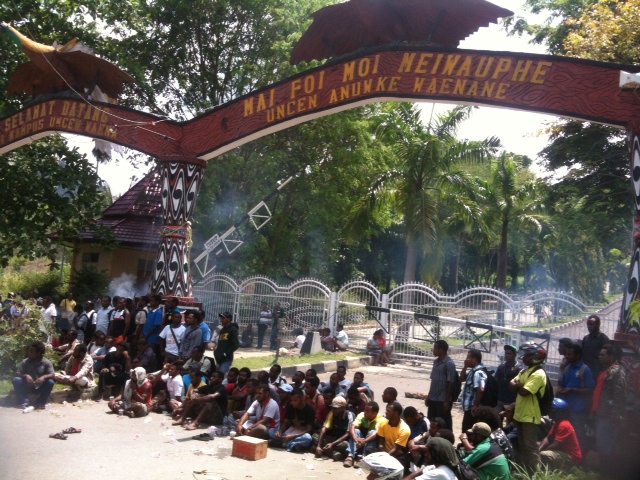
The Yakuhimo students at the dormitory were angered by the event, but held a peace blockade outside the gates of the Uncen campus in Waena, independent sources at the campus told West Papua Media. No reports were received of any forced dispersal, however tension is high and all West Papuan students are in fear that that they could be arrested or disappeared at any moment, according to human rights sources.
Yakuhimo students and supporters blockade outside Uncen Waena after the Detachment 88 raids, October 12 (West Papua Media)
These actions came after a campaign of arrests from late September of at least eight people in the highland town of Wamena after police targeted homes and offices of KNPB members, accusing them of involvement in bombings and terrorism, despite KNPB being committed to non-violent civil resistance tactics.
In a statement, UK based human rights group Tapol said that “The targeting of KNPB activists appears to have intensified after the killing of the KNPB leader Mako Tabuni, on 14 June 2012. Officers of Indonesia’s counter-terrorism unit, Special Detachment 88 (Densus 88), funded and trained by Australia, the US and the UK, are thought to have been involved in the killing of Mako Tabuni and the arrest of the KNPB members in Wamena.”
Tapol has called for Indonesian authorities to “end the campaign of terror, intimidation and violence against human rights defenders and political activists, particularly members of KNPB,” and to guarantee the safety of Fanny Kogoya, Viktor Yeimo, and others who have been targeted.
Tapol has also called on Jakarta to “end the deployment of Densus 88 to Papua, investigate all allegations of human rights violations by Densus 88 officers and other security forces personnel and bring those responsible to justice.”
Whilst tension remains high during the crackdown, KNPB activists have also warned their members not to be taken in by SMS messages that are being spread by intelligence personnel attempting to incite violence and horizontal conflict. Activists have circulated a list of mobile numbers that are responsible, and are urging all recipients to document any numbers that continue to spread these messages.
Many people have reported to West Papua Media of an upsurge in Special Forces activity, even around those who are not active on Papuan independence issues. There has been a significant increase on the presence of intelligence officers on the street. Selfius Bobii, the former Front Pepera leader serving out a three sentence at Abepura prison on a treason conviction for his role in the 3rd Papuan People’s Congress of October 2011, still maintains close and effective communications with a network of activists throughout Papua.
In an SMS sent to West Papua Media, Bobii described how the TNI “have stooped to making themselves out to be civilians, to carry out undercover operations in order muffle the independence aspirations.”
“Some are posing as Bakso (Beef offal noodles) Sellers on roadsides, some are posing as motorbike repair people and so on,” Bobii said.
Bobii described the following factual account: On 11 Oct at 2303 hours in Nabire, Yance Agapa was heading home and was given a lift by an ojek (motorbike taxi) rider to the front of the Indonesian Air Force Quarters in front of the ‘Glory’ internet cafe. When they arrived at Malompo he gave the driver Rp20000 (approx. AUD$2) who hurriedly put it into the pocket of the black jacket he was wearing. Then a pistol fell out of his jacket. Yance startled in fright to which the driver responded “Brother don’t be frightened because I’m from Ambon but my mother is from Sentani. I’ll tell you straight, I’m a member of DENSUS 88 sent from Central to get the government program happening. So let our people from the community know to be careful using hire motorbikes. ”
West Papua Media has independently verified this account.
KNPB activists, most living underground currently, have expressed significant fears for their safety and survival from the crackdown. Yohame begged in his testimony, “the condition of our current times is so dire, (we need) all my friends and the international support groups to be able to monitor our current situation. Virtually all KNPB activists are threatened at this time. “
It is unclear whether these intensified crackdown tactics will work on those close to DPO suspects to give up not just Fanny Kogoya, but other non-violent activists who are simply attempting to raise their universal human rights of self-determination and freedom of expression.
Certainly these hunting parties have confirmed one thing: that Australian trained counter-terrorism troops are without any doubt being used to suppress peaceful political activity, outside their legal mandate of counter-terrorism. This should be deeply concerning for Australia in its quest for advocating internationally the Rule of Law – and at the moment that it has just taken up a position on the UN Security Council it might prove to be an inconvenient turning of a blind eye.
Human Rights Defenders in West Papua accuse the Australian Government and an Australian-owned mining company, Paniai Gold, of being involved in ongoing military operations in Paniai, West Papua.
Mr Ferry Marisan alleges that the Australian-trained Indonesian counter-terrorism unit Detachment 88 (also known as Densus 88 or D88), is involved in ongoing military operations in Paniai. According to Marisan, the Director of Elsham Papua, the Institute for the Study and Advocacy of Human Rights in West Papua, the joint police and military D88 have been embedded in the Second “Coconut” (Kelapa Dua) paramilitary Police Force (Brimob) sent from West Java for military operations against suspected members of the West Papua Liberation Army (or TPN), based at Eduda, Paniai.
According to Mr Yones Douw, a human rights defender based in Paniai, D88 are currently being deployed against members of the TPN in a jungle warfare operation. John Yogi – the Paniai based commander of the TPN – and his men, believed to number a few dozen, fled into the jungle following an attack on his base in Eduda by the Indonesian military and police between the 12-15 December.
Marisan says that in total 30 people have died during the latest round of violence in Paniai Seventeen people were shot dead during the military operations in Eduda. Only ten of these victims were members of the TPN, according to Marisan. Between the 9th and 14th of December a further three people died, all from exposure related sickness. Amongst the dead were two children aged two and four. Prior to the military operations Brimob also shot dead eight Papuans. Yogi’s men responded by killing two Brimob soldiers, an event that triggered the recent military operations.
In addition Elsham Papua reports that the following six villages were burnt to the ground: Toko, Badawo, Dogouto, Obayoweta, Dey, and Wamanik. As a result of the violence Marisan says that up to 20,000 people have fled their homes. ”They are living in government care centres, or staying with family and friends. Many have also fled to the forest” says Marisan.
SBS Radio reported that a spokesperson from the Department of Foreign Affairs and Trade says that the “Australian Government does not train or fund Indonesia’s security forces to counter separatism.”
Irrespective of the training that both the Australian and U.S government’s say they provide to D88 , both Douw and Marisan claim that group is being used in military operations against so-called separatists. “Many of the victims in these operations” says Marisan, “are not members of the TPN, they are ordinary Papuan villagers who are supposed to be protected by the state”. D88 was also allegedly involved in the killing of six Papuans at the conclusion of the Third Papuan Congress on October 19.
D88 is not the only link between Australia and the recent wave of violence.
According to both Douw and Marisan, helicopters used at the Derewo River Gold (DRG) project were utilised by the Military and Police in these latest military operations. DRG is operated by Paniai Gold, a fully owned subsidiary of Melbourne based gold mining company West Wits Mining. A local source, requesting anonymity, told West Papua Media that the helicopters are those used by the mining company. “They are white with blue and red markings” the sources said. “They are defiantly mining company helicopters.”
The person responsible for Paniai Gold’s operations is Mr Vincent Savage, a Non-Executive Director of West Wits. According to publicly available company documents “Mr Savage has been intimately involved in all governmental and regulatory issues involving the Derewo River Gold Project as well as working closely with the Company’s local Indonesian partners.”
These same documents state that “security [for the DRG Project] will be provided by the local Paniai police and Brimob (Indonesian paramilitary police) under the supervision of a Company Security Officer”.
West Papua Media attempted to contact Mr Savage for comment, but he was not available.
The 2011 November-December military operations are not the first military operations in the area. Paniai was the scene of widespread military operations between 1963-1969, 1977-1978, and again in 1981-1982. During this period U.S. supplied Bronco aircraft were used to bomb villages while helicopters strafed Papuans with machine gun fire.
“People don’t forget these things easily” says Douw.






 West Papua Media Alerts