Full Chronology of Mako Tabuni’s killing

New Chronology from interviews of direct witnesses of the killing of Mako Tabuni on June 14, 2012

West Papua Media has been provided this chronology by a reliable and independent human rights investigator associated with Papuan Churches.

We have held back the publication as we were awaiting further elements of this story from senior international sources, however this source has gone back on agreeing to provide information so we cannot withhold publication of this critical document any further.

Gillard must raise West Papua with SBY in Darwin visit: AWPA

Australia West Papua Association (Sydney)
PO Box 28, Spit Junction, NSW 2088
Media release 1  July 2012

Aust PM to meet Ind President in Darwin. Should raise West Papua

Background 

1st Indonesia-Australia Annual Leaders’ Meeting – Joint Communique

http://www.pm.gov.au/press-office/1st-indonesia-australia-annual-leaders-meeting-joint-communique


————————————–


Australia West Papua Association (Sydney)

PO Box 28, Spit Junction, Sydney, Australia 2088

The Hon Julia Gillard MP

Prime Minister

Parliament House

Canberra

ACT 2600


1 July 2012

Dear Prime Minister,

On behalf of the Australia West Papua Association (AWPA) in Sydney, I am writing to you concerning the deteriorating  human rights situation in West Papua.

In the past two months there has been a large number of shooting incidents in West Papua by unknown assailants. The Indonesian security forces have tried to blame the attacks on the Free Papua Movement (OPM) however, the OPM has denied involvement in the attacks.

What is not in doubt is the attack on the village of Honai Lama, a sub-district of Wamena in the Baliem Valley by the  Indonesian security forces in which one person has been reported killed and up to 17 wounded and a large number of houses set on fire. There have also been reports that the military and police on Yapen Island have conducted military operations in villages looking for  peaceful political activists which the security forces  claim are so-called separatists. These military operations are creating a population living in fear from the security forces.

The security forces in West Papua have been targeting peaceful activists including members of the West Papua National Committee (KNPB). In one horrific incident the security forces killed Mako Tabuni, deputy chairman of the KNPB. The police claimed he was armed and resisting arrest but witnesses said he was not armed and shot by men in plain clothes from a passing car. 
 Some media reports have also said the Australian trained Detachment 88 was also involved in the killing.

As you will be meeting with President Susilo Bambang Yudhoyono at the 2nd Indonesia-Australia Annual Leaders` Meeting in Darwin in the next few days, we urge you to raise our concerns about the attacks against the civilian population by the Indonesian security forces in West Papua.

We note that in the official communiqué from the inaugural Indonesia-Australia Annual Leaders’ Meeting in Bali in November 2011, the statement that the two countries would work together on

“the promotion of democracy, good governance, human rights, the rule of law and capacity building”.

and on the defence relationship

“Reinforcing our comprehensive security cooperation, both leaders directed senior officials of both countries under the Security Cooperation Consultation Group to review existing cooperation, and to coordinate and set priorities under the Plan of Action of the Lombok Treaty.  Both leaders also further encouraged the finalisation of the Defense Arrangement as a basis for an enhanced defence cooperation between the two countries”.

In the wake of increased violence in Papua it would appear that the Indonesian Government is failing in its attempts to bring democracy, good governance, human rights and the rule of law to the territory.

As Australia helps train the Indonesian military and in particular Detachment 88, we have to accept some responsibility for the Indonesian security forces behavior in West Papua.

I urge you to raise the human rights situation in West Papua with the Indonesian President asking that he control the security forces in West Papua and urging him to order the security forces to return to their barracks as a way of avoiding further escalation of an already tense situation.

Yours sincerely

Joe Collins

AWPA (Sydney)
The Past That Has Not Passed: Human Rights Violations in Papua Before and After Reformasi

June 28, 2012

joint report released today by the International Center for Transitional Justice (ICTJ) and the Institute for Human Rights Study and Advocacy (ELSHAM-Papua) provides important insight into the ongoing debate on steps required to achieve a sustainable peace in Papua.

Based on more than 100 interviews carried out in 2011 in the districts of Sorong, Manokwari, Biak, and Paniai, the report reviews Papua’s recent history, including the Special Autonomy Law governing the relationship between the Papua province and Indonesia, within a transitional justice framework. It also reveals new information provided in testimonies by victims and witnesses who experienced human rights violations going back to the earliest days of Indonesia’s history as a nation.

“Even as we were conducting this research, new outbreaks of violence and cases of gross human rights violations continued to take place,” said Ferry Marisan, director of ELSHAM. “We interviewed more than 100 victims, many of whom have deep feelings of distrust that are deeply rooted in the past and present experiences of human rights abuse. Official acknowledgement of this violent past is a prerequisite to building peace in Papua,” he added.

“Unless these grievances are not only recognized, but also addressed in a practical way, reconciliation will remain elusive”
Unless these grievances are not only recognized, but also addressed in a practical way, reconciliation will remain elusive. A comprehensive transitional justice strategy could provide effective redress, and should include truth-seeking, criminal accountability, reparations, institutional reform to prevent recurrence of human rights violations, and a focus on the rights of indigenous women.

“The Indonesian government must urgently develop a comprehensive policy for dealing with this legacy of past violations. We are at risk of repeating the past through using force to deal with unrest, instead of opening a process of genuine dialogue. The first step is acknowledgment,” said Galuh Wandita, ICTJ’s senior associate.

Download the full publication here

This joint report by ICTJ and the Institute for Human Rights Study and Advocacy (ELSHAM-Papua) provides important insight into the ongoing debate on steps required to achieve a sustainable peace in Papua. The report reviews Papua’s recent history within a transitional justice framework, and provides expert recommendations on truth seeking, justice, reparations, institutional reform, and enforcing the rights of women victims. Based on more than 100 interviews carried out in 2011 in the districts of Sorong, Manokwari, Biak, and Paniai, the report reviews Papua’s recent history, including the Special Autonomy Law governing the relationship between the Papua province and Indonesia, within a transitional justice framework.

Date published:
6/28/2012

GKI Report: Report about violent incidents in Papua between May and June 2012

JPIC Desk, GKI di Tanah Papua
15/06/2012

Several violent incidents and shoot outs have occurred almost every day during the last three weeks. Some of the shoot outs have been committed by unknown perpetrators, whereas for some incidents the perpetrators have been found. JPIC has collected, investigated and analyzed several cases, which are described below.

Cases Covered include:

  • A. Mysterious Shootings and Violence against Civilians in May 2012
    • 1. Security Forces attack civilians with firearms at Degeuwo (15.05.2012)
  • B. Incidents related to KNPB Demonstrations
    • 1. Yesa Mirin tortured and killed after escalations at Kampung Harapan (04.05. 2012)
    • 2. Death of Fanuel Tablo
    • 3. Sweeping Operations at Sentani
  • C. Mysterious Shootings and Violence against Civilians in June
    • Brutal Acts of Retaliation by the TNI Batalyon 756 at Wamena (06.06.2012)

For the full report, please download or read the embedded pdf below.

OPM: ‘Three regions are ready to fly the Morning Star flag’

Bintang Papua, 27 June 2012

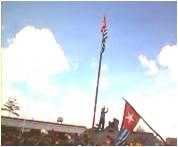
The OPM’s general coordinator, Lambert Pekikir has announced that three regions in Papua are ready to fly the Morning Star flag on 1 July, the anniversary of the OPM’s military wing, the TPN.

The flag flying will last for three days, along with fireworks. He said that the three regions are Wamena, Keerom and Yapen Waropen. People in Wamena are from the mountains, the people Yapen Waropen are coastal people, while those from valleys and lowland areas live in Keerom.

OPM troops along with  civilian sympathisers will take part in the flag-flying. ‘There will be ceremonies as well, attended by the general public and those struggling for an independent Papua.

‘Our military forces are well prepared for these events and if the TNI and police respond with violence, we are ready,’ he said.

Meanwhile,  the police have issued an ultimatum urging that there is no flag flying.  ‘The Morning Star flag is not a flag of the Indonesian Republic or a regional symbol, and anyone who unfurls that flag anywhere in Papua will be seen as having  violated the law and  will face the consequences in accord with the laws in force in Indonesia.’

The army spokesman, Yohannes Nugroho Wicaksono  called on people not to fly the flag. ‘In the interest of security and order throughout the area of Papua,  we urging people not to be provoked by those who are planning this event.’

Activities undertaken by the police in anticipation of the flag flying on 1 July include intensifying police patrols and sweepings in all police regions. He said that the police have been ordered to act professionally.’

The chairman of Commission A of  the DPRP, the Papuan legislative assembly, Ruben Magai, has called on all the people not to be provoked by unnecessary issues in advance of the TPN anniversary. He hoped that people will continue to engage in their everyday activities, while calling on the security forces not to use violence. ‘The persuasive approach must be prioritised. The best thing would be for all those concerned to sit down and talk, to as to find out what each sides wants.

[Slightly abridged translation by TAPOL]

Create a website or blog at WordPress.com

Up ↑
