KontraS reports on continuing deaths and injuries in Papua

Jubi
29 October 2012
KontraS, the Commission for the Disappeared and Victims of Violence has drawn the conclusion that from January to October this year, 107 people have been injured  as a result of acts of violence.The commission also stated that as many as 81 acts of violence occurred in Papua.Thirty-one of these people died as a result of their injuries. A spokesperson for KontraS, Sri, said that KontraS believes that since January this year, scores of acts of violence have engulfed Papua.

In a press release issued on 26 October, she said that at least thirty-one  people had died and 107 people had been injured.

This press release was issued in Jakarta together with several other NGOs, including NAPAS, BUK and YAPHAM. The NGOs were keen to draw attention to the current situation in Papua  which is becoming increasingly tense.

KontraS believes that there are serious restrictions to democracy in Papua .

‘It is a serious challenge for civil society to criticise the policy being pursued by the government,’ said KontraS

A Papuan activist n Jakarta, Martin Goo said that the continuing suppression of democracy in Papua has triggered a number of conflicts in Papua. There has also been an intensification of acts of terrorism which, he said, were being perpetrated by  certain groups who are against the people’s struggle for justice,

[Translated by TAPOL]

Tapol: Britain and Indonesia – Too close for comfort?

TAPOL Press release
President’s visit prompts fresh concerns about arms sales and training of anti-terror police

30 October 201

British-funded training of Indonesia’s anti-terror police, Special Detachment 88, should be reviewed in the light of serious concerns about the unit’s human rights record and its operations in Papua, says TAPOL ahead of a state visit to London by Indonesian President Susilo Bambang Yudhoyono from 31 October to 2 November 2012.

In the run-up to the visit TAPOL, which promotes human rights, peace and democracy in Indonesia, is also appealing for an immediate ban on the sale to Indonesia of any military equipment that may be used for internal repression.

“While British businesses are no doubt eagerly anticipating the President’s visit, victims of human rights abuses will derive little comfort from the prospect of increased arms sales and ongoing training of Indonesian security forces,” says Paul Barber, Coordinator of TAPOL.

As the UK government prepares a state welcome for President Yudhoyono, rights groups from the UK and beyond are organizing an alternative welcome at a demonstration on behalf of the victims of human rights abuses outside Downing Street from 13:00 to 14:30 on Wednesday 31 October.

While Indonesia has made substantial progress in its transition from dictatorship to democracy since the downfall of former President Suharto in May 1998, serious human rights concerns remain.

“The news that the President is to receive a prestigious honour from the Queen is a gross affront to those who have suffered violations at the hands of successive Indonesian governments,” said Barber [1].

Special Detachment 88, known as ‘Densus 88’ was formed after the Bali bombings in 2002 to combat terrorism, but is reportedly being deployed to tackle other issues, such as alleged separatism in Indonesia’s conflict-affected provinces. Local civil society monitors say Densus 88 is being used to crack down on the Papuan independence movement, and the unit has been implicated in the assassination of its leaders, such as Mako Tabuni who was shot dead in June this year.

The unit is trained at the Jakarta Centre for Law Enforcement Cooperation, JCLEC, which received a minimum of £400,000 in funding from Britain in the financial year 2011/12, as well as training provided by British officers. These include the UK’s South East Asia Counter Terrorism & Extremism Liaison Officer Detective Superintendent Phil Tucker; former Metropolitan Police Commander Bob Milton, and David Gray, an officer from the Counter Terrorism Command at New Scotland Yard who sits on JCLEC’s Board of Supervisors and has been teaching on the course since August 2009.

In July this year, leading Indonesian human rights NGO, KontraS, published research which stated that Densus 88 operations commonly involved arbitrary arrest and detention, torture, physical abuse and injury causing death [2].

Indonesia has been identified by the UK as a priority market for defence sales, with Prime Minister David Cameron boosting the export effort when he visited Jakarta with arms company executives in April 2012. The value of approved arms export licences has risen dramatically under the coalition government. The use of British equipment such as Hawk jets, armoured personnel carriers and water cannon for internal repression has been widely documented over the years and was acknowledged by the British Government in the 1990s. UK Tactica vehicles have been used to crush protest on the streets of Jakarta as recently as March this year, and are used by Indonesia’s notorious paramilitary police unit Brimob.

During the President’s visit, groups including TAPOL, Down to Earth, Survival International, Progressio and Christian Solidarity Worldwide will be highlighting these and other key issues, including Human Rights in Papua; The Need for Dialogue in Papua; Freedom of Expression; Rights, Livelihoods and Climate Justice; Religious Intolerance; and Timor-Leste and Impunity.

Information on these issues is set out in a briefing available here.

ENDS

Contact: Paul Barber on 01420 80153 / 07747 301 739 or Esther Cann on 07503 400 308.

Notes:

1. President Yudhoyono will reportedly be awarded the Knights Grand Cross of the Order of Bath by the Queen during his visit.

2. KontraS report on Densus 88 available from TAPOL on request

Warinussy: Poor Protection of Human Rights Defenders in Indonesia

by Yan Christian Warinussy

Opinion

October 25, 2012

The Government of Indonesia is lacking political commitment and has failed to take a clear stand in providing a safe, comfortable working environment for human rights defenders in Indonesia. They are not protected while carrying out their professional activities in various areas in Indonesia, particularly in conflict areas such as the Land of Papua (Papua and West Papua).

This has been proved by various types of physical intimidation towards human rights workers in the Land of Papua such as Theo Hesegem (an activist from the Papua Peace Network in Wamena), Peneas Lokbere (Coordinator of BUK in Jayapura), lawyer Olga Helen Hamadi (Coordinator of KontraS Papua in Jayapura), Fanny Kogoya (Coordinator of Walhi Papua in Jayapura) and most recently Octovianus Pogau (an online media journalist for Papuan Voice and contributor for an English language media outlet based in Jakarta), who was intimidated by members of the Manokwari police force last Tuesday (23/10).

Theo Hesegem received the same threats as those received by Peneas Lokbere and Olga Hamadi; they were visited and threatened with violence, as they undertook advocacy in relation to various cases where human rights violations have been indicated in Jayapura and Wamena. Fanny Kogoya has received some extremely brutal threats; her house has been ransacked, and it was suspected that this was carried out by police intelligence agents, in complete disregard of the law and human rights principles laid out in the Code of Criminal Procedure. Oktovianus Pogau in Manokwari was attacked by police forces from Manokwari Police District Command as he carried out his journalistic work following the KNPB demo on Tuesday (23/10) in front of the UNIPA campus in Amban, Manokwari.

As a Papuan human rights defender myself, I want to emphasise that the state is responsible for providing protection to all citizens of the country – in particular human rights defenders – from terror, threats and intimidation. The responsibility of the State is clearly laid out in article 28)4 of the 1945 Constitution which says “protection, promotion, enforcement and fulfilment of human rights is the responsibility of the state, primarily the Government.” The state is therefore responsible for fulfilling the right to freedom from fear, and this is not restricted for human rights defenders.

In connection with this, Papuan human rights defenders and all activists from non-governmental organisations who carry out humanitarian, human rights and justice work for civil society in Papua and West Papua will be undertaking consolidation work together. We will resist, legally, those actions of the state which are being used by unprofessional members of the security forces.

In particular, as regards the case of Octovianus Pogau in Manokwari, I urge the Head of Manokwari District Police force to receive the young Papuan journalist in question to file a police report, and carry out a prompt investigation in accordance with the mechanisms and legal procedure laid out in the Code of Criminal Procedure (Law 8, 1981), so that the perpetrator can be punished in accordance with his actions.

Yan Christian Warinussy

Executive Director of LP3Bh Manokwari/Human Rights Defender in the Land of Papua/ Member of the Steering Committee of FOKER in the Land of Papua
Translated by TAPOL


UNCEN students call for an end to stigmatisation

JUBI,
24 October, 2012A number of students from Cenderawasih University (UNCEN) took  part in a rally outside the office of the DPRP, the Legislative Assembly of Papua, calling for an end to the stigma of makar (treason), separatism and terrorism against indigenous Papuans. One speaker, Yason Ngelia  said he was very concerned about the crackdown on the demonstration held on the previous day in Manokwari.

‘Is this how you treat a demonstration in this country, using firearms  as a result of which some people have been injured? We demand justice for our friends who became victims of terror and intimidation during the rally in Manokwari,’ he said

The chairman of BEM (?) at the Faculty of Law at UNCEN said that the military command post at Waena should be closed down because there is already a security group in the university. ‘Troops frequently  maltreat  people who are found drunk. This is in violation of the law  although the soldiers say that  they are here to protect the community, said Musa Sama.

‘We call for the release of the eleven student activists. some of whom were shot.’

The army post is not inside the university campus  but in a public place, near shops along Jalan  Kampwolker.

Another speaker said that there is no  democratic space for students to give expression to their aspirations. ‘The military should not be searching our dormitories  on the pretext that the they are searching for people who are on the wanted list.’ He said that all their belongings such as the eleven laptops  that were seized should be handed back

Another UNCEN activist  said that the demo was intended as  an action against corruption and to commemorate the Third Papuan Congress in 2011, yet these actions were banned by the security forces. According to Law 9/1998 about freedom of expression, the police do not have the right to issue permits but only to regulate the traffic.

‘The stigmas of separatism, treason and terrorism were used by the police to refuse to grant a permit for the rally, but this is against the law. We are being denied any space for democracy by the security forces. This can only lead to an accumulation of disappoinments  which could explode into the open during the forthcoming elections. ‘The lack of democratic space will become a boomerang for the government,’ said Benyamin Gurik.

In  response to the calls being made by the students, a member of the DPRP, John Rustam said that he would raise these issues at the next meeting of Commission A which handles these matters.

He said that the demands of the students were for an end to the abuse of human rights and for their right to express their aspirations publicly which until now has been silenced. The army is continually intervening as a result of which there is no security on campus while many students are being hunted down

Another official said that the students had now been released but they were being interrogated.

[Translated by TAPOL]


Plans to commomorate the death of Theys Eluay in November

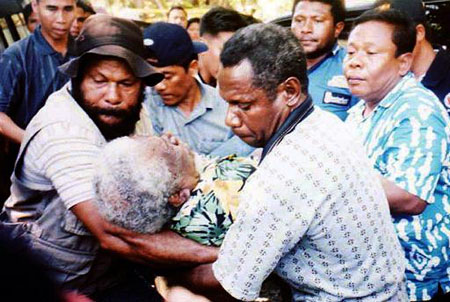
Theys Eluay‘s body being removed after his murder by Kopassus officers, November 11, 2001 (supplied)
 JUBI,
16 October, 2012
It was ten years ago [actually eleven years ago] when Megawati Sukarnoputri was the president of Indonesia, that the Papuan leader, Theys Hiyo Eluay was murdered on 10 November 2001. Theys was kidnapped and murdered because he was regarded as a danger to Indonesia’s territorial integrity.
However, the Papuan people regard Theys Eluay as a Papuan leader who was able to  unite all Papuans from Sorong to Merauke.  He was also a man who called upon people to treat Papuans with decency and respect.This is why Papuans have decided to commemorate the death of Theys Eluay.

‘We are shortly planning to mark the anniversary of the death of this great Papuan leader,’ said Thomas Syufi, president of the Militant Papuans Students Federation.
‘He was a Papuan leader who struggled for his people to be treated with decency and respect.  He did not resort to violence but the Megawati government regarded him as a threat.

He went on to say in a press conference in Jayapura, that there has been no justice yet for the death of Theys Eluay.  ‘The senior army officer who had been involved in the death was allowed to go free. [A few low-ranking Kopasus officers involved in the abduction were given short sentences which they almost certainly never served.] ‘That is why we regard Theys Eluay as a martyr ,’ the students said.

[The facts about Theys’ death are as follows: Shortly before his death he had been elected the chairman of the Papuan  Presidium Council. He was tricked into meeting some members of the army’s elite corps Kopassus on 10 November 2001, kidnapped and driven to an unknown destination. On the following day, his body was discovered in Skouw, a Papuan village near the border with PNG, more than 50 kms from where he had been abducted. He appeared to have been strangled to death; an autopsy concluded that he had died of suffocation. See Tapol Bulletin, December 2001/February 2002.]

The call made at the time by Human Rights Watch for an impartial inquiry into what was seen as a ‘well-planned assassination’ was never  responded to by the authorities.]

To mark the forthcoming anniversary of his death, Papuans were called on to gather at the grave of Theys. The government, the military and NGOs were called on not to raise banners at the grave, ‘out of respect for the fallen leader’.

Plans to move the body have been rejected by Papuans. The anniversary of his death will be marked by prayers  and other activities that have not yet been revealed.

[Translated by Tapol]

Create a website or blog at WordPress.com

Up ↑