A History of the Morning Star Flag of West Papua

by Leonie Tanggahma for West Papua Media

Historical Analysis

December 1, 2012
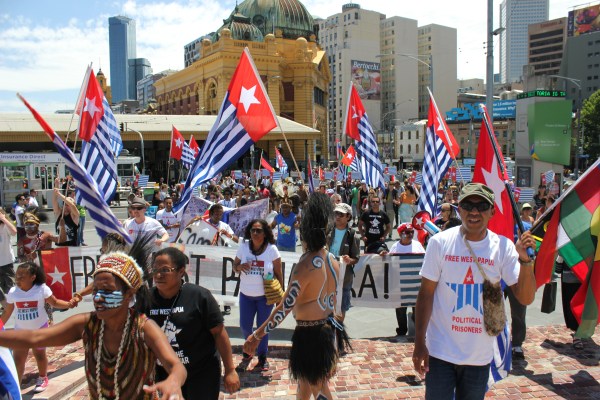
West Papuan Morning Star flags flying at Federation Square, Melbourne (Australia), December 1, 2012.  (Photo: West Papua Media)
West Papuan Morning Star flags flying at Federation Square, Melbourne (Australia), December 1, 2012. (Photo: West Papua Media)

For more than 50 years, the Morning Star Flag has been the symbol of West Papua’s unity and its quest for Freedom and Justice. Thousands have been inspired by it, as it became the main icon embodying the struggle for Independence. And this flag, just like any other flag of any other country, has a history, a proud history.

5 April 1961: Inauguration of the New Guinea Council

On 5 April 1961, a representative body for the then Dutch colony of Netherlands New Guinea was inaugurated: the New Guinea Council or Nieuw Guinea Raad[1] [1]. It was the task of the Council to make the wishes of the Papuan people known on the issue of self-determination, within a year. However, news came that the United States of America and Indonesia were putting pressure on the Dutch  to convince them to transfer its colony to the United Nations, and then to the Indonesian administration. The members of the New Guinea Council immediately gathered for an emergency session and appointed a National Committee to draft a Manifesto expressing the wishes of the Papuans which would include national symbols for the upcoming State.

19 October 1961: Flag and other national symbols officially adopted by way of Manifesto

Committee members Bonay, Jouwe, Tanggahma and Torey were asked to submit designs for the flag and arms. Mr. Torey withdrew and a choice had to be made between the designs of Messrs. Bonay, Jouwe and Tanggahma. The designs of Mr. Jouwe were accepted by 14 votes to 17 as national symbols.  After the national symbols were officially adopted, everyone was visibly moved and proud. According to official testimonies: “Then, all those present rose from their seat and while the emotion was clearly overtaking all those present the manifesto was read by the Chair of the National Committee, Mr. Willem Inury; it was subsequently unanimously accepted and signed by the National Committee. The attendees were then invited to also sign the manifesto … The national flag consists of a red vertical band along the hoist side, with a white [five-pointed] star in the center. Adjacent to the red band, is a series of [consecutive] blue and white lines, with a total of seven blue and six white lines.”[2]

This manifesto dated 19 October 1961 stated that: “in accordance with the ardent desire and the yearning of our people for our own independence, through the National Committee and our parliament, the New Guinea Council, insist with the Government of Netherlands New Guinea and the Netherlands Government that as of 1 November 1961,

a) our flag be hoisted beside the Netherlands flag;

b) our national anthem (“Hai Tanahku Papua”) be sung and played in addition to the Netherlands national anthem;

c) our country bear the name of Papua Barat (West Papua), and

d) our people be called: the Papuan people.”[3]

he Manifesto of 1961 may not have been an independence Proclamation, but its wording was strong and clear in relation to the will of the Papuan people to become independent, it was a declaration of intent, as it also stated that: “On that basis, we, the Papuan people, demand to get our place in the midst of other independent nations and peoples. In addition, we, the Papuan people, make our contribution to the preservation of peace and freedom around the world.”[4]

1 December 1961: Official inauguration of the flag as a territorial flag

The Dutch accepted most of the terms of the Manifesto except for the date of installation and the denomination of the flag: the inauguration of the flag happened on 1 December and not on 1 November as requested by the Papuans. The General Assembly of the UN was to hold a meeting in late November on the issue, and recognition by the Dutch of the symbols could have been interpreted as an endorsement of an independent West Papua by the Dutch Government. The Dutch did not want to provoke the Indonesians, even if it meant that the demand of the Papuans would not be heard. In terms of the denomination, the Dutch authorities recognized the new flag as a territorial flag (landsvlag) and not as national flag.

All the specifications concerning the flag and other Papuan symbols can be found in the so-called “Territorial Flag Ordinance” (or “Landsvlagordonnantie”) Number 68 of 1961. This Ordinance specifies among others that: “(1) The territorial flag of Netherlands New Guinea shall be a rectangle consisting of a vertical wide red striped at the hoist and seven horizontal blue stripes separated by six white stripes. In the centre of the vertical red stripe is a white five-pointed star, with one point pointing vertically upwards. The five points of the star shall each form an angle of 36 degrees. (2) The height and length of the flag shall bear to each other the proportion of 2 to 3. The width of the red stripe shall be two fifth of the height of the flag. The blue and white stripes shall be equal in height. The diameter of the circumscribed circle of the star shall be seven eighths of the width of the red stripe.” [5]  Another ordinance (Number 69 of 1961) provided for a national anthem for Netherlands New Guinea. Ordinance Number 70 of 1961, also called the “Administrative Order for the implementation of Section 2 of the Territorial Flag Ordinance”, stipulates the terms and conditions under which the flag is to be raised. And Section 5 states: “This Order, which may be cited as Flag Order, shall come into operation on December 1, 1961.”[6]

And so on 1 December it happened, for the first time, our Morning Star flag was raised, next to the Dutch flag; our national anthem (”Hai Tanahku Papua”) was played and sung together with the Dutch national anthem; our country was given the name of Papua Barat (West Papua), and our people were given a name: the Papuan people.

Nine years of international Fraud and Deception led by greed, racism and the total disrespect for human life

Just 18 days after the installation of the Papuan symbols, on 19 December 1961, the President of Indonesia, Soekarno, made his call for the infamous Tri Komando Rakyat (or TRIKORA), the People’s Threefold Command. On that day he called for a total mobilization of the people of Indonesia, (1) to destroy what he considered a Dutch-promoted Papuan State; (2) to fly the Indonesian flag over the territory of West Papua, which he erroneously called West Irian; (3) to prepare for war over what he called West Irian. For Indonesians this represented the so-called liberation of the territory from the Dutch. For Papuans the TRIKORA was the call for an illegal military aggression from a country which did not recognize its sovereignty. Military aggression was followed by legal deception as the Dutch and the Indonesians signed the New York Agreement of 15 August 1962, an agreement regarding the future of the Papuans but they themselves were never consulted. The Papuans were betrayed by those who signed this agreement which regulated the transfer of the administration of New Guinea to the United Nations. This administration lasted from 1 October 1962 to 1 May 1963. Then it was to be handed over to Indonesia for a period of six or seven years, after which the Papuans were supposed to freely choose, through a referendum, whether to join Indonesia or become an independent nation. Legal deception was followed by political fraud. In August 1969 the so-called “Act of Free Choice” was organized. At the time, West Papua had been under Indonesian rule for over six years: every expression of Papuan nationalism was systematically bloodily suppressed, possible opponents were arrested and tortured, punitive expeditions were carried out across the country and bombings and rocket attacks were conducted by the Indonesian army. The so-called “Act of Free Choice” itself was pure deception, fraud and deceit, a stage-managed play in which Indonesian officials selected 1026 Papuan electors who voted on behalf of 800,000 Papuans at the time. The electors were all carefully prepared for the Musyawarah: an Indonesian system of decision-making where there is unanimous agreement: 1025 Papuans finally decided unanimously that they wanted to belong to the Republic of Indonesia (one was sick that day). The normal one-man/one-vote principle usually applied for a referendum had not been respected as the Indonesians argued that Papuans were too primitive!

1 July 1971: the territorial flag becomes a national flag

In protest against the failure of the implementation of the “Act of Free Choice” the Free Papua Movement (OPM) proclaimed the independence of the Republic of West Papua on 1 July 1971.  Under Article 2 of UN resolution 1514: “All peoples have the right of self-determination. By virtue of that right they freely determine their political status and freely pursue their economic, social and cultural development.”  Another UN resolution, Resolution 1541, explains that exercising your right to self-determination means that you are allowed to choose between independence, autonomy or integration within an existing state. Since the beginning, the Papuans chose for independence; and they opted for that same option time and time again.

The Manifesto of 1961 was a declaration of intent; the Proclamation of 1971 was the realization of that intent. The proclamation stated: “With the help and blessing of God Almighty, we take this opportunity to declare to you all that today, 1 July 1971, the land and people of Papua have been proclaimed to be free and independent (de facto and de jure)”.

On 1 July 1971, the Papuans chose to take the Morning Star Flag which had been recognized by the Dutch as a territorial symbol. The Papuans decided to proclaim it a NATIONAL symbol; they did the same with the national anthem (Hai Tanahku Papua).


[1] Newspaper report. Sydney Morning Herald, 6 April 1961.

[2] Official government magazine Pengantara of 21 October 1961.

[3] Official government magazine Pengantara of 21 October 1961

[4] Official government magazine Pengantara of 21 October 1961

[5] Bulletin of Ordinances and Decrees of the Government of Netherlands New Guinea, 1961, No. 68, issued on 20 November 1961.

[6] Bulletin of Ordinances and Decrees of the Government of Netherlands New Guinea, 1961, No. 70, issued on 20 November 1961

Report on the US ambassador’s meetings with various government agencies and institutions

(via Tapol) The following is a summary of two lengthy reports in Bintang Papua on 7 and 8 November about the visit earlier this month of the US ambassador Scot Marciel, to West Papua:
——-
DPRP Meetings
During discussions with members of the Papuan Provincial Legislative Assembly (DPRP), the ambassador expressed strong support for the special autonomy law enacted eleven years ago and said that the US government recognises West Papua as a part of the Republic of Indonesia.He said that his main interest was in the development programme in West Papua and to discuss possible collaboration in this process.

The deputy head  of the DPRP, Yunus Wonda, said the ambassador was keen to know what the priorities were in development and said the ambassador  was particularly interested in education and health.

He also asked about the difficulties surrounding the election of the governor which resulted in the election being delayed for two years. Yunus explained that  the problems had emerged because of a dispute in the MK (This presumably refers to the Constitutional Court – Tapol).

With regard to education, the ambassador said that the US is willing to help by providing study opportunities to young Papuans in the US.

Yunus asked the ambassador how many indigenous Papuans were now studying in the US, adding that they were keen to know the names of these people, to see whether they were indeed indigenous Papuans.

The DPRP also called on the US  to support the idea of dialogue between Jakarta and Papua. He said that they would not use this dialogue to press for independence  for Papua but were only interested in advancing the implementation of the special autonomy law.

——————

Talks with military personnel

Marciel said that the US was very impressed by the developments that had already been achieved and also with the reforms that had been made with regard to the TNI (the Indonesian army). These remarks were made during a meeting between the ambassador and senior officers of the provincial military command. On this occasion the ambassador met the chief of staff of the military command along with seven other senior officers.

In a press release issued by the US team, the ambassador referred to Freeport and asked for clarifications about the company and wanted to know whether there could be more collaboration (with the company) in education, culture and security.

The chief of staff explained that according  to Law 34/2004,  the military were now implementing ‘soft power’ in their territorial operations in Papua, and were keen to assist in speeding up development and human resources so as to ensure that West Papua would not continue to lag behind other parts of Indonesia.

In response to the ambassador’s question as to why the duties of the military command in West Papua were so much greater here than elsewhere and required a very different approach, the chief of staff said that the military were acting in accordance with their noble duties as ‘Noble Protectors of the People’  (Ksatria Pelindung  Rakyat).

————————–

MRP Meeting

During a meeting with the first deputy chairman of the Majelis Rakyat Papua (Papuan People’s Council) Hofni Simbiak, the ambassador said he wanted to know more about the election of the governor and to know more about governmental affairs in the Province of Papua. Hofni said that even a very large tree could be felled at any time.  Because of this, he said that he hoped that there would be more diplomatic visits to Papua so as to give guidance on leadership on the province.

He said that the ambassador’s visit was a good opportunity to discuss the gubernatorial problem, as well as the whole process of government. in the province.  He said that they were very interested in this matter so as to ensure the the common people would not be victims of this situation.

He explained that because of the continued absence of an elected governor, no budget had been produced and there was no one who could take responsibility (for finances).  This was having serious consequences for the people.  (Simbiak) said that they had urged the KPU (Electoral Commission) to discuss this matter with the provincial government and to take firm action on the matter.   He said it was extremely important for a governor to be elected because without this, the services provided by the governor were not available and this was leading to big problems for the people.

The ambassador said that the American people were aware of the difficulties regarding the governor and said: ‘We are having an election of our president in the US and face the same situation as you here in Papua because we are keen to provide help for the government here in the fields of education, health and forestry.’

—————————-

Meeting with Tito Karnavian

In a meeting with Inspector-General of the  Police Force, Tito Karnavian,  the ambassador expressed support for  the developments already achieved by the police.

The chief of police said that when they were confronted with acts of violence, they always act in accordance with the law and in a professional manner, keeping the use of violence to a minimum. He also spoke about their activities to combat corruption so as to ensure that the development budget could serve the interests of the people.

He said that the ambassador had stressed the importance of  transparency and in case of acts of abuse by the police, everything should be made public.  When he asked in what way the US could help, the chief of staff said that they could be given advice on how best to deal with demonstrations.   The second point he made was that for purposes of investigation, the difficulty is that there is no forensic laboratory in Papua.  His third point was about the need for working together especially with Bhayangkari (the organisation of wives of the military), in particular with regard to partnerships with the people.

In response, the ambassador expressed great enthusiasm and said he hoped that joint programmes would be conducted in the next four or five years.

Marciel also expressed support for the police pursuing a lenient approach and the need to avoid projecting an image of the police as being involved only in arresting and detaining people but should prioritise activities that bring them close to the people.

[Translated by TAPOL]

[COMMENT: There is no mention at all of the ambassador having met leaders of Papuan organisations such as DAP, the Council of Indigenous People, KontraS Papua, ELSHAM-Papua or other people’s organisations.]


Is Australia funding Indonesian Death Squads? Densus 88 in West Papua

Statement by the West Papua Project, Centre for Peace and Conflict Studies, University of Sydney, 16th July, 2012

Questions are being asked about the role that the partly Australian funded
and trained elite Indonesian police squad, Densus (Detachment) 88, has
played during the recent violence in West Papua. Set up in the wake of the
Bali terrorist bombings, Densus 88’s mandate was to tackle the rise of
domestic terrorism in Indonesia. Australian support might have been
motivated by revenge as well: 88 Australians were killed in the Bali attack.
While acclaimed for capturing or killing known and suspected terrorists,
Densus 88 also gained a reputation for extreme violence: many suspects being
killed rather than arrested. Now reports are suggesting that Densus 88 is
operating in West Papua, possibly clandestinely, and has been responsible
for the assassination-like killing of Papuan political activist, Mako
Tabuni, on June 14.

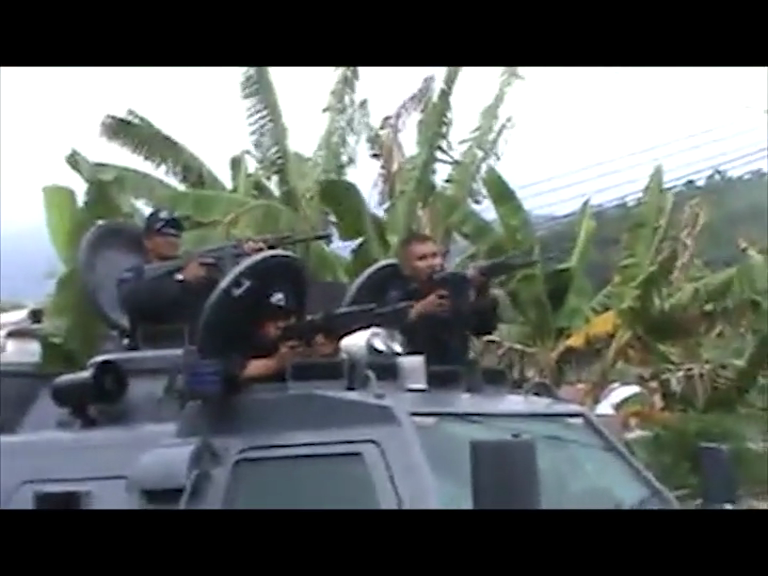
Detachment 88 troops firing live rounds at civilians during the brutal crackdown on the Third Papuan People’s Congress, October 19, 2011 (West Papua Media video still)

While Indonesian National Police spokesman, Saud Usman Nasution, has denied
Densus 88 is operating in West Papua he has left the door open for their
involvement, saying in the Jakarta Globe on June 27, “Densus will be
deployed if terrorism occurred there.” However other reports, for instance
from Kontras Papua, a local human rights organization, state that Densus 88
is already operating in West Papua “carrying out undercover activities”
(Cenderwasih Pos, June 23). Kontras Papua believes that Densus 88 was
involved in the Tabuni killing – where the victim is reported to have been
standing in the street eating betel nut when three unmarked cars pulled up
nearby. With no provocation a person emerged from one car and shot the
victim dead.

Police report that the victim had tried to snatch a weapon from the
plainclothes police involved and was killed in the resulting fracas. Police
also claim that Mako Tabuni was wanted for a series of shootings that had
occurred in Jayapura over the previous few weeks: a claim that seems
unlikely given his role as Deputy Director of KNPB (the West Papua National
Committee), which is a non-violent political organization. Tabuni had also
been publicly calling for an independent investigation into the recent
shootings of which he was accused. Nonetheless, any charges should have been
heard in court and given due legal process, now impossible with Tabuni’s
death. Other reports of Densus 88 activities in West Papua have come from
respected Papuan leaders. Reliable sources observed Densus 88 police arrest
KNPB member, Zakeus Hupla, in the lobby of the Dhanny Hotel, Entrop,
Jayapura, on the morning of June 23. Other reports indicate further arrests
of KNPB members by Densus 88 and their subsequent torture. According to
family members, no arrest warrants were issued by Indonesian police for
these arrests, and the Jayapura police deny that the KNPB members are in
their custody. Indeed it is unclear if these men have been arrested,
abducted or ‘disappeared.’

These events are of genuine interest and concern to Australia because
Australian taxpayers’ money is spent training and maintaining Densus 88.
This organization has a legitimate role to play in countering the rise of
terrorism, but it should act strictly within its organisational mandate. If
Australian taxpayers are indeed partially funding a clandestine force
involved in killings, abduction and torture of Papuan activists an
unacceptable situation has developed. These events and allegations must be
comprehensively investigated and all funding for Densus 88 frozen until
either the allegations have been disproved or the individual police officers
guilty of crimes arrested and tried in an open court. We call on the
Australian government to immediately halt the funding of Densus 88, to
investigate the claims of its misconduct, and to apologise to the Papuan
people if they are proven to be true.

The Past That Has Not Passed: Human Rights Violations in Papua Before and After Reformasi

June 28, 2012

joint report released today by the International Center for Transitional Justice (ICTJ) and the Institute for Human Rights Study and Advocacy (ELSHAM-Papua) provides important insight into the ongoing debate on steps required to achieve a sustainable peace in Papua.

Based on more than 100 interviews carried out in 2011 in the districts of Sorong, Manokwari, Biak, and Paniai, the report reviews Papua’s recent history, including the Special Autonomy Law governing the relationship between the Papua province and Indonesia, within a transitional justice framework. It also reveals new information provided in testimonies by victims and witnesses who experienced human rights violations going back to the earliest days of Indonesia’s history as a nation.

“Even as we were conducting this research, new outbreaks of violence and cases of gross human rights violations continued to take place,” said Ferry Marisan, director of ELSHAM. “We interviewed more than 100 victims, many of whom have deep feelings of distrust that are deeply rooted in the past and present experiences of human rights abuse. Official acknowledgement of this violent past is a prerequisite to building peace in Papua,” he added.

“Unless these grievances are not only recognized, but also addressed in a practical way, reconciliation will remain elusive”
Unless these grievances are not only recognized, but also addressed in a practical way, reconciliation will remain elusive. A comprehensive transitional justice strategy could provide effective redress, and should include truth-seeking, criminal accountability, reparations, institutional reform to prevent recurrence of human rights violations, and a focus on the rights of indigenous women.

“The Indonesian government must urgently develop a comprehensive policy for dealing with this legacy of past violations. We are at risk of repeating the past through using force to deal with unrest, instead of opening a process of genuine dialogue. The first step is acknowledgment,” said Galuh Wandita, ICTJ’s senior associate.

Download the full publication here

This joint report by ICTJ and the Institute for Human Rights Study and Advocacy (ELSHAM-Papua) provides important insight into the ongoing debate on steps required to achieve a sustainable peace in Papua. The report reviews Papua’s recent history within a transitional justice framework, and provides expert recommendations on truth seeking, justice, reparations, institutional reform, and enforcing the rights of women victims. Based on more than 100 interviews carried out in 2011 in the districts of Sorong, Manokwari, Biak, and Paniai, the report reviews Papua’s recent history, including the Special Autonomy Law governing the relationship between the Papua province and Indonesia, within a transitional justice framework.

Date published:
6/28/2012

Giay: West Papua – Land of Mourning, Bloodshed (Peace?) and Humanitarian Intervention

From Kingmi Church  – Papua

edited by WPM for clarity

Also at Numbay Media — posted on Engage Media website

June 28, 2012

Rev. Benny Giay
Diplomatic Briefing, Hotel Trefa
Jakarta, June 27, 2012

Papua Land of Mourning And Bloodshed (Peace????) And Humanitarian Intervention[1]

Rev. Benny Giay

Since May 2012 until June there has been a series of shootings in Jayapura in the context of our struggle to fulfill our “Papua land of peace” dream. The government has claimed the shooting has been carried out by separatist groups. Papuans respond to such claim is as usual: “Oh itu lagu lama. The authorities are playing the old song.”

One way to respond to that “old song” is to look at the root cause of shootings that ended with the killing of Mako Tabuni on 14 June, followed by the arrest of other members of KNPB in Papua a few days ago. In my view this development has something to do with (a) first of all how 2 different actors (Indonesia and Papua) that belong two {separate} cultures (Malay and Melanesia) view themselves and their past. Indonesia’s view is that Papua has become part of Indonesia and has been in contact since 8th century with them. Therefore Papuans are brothers.

Papuans on the other hand believe that it might be true that Papuans has been dealing with the ancestors of the rest Indonesians for several centuries, but that contact occurred in context of domination, slave trade and oppression. The contact between the two parties was one of master – slave  relations. Therefore, Papuans see their past relations with Indonesia (Tidore, Ternate and Maluku etc.) as history of robbery, slavery, destruction of their villages and burning of Papuan community settlements.

Secondly since 1960s when Indonesia took over Papua,  Papuans were viewed {By Indonesians} (and have been viewed until now) as primitives, backward, uncivilized people; and therefore Jakarta since that time promoted itself as the guru, the teacher of new civilization to “lift up socio-economic welfare of Papuans”. Jakarta then formulated what an Indonesian scholar call: migrant biased development policy (which in brief is a policy made by central government to guarantee the interest, safety and future of Indonesian migrants in Papua, while ignoring Papuan identity, culture and their future.) Papuans have no place in such a development scheme. Papuans are non humans. Second class citizens. This Indonesian neo-colonial policy (if we can use that term) was from the beginning up to now has been guarded by security institutions. Papuans who resisted this undemocratic policy has been dealt with by security forces.

Thirdly, as a result Papua has become “site of mourning”, “site of collective trauma”, and a site of oppression and mourning”. Three days of mourning that we had (June 14-16) as we gathered in Post 7 Sentani after the killing of Mako Tabuni, was not a new thing.  We only repeat what our past generation went through since 1960s. Facing such migrant biased development (or Indonesian colonial policy) as shown above, we, Papuans since 1960s are like the Javanese of 1900s Central Java, who were treated as second class citizens by the Dutch (as Indonesian history books say today); or Black South Africans of 1940s who suffered under apartheid policy. In fact this “migrant biased development policy” I think is “an Indonesian version of apartheid racial policy” toward Papuans. Theologically speaking Papuans of today and in the past have  been living under modern Pharaoh or modern Goliath, supported by the international community and multinational companies who had come to Papua and robbed the natural resources, killing off the Papuans.

Fourthly, the killing of Mako Tabuni by Indonesian Police has to be seen in the light of history of Papuan resistance to Jakarta’s migrant development policy pointed out above. Mako Tabuni and other civilians who voiced their right and grievances have been and are stigmatized as separatist. Mako, who was leading a civilian {civil society} group using peaceful means in demanding Referendum, has been seen as a threat to Indonesian political interest. This strategy to stigmatize was used by Erfi Triassunu, former Military Chief, in March 2011. He issued a confidential document saying that Papuan Christian Church (Kingmi – of which I am the Chairman of its Synod) is a religious arm of the Papuan Liberation organization (OPM). Other Church leaders of Papua in September 1966 were accused by security forces in Papua as an umbrella organization of OPM. Similarly Papuan NGOs who {promote advocacy around} human right abuses in the past have been seen in the same light.

The question now is who is behind the shootings that started May? According to Government it is Mako of KNPB, and Mako or KNPB is OPM. I can see the shootings from the point of view 3 actors, each of with their agendas.  First party is Mako or KNPB who represent Papua demanding referendum to deal with new modern Pharaoh. Second actor is a small and insignificant group of international solidarity group with agenda for democracy and promotion Papuan human right. Third actor is Jakarta: who fears the threat of disintegration and panic; not willing to change the approach to Papua; hold on to the sacred doctrine “territorial integrity” with the support of international community”. And that it is OK to use military or Police force to kill or annihilate separatist group to maintain “the territorial integrity”. Looking at the history of civilian’s resistance the shooting since May of this year was carried out by agents of Government to weaken the civilians struggle for referendum using means of non violence. Jakarta’s fear that is the international solidarity groups would promote the cause of Papuan civilians at the international niveau (level).

Jakarta is now on safer ground. They have has shot dead Mako Tabuni whom they accused as OPM agent. But the dream for “Papua: Land of Peace” remains a dream. Police and military are still searching for the members of KNPB. Military and Police are in control. Papua is still a land of mourning, a land of trauma and bloodshed. Modern Pharaohs and Goliath are in control in Papua today.  It is here that we need “third party” as it is in the case of Israelites and Pharaoh (Exodus 3:7-9). Papua need a moratorium”. Now is the time for Papua and Jakarta to formulate “new Indonesia”. But to do this we need a “humanitarian intervention”.

Toch, perpetrators of Human right violations in Papua will never be taken to court. They in fact will be promoted. Paulus Waterpauw (Deputy Police Chief of Papua) and Bigman Lumban Tobing (Papua Police Chief) will follow the footsteps of Col. Hartomo, the Kopassus commander who ordered the abduction and the killing of the late Theys Hiyo Eluay in November 2001; he was promoted last week as another high ranking military elite in Jakarta.

Jakarta, June 27, 2012

Rev. Benny Giay

Ketua Synode Kingmi di Tanah Papua

(Papuan Christian Church)


[1] I am dedicating this reflection to pastors and the ministers of the Lord, in Papuan Church History who were shot dead by Indonesian Security Officers in the past out allegation that they were agents of Papua Liberation Organization.

Create a website or blog at WordPress.com

Up ↑