TPN denies involvement in “unknown persons” terror plot in Wamena


from West Papua Media

October 4, 2012

A commander from the West Papua National Liberation Army (TPN) has categorically denied any responsibility or involvement in an alleged bombing campaign against security force targets in Wamena and Jayapura, joining a chorus of Papua observers raising doubts about the Indonesian police allegations against pro-independence activists

Troops from the Indonesian army (TNI) and Australian-trained Detachment 88 counter-terror unit conducted a violent raid on September 29 against activists from the West Papua National Committee (KNPB) in Wamena, arresting 8.  The eight have been charged with various offences, including  possession of explosive devices and Makar (treason).

Citizen journalists from SuaraPapua .com made contact with the Commander of the Kodap (Liberation Command Area) I  of TPN, Colonel David Darko on Tuesday (2/10) afternoon, who confirmed the bombs in  Jayapura, Wamena and throughout Papua, had no connection to the TPN OPM.

“So (the) TPN OPM states assertively, that we are not responsible for any action with bombs, because OPM is not a terrorist organisation, but an organisations of national struggle for Papua, (and for) basic rights to self-determination as any other nation on earth, ” Darko told SP.  He said it was a struggle for the liberation of the people, and “The struggle by TPN-OPM is dignified and with  full responsibility for the rights of the national struggle,” he said.  This unequivocal statement, according to David Darko, is to give notice to all parties not to associate the OPM with bombs or terror.

The non-violent activists were allegedly arrested in connection with a small bomb blast at a Wamena police station.  Detachment 88 anti-terror police claim they found explosive materials at the KNPB offices, but human rights observers across Papua have suggested the police themselves planted the materials and questioned the truthfulness of police claims.

Ferry Marisan, the director of the Institute for Human Rights Study and Advocacy in Papua (Elsham) told the Jakarta Globe, “It [the evidence] must have been fabricated by police, they placed the explosives in the office so the police would have a reason to arrest them.”

Victor Yeimo, the international spokesperson for KNPB currently in hiding after threats of arrest for subversion,  ridiculed the police assertion that the arrested activists were involved in the attack on the police station, or in making or using bombs, or engaging in acts of terror.  “West Papuan people are not involved with these bombs, and still do not know how to make bombs,”  Yeimo told West Papua Media on September 30.  KNPB has previously and publicly pledged its commitment to non-violence, saying that it is committed to the use of “civil power”

Members of the KNPB have also been subject to an escalating wave of repression by Indonesian security forces across Papua, since the beginning of an anti-violence civil resistance campaign earlier in 2012, in response to a series on mysterious “unknown persons” (OTK) shootings that had killed over 20 people since 2011. These shootings, widely believed across Papuan civil society to be the work of Kopassus Indonesian special forces creating violence to be used as a pretext for a declaration of martial law, peaked with the brazen daylight execution by Detachment 88 officers of KNPB Jayapura Chairman Mako Tabuni on June 6 this year.

Papuan civil society sources have claimed by SMS and email to West Papua Media that the current campaign of bombings and explosions is connected to the October visit of Indonesian President, General Yudhoyhono, to the UK.  SBY, as the president is known, is believed to be signing off on major defence deals with UK arms corporations, and will be pressing for increased anti-terror cooperation.  SBY is also being targeted currently by human rights activists connected with the KNPB in the UK, who have offered a GBP£50,000 bounty for a citizen’s arrest of the Indonesian President for Crimes Against Humanity.  Civil society sources believe that the campaign of crackdown of KNPB activists accused of terror acts is being orchestrated to shut down Papua rights campaigning in the UK.

The TPN Commander Darko stated that the TPN was not allied with the West Papua National Committee (KNPB) in any political or organisational sense. “We also had nothing to do with the Committee at all as we are different from them,” Darko told SP.

The new Papua Police Chief,  Inspector General Tito Karnavian – the former head of Detachment 88, conceded the TPN-OPM claim to not engage in terrorist bombings, but said to wait for the court process.

“This case is being handled, and let us see it in court. Whether they are involved or not. Let the court decide, ” he said.  Honesty awaited the court because the reverse case would cause turmoil with the grassroots people of Papua, Karnavian explained to assembled journalists.

However, with Papua still closed to international journalists or independent human rights observers, few West Papuan activists believe that the flawed court system in Papua will be able to deliver a legitimate and fair trial.


westpapuamedia


Wamena arrests as Australian-funded anti-terror troops conduct raid amid increasing repression on KNPB political activists

by West Papua Media

September 30, 2012

Unconfirmed photo from Sep 29 Detachment 88 raid on KNPB in Wamena (Supplied/KNPB)

Troops from the Indonesian army (TNI) and Australian-trained Detachment 88 counter-terror unit conducted a major raid on Saturday against activists from the West Papua National Committee (KNPB) in Wamena, according to several credible sources in the West Papuan highland town.

The raid on the secretarial office of KNPB Baliem Region at the Potikelek complex in Wamena, just before 6pm on Saturday night, resulted in the arrests of 8 KNPB members. Sources reported to West Papua Media that at least two platoons each of TNI, D88 and regular Police (arriving in 2 trucks, 11 vehicles and 14 motorbikes) were involved in the raid, with many detainees being subjected to brutal beatings and on-the-spot interrogations by security forces according to independent witnesses.

According to Simon Dabi, the Baliem region chairman of KNPB, the troops “said tomorrow they will return and burn the hut.”

“We are not aware of the reason for the arrests, but there’s a possibility it could be connected to a scenario that’s been created to make out KNPB activists to be terrorists, by connecting us to the recent bombing in Irian Road, Wamena,” explained a clearly exasperated Dabi, relayed through KNPB sources.

Those confirmed arrested are:

• KNPB Secretary General (Baliem Region) Janus Wamu (aged 26);

• Eddo Doga (aged 26);

• Irika (Ribka) Kosay (aged 19);

• Jusuf Hiluka (aged 52);

• Yan Mabel (aged 24);

• Amus Elopere (aged 22);

• Wioge (Nata) Kosay (aged 18);

• Melianus Kosay (aged 29);

Grave fears are currently held for the safety of the detainees, who were taken for interrogation to the Wamena Regional Police headquarters under the command of Jayawijaya Regional Police Chief Arivin. Simon Dabi told stringers that the arrest was carried out arbitrarily and without proper legal procedure and those arrested “are at present in an unsafe situation”.

West Papua Media repeatedly attempted to seek comment from the operation commander Kapolres Arivin, and written questions were submitted to clarify details of the raid, however, Arivin hung up twice upon answering and then switched his phone off.

The Papua-wide General Chairperson of KNPB, Victor Yeimo, also urged the Chief of Jayawijaya Regional Police to release the KNPB members. “I have just telephoned direct but the phone was unanswered, so I was only able to send an SMS to the Head of Regional Police to insist that the 8 young ones I am responsible for, be immediately released as their action (in arresting the 8) is uncivilized and improper” asserted Yeimo.

Yeimo ridiculed the police assertion that the arrested activists were involved in the attack on the police station, or in making or using bombs, or engaging in acts of terror.  “West Papuan people are not involved with these bombs, and still do not know how to make bombs,”  Yeimo told West Papua Media.  KNPB has previously and publicly pledged its commitment to non-violence, saying that it is committed to the use of “civil power”

KNPB members have reason to be concerned for the safety of their colleagues. On September 23, 6 local youth members of KNPB were arrested, tortured and beaten in arbitrary arrests following an apparently suspicious death of an Indonesian colonist, and then all released without charge. “Having done no wrong, KNPB activists are constantly being chased, arrested, intimidated and killed by NKRI (the Indonesian state),” said Yeimo.

Members of the KNPB have also been subject to an escalating wave of repression by Indonesian security forces across Papua, since the beginning of an anti-violence civil resistance campaign earlier in 2012, in response to a series on mysterious “unknown persons” (OTK) shootings that had killed over 20 people since 2011. These shootings, widely believed across Papuan civil society to be the work of Kopassus Indonesian special forces creating violence to be used as a pretext for a declaration of martial law, peaked with the brazen daylight execution by Detachment 88 officers of KNPB Jayapura Chairman Mako Tabuni on June 6 this year,

After his appearance on a major report on Australia’s ABC TV describing the tactics of the Detachment 88 state terror campaign against Papuan non-violent activists, Victor Yeimo, found himself with other KNPB members on the Daftar Pencarian Orang (Wanted persons list) in a clear retaliation for speaking out to the international community.

In recent weeks, many non-violent activists engaging in peaceful acts of political expression across Papua have been targeted by security forces including those from D88.

Saturday’s so-called “anti-terror” raid in Wamena is the first major raid since the former head of Detachment 88 Tito Karnavian was appointed as the new police chief in West Papua. Karnavian loudly promised a new “hearts and minds approach” to reducing violence across Papua, and “vowed to take a grassroots approach to stopping the violence”. However, according to Papuan activists across the occupied territory, it seems that the only approach is the intensification of repression of grassroots people.

Westpapuamedia

Activists threatened with twenty years jail for organising a nonviolent march about media freedom in West Papua

by Alex Rayfield

28 September 2012

Two West Papuan activists currently in police detention in Yapen Island in West Papua are being threatened with twenty years jail by the Indonesian police for organising a nonviolent march in support of the United Nations International Day of Indigenous People which this year celebrated the role of indigenous media.

Edison Kendi (37 years) and Yan Piet Maniamboy (35 years) from the pro-independence group West Papua National Authority were arrested by Indonesian police on 9August 2012.

The activists were leading a march of approximately 350 people in support of the International Day for Indigenous People. Police used force to break up the march. According to witnesses they beat up several Papuans and repeatedly discharged their weapons into the air. Sixteen people were arrested at the scene and a laptop, hard disk, modem, digital camera, documents and three Morning Star flags were later seized by police.

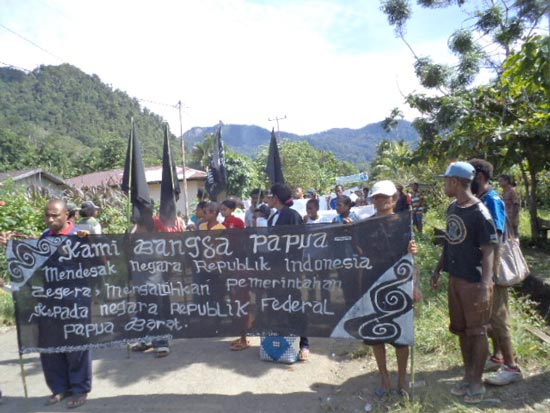
Banner at freedom of expression rally rejecting Indonesian rule in Papua on the International Day for Indigenous People. Photo via Alex Rayfield from West Papua Media stringers in Yapen.

Those arrested were subsequently released except for Edison Kendi and Yan Piet Maniamboy who remained in police custody. A local stringer told West Papua Media and New Matilda that Indonesian police investigators Sudjadi Waluyo and Arip Marinto have charged the two men with rebellion (makar) under section 155 of the Indonesian Criminal Code. Both defendants have been told that the police will seek jail sentences of 20 years each.

The controversial charge of makar has come under intense criticism from Papuan lawyers Yan Christian Warinusy from the Legal Aid Institute in Manokwari and Gustaf Kawer and Olga Hamadi from the Commission for the Disappeared (Kontras Papua). The lawyer argues that the charge of makar has been used as a tool of political repression to deny nonviolent activists their right to free speech. The law actually dates back to Dutch times and was used extensively by the former dictator to repress dissent in Indonesia. Suharto was overthrown by a nonviolent student movement in May 1998 but the law has remained on the statute books. Amnesty International and Human Rights Watch have also called for the makar provisions to be struck from the criminal code and all political pisoners in Papua to be released.

The WPNA march was organised to commemorate the International Day of Indigenous Peoples. Ironically the United Nations theme for this year was to celebrate indigenous media. Yapen is extremely isolated. International media is banned in West Papua and local media is censored. So the very fact that story got out in the first place is testimony to the growing power and skill of indigenous media activists in West Papua.

Kendi and Maniamboy told New Matilda and West Papua Media by text message from their jail cell that they want the international community to help them. “We don’t want Autonomy or to remain with Indonesia. We want to be free! Don’t continue to let us be killed and thrown in jails” they said. WPNA media activist and Governor of Jayapura (under WPNA’s parallel political structure), Marthen Manggaprouw said his organisation wants the Indonesian government to negotiate with the independence movement to resolve the conflict. “The basic rights of indigenous Papuans are not respected in West Papua. There is no democratic space for us Papuans. We are criminalised simply for expressing our opinion” said Manggaprouw.

The men number amongst some 100 West Papuan political prisoners currently languishing in Indonesian jails. Although the Indonesian constitution technically guarantees freedom of speech in reality basic rights are routinely denied to the indigenous Papuan population. Papuans calling for genuine political freedoms are vigorously repressed by Indonesian police and military.

This is the original article to one which appeared in New Matilda

The Coverage of Gunfire in Nabire is Public Deception

Tabloid Jubi

September 25, 2012

by Victor Mambor

Jayapura, (25/9) The coverage about gunfire between police and armed civilian groups in Urumusu, Nabire Regency on Monday (24/9) that was reported by national and local media, has been described as ‘public deception’ by human rights activists in Nabire. A resident called Kristian Belau/Zonggona, named by police, was shot in the gunfire.

This allegation of public deception was asserted by the Nabire Kingmi Klasis Church Bureau of Justice and Peace in a chronological report of events received by tabloidjubi.com , on Tuesday (25/9). The Bureau of Justice and Peace of the Nabire Kingmi Klasis Church, which undertook an investigation into this incident says that this was actually a case of police shooting the victim, Kristian Belau/Zonggonau, because of road-blocking elated activity on the Interior Trans-Nabire road, not because of gunfire between police and armed civilian groups.

From the chronolgy collected by the Bureau of Justice and Peace, on Tuesday 25 September 2012, at approximately 6:00am CDT, a group of Moni Youth were road-blocking on the roadside of the Interior Trans-Nabire Road next to the Wadio Atas Elementary School, Gerbang Sadu Villiage, in the West Nabire District of Nabire Regency. Unfortunately, when these young people stopped an Inova type car that was heading inbound and requested money from the passengers, it turned out there was a police officer in the car. The police officer then fired into the air three times, which made all the Moni youth run to safe themselves. But three other Moni youth used a motor bike to travel to the rubbish dump in Wadio Atas and continued their road-blocking actions. The police officer that fired the shots directly reported to Nabire Police District Command (Polres) that there were people carrying out road-blocking in Wadio Atas.

Kristian Belau lying down awaiting the operation to remove the bullet

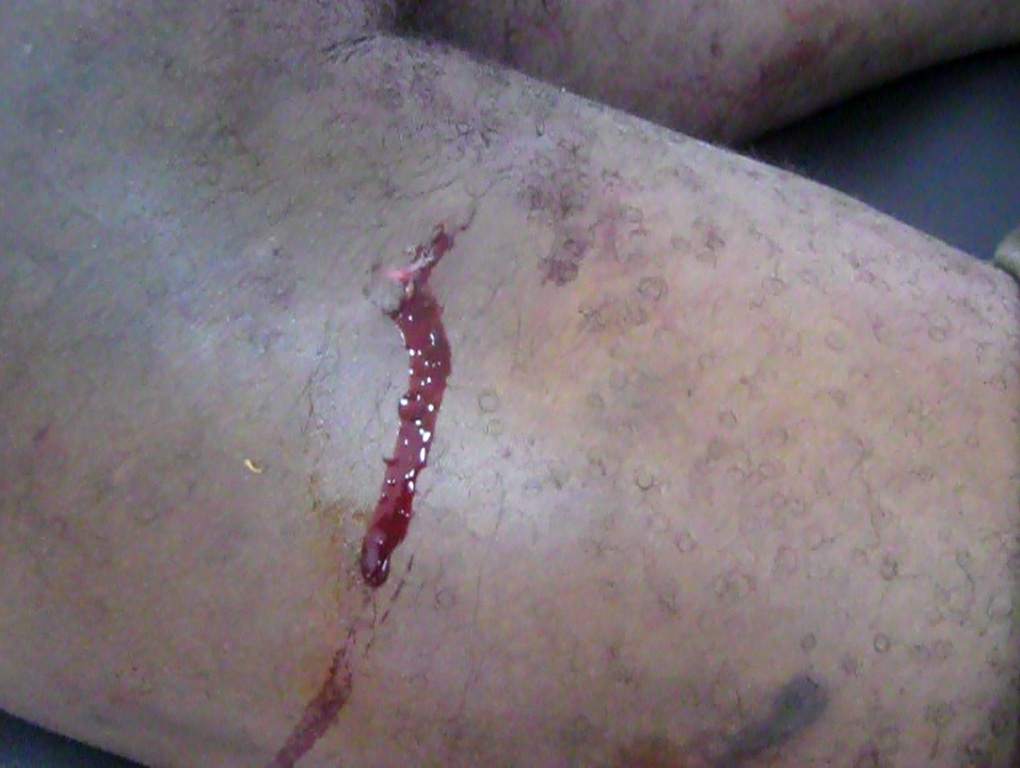
After morning assembly, police from Nabire District Command took one track heading towards Wadio Atas and checked a spot that is often blocked. Upon arriving at the rubbish dump in Wadio Atas, Gerbang Sadu Villiage, Nabire West District, police met with the three Moni Youth. When the police attempted to arrest the three, two escaped. However, one of them, Kristian Belau/Zonggonau, instead advanced towards police. At the time, Kristian Belau/Zonggonau is suspected of being drunk because all night he was drinking heavily. When he advanced towards the police officers, he was shot in the right thigh. Kristian was then lifted to the police patrol car to be taken to the Siriwini Hospital Emergency Room, Nabire. Currently, the victim is in custody at Nabire Police District Command for questioning. According to several citizens in around Gerbang Sadu villiage, road-blocking on the Interior Trans-Nabire Road happens every night. It has been occurring for quite a while. Although police have repeatedly arrested road-blockers, there still are those who road-block. Usually every vehicle that travels inbound is billed according to the type of vehicle. Taxis are billed RP 50,000, private vehicles are billed RP 50,000 and trucks are billed RP 100,000. This issue makes the police angry, to the point that they carried out the shooting of Kristian Belau/Zonggonau.

In the reporting that followed, police said they could not avoid exchanging fire with armed civilian groups in the mentioned location. ‘Because a member was shot, in the end returning fire could not be avoided, one person of the armed group was named Kristian Belau/Zonggonau was shot in his left thigh. Other members of the armed group successfully escaped into the forest whist continually firing at police with revolvers and SS1 type guns’, explained Lieutenant Colonel Gede Sumerta to tabloidjubi.com (25/9),

Based on the investigation carried out, given to tabliodjubi.com the Nabire Kingmi Klasis Church Bureau of Justice and Peace disputes the police explanation. According to them, statements of gunfire between police and armed civilian groups that use revolver and SSQ type weapons is information that has been distributed by irresponsible parties and constitutes public deception. ‘Gunfire between police and armed civilian groups that use revolver and SSQ type weapons is an announcement that is irresponsible and public deception’, said Yones Douw, an activist from Nabire Kingmi Klasis Church Bureau of Justice and Peace to tabloidjubi.com (25/9).

‘Because the Urumusu location is far from the Interior Trans-Nabire road, entering Topo District, Nabire West Regency, a distance from the incident of approximately 45 kilometres. This morning, our human rights activists met with Kristian’s elder sibling and the Moni community in Wadio Atas. They said their children (the three youths who were road-blocking) do not own weapons. If they get drunk and road-block, it’s possible’, continued Yones Douw. (Jubli/Victor Mambor).

a policeman with his weapon guards Kristian Belau

Kristian Belau awaiting operation

right thigh hit by bullet

Obamacopters Give West Papuans Another Reason to Worry

Copyright, Truthout.org. Reprinted with permission from http://truth-out.org/news/item/11169-obamacopters-give-west-papuans-another-reason-to-worry

West Papua Media assisted in the research for this article.

Wednesday, 29 August 2012

By Philip Jacobson, Truthout

An AH-64 Apache attack helicopter hovers before takeoff from Balad Air Base, Iraq, Jan. 3, 2008.An AH-64 Apache attack helicopter hovers before takeoff from Balad Air Base, Iraq, January 3, 2008. (Photo: Master Sgt. John Nimmo, Sr. / US Air Force)

There has been talk of an arms deal between the United States and Indonesia. Reportedly on the table are eight Boeing AH-64 Apache helicopters. These are top-of-the-line attack machines, the best in their class.

The exact status of the deal is unclear, but all indications are that both Boeing and Indonesia have pushed things as far as they can and that the ball on whether to move forward with discussions is somewhere in the US government’s court.

For American officials, the presumable cause for concern is the political fallout that could arise from permitting this kind of exchange with Indonesia, as its military is infamous for atrocities committed against the country’s own people.

But the Americans must also be weighing the benefits the deal would bring. Not only would Indonesia upgrade its aging arsenal and Boeing make up for business it is losing as the US cuts defense spending, but President Obama would come that much closer to fulfilling his pledge to double exports by 2015.

For the black Melanesian people of West Papua, too, the deal would seem to matter greatly. The region, Indonesia’s easternmost, is one of the most militarized places in the world[1]. Since the 1960s, Indonesia has maintained a continuous security presence there, ostensibly to counter a low-level separatist insurgency. It has also carried out a number of full-scale military campaigns, for the same reason. Indonesia is a land of incredible natural diversity, with hundreds of ethnic groups and languages spread across thousands of islands, and since it became independent in 1945, a fracturing of the unitary state has been what the country’s nationalist leaders, the vast majority of whom are Javanese, fear most.

Since Indonesia annexed it in 1969, resource-rich West Papua has always been at odds with the central government. The region is unique in that it is the only place in the country subject to a virtual media blackout, with foreign journalists effectively barred from working there[2]. Despite the restrictions, however, reports of human rights abuses by the security forces filter out frequently.

Last winter, the Army and police concluded Operation Annihilate Matoa[3], a massive joint offensive in the remote central highlands. According to reports by West Papua Media, an independent outlet headquartered in Australia that draws from a network of trained West Papuan journalists, Indonesian troops in search of Free Papua Movement (OPM) commander Jhon Yogi forcibly evacuated more than 130 villages, torched countless homes and killed dozens of civilians.

The operation also involved crude helicopter attacks. Using commercial helicopters borrowed from an Australian gold mining company, troops perched in the sky threw tear gas and grenades, poured fuel onto the hamlets below, and strafed them with machine-gun fire.[3a]

Clean Sweep

The Apache deal first came to light in February when Indonesia’s state news agency, Antara, reported that the parties only still needed to hammer out a purchase plan. The article, titled “Indonesia to buy Apache helicopters from US,” sourced the Deputy Defense Minister, Sjafrie Sjamsoeddin[4a]. It gave the impression that the transaction was all but a certainty.

If so, it was only Boeing’s latest Indonesian score. Last November, the plane maker secured the largest deal in its history when Indonesia’s Lion Air, a private carrier, agreed to pay $21.7 billion for 230 Boeing Dreamliner jets. To win the contract, Boeing had fended off Europe’s Airbus, its main rival in the commercial aircraft sector. It was a big victory and not just for Boeing, but also for Obama, who has worked hard to make US firms more competitive internationally in order to boost jobs at home.

And not only did Obama, presiding over the signing ceremony in Bali, beam as executives from Boeing and Lion Air consummated the agreement – “This is an example of how we are going to achieve the long-term goals I set of doubling our exports over the next several years,” he said at the event – he also claimed to have helped broker the sale. “The US administration and the [Export-Import Bank] in particular were critical in facilitating [it],” he said.[4b]

Shortly after Antara broke the Apache story, the nonprofits East Timor Action Network and West Papua Advocacy Team formulated a mass letter to Congress asking it to oppose the sale of the helicopters. Signed by 90 organizations, the letter cited the Indonesian military’s (TNI) “long record of disregard for civilian casualties, corruption, human rights violations and impunity.”[4] The Apaches, it stated, would “substantially augment the TNI’s capacity to prosecute its ‘sweep operations’ in West Papua and thereby almost certainly lead to increased suffering among the civilian populations long victimized by such operations.

“TNI ‘sweep operations’ involve attacks on villages,” it continued. “Homes are destroyed, along with churches and public buildings. These assaults, purportedly to eliminate the poorly armed Papuan resistance, force innocent villagers from their homes. Papuan civilians either flee the attacks to neighboring villages or into the surrounding forests where many die or face starvation, cut off from access to their gardens, shelter and medical care.”

Nick Chesterfield, WPM’s founding editor, elaborated further. “Sweep operations are anything but benign,” he wrote in an email. “They involve house to house searches, entire villages of people being captured, hogtied and brutally interrogated. It is what [convicted American war criminal] William Calley called a ‘search and contain’ which is usually ‘search and destroy’.”

Priorities

Could Obama’s people have helped orchestrate the Apache deal, just as he claimed they did with the Dreamliners? Press officials at the US Embassy in Jakarta, at the US Army Aviation and Missile Command (AMCOM) in Huntsville, Alabama, and at Boeing Defense would not comment substantively on the matter[5].

Given what is known about how US policymakers promote American weapons exports, though, it seems not unlikely. On August 2, Andrew Shapiro, the assistant secretary of state for political-military affairs, boasted to military reporters about the government’s role in producing record-high arms sales abroad. “We’ve really upped our game in terms of advocating on behalf of US companies,” he said. “I’ve got the frequent-flyer miles to prove it.”[6]

It was hardly a revelation. Diplomatic cables released by WikiLeaks had already confirmed that, as Fortune magazine put it, “in backdoor dealings with other nations, American officials acted as de facto pitchmen for US-made weapons.” One 2009 wire from Brasilia describes how a US diplomat urged Brazil to buy American jets, noting that “the charge reiterated and deepened advocacy points … calling a decision to select the US bid an accelerator for an already growing US-Brazil military and commercial relationship’.”[7]

With Boeing, furthermore, Obama’s political ties run deep, his interests increasingly parallel. The National Export Initiative is a pillar of Obama’s economic recovery plan; Boeing is America’s largest exporter. Boeing’s CEO and Chairman, James McNerney, chairs the President’s Export Council; Obama appointed him in 2011. Several Boeing lobbyists – Tony Podesta, Oscar Ramirez, Linda Daschle – are close Obama allies. Recently, Obama succeeded in reauthorizing the contentious Ex-Im Bank; the institution, which channels by far the largest portion of its loan guarantees to Boeing’s benefit, is often derided as “Boeing’s Bank.”[8]

Indonesia has been an Obama prerogative, too. Export.gov, the web site his administration set up to help American companies export their products, christened the country a “national priority” for US firms. That goes for military as well as commercial fare: the same site trumpets “the US Pavilion at Indo Defence 2012,” an upcoming trade expo in which American defense companies can “find new opportunities in one of the hottest markets in the world.”

It isn’t just Obama and Boeing that want a piece of Indonesia’s weapons market. In April, British Prime Minister David Cameron made his own trip to Jakarta, a crew of defense company executives in tow. It had been more than a decade since Britain had imposed an arms embargo on Indonesia – a response to allegations that British-built Hawk aircraft had been used to bomb civilians in East Timor – and now he was calling for exports to resume. “We have to be honest and straightforward about the problems in the past,” Cameron told Kompas Daily ahead of his arrival in Jakarta. “But both Britain and Indonesia have made significant changes since then.”[9]

Reformed?

For a long time, the US provided Indonesia with military equipment. This came to a halt after 1991, when Indonesian troops armed with US-made M16 rifles gunned down more than 270 civilians in East Timor[10]. Following that, the US began imposing various restrictions on arms sales with Indonesia. These became most stringent in 1999 as the violence in East Timor reached a peak.

Under the Bush and Obama administrations, those ties were gradually restored. In 2006, Bush lifted all restrictions on military exports to Indonesia, citing the need for its cooperation in the War on Terror. In 2010, Obama removed the last barrier to normal relations when he did away with the ban on assistance to Indonesia’s notorious special forces, Kopassus. The Pentagon press secretary was quoted at the time as saying, “Clearly, [Kopassus] had a very dark past, but they have done a lot to change that.”[11]

Activists begged to differ. Sophie Richardson, a director at Human Rights Watch, said the administration’s stated criteria for resuming interactions with Kopassus were “far from adequate” and that anyway they were not being met. “It’s hard to see the [US] administration’s decision as anything other than a victory for abusive militaries worldwide,” she said[12].

HRW has similarly condemned the Apache sale. Elaine Pearson, another HRW director, said the TNI had shown “complete intransigence” over calls for accountability. “These are lethal killing machines. I am very concerned,” she said in an interview, referring to the Apaches. “Indonesia hasn’t lived up to its human rights commitments. If you have soldiers captured on video and they are not prosecuted, [a sale like this] sends exactly the wrong message.”

Pearson was referring to one of the more high-profile TNI abuse stories of late: a video depicting Indonesian soldiers torturing a Papuan man as they question him over the whereabouts of a stash of weapons. After the “graphic and distressing footage,” to quote an anchor from Britain’s Channel 4 news, went viral in 2010, the incident made headlines across the world. “The Indonesian government has worked hard to clean up the image of its military since the excesses of the war in East Timor,” Channel 4 reporter Kylie Morris said during the segment. “But these images tell a different story.” At one point in the video, you can hear the man scream as the soldiers torch his genitals with a burning stick.[13]

The incident was only one among the latest wave of savage acts by the security forces in the region. Last October, six bodies were found after military and police cracked down with their guns on the Third Papuan People’s Congress, in which local leaders and tribal representatives declared West Papua’s independence[14]. In June, more Papuans were killed after soldiers from TNI Battalion 756 rampaged through Honai Lama village, in retaliation for an earlier attack by an angry mob on a pair of soldiers who, while riding a motorcycle, had allegedly hit a small child.

William Hartung, director of the Arms Resource Center at the World Policy Institute, said the Apache sale should be stopped. “Given the Indonesian government’s record of attacks on civilians in West Papua, there is a significant possibility that the helicopters would be used for this purpose,” Hartung wrote in an email. “Selling offensive weapons to a country that may use them in systematic human rights abuses violates the spirit of U.S. law. More importantly, it is immoral. It is unacceptable for a democracy to act in this fashion.”

Others questioned Indonesia’s need for Apache helicopters. “I don’t know why Indonesia really needs these things,” said Jeff Abramson, a director at Control Arms. Pearson suggested one reason Indonesia might want them was because its neighbors Singapore and Malaysia had them. But those countries aren’t known for the types of abuses Indonesia is, she said. “Why Apaches?” she asked. “There is a whole lot of other military assistance the US could give them. Australia is providing Hercules [transport] aircraft, for example.”

The Apache’s night vision capacity would be of particular use in sweep operations, said Edmund McWilliams, Charge d’Affairs” (Chief of Mission) to Tajikstan, who now works with ETAN. Chesterfield agreed. “The Apaches are designed for night operations and deep penetration of forest areas through remote sensing and are designed to find human beings in hostile environments – fast,” he wrote. “They are able to go into an area that traditional ground troops, even special forces – would have a hard time getting to.”

The TNI now commands eight Russian-built Hind attack helicopters, but in nearly every respect the Apaches are much more powerful machines, Chesterfield said. “They more manoeuvrable than Hinds, can turn on smaller footprints, are quieter and are equipped with less rigid cannon which can pivot in any direction. They can deliver a wide variety of munitions, much wider than the Hind,” he wrote, adding: “The Apaches would be a whole new ballgame.”

Bad Memories

During the NATO summit in May, anti-war demonstrators marched on Chicago-based Boeing’s corporate headquarters. Calling Boeing a “war machine that produces war machines,” the crowd held a “die-in” outside its office, then took the protest to Obama’s campaign headquarters.

In response, Boeing spokesman John Dern said the company takes pride in its work. “We wish and hope that people understand what we do,” Dern told CBS News. “We understand that they are upset with us for whatever reason. Having said that, to the extent that we have a role in protecting our troops – protecting the people who are protecting all of us – that’s something we’re proud of and our employees are proud of.”

In a recent issue of Boeing Frontiers, the company’s monthly magazine, a worker at Boeing’s Mesa site, where Apaches are produced, expressed a similar sentiment. “Just to hear those things fly above … It gives you a sense of accomplishment and pride to know you had a hand in something that was worthwhile,” said Ramon Pena Jr., an electrical engineer and mechanical assembler who has spent 26 years working on the Apache.

Asked how he felt about the Apaches, the Papuan exile and independence activist Benny Wenda also recalled military aircraft flying overhead, although in a starkly different light. In 1977, when Wenda was a small child, the Indonesian armed forces undertook aerial bombing raids over the central highlands and most of his family was killed.

Things haven’t changed much, he said.

“I’m worried Indonesia will misuse [the Apaches],” he said by phone from Britain. “They are killing their own people. There is no threat. Who do they want to invade? Papua New Guinea? Australia? They are paranoid in this situation. I hope they don’t send this.”

[1] In 2009, James Page, Syafuan Rozi Soebhan and Jeremy Peterman wrote, “It has been suggested that the region is now the most militarized area in the world, with one security person for every 100 citizens, compared to the situation in Iraq, with one security person for every 140 citizens.” See also a recent Jakarta Post editorial: “There is no official data available on the number of security personnel in Papua, but it is estimated that some 16,000 Indonesian Military (TNI) troops are stationed in Papua. If combined with the police, roughly at the same staffing levels as the TNI, there are over 30,000 security personnel on duty in the province. The figure excludes hundreds of intelligence officers deployed there.”

[2] Foreign journalists cannot enter West Papua, unless pre-approved by a slow, bureaucratic process from the Ministry of Information. Even after approval, journalists are always accompanied by a government minder. Only three foreign journalists were allowed access to West Papua in 2011. See Perrottet, A. and Robie, D. (2011). “Pacific media freedom 2011: A status report.” Pacific Journalism Review.

[3] Matoa stands for the sweet fruit one finds in West Papua, a symbol of the region,p.208.

[3a] See here and here.

[4] “Groups Urge US Not to Sell Attack Helicopters to Indonesia.”

[4a] See here.

[4b] See here.

[5]Hal Klopper, head of international communications at Boeing Defense, Space & Security, wrote in an email: “I can tell you that Boeing is aware of Indonesia’s interest in the Apache and would support the US Army if it chooses to move forward with discussions. Since this would be handled as a Foreign Military Sale, all questions should (be) directed to the US Army for comment.” The contact he provided, AMCOM press specialist Sophia Bledsoe, however, declined to comment: “I checked with our International Apache folks and they said that we’re not in a position to discuss any detail in this potential case and don’t have the proper approvals related,” she wrote in an email. So did Philip Roskamp, assistant press attaché at the US Embassy in Jakarta: “At this time, the Embassy has no comment,” he wrote.

[6] According to Shapiro, US arms sales as of July 27 had already surpassed $50 billion in fiscal 2012, a jump of at least two-thirds over last year’s total of $30 billion. The biggest contributor to the increase has been a record $29.4 billion sale to Saudi Arabia of up to 84 advanced Boeing Co F-15 fighter jets. Among the deals still at play were a potential $1.4 billion sale of Apache helicopters to India. There was also Brazil, where Boeing’s F/A-18 Super Hornet is competing with the Rafale fighter built by France’s Dassault for a multibillion-dollar defense contract. With regards to the latter, Shapiro said, “We’re eager to make the best possible case for the Boeing aircraft and we’re hopeful that it will be selected.” “US government advocacy said boosting foreign arms sales” July 27, Andrea Shalal-Esa.

[7] See here.

[8] “In fiscal 2009, Ex-Im guaranteed $8.4 billion of loans to benefit Boeing, an astounding 90 percent of all of its loan guarantees. This past fiscal year, according to a recent annual report, Boeing won $6.4 billion in Ex-Im loan guarantees, 63 percent of the total.””Boeing lives by big government, dies by big government,” Washington Examiner, 24 April 2011, Timothy Carney.

[9] “David Cameron calls for U.K. arms sales to Indonesia,” Nicholas Watt, The Guardian UK, 11 April 2012.

[10] “The Santa Cruz Massacre sparked the international solidarity movement for East Timor, including the founding of the East Timor Action Network and was the catalyst for Congressional action to stem the flow of US weapons and other military assistance for Indonesia’s brutal security forces. Ali Alatas, former foreign minister of Indonesia, called the massacre a “turning point,” which set in motion the events leading to East Timor’s coming independence.”

[11] “US Lifts Ban on Indonesian Special Forces Unit,” 22 July 2010, Elisabeth Bumiller and Norimitsu Onishi.

[12] See here.

[13] See here.

[14] Octovianus Pogau, a prominent West Papuan blogger, provides a firsthand account of the crackdown.

PHILIP JACOBSON is a journalist with the Jakarta Globe, an English-language newspaper in Indonesia.

Create a website or blog at WordPress.com

Up ↑