“Victor, we are ready to wreak havoc and clash with all of you” : Reflections by an unrepentant leader

by Victor Yeimo

Witness: Participant Analysis

December 3, 2012

Police Captain Kiki Kurnia: “We’re Ready To Clash.”

“Victor, we are ready to wreak havoc and clash with all of you.”

Those are the words spat out by police captain Kiki Kurnia, who yesterday (December 1) led hundreds of fully-armed police officers to put a stop to the Long March of students and the people. I was very sad to hear these words so righteously issued by the police, who present themselves as being on the side of safety. Do the police want safety, or do they not?Yeimo-ditangkap
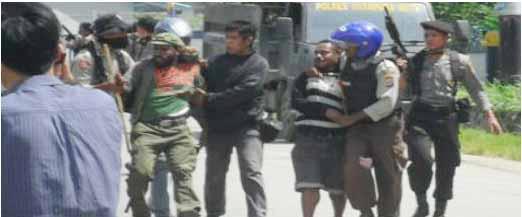
When I was the leader of the Long March headed for Expo Waena on December 1 in Sentani, police backed by the Indonesian military had already closed off access to the people of West Papua who would pray. Since the late afternoon (30/11), Theys H. Eluay field, which is the field of (great significance and sacredness to) the West Papuan national struggle, had been controlled by the military and by the national police, although all the civil society organizations had long since said that their prayers and celebrations would take place there.

On November 19, police entered a prayer room in Aula STAKIN in Sentani and tried to stop me as I was giving a reception after prayers, and then yesterday on December 1 the people wanted to worship and eat at the Theys H. Eluay field but were prohibited, blockaded and arrested by the full force of the military. The question is, why did the military and the police force deliberately take control of the field and then shamelessly hold a traditional stone cooking event (a Indonesian-appropriated Papuan Custom) with a handful of residents who were offered money?

If the police are tasked with security, why exactly is that security so insecure when facing inhabitants who are conducting prayers peacefully? Is the Theys H. Eluay field, owned by the traditional people of West Papua, only permitted for use by the Indonesian military and the police force? If the law is just, why wasn’t police captain Kiki Kurnia charged with incitement to violence? As he himself clearly  (attempted) incited the mass action I led to commit violence on the streets in front of Dian Harapan Hospital yesterday.

If the police prohibit students from campaigning to put a stop to AIDS on West Papua’s Independence Day, why must it be prohibited? Do the police not want HIV/AIDS awareness campaigns to take place? Isn’t his proof that the police are ensuring and championing ethnic cleansing in West Papua? Why do the police prevent worship on West Papua’s Independence Day? Why do the police see more political and economic motivations than the goodwill and intentions of the people who want to interpret December 1, 2012 as World AIDS Day, the opening of Christmas festivities and the Independence Day of West Papua?

I lead my people safely and with restraint. I have personally guaranteed that I will be arrested or shot if there is a criminal act committed by people, but why in the safe Long March were we forcibly dispersed and captured like animals? Actually, who was it that committed the crime? Was it the people, or the police?

The police did not only incite the violence that happened, but yesterday (1/12) the police, through (Adjunct Senior Commissioner) Alfred Papare, publicly lied. Myself and the masses did not throw rocks at the police, however it was covered by several media sources that the police chief said we did so. In an era of openness such as this, why is there a need for mutual deceit when everybody saw yesterday that the police had no reason to blockade, arrest and attack people with tear gas? After I “escaped” from Abepura Sub-District Command, I had not received a call from the Jayapura Chief of Police, the aforementioned Alfred Papare, as stated by Wakapolda Papua, Paulus Waterpau, to Tabloid Jubi.

Better for the Police to become the Social Services

The idea of Papua’s Chief of Police, Tito Karnavian, to give out groceries and distribute help the mountain people of Papua in Jayapura and the Jayapura municipality makes me wonder a little. Has the police chief already switched functions from a chief of police who must preserve security, only to become the head of the Department of Social Services who must give social support to the people? Is this country unhealthy? Money for providing support to the people is redirected into the Police Department and the Police Department takes over the functions of the Department of Social Services.

For me, the efforts of the police department to muffle and destroy the basis of the Papua Independence conflict are obviously speculative, as well as inappropriate. Go ahead, if the police department and the Republic of Indonesia believe that our ideology can be bought off with money. Tens to hundreds of millions have been redirected to the Asrama Rusnawa Uncen, since becoming the basis for conflict, and the police are very hopeful that students will regard them as righteous people, as kind people. Well, again, it is better that the Police Institution in Jayapura be renamed as the Department of Social Security or the Department of Education, so that matters concerning the improvement of the Asrama Rusnawa Uncen and student welfare can just be taken over by the police.

Does Indonesia believe that money can silence the aspiration and ideology of independence for the people of West Papua? I am convinced the people of Papua that are given money and material aid from the police are only making use of them, because within the individual West Papuan person there is a flesh-and-blood desire for Papuan Independence, however difficult it is. So, go ahead, half-dead police and a waste of money to the people of Papua. Go ahead and pan the sympathy and dreams of the people who have hated the occupation of this land. Almost half a century practicing the policies of the Republic of Indonesia, and all models of development cannot turn the people of West Papua into people of Indonesia. Papua will rise and awaken by itself alone.

Idea of Separatists and Terrorists is a project of the TNI and Police 

There are no separatists and terrorists in West Papua; only those who demand the right to self-determination as legally protected under international law. The idea of separatists and terrorists is created by the state to disgrace the legal struggle of the West Papuan people, and created by the Indonesian military and the police with a view to expanding their territory, and their wealth. For the sake of money alone, the circumvention of the state apparatus and the deception of the state apparatus, alias “bullshitting a lot” (direct translation).

My organization, the National Committee of West Papua (KNPB), struggles in peace and does not want to create chaos that will strengthen the funds of the military and the police force. Consequently, the national police force does not like peaceful action, because in a situation that is safe and peaceful, the military and the police force will be poverty-stricken. Many security institutions in Indonesia have hundreds of troops that must be paid by the state. Moreover in Papua, there are now many civilian militias formed by the state; thousands have been recruited, and must be paid. All are created with the objective of “stripping bare” the security responsibility from the Indonesian government in West Papua that fall under the name of “eradicating separatists and terrorists.”

Forgive me; my group and I will not accept food from the military or the police, so there is no need to criminalise or drop that bomb on the National Committee of West Papua to stigmatise us, so that the project money can be maintained. These ways have become commonplace, and we are bored of them. The people are smart, and getting smarter: they have already been taught these ruses by the colonialists. Ways such as this will finally tarnish the image of the Republic of Indonesia in West Papua. So it is best not to try to painstakingly search for such an image. Oh, and yesterday in Guyana, Member of Parliament told Benny Wenda: “Oppression alone will burn the spirit of the independence struggle.”

Why not kill me, or imprison me? Why was I released? Oh, it is certainly not because I cheated. I will see this for what it truly is. There are demonstrations in the streets. Now that I have planted the seeds of resistance here and the invaders sow these seeds with their own actions. I must thank the colonialists for continuously teaching us to aspire to true humanity by means of rebellion.

Victor Yeimo wrote this article immediately upon his release from police custody on Monday December 3. 

Translated by West Papua Media volunteer translators

A History of the Morning Star Flag of West Papua

by Leonie Tanggahma for West Papua Media

Historical Analysis

December 1, 2012

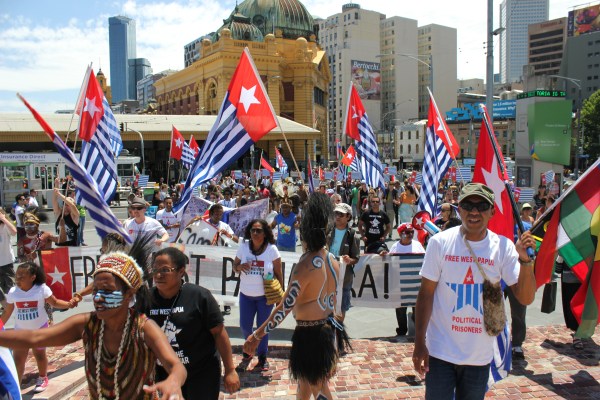
West Papuan Morning Star flags flying at Federation Square, Melbourne (Australia), December 1, 2012.  (Photo: West Papua Media)
West Papuan Morning Star flags flying at Federation Square, Melbourne (Australia), December 1, 2012. (Photo: West Papua Media)

For more than 50 years, the Morning Star Flag has been the symbol of West Papua’s unity and its quest for Freedom and Justice. Thousands have been inspired by it, as it became the main icon embodying the struggle for Independence. And this flag, just like any other flag of any other country, has a history, a proud history.

5 April 1961: Inauguration of the New Guinea Council

On 5 April 1961, a representative body for the then Dutch colony of Netherlands New Guinea was inaugurated: the New Guinea Council or Nieuw Guinea Raad[1] [1]. It was the task of the Council to make the wishes of the Papuan people known on the issue of self-determination, within a year. However, news came that the United States of America and Indonesia were putting pressure on the Dutch  to convince them to transfer its colony to the United Nations, and then to the Indonesian administration. The members of the New Guinea Council immediately gathered for an emergency session and appointed a National Committee to draft a Manifesto expressing the wishes of the Papuans which would include national symbols for the upcoming State.

19 October 1961: Flag and other national symbols officially adopted by way of Manifesto

Committee members Bonay, Jouwe, Tanggahma and Torey were asked to submit designs for the flag and arms. Mr. Torey withdrew and a choice had to be made between the designs of Messrs. Bonay, Jouwe and Tanggahma. The designs of Mr. Jouwe were accepted by 14 votes to 17 as national symbols.  After the national symbols were officially adopted, everyone was visibly moved and proud. According to official testimonies: “Then, all those present rose from their seat and while the emotion was clearly overtaking all those present the manifesto was read by the Chair of the National Committee, Mr. Willem Inury; it was subsequently unanimously accepted and signed by the National Committee. The attendees were then invited to also sign the manifesto … The national flag consists of a red vertical band along the hoist side, with a white [five-pointed] star in the center. Adjacent to the red band, is a series of [consecutive] blue and white lines, with a total of seven blue and six white lines.”[2]

This manifesto dated 19 October 1961 stated that: “in accordance with the ardent desire and the yearning of our people for our own independence, through the National Committee and our parliament, the New Guinea Council, insist with the Government of Netherlands New Guinea and the Netherlands Government that as of 1 November 1961,

a) our flag be hoisted beside the Netherlands flag;

b) our national anthem (“Hai Tanahku Papua”) be sung and played in addition to the Netherlands national anthem;

c) our country bear the name of Papua Barat (West Papua), and

d) our people be called: the Papuan people.”[3]

he Manifesto of 1961 may not have been an independence Proclamation, but its wording was strong and clear in relation to the will of the Papuan people to become independent, it was a declaration of intent, as it also stated that: “On that basis, we, the Papuan people, demand to get our place in the midst of other independent nations and peoples. In addition, we, the Papuan people, make our contribution to the preservation of peace and freedom around the world.”[4]

1 December 1961: Official inauguration of the flag as a territorial flag

The Dutch accepted most of the terms of the Manifesto except for the date of installation and the denomination of the flag: the inauguration of the flag happened on 1 December and not on 1 November as requested by the Papuans. The General Assembly of the UN was to hold a meeting in late November on the issue, and recognition by the Dutch of the symbols could have been interpreted as an endorsement of an independent West Papua by the Dutch Government. The Dutch did not want to provoke the Indonesians, even if it meant that the demand of the Papuans would not be heard. In terms of the denomination, the Dutch authorities recognized the new flag as a territorial flag (landsvlag) and not as national flag.

All the specifications concerning the flag and other Papuan symbols can be found in the so-called “Territorial Flag Ordinance” (or “Landsvlagordonnantie”) Number 68 of 1961. This Ordinance specifies among others that: “(1) The territorial flag of Netherlands New Guinea shall be a rectangle consisting of a vertical wide red striped at the hoist and seven horizontal blue stripes separated by six white stripes. In the centre of the vertical red stripe is a white five-pointed star, with one point pointing vertically upwards. The five points of the star shall each form an angle of 36 degrees. (2) The height and length of the flag shall bear to each other the proportion of 2 to 3. The width of the red stripe shall be two fifth of the height of the flag. The blue and white stripes shall be equal in height. The diameter of the circumscribed circle of the star shall be seven eighths of the width of the red stripe.” [5]  Another ordinance (Number 69 of 1961) provided for a national anthem for Netherlands New Guinea. Ordinance Number 70 of 1961, also called the “Administrative Order for the implementation of Section 2 of the Territorial Flag Ordinance”, stipulates the terms and conditions under which the flag is to be raised. And Section 5 states: “This Order, which may be cited as Flag Order, shall come into operation on December 1, 1961.”[6]

And so on 1 December it happened, for the first time, our Morning Star flag was raised, next to the Dutch flag; our national anthem (”Hai Tanahku Papua”) was played and sung together with the Dutch national anthem; our country was given the name of Papua Barat (West Papua), and our people were given a name: the Papuan people.

Nine years of international Fraud and Deception led by greed, racism and the total disrespect for human life

Just 18 days after the installation of the Papuan symbols, on 19 December 1961, the President of Indonesia, Soekarno, made his call for the infamous Tri Komando Rakyat (or TRIKORA), the People’s Threefold Command. On that day he called for a total mobilization of the people of Indonesia, (1) to destroy what he considered a Dutch-promoted Papuan State; (2) to fly the Indonesian flag over the territory of West Papua, which he erroneously called West Irian; (3) to prepare for war over what he called West Irian. For Indonesians this represented the so-called liberation of the territory from the Dutch. For Papuans the TRIKORA was the call for an illegal military aggression from a country which did not recognize its sovereignty. Military aggression was followed by legal deception as the Dutch and the Indonesians signed the New York Agreement of 15 August 1962, an agreement regarding the future of the Papuans but they themselves were never consulted. The Papuans were betrayed by those who signed this agreement which regulated the transfer of the administration of New Guinea to the United Nations. This administration lasted from 1 October 1962 to 1 May 1963. Then it was to be handed over to Indonesia for a period of six or seven years, after which the Papuans were supposed to freely choose, through a referendum, whether to join Indonesia or become an independent nation. Legal deception was followed by political fraud. In August 1969 the so-called “Act of Free Choice” was organized. At the time, West Papua had been under Indonesian rule for over six years: every expression of Papuan nationalism was systematically bloodily suppressed, possible opponents were arrested and tortured, punitive expeditions were carried out across the country and bombings and rocket attacks were conducted by the Indonesian army. The so-called “Act of Free Choice” itself was pure deception, fraud and deceit, a stage-managed play in which Indonesian officials selected 1026 Papuan electors who voted on behalf of 800,000 Papuans at the time. The electors were all carefully prepared for the Musyawarah: an Indonesian system of decision-making where there is unanimous agreement: 1025 Papuans finally decided unanimously that they wanted to belong to the Republic of Indonesia (one was sick that day). The normal one-man/one-vote principle usually applied for a referendum had not been respected as the Indonesians argued that Papuans were too primitive!

1 July 1971: the territorial flag becomes a national flag

In protest against the failure of the implementation of the “Act of Free Choice” the Free Papua Movement (OPM) proclaimed the independence of the Republic of West Papua on 1 July 1971.  Under Article 2 of UN resolution 1514: “All peoples have the right of self-determination. By virtue of that right they freely determine their political status and freely pursue their economic, social and cultural development.”  Another UN resolution, Resolution 1541, explains that exercising your right to self-determination means that you are allowed to choose between independence, autonomy or integration within an existing state. Since the beginning, the Papuans chose for independence; and they opted for that same option time and time again.

The Manifesto of 1961 was a declaration of intent; the Proclamation of 1971 was the realization of that intent. The proclamation stated: “With the help and blessing of God Almighty, we take this opportunity to declare to you all that today, 1 July 1971, the land and people of Papua have been proclaimed to be free and independent (de facto and de jure)”.

On 1 July 1971, the Papuans chose to take the Morning Star Flag which had been recognized by the Dutch as a territorial symbol. The Papuans decided to proclaim it a NATIONAL symbol; they did the same with the national anthem (Hai Tanahku Papua).


[1] Newspaper report. Sydney Morning Herald, 6 April 1961.

[2] Official government magazine Pengantara of 21 October 1961.

[3] Official government magazine Pengantara of 21 October 1961

[4] Official government magazine Pengantara of 21 October 1961

[5] Bulletin of Ordinances and Decrees of the Government of Netherlands New Guinea, 1961, No. 68, issued on 20 November 1961.

[6] Bulletin of Ordinances and Decrees of the Government of Netherlands New Guinea, 1961, No. 70, issued on 20 November 1961

KNPPB A Rival Organization Created By Indonesia To Compete With KNPB

by wedaumamo at KNPB News
November 17, 2012
Analysis / Opinion

Jayapura, KNPBnews – In their continuous efforts to destroy the legitimate movement of the people of West Papua who are fighting for their rights, Indonesian counter-intelligence operations have now created a rival organization called the West Papua Youth National Committee (Komite Nasional Pemuda Papua Barat, or KNPPB). The organization claims itself to be a forerunner of a self-claimed Republic of West Papua under the leadership of Yance Hembring, an agent of the Indonesian Republic.

The KNPPB, an acronym which bears a striking resemblance with KNPB, was created by Indonesia to further strike a blow at the genuine struggle for Papuan rights, led by the KNPB. The fact that Indonesia would instigate further attacks towards the good image of the political struggle of the people of West Papua was to be expected and it was also predicted. It was only a matter of time before journalists of the newspaper Bintang Papua, a number of which are mere agents of Indonesia, calculatedly published the news item concerning the establishment of this rival organ, based on information passed on by sources who are nothing more than the minions of the Unitary Republic of Indonesia (NKRI), and who have been paid to discredit the struggle of the people of West Papua, a struggle led by the KNPB and the people of West Papua.

Active monitoring of the online media shows that Yance Hembring’s group constitutes a faction of the OPM which has already surrendered to the Republic of Indonesia and which is now being used by Indonesia to influence and destroy the bases of the OPM. This faction is now also being used by Indonesia to recruit young people to destroy the KNPB by setting up the rival organ called KNPPB, in exchange for money.

The release today of this deceit by the newspaper Bintang Papua (issues numbers 14 and 15) has as main purpose to blacken the good image of the KNPB and to diminish the sympathy of the people of West Papua for the KNPB. Wim Metlama, KNPB’s National Spokesperson, said that Indonesia was resorting to the old ways of paying Papuans and Papuan newspapers in order to play their dirty political games and soiling the good image of the struggle of West Papua.

“Treacherous moves like these are not something new. These are old tricks that Indonesia has been using, but it has always been to no avail. And we are convinced that the people of West Papua are wise enough to recognise these dreadful tricks played by the colonisers. Even more so, this deceit only proves once again to the people of West Papua that Indonesia is in the habit of manipulating the truth and lying to the people, and precisely for that reason will they realise that the NKRI is truly an occupying colonial force in West Papua”, said Wim.

The newspaper Media Papua is unfortunately contributing to the spreading of the lie, by publishing the news item and disseminating the deceitful information into the public in West Papua. According to our monitoring, a month ago, Papua police chief Tito Karnavian had approached the board of editors of the newspaper Bintang Papua and he had asked them for their support for his colonial agenda. Soon, if not already, many agents of the printed media and other reporters in West Papua will be offered money in return for services to support the colonial program as Tito Karnavian has recently requested.

[Translated by LT]


LP3BH-Manokwari calls for dialogue between Papua and Indonesia

COMMENT by Yan Christian Warinussy
Executive-Director of LP3BH, Manokwari
November 14, 2012In the concluding months of 2012, there have been many more acts of violence in Papua and West Papua which reflects very badly on the government of Susilo Bambang Yudhoyono (SBY) at a time when development, good governance and security  are essential in the Land of Papua as an integral part of the Republic of Indonesia (NKRI). This is happening as a time when many countries  which are members of the UN Human Rights Council are closely watching the situation, following the  Universal Periodic Review  in May 2012, which made  180 recommendations, thirty of which were rejected by the Indonesian government.

One of the recommendations that was rejected was that arrests and detentions on the basis of Articles 106 and 110 for treason should stop. This means that the state will continue to take firm measures, possibly including the use of firearms, against peaceful actions by members of civil society who give expression to their opinions and political views which are opposed to the views of the government. Several activists of the  National Committee of West Papua (KNPB)  have been summoned and interrogated and are likely to be charged for treason. One of these activists is Alexander Nekenem, chairman of the DWP, the local parliament, who was recently summoned  by the police in Manokwari.

The Indonesian government has also rejected the recommendation regarding freedom of expression for persons who have been detained merely for taking peaceful actions, a recommendation that was made by the USA and Canada. What this means is that Filep Kara, Forkorus Yaboisembut, Edison Waromi, Selpius Bobii, Sananay Karma and Dominikus Sorabut  will continue to be deprived of their lawful right to freedom of expression.

Another very bad thing for the Papuan people is that the Indonesian government has rejected the recommendation by the Japanese government which called on Indonesia to end all violation of  human rights  by the security forces (TNI and Polri, the army and the police), because the Indonesian government claims that this is not relevant for Papua because it is not in accord with the facts, whatever they mean by the facts. In my opinion, the Indonesian government’s rejection of this means that there will continue to be an intensification of violence and hence systematic abuses of basic human rights which will continue to occur into the future in the Land of Papua.

In view of all this, as Executive Director of the LP3BH and a defender of human rights in the Land of Papua, I urge the SBY government  to open up space for dialogue  between Papua and Indonesia before the end of 2012. The SBY government should appoint a team of people to meet Father Dr. Neles Tebay, co-ordinator of the Papuan Peace Network, in order to discuss  the format of this dialogue. This would mean that by early 2013,  preparations could be started for a dialogue between the Indonesian government and the Papuan people.

In my opinion, dialogue is the best path to take, in the interests of justice, peace and dignity on both sides, as the way, according to universal standards, to resolve  the conflicting political views which have existed for such a long time, causing the deep frustration  that has borne down both on the Papuan people and the Indonesian government to this very day.

In this way, the Indonesian government would  win the respect of the international community for  having accepted that the political conflict that has lasted for such a long time should be resolved b means of dialogue.

[Translated by TAPOL]


Report on the US ambassador’s meetings with various government agencies and institutions

(via Tapol) The following is a summary of two lengthy reports in Bintang Papua on 7 and 8 November about the visit earlier this month of the US ambassador Scot Marciel, to West Papua:
——-
DPRP Meetings
During discussions with members of the Papuan Provincial Legislative Assembly (DPRP), the ambassador expressed strong support for the special autonomy law enacted eleven years ago and said that the US government recognises West Papua as a part of the Republic of Indonesia.He said that his main interest was in the development programme in West Papua and to discuss possible collaboration in this process.

The deputy head  of the DPRP, Yunus Wonda, said the ambassador was keen to know what the priorities were in development and said the ambassador  was particularly interested in education and health.

He also asked about the difficulties surrounding the election of the governor which resulted in the election being delayed for two years. Yunus explained that  the problems had emerged because of a dispute in the MK (This presumably refers to the Constitutional Court – Tapol).

With regard to education, the ambassador said that the US is willing to help by providing study opportunities to young Papuans in the US.

Yunus asked the ambassador how many indigenous Papuans were now studying in the US, adding that they were keen to know the names of these people, to see whether they were indeed indigenous Papuans.

The DPRP also called on the US  to support the idea of dialogue between Jakarta and Papua. He said that they would not use this dialogue to press for independence  for Papua but were only interested in advancing the implementation of the special autonomy law.

——————

Talks with military personnel

Marciel said that the US was very impressed by the developments that had already been achieved and also with the reforms that had been made with regard to the TNI (the Indonesian army). These remarks were made during a meeting between the ambassador and senior officers of the provincial military command. On this occasion the ambassador met the chief of staff of the military command along with seven other senior officers.

In a press release issued by the US team, the ambassador referred to Freeport and asked for clarifications about the company and wanted to know whether there could be more collaboration (with the company) in education, culture and security.

The chief of staff explained that according  to Law 34/2004,  the military were now implementing ‘soft power’ in their territorial operations in Papua, and were keen to assist in speeding up development and human resources so as to ensure that West Papua would not continue to lag behind other parts of Indonesia.

In response to the ambassador’s question as to why the duties of the military command in West Papua were so much greater here than elsewhere and required a very different approach, the chief of staff said that the military were acting in accordance with their noble duties as ‘Noble Protectors of the People’  (Ksatria Pelindung  Rakyat).

————————–

MRP Meeting

During a meeting with the first deputy chairman of the Majelis Rakyat Papua (Papuan People’s Council) Hofni Simbiak, the ambassador said he wanted to know more about the election of the governor and to know more about governmental affairs in the Province of Papua. Hofni said that even a very large tree could be felled at any time.  Because of this, he said that he hoped that there would be more diplomatic visits to Papua so as to give guidance on leadership on the province.

He said that the ambassador’s visit was a good opportunity to discuss the gubernatorial problem, as well as the whole process of government. in the province.  He said that they were very interested in this matter so as to ensure the the common people would not be victims of this situation.

He explained that because of the continued absence of an elected governor, no budget had been produced and there was no one who could take responsibility (for finances).  This was having serious consequences for the people.  (Simbiak) said that they had urged the KPU (Electoral Commission) to discuss this matter with the provincial government and to take firm action on the matter.   He said it was extremely important for a governor to be elected because without this, the services provided by the governor were not available and this was leading to big problems for the people.

The ambassador said that the American people were aware of the difficulties regarding the governor and said: ‘We are having an election of our president in the US and face the same situation as you here in Papua because we are keen to provide help for the government here in the fields of education, health and forestry.’

—————————-

Meeting with Tito Karnavian

In a meeting with Inspector-General of the  Police Force, Tito Karnavian,  the ambassador expressed support for  the developments already achieved by the police.

The chief of police said that when they were confronted with acts of violence, they always act in accordance with the law and in a professional manner, keeping the use of violence to a minimum. He also spoke about their activities to combat corruption so as to ensure that the development budget could serve the interests of the people.

He said that the ambassador had stressed the importance of  transparency and in case of acts of abuse by the police, everything should be made public.  When he asked in what way the US could help, the chief of staff said that they could be given advice on how best to deal with demonstrations.   The second point he made was that for purposes of investigation, the difficulty is that there is no forensic laboratory in Papua.  His third point was about the need for working together especially with Bhayangkari (the organisation of wives of the military), in particular with regard to partnerships with the people.

In response, the ambassador expressed great enthusiasm and said he hoped that joint programmes would be conducted in the next four or five years.

Marciel also expressed support for the police pursuing a lenient approach and the need to avoid projecting an image of the police as being involved only in arresting and detaining people but should prioritise activities that bring them close to the people.

[Translated by TAPOL]

[COMMENT: There is no mention at all of the ambassador having met leaders of Papuan organisations such as DAP, the Council of Indigenous People, KontraS Papua, ELSHAM-Papua or other people’s organisations.]


Create a website or blog at WordPress.com

Up ↑