5 October 2012 Papuan leader keen to affirm the identity of his people
The Rev. Socrates S. Yoman is well known for his prolific writings about his people’s struggle. He was recently interviewed by Bintang Papua at his home.
The problem of West Papua has for a long time stagnated, spreading fear among the Papuan people who are confronted by a brutal governmental system that lacks any sense of humanity. This is why the Rev. Yoman spends most of his time writing books that are often very controversial. Some of his books have been banned in Indonesia. He said that the Papuan leader who has inspired him for years is Arnold Ap, the anthropologist who was murdered in 1984 by Kopasanda (now called Kopassus). He was well known for the Mambesak songs he composed.
The songs were all about promoting the identity of the Papuan people and were intended to foster the spirit of the Papuan people. His songs called on the Papuan people to use their own language and to revive their own culture. Although Ap was murdered many years ago, he is still an inspiration for his people.
‘As for me, I am not able to sing but God has given me another talent, the ability to write for which I thank the Almighty.’
The support from his wife and children and all those who are part of the Alliance of Baptist Churches in Papua has been a source of inspiration for him, encouraging him to produce a number of books, some of which are now well known in other countries.
His intention has always been to call on his people to be true to their own identity in face of the attempts by Indonesia to bury it.
While other clerics give sermons from the pulpit, he has decided to write books to spread his message. ‘Whether or not people can accept them is of less importance to me because my intention above all else is to persuade my people that they have an identity of their own.’
‘I also try to tell my people that they are the legitimate owners of the land. My message to those Indonesians who have now settled in Papua is that you have been mis-informed by your government. about the Papuan people. ‘
He said that some of his books are now in the library of the US Congress. ‘They wrote to me two years ago and asked me to send them some of my books.’ His latest book is now being edited in preparation for printing and is being sought by people here in Indonesia as well as in other countries.
The Dutch author, Pieter Grooglever, has said: ‘People should read the books by Rev. Yoman. ‘His is a voice full of sadness which no one should ignore.’
The title of his latest book is The Voice of a Shepherd who Opposes the Crimes against Humanity in the Land of Papua. He has also received an offer of money to pay for the book to be translated into English.
And moreover, he has already written two other books that are likely to be published quite soon.
Legal and Constitutional Affairs Legislation Committee – 16/10/2012 – Estimates – ATTORNEY-GENERAL PORTFOLIO – Australian Federal Police
Senator DI NATALE: I have some questions relating to the AFP’s role in the training of counterterrorism operations in Indonesia. On 28 August this year, the ABC’s 7.30 program aired some evidence about the counterterrorism unit Detachment 88, which as I think we discussed in the last estimates hearing, receives training and support from the AFP. The program aired evidence that Detachment 88 has been involved in torture and extrajudicial killings in West Papua. We know that these allegations of torture and ill treatment have also been verified by groups like Human Rights Watch. During the program there was a call from the foreign minister, Bob Carr, in relation to the recent shooting of Papuan independence leader Mako Tabuni for an inquiry. He called for an inquiry. I note the AFP’s response was that it does not investigate received briefings on or ask what I think are fairly basic questions from the Indonesian authorities about human rights abuse allegations. Given that background, I want to ask a few more questions about the training and support provided to detachment 88. I understand that there are hundreds of thousands of security forces in Indonesia and that AFP does not train all of them, but is it correct to say there have been around 12,000 trained in total since the Bali bombings, through the Jakarta Centre for Law Enforcement Cooperation? Would that be about right?
Mr Negus : Senator, those figures are right, but there have been 12 000 officers from, I think, around 55 or 56 countries who have been trained at that facility that make up that 12,000—including Australian federal police. I think Deputy Commissioner Drennan might have the numbers here for us about Detachment 88. The media reporting you talked about, back in August: I put out what we call a ‘blue-line response’ the following day, to correct some of the public speculation in regard to the AFP’s support of Detachment 88. I will let Deputy Commissioner Drennan elaborate on this, but the first two points I just want to make are that the AFP does not provide public order, tactical training, or related equipment to Detachment 88 and the AFP does not, and has not, provided any support to the Indonesian National Police, or Detachment 88, in any of their operational activities in West Papua. Again, on our website there is a very clear statement of what our responsibilities are and what we do.
We have been working with Detachment 88, in one sense, since 2005. There has been a range of things they have done very positively in Indonesia, apartment from the allegations of abuse that you mention. They have been responsible for the arrest of over 770 people for suspected terrorism offences. Around 600 of those have been convicted in the Indonesian courts. And I have got to say, from being in Bali last weekend for the Bali memorial, the work of Detachment 88—and it is a very large organisation—the work of parts of Detachment 88 I have no doubt have saved Australian lives in the context of the work they have done in breaking up JI across the Indonesia archipelago. So, in that regard there is a range of very much positive activities that should be looked at, as well as the issues that you raise of the allegations of abuse and particularly around the West Papua issue. So, the AFP is focused very much on the positives, and we do not get involved in any of the areas that have been reported in the media.
I have got to say, though, the media reporting has been quite loose with some of the factual data in regards to allegations against Detachment 88. I know there have been a range of issues attributed to other forces in Indonesia which Detachment 88 has certainly copped the blame for. I will let Deputy Commissioner Drennan talk about this, because I specifically tasked him in the last month or so to sit down with people who have worked in Indonesia, sit down and look at all of our programs with Detachment 88 to make sure that we were more than comfortable, given the basis of your questioning at the last estimates hearing, to reflect on that and to talk to the people on the ground, to be very, very clear about the role played by the AFP and the sort of support that is given to Detachment 88 in that context. So, Deputy Commissioner.
Mr Drenna n : Thanks, Commissioner. Senator, if I could just go back to the beginning there, where you raised the allegations of Det. 88’s involvement in the death of Mako Tabuni—
Senator DI NATALE: I will correct you on that: the 7.30 program raised the allegation, I was just reporting that.
Mr Drennan : Okay, thank you. The International Crisis Group have actually reported on this incident and they have actually reviewed the matter and their finding was that Det. 88 members were not involved in any way in the operation resulting in Tabuni’s death. The INP have affirmed that that is the position. So, again, as the commissioner said, we just need to be a little bit cautious on what the media say, in some circumstances. The International Crisis Group has reviewed that matter, and I think the International Crisis Group’s reputation speaks for itself in its level of scrutiny and independence. Also, if we could just go to the number of officers who have been trained at the Jakarta Centre for Law Enforcement Cooperation; from the Indonesian National Police there have been 6,932 students. There have been 702 students from Detachment 88, 11 students—
Senator DI NATALE: Sorry, what was that number?
Mr Drennan : 702. Eleven of those members of Det. 88 have been from the Papua province. And there is one member from Det. 88 who is stationed in Papua province, who has attended a course at JCLEC, which has been supported by the AFP, or funded by the AFP, and that was a counter-terrorism investigations program.
The types of courses that other members from Det. 88 from West Papua have undertaken at JCLEC, are CT investigations management, counter-terrorism financial investigation workshop, counter-terrorism investigation management, informer handling and interviewing techniques, investigation management, CT in analysing the internet, interviewing in-prison debriefing course, and CT investigations management course. Now, those courses are held at JCLEC but are provided by a range of donor countries, primarily from Europe and the UK. You will see from those that there are no courses there that are tactically orientated, that is none which deal with public order or any tactical operations the police may be involved in.
As regards to the other types of courses Detachment 88 officers may have attended at JCLEC, they are of a similar nature and I will run through those as it may help you: crime investigations, management of transnational crime, criminal intelligence, financial investigations, proceeds of crime, communications, management, security risk management, response to CBRN, which is chemical, biological radiological and nuclear events, internet offences, child protection and post bomb blast management. Again you will see from that list of courses that there are none there which are tactical in their nature whatsoever. The other thing I would mention there is that the officers who attend from Detachment 88 is a decision by the Indonesian National Police. JCLEC provide the courses, the request goes to the Indonesian National Police to provide officers and they select officers from across the entire INP to attend those different programs.
Senator DI NATALE: Thank you for that comprehensive background there. It is nice to have someone who has answered a lot of the questions before I have had the opportunity to ask them, so I appreciate that.
Mr Drennan : Here to assist you, Senator.
Senator DI NATALE: I have a few questions about background checks. What is actually done in the way of background checks? I take your point that there may be some controversy around the incident with Mako Tabuni but I think it is reasonably well-established that there have been members of Detachment 88 who have been involved in other non-lawful activities. What work is done in the way of background checks prior to the training? I understand that they are selected by the Indonesian forces but is there any work done in the way of background checks to establish that the people we are training have got a track record that we are pleased to support?
Mr Drennan : It is probably best to answer it this way. Firstly, the nature of the courses, as I articulated, is very much focused on investigations, investigations management, forensics and child protection type things. The nature of the allegations which have been raised in the media—and, as I said, I treat them with some caution—
Senator DI NATALE: It is not just the media; Human Rights Watch have also indicated concerns.
Mr Drennan : Again, I treat those with some caution. They are operations of a tactical nature, so when police officers have been involved in a tactical sense of resolution of matters, of arrests. So the actual type of people who have been selected to go on the courses which are conducted at JCLEC which we are supporting are of a different nature to the type of activities that the police would be involved in. As far as are there checks done in regard to the history of each individual officer, the INP select those officers. We do not have any involvement in that. But the INP are also very aware of our position in that we provide these courses for investigations and the nature of the things I described earlier and we rely upon them selecting suitable officers to attend those training programs. Within the training programs themselves, though, there is a human rights element which is built in. Whether that is through the scenario base of the training or whether it is a specific element of the training, it is incorporated in each of those training programs.
Commissioner Negus : I add that that human rights training is to Australian standards. We have the commandant of JCLEC, which is a joint facility between the INP and the AFP, and we insist on the training in those things being done to international standards, including what we here in Australia commit to as far as international human rights and the protection of human rights are concerned. So this is an opportunity to have people from multiple countries—as I said, over 50 countries have trained there—come together and talk about some of the implications of potential human rights abuses, take these as case studies and discuss these in the classroom before they leave and go back to their various areas.
Senator DI NATALE: If you became aware of a specific allegation of human rights abuse, what would the process then be for gathering more information about the specific allegations?
Mr Drennan : Are you asking what process we would have?
Senator DI NATALE: What is the process in general obviously within JCLEC, or whether the AFP in particular would follow those issues up.
Mr Drennan : We would certainly report those matters to the Indonesian National Police, who would have the responsibility of dealing with them. And if I could just add: the Indonesian National Police are actually overseen by the Indonesian National Human Rights Commission, the National Police Commission and, as you mentioned before, also numerous government organisations and human rights groups closely monitor activities.
In 2009 the Chief of the Indonesian National Police introduced a regulation specifically addressing the implementation of human rights principles and standards in the discharge of the duties for the Indonesian National Police. In a more general sense, the INP is responsible for prosecuting matters according to the rule of law and which therefore brings those matters under the scrutiny of the courts.
We rely upon those tiers of governments and oversight to ensure that the INP discharge their obligations in relation to a range of international human rights conventions to which they are signatories. Again, there are nine core international human rights treaties under the United Nations. Indonesia has signed all nine of those and ratified eight, with one more to come.
Senator DI NATALE: So how often are specific allegations brought before the AFP?
Mr Drennan : I am not aware that any have been brought specifically to the AFP.
Senator DI NATALE: So, in your view, does that indicate that the human rights issue in terms of some of the people who are being trained is a non-issue?
Mr Drennan : No, what I am saying is that none have been brought before us. The type of training that we provide and the officers who are participating in training are not ones we would expect to be involved in activities of the nature where allegations of human rights abuse have been raised.
Mr Negus : One of the points I made in the opening comments, before I passed to Deputy Commissioner Drennan, was that Detachment 88 have a very wide role in Indonesia. They are really the investigative capability for the Indonesian National Police to investigate and prosecute terrorist offences. So think about that in the context of across the whole of the archipelago. Again, they have arrested 775 people with terrorism offences since the Bali bombings took place in 2002, with over 600 of those being prosecuted and convicted in the courts in Indonesia. So we are talking about a very large group of people here in which we have a very small slice—I think 78 of them from Detachment 88 have done those training programs with us. So we are open to a very small component of what is a very large group within an even larger organisation of the Indonesian National Police.
Senator DI NATALE: I appreciate that. Small or large, it is important to establish whether—
Mr Negus : I think publicly, though, there is a perception that Detachment 88 is a small group of people who move around in one group and that is not the case, as we have—
Senator DI NATALE: I am aware of that. I think we share a view that they have done some good work in preventing terrorism in Indonesia. The concern I have is that some of the activities within segments of Detachment 88 have moved from a counter-terrorism operation to a counter-separatism operation within Papua and that may apply only to a small number of that unit. But it is still significant, particularly for the people of West Papua. So understand the basis for my questions—
Mr Negus : We are very careful and, hopefully, you are seeing that we are very careful to limit our support to those actions that are instrumental in ridding Indonesia and the region of terrorist activity and protecting Australian lives in the process.
Senator DI NATALE: Do you share a concern that some of the allegations that may be made end up being investigated by the same agencies that are essentially responsible for committing the abuses? Is that of concern to you?
Mr Negus : We do not have visibility on that. People make the same allegations against police forces, which have internal investigation units. So it is impossible for me to say what level of scrutiny should be applied to those things in a foreign country.
Mr Drennan : I did articulate again a short time ago that there are a range of oversight bodies which sit across the top of the Indonesian National Police.
Senator DI NATALE: Sure. They do not do the investigating, do they?
Mr Drennan : They certainly provide scrutiny in relation to it. Similarly here, the Ombudsman or any range of committees here in Australia have a monitoring role of what the AFP does. Certainly, if they are not happy with what we are doing, then we are held to account.
If I could just go back to the other issue you raise with regard to counter-terrorism work morphing into counter-separatist work: the INP are very clear on the fact that we support them in their counter-terrorism activities.
They do draw a very distinct difference between counter-terrorism and counter-separatism and they are fully aware that we do not and would not be involved in any counter-separatism work. On that note, we have not been involved in any activities in West Papua at all.
Senator DI NATALE: You have not been directly involved but you have trained members of Detachment 88 and we do not know what numbers are involved in West Papua and what activities they have been involved in in West Papua.
Mr Drennan : To be clear, we have trained one person from Detachment 88 who is in West Papua on a CT investigations course.
Senator DI NATALE: Of the other members, again to be clear, the total number was 702 members of Detachment 88; is that correct?
Mr Drennan : That is correct.
Senator DI NATALE: I thought you had said 11—
Mr Drennan : Eleven have undertaken training programs through JCLEC from Detachment 88 in West Papua and one of those members had attended a course that was funded by the AFP. The other 10 had attended courses that had been funded by other donor countries. Again those courses were of a similar nature.
Senator DI NATALE: In terms of the threshold test for limiting an individual’s involvement in training, at what point do we say that there is evidence against them and that we should withhold any training activities for an individual should that be brought to your attention?
Commissioner Negus : We really rely on the Indonesian National Police to select the appropriate people to come on those programs. You have to understand that we are talking about relatively small numbers of people who come and do the training. These are highly competitive programs. These are programs in which only the best people would be selected to come and who have a significant leadership future within that organisation. The level of scrutiny that is placed by the INP would be significant in that regard. In an organisation of over 400,000 police in the Indonesian National Police we are talking about fewer than a hundred who have been trained in that regard from Detachment 88. We really do rely on the Indonesian National Police. They know very well our stance on this. We have been very clear about that, in what support we can and cannot provide. I brought with us today a chart which we could table for you which lists the expenditure we have in each of those areas. It is around three hundred and something thousand dollars in direct support to them over the last few years. That is not a lot of money in the context of broader aid, but we would be more than happy to table that for the committee so you can see exactly where your money has been going and how that has actually worked.
Senator DI NATALE: Thank you, I would appreciate that. I suppose you have really come to the point that I am trying to make. Given that it is such a competitive program, it has to carry with it some degree of legitimacy. Being trained gives some measure of credibility and international legitimacy to those people who have trained, and what I am trying to establish is that we are ensuring that that legitimacy is deserved and is earned. You are telling me that the screening process is essentially done by the Indonesian National Police and that the AFP have no real role in the vetting of individual people who are going through the training program. Is that a fair analysis?
Commissioner Negus : That is right. To be realistic about this, we are talking about training delivered in Indonesia. Yes, we have supported it financially and we support some of those programs financially, but we do have to rely on and trust our partners to pick the right people to come on to our programs. They know our stance on this, they read the newspapers like everyone else does, they realise that in Australia this is a very topical issue and they are certainly aware of 7.30 and some of the other media that has been raised about this, because we have spoken with them about it personally. They are very clear on our expectations and very clear on our obligations and requirements for them to be selecting the right people to come on these programs.
The reason I had the Deputy Commissioner sit down with people who have been in Indonesia for a couple of years, worked with Detachment 88, worked on these programs, is to satisfy myself, given the media reporting, that we are doing everything that is reasonable and appropriate to ensure that we are only supporting activities that would be acceptable to the Australian community. I have done that, and I am satisfied, given what has been told to me and given what we have told to you today, that we are taking significant precautions to make sure that the Australian community is not tantamount to funding anything which would be unacceptable in this country. I go back to 775 arrests for counter-terrorism matters, 600 people prosecuted and convicted in Indonesian courts for terrorism related offences, which, as I said, have saved Australian lives. There are over 900,000 people who go to Bali each year and after being there last week, seeing the memorial and the surviving victims of the Bali bombings, I think that some of the work that has been done in Indonesia by the Indonesian National Police needs to be recognised.
Yes, we need to be very careful about where the funding is going, but I think that we also need to recognise the terrific work that has been done across the board in protecting Indonesians and Australians from future attack.
Sena tor DI NATALE: I recognise that and, as I said previously, I understand the important work that has been done in counterterrorism. But I have also seen the number of people who have died in West Papua, the people who during the recent national congress were arrested, a number of whom were killed and a number of whom were imprisoned. There were very clear reports that the Indonesian forces and members of Detachment 88 were involved in that, and it is for that reason that I am asking you these questions. I appreciate what you are saying about the role that they have played in terms of terrorism and I share the view that they have done some very important work. But I do not think you can use that and ignore what is happening in West Papua at the moment and the fact that there are very credible reports—not just in the media but by a number of human rights monitors with very credible allegations: interviews with victims, eyewitnesses of incidents and so on—which have implicated members of the Indonesian police force in some of those unlawful activities. I think it is worthy of ensuring that the work that we are doing through our training activities is not contributing to that, and it is for that reason I ask those questions.
Mr Negus : I understand that. All I am saying is that I hope we have been able to give the committee some confidence that the appropriate level of scrutiny is being applied by the senior executive of the AFP, including personally by me, to ensure that that is not the case.
Senator DI NATALE : Okay, thank you. I have one final question. If a specific allegation against an individual were made, would the AFP have any role in following that up, or are you saying that you would leave it entirely up to the Indonesian National Police?
Mr Negus : The issue of jurisdiction becomes central to all of this, and we would not have any jurisdiction to investigate that matter. We would report it to the appropriate authorities in Indonesia. We may well report it to the Department of Foreign Affairs and Trade if it related to activities of a certain type, but the jurisdiction is within Indonesia to settle its own affairs, and we would just ensure that that information was passed through.
Senator DI NATALE: But we are funding the training activities that are going on, so my question relates specifically to individuals who may have benefitted from that training. Would that cause some concern to reconsider?
Mr Negus : It is a hypothetical question, but I can tell you that if there were ever any taint of anyone we had trained being involved in inappropriate activity, we would certainly have to review the level of support that we would provide.
Senator DI NATALE: Okay.
Mr Negus : And that is clearly evident to the Indonesians as we speak.
Senator DI NAT ALE: Thank you for that assurance and thanks for your time today.
Open Letter/ Statement from Simeon Dabi, Chairman of KNPB Baliem
October 15, 2012
On September 20 2012, I, Simeon Dabi, Head of the KNPB (National Committee for West Papua), was in Jayapura and received a telephone call from Kasat Reskrim Agus Supriadi Siswanto about bombings that occurred in two places: a Traffic Police Post at Irian street, Wamena and at the Jayawijaya Province Parliament Building. I was urged to immediately come to Wamena. On the 27th of September I received another telephone call urging me to quickly come to Wamena about the bombing case there. I arrived in Wamena on Friday September 28th, 2012, and when I arrived at Wamena airport I directly headed to the Jayawijaya Traffic Police Post so that I could become a witness to the treason charges against two of my colleagues, Enos Itlay and Semi Sambom who were arrested on July 1st 2012 related to possessing an OPM (Free Papua Movement) document.
Once I arrived at Jayawijaya Police District Command, I immediately met with Kasat Reskrim Agus Supriadi Siswanto in his office. I was asked many questions about the treason case against my two colleagues, then forced to become a witness for my two colleagues from 11:09-15:27 WPB. I was asked a number of questions including: “Where is the KNPB Secretariat at the moment?” to which my answer was that the KNPB does not yet have a clear secretariat; “What is the total number of KNPB members?” to which my answer was the entire Papuan society; “Does the KNPB wish to separate itself from the United Republic of Indonesia?” to which my answer was the KNPB is a medium for the people and the people will decide.
After this I went home. One day later, on Saturday 29th September 2012, at 5:15pm. The Traffic Police together with Densus 88 troops carried out a sweep and ambush of the KNPB secretariat of the Baliem-Wamena Region with goals that are not clear. In my opinion, the sweep of the KNPB secretariat was done because from the time of the bombing until when I arrived in Wamena, officers had not been able to find the bombers, due to the fact that Kasat told me last time that they will give imbalah (poss. transl. money to God?) to find the bombers.
Until now I am deeply surprised and do not believe that the sweep carried out by police officers found homemade bomb materials in the KNPB Baliem-Wamena Secretariat office – it is not true!! This is proof that the police were not able to find the bomber, so the KNPB were framed by the Jayawijaya Chief of Police. It is a political scenario to frame West Papuan civil society, especially people in the central highlands of West Papua.
Sweeping and arbitrary arrests of civilians by the Military/Jayawijaya Police occurred in places including Kurulu district, Wosi and Kimban district on Sunday 30th September 2012, at 5:00am Papuan time.
From then until now, the Military/Jayawijaya Police are carrying out pursuits and arrests of all KNPB members, even KNPB people throughout the entire Central Highlands region of West Papua, and are entering into villages.
From the brief description above, as head of the KNPB Baliem-Wamera, I have several concluding questions:
Why was I, head of KNPB Wamena, made to immediately come from Jayapura in relation to the Wamena bombing case?
What is my connection to the bombings that occurred in Wamena whilst I was in Jayapura?
Why upon my arrival at Wamena did Kasat of Jayawijaya Police force me to search for the bomber?
After I was interrogated at Jayawijaya police, one day later Jayawijaya Police District Command carried out sweeps at the KNPB Baliem-Wamena Secretariat. How and from where did police get an explosive?
Are Papuan people, particularly people of Wamena, capable of designing/creating a homemade bomb?
Conclusion:
The Military/Police have created a political scenario in order to frame the West Papua National Committee (KNPB) Baliem-Wamena with a criminal offence. Police are the main troublemakers in Wamena, the Wamena bombers are themselves actors of state security forces. (emphasis added by WPM)
Police officers of the Republic of Indonesia: Why does a united nation need national security? Police are security for the United Republic of Indonesia. In simple language, police are often called ‘security’. Police are often also called troublemakers in situations of national security?? Is the role and function of Indonesian Police as security or troublemaker?? Especially throughout all parts of West Papua, police are vandals of national security that always act outside the procedure/law of the United Republic of Indonesia.
Simeon Dabi is currently being held in the Jayawijaya Police HQ prison in Wamena and there are grave fears for his safety, his access to legal representation, and the likelihood of a fair and impartial trial.
Jayapura: A group called the Federated State of West Papua, known by its Indonesian initials as the NFRPB plans to mark the first anniversary of the Third Papua Conference on 19 October held last year. It was at the third conference that the Papuan people declared the restoration of their independence.
Chairman of the organising committee, the Rev. Ketty Yabansabra, said the celebration will take the form of joint worship and dialogue. and will proceed peacefully. The President of Indonesia Susilo Bambang Yudhoyono has been invited to attend. The event will proceed peacefully because the theme of the event is all about the preservation of peace in Papua.
The organising team which has been acknowledged by the president of the NFRPB, Forkorus Yaboisembut , has conveyed messages to the President of Indonesia and a number of Indonesian state dignitaries including the military commander, the governor of West Papua province and the Indonesian police. These letters have been acknowledged.
In view of the above, said the organisers of the event, ‘we are confident that we will be able to hold communal worship, having sent the necessary notification to the Indonesian police.’
All sections of society in West Papua, including the many Indonesians now living in Papua, who have throughout behaved with decorum, have also been invited to attend the event.
Furthermore, with regard to the plan to hold dialogue with the Indonesian president, invitations to the aforesaid were sent earlier this month. It is doubtful whether any dialogue will happen on this occasion, because a similar request was made ten years ago, to which there was no response.
However, the NFRPB formally declared its independence on the occasion of the conference, for which a struggle has been waged since 1961.
‘We are continuing with our efforts to obtain recognition from the Republic of Indonesia,’ a spokesman for the organising committee declared.
The chief of security of the NFRPB, Elias Ayakading said that they sincerely hoped that the tragic events which occurred last year (when several people were killed and many injured) will not be repeated this year. He therefore called on the security forces in the land of Papua to ensure that the event is allowed to proceed peacefully.
The organisers urged all sides to avoid raising unnecessary issues so as to ensure that the event proceeds peacefully, because this will take in the form of worship, praying for a peaceful atmosphere and assurances that security will be safeguarded.
Timika Conflict Report by Steven Itlay [Chair KNPB Mimika]
Analysis – edited by West Papua Media
Since the civil war broke out on June 2, 2012 in Timika,West Papua the number of victims among the indigenous people continues to grow. Freeport Indonesia Pty Ltd, the army, police and Government of Indonesia have not been able to resolve this insignificant dispute. They have allowed and indeed fostered this civil war.
As a result, at the time of this report (5/10), scores of lives have been lost and many (people) wounded. According to monitoring, the majority of the victims were hit by arrows; however a number were also shot dead by Indonesian Police. Yet others have disappeared as the result of “lightning” (speedy) killings by certain criminal elements. The Government of Indonesia and Freeport have not been able to resolve the conflict; therefore the (local) people are demanding an international security force to protect their lives.
The West Papua National Committee (KNPB) Mimika has been monitoring this situation, and has come to the conclusion that the civil war between clans has been allowed (to occur) by the Indonesian government and Freeport. The situation is trending towards genocide, and the Indonesian authorities – with the American corporation which is established on the Amungsa land – are deliberately permitting genocide in Timika, West Papua.
Chronology of the civil war
The civil war began from a misunderstanding which occurred since May 20, 2012 in Timika, Papua. In the beginning an incident occurred between Ronny Ongomang and Aroki Komangal. (Ronny Onggomang was the son of Hosea Onggomang and Aroki Komangal was the son of Atimus Komangal). At 4.00 p.m. Aroki called Ronny at his house and invited him to go for an evening ride, and .took the streets in the afternoon. The two went out, each using his own motorcycle heading along Old Freeport Street, next to Timika Airport. They sat down and began drinking (liquor).
Not long after that, a youth named Oni Kerembo who had just finished bathing at the side of Old Freeport Street was starting up his motor cycle, was suddenly hit by Ronny Ongomang who was crossing the road with his friend Mickieto while giving a ride on the back of his bike at high speed, despite being affected by alcohol.
After the collision with Oni, Ronny could still stand, and panicking, mounted his motorcycle and sped off about 1 kilometre, stopping at the side of a ditch by the road. According to police information, Ronny fell (from his bike) there and died suddenly (from his injuries). At the same time Oni Kerembo suffered broken bones and was rushed to Mitara Community Hospital RSMM Karitas for treatment.
The following day (21 May 2012), around 8.00 a.m, a citizen discovered the body of Ronny Onggomang in the ditch at the side of the road where he had fallen. The citizen immediately contacted the police, Polantas (traffic) section, and the body was removed to the District of Mimika General Hospital (RSUD Mimika). His parents were notified and identified Ronny Onggomang’s body at RSUD.
On 22 May 2012, his body was buried at the house of his father Hosea Ongomang at Kwamki Narama, Mimika.
On 24-26 May 2012 in Mimika, the victim’s family together with police from Polantas carried out an investigation into Ronny’s death. The police from Polantas said that it was clearly an accident, but the victim’s family did not accept this because there were no signs of scratches or lacerations on the body.
On 29 May 2012, the family of the victim (who) were making accusations everywhere, invited all the elders (including) the father of Aroki Komangal to go at once to the Police, Polantas Section and request clear information on the case. Polantas stated that from their viewpoint it was clearly an accident and there was no perpetrator. However the family of the victim were not satisfied with the police explanation. As a result of this dissatisfaction the family accused Aroki Komangal as the murderer without evidence.
Atimus Komangal and Benyamin Kiwak head of the large Damal clan apologised to the victim’s family but they rejected the apology from the side of the accused, and they wanted to “seek proof in the field” with a traditional physical confrontation or war between the clans, according to traditional custom.
In this small case the police let things be and did not complete the handling of the matter in order that a civil war did not occur. But (by failing to intervene with conflict resolution before violence broke out) it was as if the police provided an opportunity for this war to happen in Timika.
On 2 June 2012 in Mimika Papua, a civil war broke out, The clan of Hosea Ongomang fought against the clan of Atimus Komangal. Finally there was a victim on the Hosea Ongomang side, identified as Deminus Ongomang.
On 5 October 2012, around 8.24 a.m., community leaders, church leaders and womens’ leaders, forcibly chased away the Indonesian police because the police only watched and deliberately encouraged the conflict in Kwamki Narama, even though victims were dying. One Amungme community leader said, “The government of Indonesia, and TNI/POLRI only come to show off in the in an area of conflict like this, because of the political and economic interests of their office. They never truly resolve problems in Papua, especially in the gold mine region of Timika.”
At 09.00 a.m. local time, all the police who were serving in the war area left that war area in shame. All members of community organisations, church groups NGOs and elders regard the Indonesian government army and police (TNI/POLRI) as being incapable, and have failed totally to calm the civil war in Timika.
To the present moment the war is continuing. The Indonesian police have not yet succeeded in calming the civil war. In fact the police are just busy providing security for Freeport Indonesia. They carry out arrests of KNPB activists in the streets. This war which has been encouraged prevents the people from engaging in (peaceful and legitimate free expression) activism. The citizens are afraid to oppose the arbitrary activities of the police.
This slideshow requires JavaScript.
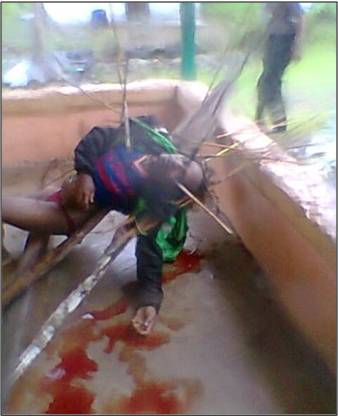
Above: Images from the horizontal conflict of 2012 in Mimika (Courtesy KNPB Mimika) List of names of the victims (of the war) from 20 May to 5 October 2012 A. From the side of Hosea Onggomang
1. Roni Onggomang (16), died in ditch at side of the road, after motorcycle collision with Oni Kerombo .
2. Deminus Onggomang (30). Killed by an arrow, fired mistakenly by one of his friends.
3. Dominus Ongomang (32) shot dead by police officer in Mimika. Perpetrator: Brimob AKBP Denny Siregar S.IK of Batak descent.
4. Doni Onggomang (28). Shot dead by police. Doni had just seen his older brother Dominus shot by Kapolres (Police). Doni was angry and wanted to attack the Kapolres but he was also shot, by Adjutant Kapolres Abram, native of Jayapura.
5. Antelius Ongomang (24), Killed by arrow.
6. Aroki Tabuni (29). Killed by an arrow.
7. Pak Enos Murib (35). Killed by an arrow
8. Ibu (Mrs) Medina Wenda (24). Killed by an arrow in a plantation outside the battlefield.
9. Seki Tabuni (36). Killed by an arrow.
10. Kamoro Tabuni (30). Killed by an arrow.
11. Herry Tabuni (25). Chased and killed in the street.
B. Victims from Atimus Komanggal’s side
1. Parael Alom
2. Yanuarius Misimbo, killed in a plantation.
3. Nike Misimbo (10). killed in a plantation.
4. Ince Komangal (15). killed in a car.
5. Eterikus Beanal. Killed in a car.
6. Jhon Beanal (29). Disappeared, abducted by person unknown
7. Frans Beanal, (30). Disappeared, abducted by person unknown.
8. Pdt. (Reverend) Barnabas Komangal (57). Killed in family fight.
9. People seriously wounded; 12 men and 2 women, names not yet known.
10. Filemon Hagabal, (35). seriously wounded by an arrow.
11. Head of the Dama clan, Victim of bashing carried out by member of the police force, is now left with paralysis in his left leg and has broken ribs. At present still in detention in Polres Mimika Mil 32.
12. Other victims outside the warring clans, Bapak Tom Yarangga (45 years), Yaranggawas burned in a car (fire) carried out by a specially trained group. (Kelompok yang di lati Khusus?), up to now the murderer has not been identified by the police.
Bapak Nasyum killed by a specially trained person. To date police have not identified the murderer.
(WPM Comment: The “Specially Trained Group” or Orang Terlatih Khusus is a euphemism for terror squads of the Indonesian special forces Kopassus, who are believed to responsible for a massive campaign of shootings, stabbings, muggings and bombings against a variety of targets, blamed on highland Papuans, and engineered by design to discredit the civil resistance movement in Papua. Indonesia, and Kopassus, have used proxy militia and jihadist groupsthis as their standard operating procedure since the bloodbaths of the 1965 Coup.)




 West Papua Media Alerts