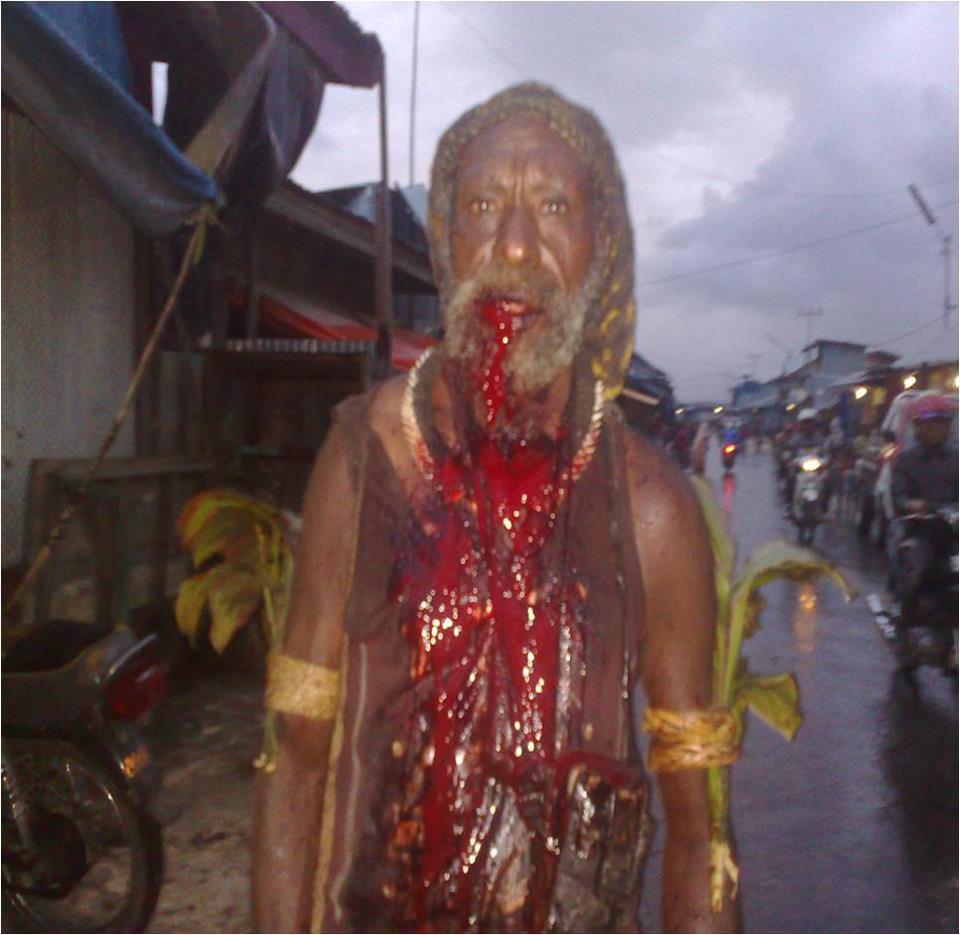
BRIMOB Paniai severely beat teacher Yulian Yeimo

November 28, 2011

(ENAROTALI, Paniai, West Papua)  In another display of arbitrary brutality against civilians, members from the increasingly notorious Indonesian paramilitary police unit Brimob last Thursday severely beat a local teacher without cause.

Yulianus Yeimo, 46, a teacher from Paniai was beaten  at 15:00 local time on 24 November by Brimob officers at Kogekotu / awabutu field in Enarotali, Paniai, Papua.   Police Officers fractured Yeimo’s nose and jaw from repeated blows with rifle butts.  The injuries caused by the Mobile Brigade officers caused severe bleeding, with his tongue almost severed by blows from the rifle butts.

West Papua Media has verified the photograph as genuine, and consistent with injuries reported.  Local sources have reported that Brimob and military officers are constantly raiding houses, taking away traditional hunting wepons and gardening tools such as axes, machetes and knives.  According to the same sources, this has made work and finding firewood for cooking impossible.  Many people have fled into the surrounding hills for shelter, fearful of continued arbtitrary violence from Indonesian security forces.

Combined operations throughout the Paniai district by Indonesian police and army since July have displaced several thousand local people, with many unable to find food or effective shelter in the mountains.

The district is subject to increasing tension, so please stay tuned to westpapuamedia.info for further updates.

AAP: Exodus in Papua amid fears of crackdown

http://news.smh.com.au/breaking-news-world/exodus-in-papua-amid-fears-of-crackdown-20111127-1o10t.html

 Karlis Salna, AAP South-East Asia Correspondent

November 27, 2011 


AAP
Human rights groups have called for Australian monitors to be allowed into Papua amid reports people are fleeing parts of the Indonesian province due to fears of another violent crackdown on pro-independence rallies planned for next week.
In a joint letter to Foreign Minister Kevin Rudd, Human Rights Watch and the Melbourne-based Human Rights Law Centre have called for Australian embassy staff to be deployed to the restive Indonesian province to monitor events on December 1.
Large numbers of people are expected to gather in cities and other areas in Papua on Thursday for rallies to mark an unofficial independence day and the 50th anniversary of the first raising of the Morning Star flag.

The flag has been adopted by the separatist Free Papua Movement(OPM) and is regarded as a symbol of independence in the province which has been racked by a surge in violence over the past six months.

However, the Indonesian government considers the raising of the flag an act of treason.
At least three protesters were killed and another 90 people injured last month when Indonesian police and military stormed a pro-independence rally in Abepura after the raising of the Morning Star flag.
Video of the aftermath of the rally, broadcast on Australian television, also showed police beating unarmed protesters, including children.
As many as 300 people were arrested.
A spokesman for the pro-independence group, the National Committee for West Papua (KNPB), has told AAP that large numbers of people have begun leaving Jayapura and Manokwari in Papua, fearing a backlash from security forces at rallies planned for Thursday.
As Indonesia remains off limits to foreign journalists, the report could not be confirmed.
In the letter to Mr Rudd, Human Rights Watch and the Human Rights Law Centre raise concerns about the likelihood of a repeat of last month’s violence as well as the use of excessive force by the police and military.
The letter calls on Mr Rudd to urge the Indonesian government to allow full and free access of journalists to Papua and to deploy Australian embassy staff to monitor and observe events on December 1.
The human rights organisations say there should also be a full and impartial investigation into the deaths and injuries, and allegations of excessive use of force by the authorities, arising from the demonstration in Abepura on October 19.
But the letter also criticises the Australian Ambassador to Indonesia Greg Moriarty who had described the actions of the protesters at the rally as provocative.
“In our view, a clear and firm public statement on Australia’s position on human rights in the area is critical, especially since there is a real risk that Australian Ambassador Greg Moriarty’s recent reference to the actions of Papuan People’s Congress leaders as illegal, provocative and counterproductive may otherwise be interpreted as supporting a government crackdown on the congress,” the letter said.
Mr Moriarty, however, had also pointed to the response by Indonesian security forces as being disproportionate.
The letter to Mr Rudd also questions Australia’s funding and training of Indonesia’s elite anti-terrorism squad Densus 88, members of which were among the security forces present at the rally on October 19.
“Australia plays a critical leadership role on human rights in Asia and the Pacific and should take a principled and proactive stand on human rights with a key partner like Indonesia,” the two human rights organisations said.
Indonesia has been battling a long-running but low-level insurgency since its takeover of Papua in 1969.
However, the security situation has deteriorated in recent months with the province experiencing its worst violence in years.
Figures from Indonesia’s Commission for Missing Persons and Victims of Violence show at least 40 people have been killed as a result of the violence since the beginning of July.
© 2011 AAP

Why Now? A West Papua Backgrounder

from our partners at New Matilda.com

By Jim Elmslie

Papuans demand referendum.

NM has kept a close eye on West Papua as pressure in the breakaway Indonesian province builds. Long-time Papua watcher Jim Elmslie explains why the situation has escalated – and may get worse in coming months

Two seminal events have shattered the uneasy status quo in West Papua: a labour strike at the Freeport mine, and the declaration of an independent West Papua at a landmark mass meeting of Papuan nationalists, the Third Papuan Congress.

Papuans are in a weak position to effectively pursue any policies that would improve their situation, or move towards the desired goal of many — independence. In fact their situation continues to deteriorate as more non-Papuan migrants arrive and the militarisation of West Papua continues unabated.

By 2010 the indigenous Melanesian population comprised slightly less than half the total population of 3.6 million. Military repression has contained, but done nothing to abate, Papuan resistance to what many perceive to be their “slow-motion genocide”.

It is hard to disentangle the history of the Freeport mine from the larger history of West Papua since the Indonesian takeover.

Indonesia took West Papua by diplomacy backed by military force: a force that no other country, including Holland, was ultimately prepared to oppose. President Sukarno and his successor, President Suharto, felt fully entitled to the riches of West Papua, won in the face of adversity.

The greatest of these riches has been the Freeport mine, the most valuable mining operation in the world. It was imposed on the Amungme people against their will and has been dominant in the political economy of West Papua ever since. The Freeport mine is very much a metaphor for the occupation of West Papua by the Indonesians and developments at the mine site cannot help but have profound effects across the entire country.

The status quo at the mine has been irrevocably transformed by the miners’ strike.

Blowing up the diesel and concentrate pipelines and blocking the mine access road has not only temporarily crippled the mine; it has permanently weakened the company. Once the epitome of aggressive American capitalism, it is now a victim of its own success, beholden to many forces and actors beyond its control which threaten the very survival of the company in Indonesia. Whether it be Papuan tribesmen, Indonesian unionists, theTNI or nationalist politicians in Jakarta, many people are out to get Freeport.

This phenomenon loosely coincides with the world-wide movement against authoritarian regimes (such as the Arab Spring) and against capitalist excess (such as the Occupy Wall Street movement). These movements have at least partly been fueled by the technological revolution that has thrown up new forms of communication such as the internet, mobile phones, Facebook and You Tube. Whereas Freeport and West Papua have always been hidden by their remoteness, they are now no more remote and disconnected from the rest of the world than anywhere else. What has worked in the past will no longer suffice.

Similarly the shooting by the TNI of unarmed protestors after the Third Papuan Congress did not take place in a vacuum. Within minutes of the first shots being fired news reports were being sent out by SMS, followed by mobile phone calls, emails, Facebook postings and uploads on You Tube.

Organisations around the world, such as Human Rights Watch in New York, were quick to condemn the shootings.

In Australia, Greens Senator Richard Di Natale moved a motion in the Senate calling for an end to military aid for Indonesia — a motion that now will have to be taken seriously as the Greens hold the balance of power in the Australian Parliament. There was no public condemnation of the shootings and associated human rights abuses from the Australian government, reflecting its extreme reticence to criticise Indonesia and the fragility of the relationship — at least over the issue of West Papua.

Other countries were not so constrained. Lord Avebury, Vice-chair of the UKParliamentary Human Rights Group, said, “this appalling display of excessive force has no place in a modern democracy”. In the US, Congressmember Eni Faleomavaega, well known for his outspoken support for West Papuans’ human rights, wrote a letter to the Indonesian Ambassador to the US, Dino Patti Djalal. Faleomavaega expressing his concerns about the Congress shootings and calling for the safety, “humane treatment” and immediate release of Forkorus Yaboisembut.

The geo-political importance of Indonesia, as a “moderate” Islamic nation, emerging economic force and potential bulwark against growing Chinese power, tended to mute further negative comment.

While the old status quo has been shattered with the strike and the Third Papuan Congress, no new equilibrium is in sight. In fact by 4 November the workers’ strike had coalesced with the Papua peoples’ political demands when tribesmen joined the strikers at the Freeport blockade and successfully fought back police attempts to break through. The tribesmen were drawn in by the strike and, armed with spears and arrows were expressing their own grievances over land rights, pollution and (lack of) compensation from the mine.

This was a seminal event in the political evolution of West Papua wherein all of the different agendas — and different sets of players — have come into play together at the political and economic heart of West Papua: the Freeport mine.

Freeport will probably (but not certainly) reopen in the coming months and resume production, but the mine and the company will now live forever in the shadow of the events of the past six weeks. The next attack will always be hanging imminent: maybe tonight; maybe never. But the illusion that the mine is safe and secure is gone forever. It is, for the time being, a defenseless victim which can be brought to a grinding halt at will. The security bought with the tens of millions paid to the TNI and police has proved to be no security at all; on the contrary those payments have made the mine even more vulnerable. All those billions seem up for grabs now.

Politically West Papua is in an even more chaotic and dangerous stalemate. Papuan aspirations for independence are being expressed ever more openly, defying the guns and threats, defying what most observers would see as logic: that independence seems an impossible dream. The Papuans believe that God is on their side; that history will vindicate them; that, like East Timor, their day will come and their imprisoned nation will one day be free.

Simultaneously the Indonesian nationalist position has hardened: the Papuans are seen as traitors trying to break up the nation and deserving of armed response, of death. Against this there are elements of Indonesian society that are considerably more flexible and nuanced in their understanding of the West Papuan conflict, exemplified by leading academic researcher, Muridan Widjojo, who has co-authored an important study on West Papua which strongly advocates negotiations.

Indeed, by 10 November even President Susilo Bambang Yudhoyono was starting to talk about dialogue, but with such restrictive preconditions — predictably the non-negotiability of sovereignty, but also the centrality of Special Autonomy — that many Papuans may baulk at participation, sensing another pointless exercise in propoganda. Meanwhile the real power continues to reside with the military in West Papua, which clearly views separatism as a traitorous threat to national sovereignty and negotiation or concessions as a sign of weakness.

As the currents that are rippling across the rest of the world inexorably flow through cyber space and into the computers, smart phones and consciousness of Papuans, the scene is set for an ever-bigger confrontation. The trends are ominous, and the process structurally violent.

Other nations, particularly Australia (as near neighbour, Indonesian military ally and home to the most significant foreign based corps of pro- free West Papua supporters — both Papuan and non-Papuan) are being drawn into this struggle. Just as Australia was drawn into the East Timor struggle, against the fervent wishes of both the conservatives and the Labor Party, Australia is now involved in West Papua.

If nothing else the Lombok Treaty signed in 2007 makes Australia a virtual military ally of Indonesia. One purpose of the treaty was to suppress support for West Papuan separatism, particularly in Australia. Official Australia is, therefore, directly participating in the repression of the Papuans, as it participated in the Indonesian occupation of East Timor with military cooperation and diplomatic support. This reflected the view within Australia’s foreign policy establishment that erroneously saw East Timor’s status as an Indonesian province as final (as they now see the status of West Papua). Eventually the Australian public rejected this position over East Timor; the same is likely to happen over West Papua as an understanding of the situation there filters out.

However the cards unfold the situation in West Papua will likely get much messier and more violent. The possibility of a quiet genocide occurring is real. Australia must come to expect this and realise that the future relationship between Australia and Indonesia will be forged in how our respective nations deal with this difficult and traumatic conflict, not through trade deals and jaunts to Bali. In this context, the call by Senator Richard Di Natale to cut military ties with Indonesia is the best immediate policy response available and should be widely supported.

West Papua: How to lose a country

November 23, 2011

by Jason Macleod

with This Blog Harms at Crikey

When Julia Gillard meet Indonesian President Susilo Bambang Yudhuyono in Bali on the weekend West Papua barely got a mention. Although the text messages inside West Papua went into overdrive with the rumour that the reason Australia and the United States were stationing 2,500 U.S Marines in Darwin was to prepare for military intervention in West Papua.

I told my friends in West Papua it wasn’t true.

But then I got thinking. Actually Australia is doing a lot to help Indonesia loosen their grip on the troubled territory. Not by design of course. But the effect is much the same as if the Government suddenly adopted a radical pro-independence policy.

Confused? Let me explain.

Last month the Indonesian police and military fired live rounds into an unarmed crowd of civilians in West Papua, killing five. The Army and Police then tried to make out that it wasn’t them, that what had taken place was a coup by the Papuan Liberation Army; that it was the Papuans who were doing the shooting. Yudhuyono tried to sell Obama and Gillard a version of that story in Bali on the weekend. That might have washed twenty years ago but in this age of social media and smart phones it is much more difficult to hide the evidence.

Since the killing of five Papuans on October 19, the wounding of scores more and the arrest of six Papuan leaders, international media coverage of West Papua has spiked and Indonesia’s international standing has taken a beating. The Army, Police and President’s denials and attempts at cover-up have not helped the government’s reputation.

The killings have also generated outrage and division within Indonesia. And October 19 was not an isolated incident. A series of shocking acts of torture of Papuans by the Indonesian military have been captured on video and recently released. And when I speak of outrage I am not talking about protests from human rights groups. National legislators from a range of Indonesian political parties have begun to publicly criticise the Indonesian military, police and even the President over the government’s policy, or lack of it, in West Papua. Even the cautious Indonesian Bishop’s Conference urged Indonesian President Susilo Bambang Yudhuyono to hold a third party mediated dialogue without delay.

Indonesian critics recognise that the political crisis in West Papua is spiralling out of control and that the central government and the security forces are making things worse. Indonesian journalist Bramantyo Prijosusilo writing in the Jakarta Globe went as far as saying that the “powerful forces bent on forcing Papuans to separate from Indonesia are none other than the central government, especially its military and police force.”

He has a point. West Papua teeters on the brink of open rebellion. After the shooting on October 19 one student previously uninvolved with politics told me “if the police and military thought they could shoot us dead like animals and we would somehow stop pressing for freedom, they are wrong. We don’t care about the military; we don’t care about the police. We are not afraid anymore.” Days later he was on the streets along with 3,000 other Papuans calling for a referendum.

This is not just about political insurrection. The economy is on the brink as well.

Consider the massive Freeport/Rio Tinto gold and copper mine. Eight thousand mine workers there have been on strike since July. Freeport’s pipeline has been cut in more than 20 places, the company has been unable to deliver on its contracts, the local government in Mimika which depends on revenue from the mine to supply services is cash strapped, and Freeport itself is losing billions.

That could mean Australian jobs are affected. Over 800 Australian companies supply the mine through Cairns and Darwin. The Australian owned company International Purveying Incorporated sends everything from Toyota’s, heavy mining equipment, and frozen beef dinners to Freeport every few days.

How long shareholders and investors will put up with heavy loses and adverse economic risk is any ones guess. But it won’t be forever. And it is not just Freeport / Rio Tinto that is in the firing line. BP, Clive Palmer’s nickel businesses in Raja Ampat, and logging interests are all the target of a torrent of anger from landowners. CEOs like Palmer and Freeport’s Bob Moffet may not ask the Indonesian government to negotiate with Papuans demanding political freedoms but sooner or later shareholders and investors will demand just that.

So how is the Australian government responding to these shifting power dynamics? Well that is the problem. They are not. The government’s position is the same as it has always been: continued support for the Indonesian military / police unhinged from any tangible improvements in human rights such as guarantees of free speech, release of political prisoners or moves towards supporting political dialogue.

No matter what side of the political fence you sit this is not smart policy.

For years Papuans have been telling our leaders that Special Autonomy had failed, that the Freeport mine was a source of conflict, and that the military and police were killing them. Just in case we were not paying attention they described the situation as “slow motion genocide”.

So for those realists out there who think an independent West Papua would be a mistake, here’s some free policy advice: stop funding the armed group splitting Indonesia apart.

Giving a blank cheque to the Indonesian military while there is continued suppression of political freedoms in West Papua is the surest way for Australia to help Indonesia lose a country.

It seems the Australian government might be eager to usher in freedom in West Papua after all.


How the National Government Is Encouraging Papua to Break Away

Exceptionally powerful article appearing the Jakarta Globe: a must read for all Indonesians who are concerned for Papua, either for or against.
Bramantyo Prijosusilo | November 22, 2011

Transparency and accountability are universally accepted as the cornerstones of good governance. With neither present in Papua, we can be sure that the natural riches of the region will never come to benefit local communities, but will rather bring about the so-called “resource curse” in the form of economic, cultural, social and political strife and ecological disaster.

The massive destruction caused by Freeport-McMoRan, the American mining conglomerate, can now be witnessed by anyone with an Internet connection thanks to Google Earth. The continuous stream of stories of torture and murder that leak out of the region is proof that people are unhappy and that the national government is acting less than honorably there.

What the central government claims about goings-on in Papua cannot be trusted because its claims can be disproved immediately. Since the act of free choice in 1969 (called “the act of no choice” by Papuans resisting Indonesia’s “occupation”), the western half of Guinea island has been covered by a “batik curtain.” Foreign independent journalists are banned from working there freely, as are international NGOs.

However, with the advance of information technologies and the fact that more and more Papuans are receiving modern education, the contemptuous treatment of indigenous people at the hands of the nation’s police and military is becoming more and more difficult to conceal. Gleaning information on Papua from the Internet it becomes obvious that there are powerful forces at play in Papua that are bent on reaching the point of no return — where either all Papuans must be exterminated, or a second and more honest “act of free choice” is conducted, for the world to witness the true aspirations of the people of Papua in terms of their relationship with the Indonesian state.

The powerful forces bent on forcing Papuans to separate from Indonesia are none other than the central government, especially its military and police force.

Since the brutal murder of Papuan leader Theys Eluay a little over 10 years ago, the world has seen how Indonesia has yet to reform its approach to the issue of Papuan independence. As we near Dec. 1 — the date that Papuans consider to be their independence day — the world is fearfully expecting to witness more state violence against Papuans peacefully expressing their aspirations. Indeed, in the past few months we have witnessed attacks on journalists and peaceful protestors, including the still unclear circumstances surrounding the latest fatal shooting of eight gold prospecting civilians in the Paniai district.

On the issue of the Freeport workers on strike demanding better pay, the world witnesses how the central government’s actions toward the Freeport strikers differs from the government of Peru’s reaction toward the same sort of strike at a Freeport mine there. While the government of Peru visibly takes the role of a mediator that holds the interests of its own people foremost, Indonesia appears to unashamedly play the role of Freeport’s guard dog, and without hesitating to release live ammunition on its own people.

The recent armed police and military raids of Papuan students’ dormitories in Java and Bali are an indication of what is likely to come on Dec. 1. The recent Papuan voices that have leaked out thanks to the Internet indicate that there are plans for at least a “Morning Star” flag rising in Papua on that date. Although the government has cracked down hard on similar events in the past, it is unthinkable to imagine that the people of Papua have been cowed into submission by these repressions. Just as Indonesian youth defied the Dutch colonialists in the early 20th century and continued to raise the “Red and White,” so will the youths of Papua. After all, most Papuan youth leaders were educated in Indonesia, so they fully understand that perseverance pays and aspirations for independence cannot be stifled by force. Yhe more Indonesia uses force to keep its hold on Papua, the stronger its independence movement will become.

Papuan activists can also see how Islamists in Indonesia can actively work to destroy the country not only with impunity, but also with the tacit support of the state and members of the government. The Islamist party, Hizbut Tahrir, for example, openly agitates for the fall of the republic to build a global Islamic caliphate in its place, but the authorities tend to aid and support it rather than take action to hinder its activities. Islamists in the country openly work for the resurrection of the age of the Islamic caliphs, or at least work toward their version of Shariah being enshrined as state law, but even though these activities are in blatant contempt of our constitution, the government has never done so much as lift a little finger in defense of the republic and its principles in the face of these orchestrated attacks.

Therefore it is natural that activists from Papua feel that they are being continuously discriminated against, for they receive the harshest treatment for the simple activity of raising a flag.

So who is it that is working hardest to compel Papua break away? Are the people of Papua to blame for objecting to having their sacred lands ripped apart by corporations making profits for shareholders far away? Are they to blame if they do not trust Indonesia’s capacity or intent to develop the country along the lines of the constitution?

If Indonesia wants to keep Papua as part of the family, it needs to clean up its act, especially in curbing Islamist treason and protecting minorities. It also needs to open up Papua to the world and come clean and apologize for the wrongs it has inflicted on the people there. As Dec. 1 approaches, we can expect that the national government will try to further alienate Papuans to a point where the only way forward will be through a sea of blood.

Bramantyo Prijosusilo is a writer, artist and broadcast journalist in East Java.


Create a website or blog at WordPress.com

Up ↑