Prison warders beat and kick more than forty prisoners

JUBI, 10 May 2012

At least 42 prisoners – both political and criminal – have been beaten by warders in Abepura Prison where they are being held,  with these beatings occurring on 30 April.

According to information from the Justice, Peace and Creation Secretariat (SKPKC) in Jayapura, the prisoners who were beaten included Selfius Bobii, Luis Kossay, Terianus Tabuni, Wayus Hubi, Markus Dubi, Stenly Palondong, Alfian Palendeng, Erens Apromis, Octo Ikinia and Fredy Marsyom.

Some of them were beaten until they were black and blue all over. Selsius Bobii said he had ben slapped, hit and kicked all over his body. He was then dragged into the prison office. Luis Kossay said that he had been struck by a bludgeon, by iron rods and beaten with a rope and while being beaten he was kicked and then dragged out of his cell, dragged 200 metres and thrown into the yard. In the yard, his fingers and toes were stamped on by warders with their heavy boots. After suffering all this, he was ordered to remain in a half-squatting position for an hour.Three other prisoners were subjected to the same painful treatment and the rest were also beaten and kicked without mercy.

These acts of maltreatment occurred on 30 April and began when Selpius Bobii and some other prisoners asked the warders not to lock their cell doors because they wanted to practise singing some songs for their co prisoners. However, he was ordered out of his cell and taken to stand before the security official  who refused to grant him permission to do this. Selpius tried to explain that they wanted to rehearse some songs to be recorded later on, but permission was refused. and he was ordered to return to his cell.

Selpius said later that the previous warder, Ayurbaba, had given them permission to do these things and had allowed the prisoners to have recreational activities. When the new chief warder Liberty Sinijak heard this going on, he came out and started shouting at Selpius. In response Selpius shouted back, saying that the warders were doing nothing to help the prisoners but only trying to crush them.

The chief warder shouted back and ordered Selpius into the isolation wing. When the other prisoners in their cells heard all this shouting, they started calling out to the warders to stop maltreating Selpius.

Children pray for release of Forkorus and his co-defendants

Forkorus Yaboisembut outside court. Photo: West Papua Media
JUBI, 9 May 2012Dozens of children  from the KINGMI Church in Waena held joint prayers on Wednesday this week, praying for the release of Forkorus Yaboisembut and his four colleagues.  They were intending to hold the joint prayers in the grounds of their school in Abepura but because the building was undergoing restoration, the prayers were said at the church.

JUBI journalist said that the children were very enthusiastic about the event  and had made posters about the many social and political issues in Papua.that have overwhelmed the Papuan people.

Adolof Tenouye, who led the prayers said  that they were all very concerned about the numerous problems in Papua, such as human rights violations, as well as economic and cultural problems.They said prayers for the restoration of their country in the hope that it could emerge from its present problems

One of the banners which they unfurled said: ‘We love my father, the President of West Papua.’ As is known, Forkorus Yaboisembut is the president of the Federal Republic of West Papua which was proclaimed on 19 October 2011, at the end of the Papuan People’s Congress. Forkorus and his co-defendants were found guilty of treason and were convicted to three years each.

The other four men are: Edison Waromi, Selpius Bobii, Dominikus Sorabat and Agust Makbrawen who are all in custody in Abepura Prison.

14th Year of ELSHAM Papua Presence in the Land of Papua


KITONG MAU TANAH PAPUA DAMAI*

 (Media Release: 14th Year of ELSHAM Papua Presence in the Land of Papua)

S

ince its founding in 5 May 1998, Institute for Human Rights Study and Advocacy of Papua (ELSHAM Papua) has consistently endeavored to promote observance and respect for human rights in the Land of Papua. ELSHAM Papua’s creation constitutes a response to ongoing human rights violations in Papua which warrant specific and comprehensive handling. ELSHAM is a non government organization (NGO) founded by 3 major church denomination, namely Evangelical Christian Church in the Land of Papua (GKI Di Tanah Papua), Catholic Diocese of Jayapura, and Gospel Tabernacle Church of Papua (Kingmi), with an aim to promote observance and respect for human rights in the Land of Papua.

Being  then the most prominent human rights organisation to tackle gross human rights violations in Papua ELSHAM managed to provide advocacy and campaigns for a number of human right violation cases like: Biak case ( 6 July 1998), Mapnduma (August 1996), Nabire (May 2000), Abepura (7 December 2000), Wamena (6 October 2000), Wasior (June 2001), Theys Eluay (10 November 2001), Timika (October 2002), and some others. Since 1998 – 2004, ELSHAM Papua regularly intervened at the UN Human Rights High Commission in Geneva to report on the human rights situation resulting in the visits to Papua by two UN Special Rapporteurs:  UN Special Rapporteur on Torture (2007) UN Special Rapporteur on Human Rights Defenders (2007).

Observing the human rights situation in the Land of Papua since mid 2011 until now, there is an increase of violence. ELSHAM noted that between July to September 2011 there has been at least 28 cases of violence which took the lives of Papuan civilians as well as the Indonesian security personnel.  Despite the fact that Papuans have declared their desire to create peace through Papua Peace Conference on 5-7 July 2011, nonetheless sporadic violence continued to occur in Puncak Jaya and Timika areas.

Violent acts resurfaced on 19 October 2011 when police personnel backed by the TNI force violently dispersed the Third Papuan People Congress at Zakheus soccer field in Abepura. 3 civilians were killed while 387 others arbitrarily arrested and detained for more than 24 hours.

Other violent act by security personnel also occurred through limited military operation in the Puncak Jaya and Paniai regions under Operation AMAN MATOA (Operation Secure Matoa) and Operation TUMPAS MATOA I (Operation Eradicate Matoa I) 2011. On 13 December 2011 around 07.30 AM (Eastern Indonesia Time), 6 groups of Mobile Brigade personnel attacked the head-quarter of War Area Command IV (TPN-OPM Kodap IV) of the Papua National Liberation Army at Eduda Hills in the Paniai region. A privately owned helicopter was used by the attacking Mobile Brigade force. This military offence was directly led by commander of Operation Tumpas Matoa Senior Police Commissioner Leo Bona Lubis. ELSHAM’s volunteer in Enarotali reported that as a result of this operation at least 14 people were killed, 6 were wounded, and hundreds of civilians living in nearby villages fled to Enarotali,  Dogiyai and Deiyai.

Conflict and violence that erupted in Ilaga of Puncak Jaya regency was a tragedy. This conflict was triggered by provision of recommendations to two candidates who were competing for the position of Head Regency of Puncak Jaya.  The central management of Gerindra Party in Jakarta recommended Simon Alom as their chosen candidate to run for the position, whilst the provincial Gerindra party officials in Jayapura recommended Elvis Tabuni, another candidate. These conflicting recommendations resulted in open conflicts between the supporters of the two candidates. War between the two opposing groups lasted from 31 July 2011 to 25 February 2012, creating a death toll of 94 people: 72 died of attacks from both parties, 22 died while taking refuge. At least 1.573 people were reported to have fled to Nabire as a result of the conflict in Puncak Jaya. Others who fled to other areas have not been documented.

Looking at the significant rising trend of violence in Papua which claimed many lives then the endeavor to create peace in the Land of Papua must be the priority of all people. Since 2002 ELSHAM Papua has actively engaged with other parties to create peace in the Land of Papua. ELSHAM Papua believed that conflicts occurring in Papua can be settled peacefully.

The people of Papua have creatively proposed for dialogue to find solutions to problems in the Land of Papua. Papuan people’s initiative to engage in dialogue with the government of Indonesia was positively responded by the Indonesian President on 9 November 2011. Until now the people of Papua still wait for realization of the intent of the Indonesian government to create peace in Papua.

Commemorating the 14th anniversary of ELSHAM Papua we would like to extend our highest appreciation to all people who incessantly work to create peace in the Land of Papua. May the effort expended to create PAPUA LAND OF PEACE can be realized.

Director of Elsham Papua

Ferdinand Marisan, S.Sos

MP : +62 (0)81344937471

Email: marisan_ferry@yahoo.com.au


*    14th year reflection of endeavor to realize justice in the Land of Papua.


***ELSHAM NEWS SERVICE provides regular reports and information on social and political development and their implication on Human Rights situation and democracy in Papua. The reports and information provided are obtained from ELSHAM PAPUA local, national and international networks. Those interested in subscribing to this service are advised to register to ELSHAM PAPUA. Please provide complete information (Name of institution/ or individual; address, etc). ELSHAM PAPUA is a human right organization with a mission to eliminate militarism, impunity, and to promote Human Rights and democracy. And to promoye human rights education for the people of Papua. ELSHAM PAPUA was founded on 5 May 1998.

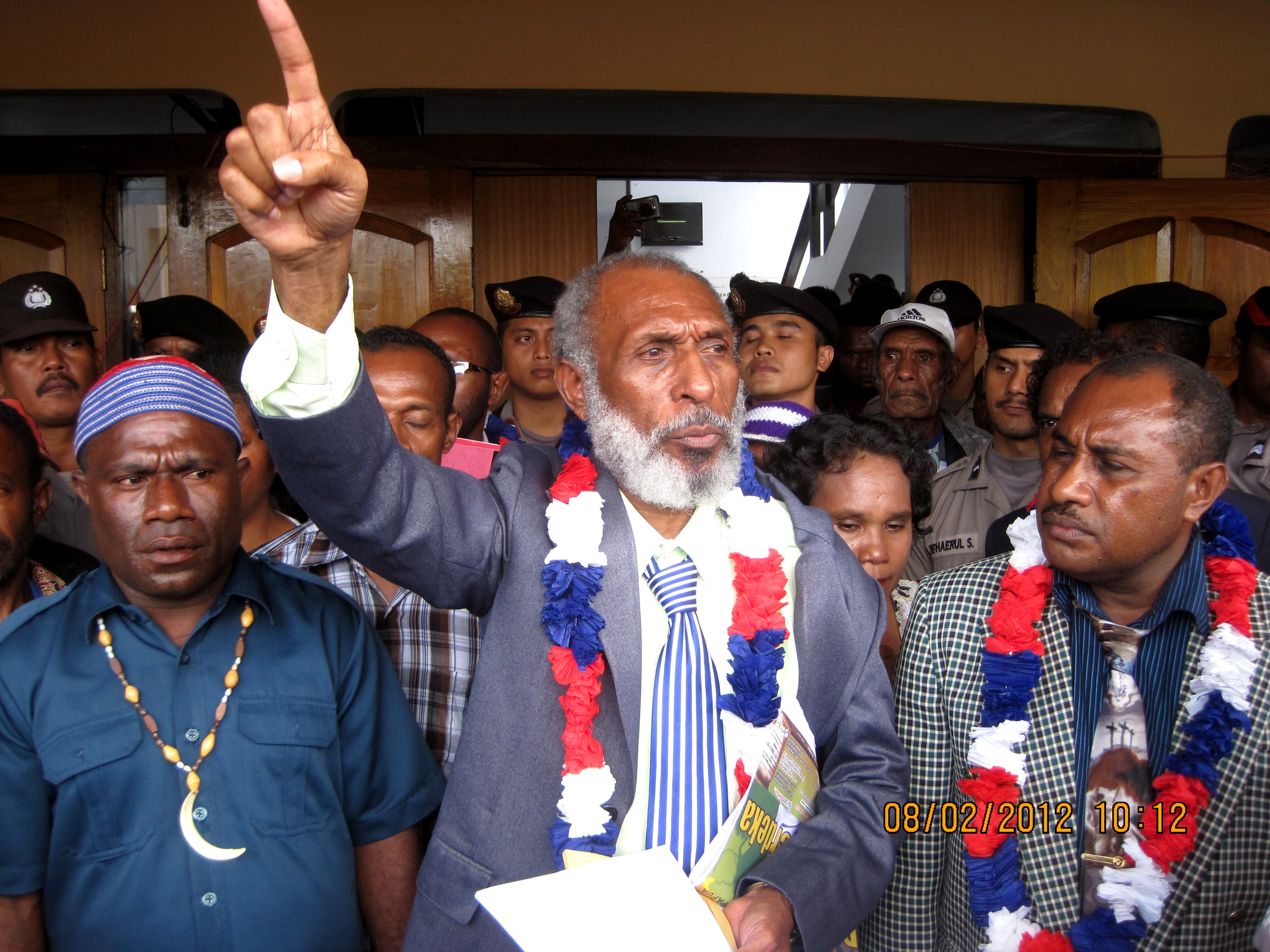
KNPB: We never seek justice from Indonesia

Bintang  Papua, 4 May 2012

Jayapura: Following the death of a sympathiser of the KNPB, the deputy chairman of the organisaation Mako Tabuni said that such a thing is part of the risk of the KNPB’s struggle for a referendum. ‘ We do not regard such things as a violation of human rights  but as part of the risk of our struggle,’ he said.

He said that they recognise that loss of life and loss of property  are inevitable.

He said that with regard to the latest victim, they were not intending to seek justice from Indonesia ‘because none of the victims which we have suffered has resulted in justice for the Papuan people.’

With regard to reports alleging that skirmishes said to have been caused by the KNPB masses and in which one student and one member of the security forces were injured and one young man died, he said that he would take responsibility if the police try to prove this.

In a press release issued by the KNPB, the organisation made the following demands:

1.    The Indonesian government should recognise the political right of the Papuan people to determine their own future by means of a referendum because the process of annexation following the New York Agreement of 16 August 1962 violated the principles and standards of international law and universal human rights.

2.    As from 1 May 2012, the Papuan people herewith declare that the presence of the Republic of Indonesia on Papuan soil is illegal and the  Papuan people only recognise the national parliamentary administration of West Papua.

3.     The Dutch people, the Indonesian people and the United Nations must accept responsibility for the hand over of of the administration of the West New Guinea Council/West Papua to the Government of Indonesia on 3 May 1962, without the consent of the Papuan people who were the ones involved in the dispute.

4. The Papuan people are ready to struggle for their right to self-determination by all means possible.

5. That the Papuan people should not become panic-stricken in the present situation.

More than 10,000 HIV/AIDS cases in Papua

JUBI, 27 April, 2012

Jayapura: According to a report  by the Health Department in  Papua which was made public on 31 December 2011, there have been 10,783 cases.of HIV and AIDS, of whom 4,437 people had HIV and 6,348 had AIDS. 778 people have died.

The most prominent cause of the disease is sex relations  between heterosexuals  which accounted for 93.45%. The other source of the disease is blood transfusion. The number of cases caused by the use of needles used by narcotics is minimal.

The ratio between men and women is almost equal with 50.07% of the persons suffering from the disease being men.

According to the report, the largest number of cases were in Mimika district , with 2,180 cases. Jayapura came second with 1,914 cases, Nabire with 1,912 cases, Jayawijaya with 1,479 cases and 1,329 cases in Merauke.

Create a website or blog at WordPress.com

Up ↑
