Take Care of Our Rivers and Give Us Back our Land

Sawit Watch / SKP KAMe

Press Release

December 20, 2012

West Papua’s natural resources are being exploited by extractive industries, especially around Merauke. When it was launched in August 2010, the MIFEE mega-project was described as an initiative to meet the world’s food needs, a response to the world food crisis. As well as this, there are the current global concerns that the diminishing reserves of fossil fuel globally are bringing about a energy crisis.

https://i0.wp.com/sawitwatch.or.id/wp-content/uploads/2012/12/Sawit-Papua.jpg

With an area of over 1.2 million hectare earmarked for the project, the Merauke Regency Government hoped to turn Merauke into a centre of urban agriculture, agribusiness and agrotourism. Many companies welcomed the government’s offer and saw it as a great opportunity to expand their operations in eastern Indonesia. Merauke Regency’s Investment Planning Board (Badan Perencanaan Investasi Daerah or BAPINDA) has recorded that 46 companes have obtained permits, and some of which have already commenced operations. (data from Bapinda, September 2012).

The extent of concessions for large-scale oil-palm plantations in Indonesia currently exceeds 11.5 million hectares (Sawit Watch, 2011), stretching over all of Indonesia’s island groups both large and small, from Sabang at the westernmost tip of Aceh, to Merauke in South-East Papua.  The first palm-oil plantation in Merauke was started in 1997 by Pt Tunas Sawa Erma, a subsidiary of the Korindo Group. There are currently six oil palm plantation companies which have begun operations on Malind Anim land in Merauke: PT Dongin Prabhawa (Korindo Group), PT Bio Inti Agrindo (Korindo Group) [awasMIFEE note: PT Bio Inti Agrindo was actually bought by Daewoo International in 2011, and still belongs
to that company as far as we know], PT Central Cipta Murdaya (CCM), PT Agriprima Cipta Persada, PT Hardaya Sawit Papua and PT Berkat Citra Abadi (Korindo Group). Hundreds of thousands of hectares of indigenous people’s land will be appropriated, the forest destroyed and replaced with large-scale oil palm plantations.

Oil-palm plantations along the shores of the Bian and Maro Rivers have already brought serious problems for the indigenous people and clans that live in the area and own the land.  Oil-palm companies have been clearing land by burning, which has polluted water in the rivers and swamps, damaged and wiped out cultural sites and caused irreplaceable damage to the natural environment.  This is aggravated by a lack of information about companies’ status and plans, wrongful identification
of which clans own or have rights over which land, insufficient payment of compensation and deception and manipulation of data.  As a result the clans and tribes living along the Maro and Bian rivers have been dispossessed of their customary lands.

On the 31st July2011, 13 civil society organisations signed and delivered a letter to the UN Committee on the Elimination of Racial Discriminaton (CERD), accusing the MIFEE Mega-Project of bringing about the destruction of indigenous societies in Papua and in Merauke in particular.  A response to this letter was received from Anwar Kemal, Chairperson of the Committee on the Elimnation of Racial Discrimination, on the 2nd September 2011.  It requested that the Indonesian Government, which became a party to the International Convention on the Elimination of All Forms of Racial Discrimination 1965 when it ratified Law number 29 of 1999, to give a swift response and clarification before 31st January 2012.   Until now, the government has still not given its response. The government is showing neglect and disregard and it’s not for the first time – previously in 2007 they had planned to fell the forest along the whole Indonesia-Malaysia border for oil palm plantations.

Seeing the conditions that indigenous communities in the villages along the Bian and Maro rivers are currently facing, with their land already allocated to large scale oil palm plantation concessions, we strongly advocate the following:

1. Companies must be responsible and make restorations, as well as giving compensation to people living along the Bian River as far as Kaptel and the Maro River for the environmental damage and pollution caused by oil palm plantation operations.

2. The government must carry out a review and evaluation of the permits which have been given to oil palm plantations on indigenous land belonging to the clans and tribes which live in Merauke Regency, revoke and cancel location permits and withdraw all commercial cultivation rights from customary lands in Merauke Regency.

3. The government must stop issuing new permits in Merauke Regency before all current problems are resolved, as well as repairing the damage that has already been done to the various communities.

4. As a party which has ratified the International Convention on the Elimination of All Forms of Racial Discrimination 1965 through Law number 29 of 1999, the government must immediately respond to the Chairperson of the Committee on the Elimination of Racial Discrimination Anwar Kemal’s letter dated 2nd  September 2011 (which was a response to the concerns raised to the UN CERD on 31st July 2011).

Source: Sawit Watch http://sawitwatch.or.id/2012/12/1047/
Translated and posted on awasMIFEE: https://awasmifee.potager.org/?p=302

PRD Merauke Secretary badly beaten by TNI 755 Btn

by West Papua Media and local sources

November 6, 2012

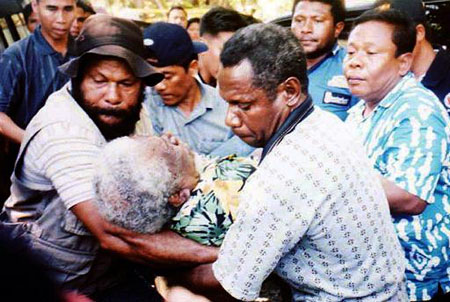
Information and video footage has emerged from Merauke, Papua, documenting the beating by Indonesian soldiers of the Secretary General of the Parlemen Rakyat Daerah (People’s Regional Parliament), further fulling tensions in the area between occupation forces and the local population.

The incident occurred around 3pm local time on November 3 , as the SekJen, Peter T. Katem was riding his Yamaha motorcycle with a community member, Mr Robert Mayonim.  The pair lost control of their bike due to newly made but rough village roads in Domba Empat street,  accidentally nudged a military officer with their motorbike outside the office of E Company, 755 Battalion (Merauke) of the Indonesian Army (TNI), according to witnesses.

Citizen journalists, Lintah Digoel and Rade Minyak. who interviewed the victims reported that the TNI member and two colleagues then gave chase after they refused to accept the accident, and attacked the pair at the crossroads outside the Company post.  As the beatings continued, more soldiers arrived on the scene and joined in, some in plain clothes and some in uniform.  The beating was filmed (below) by a witness.

According to local sources, Katem and Mayonim were taken forcibly to the E/755 Btn Post with beatings continuing as they were being dragged.  Arriving at the office, they were then tortured for about an hour and a half, they were punched, kicked and beaten with wood, fruit and bamboo.

This slideshow requires JavaScript.

The persecution ended after a number of Domba Empat community members   came to the office to demand their release, which occurred two hours later, Digoel and Minyak reported.

So far, none of the perpetrators have been investigated.


with KNPBNews.com


Papuan Voices: The Papuan Serving of Culture, Video and Change

Wempie talks to KBR 68H about Papuan Voices
Wempie talks to KBR 68H about Papuan Voices (Photo credit: EngageMedia.org)


The BAKAR BATU Papuan Voices Launch in Goethe-Institute, Jakarta on October 13, 2012 provided an eye-view of the struggle and inspiration in West Papua, brought to you by Papuan video activists from Jayapura and Merauke.


dancers2As the Merauke dancers waltzed into the Goethe-Haus theatre, the people who turned up for the Bakar Batu Papuan Voices Launchknew they were in for an evening of West Papuan culture which was filled with more than just the usual sad stories, but more so with hope and inspiration.Master of ceremony and Papuan Voices filmmaker Cyntia Warwewelcomed the audience, giving a bit of a philosophical explanation of the event.“Bakar Batu (literally translates to earth oven in Indonesian) or ‘barapen’ is an event where Papuans gather for a special occasion,” said Cyntia. “And this is a special event indeed, we’ve cooked up nine videos proudly, and we want to serve them to you, our friends.”

The theatre was packed. The Sisir Bambu acoustic group followed the dancers. Lead singer Sem Awom sang his work and also Mambesak songs to celebrate the cultural struggle of Papua.

“Years ago, there was a guy named Arnold Ap who worked very hard to keep the Papuan culture alive through the group Mambesak,” Sem said. “Unfortunately, his great work was deemed separatist by the then regime, and in the end he was arrested and killed.”

The award-winning filmmaker Wenda Tokomonowir kicked off the film screening  with the acclaimed “Surat Cinta Kepada Sang Prada’ (Love Letter to the Soldier). There were a total of 11 films screened. It was an emotional roller coaster as the films showed the tough lives many Papuans have to face, but encouraging as the same peoples are also not back down and fighting hard for survival. A video called ‘Salam Bilogai’ about a traditional Bilogai click handshake lit up the theatre with laughter as the audience demonstrated the handshakes with one another.

Papuan Voices co-producer, Wensi Fatubun, said that even though the project that ran since 2011 was a video initiative, both EngageMedia and Church group JPIC MSC have encouraged the participants in Jayapura and Merauke to design and use the videos for change.

“Papuan Voices is a cultural struggle,” said Wensi. “We want people to see Papua through the eyes of the Papuans themselves.”

Winning accolades was not the intention, but we are grateful of that. But to change and inspire is a lot more important.”

Web Launch

The evening was also about the unveiling of the dedicated Papuan Voices website – www.papuanvoices.net. This particular site compiles the nine Papuan Voices videos, along with various background information about the places and issues raised in the videos, a study guide that teachers/educators can use to trigger discussions, a screening guide and a take action page that provides information on groups to join and resources to read more about West Papua.

At the end of the screening, the audience were led outside to eat the sago and betel nut made by the indigenous market traders in the video ‘Awin Meke’.

pack

One audience said: “Thanks for letting me take a peek to the window of lives in West Papua for the first time. I hope folks in the TNI (the Indonesian Armed Forces) and the Government can have the opportunity to take a look at the videos also.”

The Papuan Voices Compilation DVD can be purchased here.


Plans to commomorate the death of Theys Eluay in November

Theys Eluay‘s body being removed after his murder by Kopassus officers, November 11, 2001 (supplied)
 JUBI,
16 October, 2012
It was ten years ago [actually eleven years ago] when Megawati Sukarnoputri was the president of Indonesia, that the Papuan leader, Theys Hiyo Eluay was murdered on 10 November 2001. Theys was kidnapped and murdered because he was regarded as a danger to Indonesia’s territorial integrity.
However, the Papuan people regard Theys Eluay as a Papuan leader who was able to  unite all Papuans from Sorong to Merauke.  He was also a man who called upon people to treat Papuans with decency and respect.This is why Papuans have decided to commemorate the death of Theys Eluay.

‘We are shortly planning to mark the anniversary of the death of this great Papuan leader,’ said Thomas Syufi, president of the Militant Papuans Students Federation.
‘He was a Papuan leader who struggled for his people to be treated with decency and respect.  He did not resort to violence but the Megawati government regarded him as a threat.

He went on to say in a press conference in Jayapura, that there has been no justice yet for the death of Theys Eluay.  ‘The senior army officer who had been involved in the death was allowed to go free. [A few low-ranking Kopasus officers involved in the abduction were given short sentences which they almost certainly never served.] ‘That is why we regard Theys Eluay as a martyr ,’ the students said.

[The facts about Theys’ death are as follows: Shortly before his death he had been elected the chairman of the Papuan  Presidium Council. He was tricked into meeting some members of the army’s elite corps Kopassus on 10 November 2001, kidnapped and driven to an unknown destination. On the following day, his body was discovered in Skouw, a Papuan village near the border with PNG, more than 50 kms from where he had been abducted. He appeared to have been strangled to death; an autopsy concluded that he had died of suffocation. See Tapol Bulletin, December 2001/February 2002.]

The call made at the time by Human Rights Watch for an impartial inquiry into what was seen as a ‘well-planned assassination’ was never  responded to by the authorities.]

To mark the forthcoming anniversary of his death, Papuans were called on to gather at the grave of Theys. The government, the military and NGOs were called on not to raise banners at the grave, ‘out of respect for the fallen leader’.

Plans to move the body have been rejected by Papuans. The anniversary of his death will be marked by prayers  and other activities that have not yet been revealed.

[Translated by Tapol]

Kopassus intelligence officer murders Boven Digul man accused of sexual assault: reports

by West Papua Media from sources in Merauke.

September 7, 2012

A local Papuan man has been murdered by an elite Kopassus special forces officer in a village in the remote district of Boven Digul, near the Fly River area adjacent to the West Papua – PNG border, after a local man was accused of sexual assault of a military officer’s wife, according to local human rights sources.

The shooting on Monday September 3, occurred after the victim, Januarius Kimko, was accused by a TNI officer (from the Boven Digul Koramil company of the Merauke 755 Battalion) of sexually assaulting his wife, despite protestations of innocence from the accused man.

West Papua Media has been unable to fully and independently verify the claims from human rights sources, due to the extreme difficulty of communication in these remote areas under military control, however, he investigating sources have been highly reliable in the past.

According to local human rights sources and witnesses interviewed on the grounds by Merauke-based media activists from the West Papua National Committee (KNPB), Kimko was arrested by “Buser” commandos from a joint military/police team in Boven Digul after the military couple reported the alleged sexual assault to the local Police.

The special BUSER ( BU = Berburu (hunting); and SER – serangan (attack))  is a joint “search and destroy” joint SatGas (taskforce) squad between Brimob and Kopassus, whose role is replicated by  part of the “anti terrorist” Detachment 88, funded by Australia.  All sections of this unit receive training and supplies by the Australian Defence Forces.  No information has been received that show if serving members of D88 are present in the Boven Digul unit.

The joint taskforce was immediately activated and conducted house to house raids across the town on Monday night whilst trying to capture the man accused of sexual assault, terrorising local residents.  An ambush was set on the house of Kimko, who was in his home in Ememes Ambonggo complex.  He was arrested and emerged with police without resistance, as he was to be conveyed to the police station for questioning, according to witnesses.

As he reached the street, a Kopassus intelligence officer from the Satuan Gagas Intelijen (Strategic Intelligence Unit) rushed the victim and pressed the muzzle of his weapon (type unknown) against Kimko’s side.  He then shot the victim four times, with the bullets penetrating the victim’s thigh and left wrist.

Witnesses reported to the investigators that as soon as Kimko was shot, members of the Buser Commando and TNI officers at the scene immediately threw his body in to a car, and conveyed him to an unknown location.

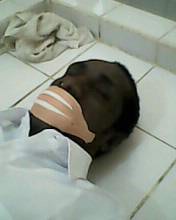
Januarius Kimko’s body was discovered by human rights sources at the emergency room of Merauke District l, over 120km from Boven Digul, late on Wednesday September 5.  His body had been in the custody of the TNI of Koramil Kabupaten Digoel from his shooting until the victim’s burial, preventing an independent assessment of his injures.  Kimko’s family were not informed of his death until after his burial.

Create a website or blog at WordPress.com

Up ↑