Maire Leadbeater reflects on West Papua’s ‘Arab Spring’

November 1, 2011
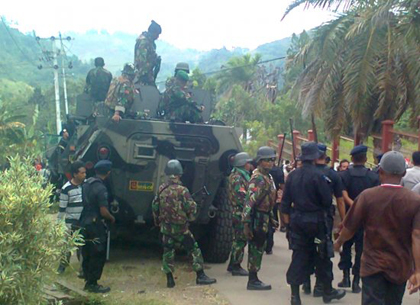
Indonesian forcesIndonesian security forces staking out the Third Papuan People’s Congress in Jayapura earlier this month. Photo: West Papua Media

Pacific Scoop:
Opinion – By Maire Leadbeater

It was not in the headlines, but our neighbourhood has had its own ‘Arab Spring’. The Melanesian people of Indonesian-controlled West Papua, have shown the same determination to pursue non-violent struggle as their counterparts in Egypt and Syria.

A 5000-strong Third Papuan People’s Congress took place over three days in a Jayapura field ringed with menacing armoured riot control vehicles and heavily armed police and soldiers. It was led by Forkorus Yaboisembut, chair of the Papuan Customary Council, who is highlighted on the Indonesian military’s leaked watch list of dangerous “separatists”.

As the Congress came to an end on October 19, Forkorus read a Declaration of Independence first penned in 1961, prior to the Indonesian take-over of the territory.

He then announced that he had been elected to be the “President” of the “Democratic Republic of West Papua”.

As the gathering began to disperse, the military began firing from their assault weapons and launched themselves on the crowd, arresting and beating some 300 people. Forkorus was forcibly arrested along with his “Prime Minister” Edison Waromi and they and three others now face charges of treason.

Dozens were injured, many with gunshot wounds, and up to six people were killed. The first death to be confirmed was that of a law student Daniel Kadepa who was shot in the head as he tried to flee.

Many terrified delegates tried to seek refuge in the nearby Catholic Seminary. Fr Neles Tebay, a prominent advocate for peaceful dialogue, has supplied a detailed account of the violent disruption and brutality displayed as the soldiers invaded the sacrosanct mission complex.

Terrified students
Terrified students were tear-gassed and threatened at gunpoint while one Franciscan brother was taken into custody despite the serious injuries he sustained in the attack.

A menacing security force presence is also ongoing in the remote Timika region, location of Freeport McMoRan mine, where an American multinational makes vast profits from the largest recoverable reserves of gold and copper in the world. About 8000 workers have been on strike since September seeking to lift their wages from the current hourly rate of around NZ $1.80 to $3.60 to parity with the wages paid to Freeport’s workers in other parts of the world.

Petrus Ayamiseba, one of the striking workers, was shot dead by the Indonesian police on October 10, provoking Papuan outrage and an unprecedented level of international union solidarity for the Freeport workers. Since then at least three others have been killed in the area by unknown assailants.

Rather than conciliation, the mine management has resorted to hiring contract workers as scabs.

Freeport McMoRan has had a dream run for more than 40 years. The first contract negotiated with President Suharto gave the mining company virtually free rein as well as generous tax concessions. This was in 1967 when Indonesia did not even have formal control over the territory.

In 1969, Indonesia pulled off a self-determination fraud by conducting a so called “Act of Free Choice” ( known as the “Act of No Choice” to the indigenous Papuans). Just over a thousand Papuan men took part out of a population at the time of nearly one million.

The Freeport mine has always been synonymous with violence and grave human rights abuses, as well as environmental destruction and the abuse of customary land rights. Amungme and Kamoro tribal people have had little recourse but to watch as the mine took over their lands and “decapitated” their sacred mountain.

Gunned down
In the last few years, especially since some Western mine employees were gunned down on the mine access road, the company has come under international scrutiny. However, the Jakarta government is in no hurry to interrupt the flow of taxes, dividends and royalties from Freeport, its biggest taxpayer.

There is an ongoing controversy around the way in which Freeport pays out millions of dollars so that Indonesian military and police forces can provide its security. Direct payments to individual police officers were supposed to have stopped, but the National Police Chief Timur Pradopo revealed in October that these payments of “lunch money” continue.

The security forces have a direct stake in a level of ongoing insecurity, a factor many believe underlies much of the violence in the area.

Following recent events, Indonesia has sent in yet more police and tried to justify the scandalous actions of its security forces as necessary to deal with “separatism”.

Why has New Zealand made no public statement condemning this latest crackdown? Our Government Superannuation fund and other Crown Financial Institutes invest in Freeport McMoRan.

Both government and the Superannuation Fund Board have so far resisted all calls to follow the ethical example of the Norwegian Government Pension Fund which divested from Freeport in 2006.

The New Zealand Minister of Defence recently talked about increasing our defence ties with Indonesia by extending the training we currently offer to Indonesian officers and hosting some “higher level” visits of Indonesian personnel. We also have an NZAID training programme for the mainly migrant West Papua police.

We promote “community policing”, a non-confrontational model that is about as far from current Papuan police practice as it is possible to imagine.

The buzz word is “engagement” – if we talk nicely, the military and police will learn not to open fire on unarmed civilians and Freeport will improve its human rights and environmental standards. Instead we should go with the tide of history, and start listening to West Papuan leaders who want us to support their call for peaceful dialogue

Maire Leadbeater is spokesperson for the Indonesia Human Rights Committee. This article was first published on the New Zealand Herald Online.

Violent Tactics Backfire In Papua

1 Nov 2011

By Alex Rayfield

waiting

The tough response of the Indonesia armed forces to the Third Papuan People’s congress has strengthened calls for freedom. NM’s West Papua correspondent Alex Rayfield reviews the fallout

If the Indonesian police and military thought shooting live ammunition into a mass gathering of unarmed Papuans would somehow dampen dissent and endear them to Jakarta’s continued rule, they were mistaken. Indiscriminate repression meted out against those gathered at the Third Papuan People’s congress is showing signs of having the opposite effect: widening the circle of dissent inside West Papua and igniting international support outside.

First the Indonesian military and police denied they shot dead peaceful protesters. But that was too difficult to sustain. New Matilda received text messages as soon as the shooting started which were followed by urgent phone calls. Gunfire could be heard in the background.

When it became clear that covering up the shooting would not wash, the Indonesian Chief of Army in West Papua, Erfi Triassunu, admitted opening fire but claimed his troops only fired warning shots. He insisted no one had been hurt. Some of the international media bought the story. With foreign journalists banned from West Papua, some media outlets went to the police and military for confirmation. This is in spite of the fact that West Papua Media, with their extensive network of citizen journalists and local stringers, broke the story, verified it and began filing reports about what happened within a few hours.

A few hours after the shooting, the Indonesian police in West Papua were telling journalists in Jakarta that an attempted coup d’état had taken place and that police had used force to defend the state. The Jayapura Chief of Police, Imam Setiawan, even went as far as saying that members of the Papuan Liberation Army had attacked the Congress.

Setiawan took this line again on Thursday 20 October. In an interview with Bintang Papua, a local Papuan daily, he outlined how he thought police should respond to a gathering of unarmed Papuans expressing their political opinion: “Whoever supports separatism or subversion activity, I will do the same as yesterday. I’ll finish them.”

The language used by Setiawan echoed hard-line nationalists in Jakarta. It follows a deadly trajectory. Cast the Papuans in the worst possible light. Label them as “separatists” — which in Indonesia is the worst kind of criminal, someone who is treasonous, dangerous and violent. From here it was only a short step to imply that those at the Third People’s Congress were using violence to try and seize control of the state. This narrative makes it sound like the police and military were taking evasive action to stop the Papuans storming the Bastille of Indonesian rule. This is pure fantasy.

Initially it was reported that police and the military raided the stage after Forkorus Yaboisembut and Edison Waromi (appointed as President and Prime Minister of the Federal State of West Papua respectively) declared independence. We now know that the attack did not happen until well after the three-day gathering had finished.

After the Declaration of Independence was read around 2.00pm local time, the Congress concluded. The leadership — Yaboisembut, Waromi, Dominikus Surabut, Helena Matuan and a few others left the field to rest in the nearby Sang Surya Catholic Friary in the grounds of the Fajar Timur Theological College where the Congress was being held. Those remaining on Taboria oval (Zaccheus Field) danced the Yospan, a traditional Papuan group dance.

The festivities continued for around 60-90 minutes. We don’t know exactly what the police, military and Brimob soldiers were doing between the time the Declaration was read out and the time the shooting started. Presumably they were discussing what to do. Most likely they consulted commanding officers locally and in Jakarta.

According to Yan Christian Waranussy, a prominent Papuan human rights lawyer, members of the security forces under the command of Police Chief Imam Setiawan arrested Edison Waromi as he drove out of the Fajar Timur grounds on Yakonde Street. Waranussy reports that the police pulled people out of the vehicle and started beating them before pushing them into a police van. Following the arrest of Waromi, Waranussy says the security forces starting firing their weapons into the crowd.

This occurred at around 3.30pm. One of the first killed was 25-year-old Daniel Kadepa, a student at Umel Mandiri Law School. According to those who knew him, Kapeda did not even attend the Congress. He was passing by when the security forces opened fire. Witnesses said that he died from gunshot wounds to the head and back after soldiers fired on him as he was running away.

Video footage obtained by EngageMedia and published by New Matilda shows people hiding in nearby buildings just after the police and military opened fire. In the background you can hear shooting. This is not automatic gunfire. They are single shots. Then there is a pause, followed by more shots. It is as if the shooter is walking around picking people off. There is very little background noise. No screaming or yelling, just an eerie silence … and gunshots.

According to Catholic clergy who witnessed the event, the police, Indonesian military and the the paramilitary Mobile Police Brigade continued discharging their weapons for approximately 25 minutes.

Eyewitnesses report that when the shooting started, Yaboisembut and Surabut were talking and relaxing in the Sang Surya Friary, a few metres from the oval. Then bullets smashed through the window. According to statements obtained by New Matilda people immediately hit the ground and began crawling to safety as the police indiscriminately fired live ammunition and canisters of tear gas into the buildings surrounding the oval.

According to statements obtained by New Matilda, police, military and Brimob personnel ransacked student dormitories, clergy residences and offices. One witness reported an Indonesian security officer yelling “Where are those idiot priests? Why do priests hide criminals?”

Those present also reported security personal using combat knives or bayonets and beating people with truncheons and rifles. At least 300 people were arrested and taken away in army and police trucks where they were detained overnight in the tennis courts at the police station.

We now know that three people were shot dead that day. They are Daniel Kapeda, Max Asa Yeuw, and Yakobus Samansabra. Two others, Matias Maidepa and Yacop Sabonsaba, were allegedly found dead behind the military headquarters in Abepura. According to the Indonesian military sources quoted in the local Papuan press, the victims had been stabbed. In addition, members of the Organising Committee of the Third Papuan Congress allege four other people died, all from gunshot wounds, two from Sorong and two from Wamena.

Six people are still in detention charged with rebellion. According to family members they have all been badly beaten. According to Human Rights Watch and KONTRAS Indonesia (the Commission for the Disappeared and Victims of Violence) those still in detention are:

• Forkorus Yaboisembut, chairman of the Papua Customary Council, probably the most prominent pro-independence leader in Papua. When New Matilda interviewed him in West Papua in 2010 and again in 2011 he was regularly receiving death threats. A few people had even come forward and told the local press that they were offered new motorbikes and other inducements if they would help orchestrate a fatal “accident”.

• Edison Waromi, president of the West Papua National Authority. Edison Waromi’s daughter, Yane, was kidnapped and assaulted by the security forces in 2008.

• Dominikus Surabut, secretary of the Papuan Customary Council in La Pago region.

• Selpius Bobii, a social media activist, who organised the Papuan Congress. He initially eluded the police crackdown, but surrendered to police on October 20, accompanied by his lawyers and a Papuan journalist.

• August M. Sananay of the West Papua National Authority.

• Gat Wanda, a member of PETAPA (Defenders of the Land of Papua, an unarmed civilian defence group), charged with possessing a sharp weapon.

It will take some time before the immediate effect of the repression is made clear, but early signs suggest the use of extreme and deadly violence against nonviolent activists has enlarged the circle of dissent inside West Papua and ignited international support outside.

Certainly Church leaders — both Catholic and Protestant — have expressed their outrage. Neles Tebay, a key Papuan intellectual, defended the role of clergy who provided humanitarian protection for those seeking safety. Tebay, who also gave permission for the Committee to hold the Congress in the Theological College grounds, was quoted as saying that he “rejects the use of all kinds of repression in dealing with the problems. Using violence undermines the dignity of all concerned, above all the dignity of the victims as well as the perpetrators.”

Tebay has repeated his call “for all people of goodwill to jointly press for dialogue, for the sake of peace in Papua”.

Political representatives of the Papuan Provincial Parliament, a group that until now has sided with the government on matters of national security, expressed their dismay. Bintang Papua reported that Yan Mandenas, chairman of the Pikiran Rakyat Group in the Provincial Parliament said “the actions of the security forces in dispersing the Congress exceeded all bounds and … were in violation of the law”.

Similar views were expressed by Ruben Magay, chairman of Commission A on Politics and Law of the Provincial Parliament who reportedly urged the chief of police to withdraw his men because the Congress was already over. Magay said that what happened was clearly “a violation” and that “no one was fighting back”.

And while a large group of hard-line nationalists in Jakarta applauded or condoned police and military action, Effendy Choirie and Lily Chadidjah Wahid, both members of House of Representatives Commission I on information, defense and foreign affairs in Jakarta, warned the government that the mounting tension could lead to the province’s separation from Indonesia. In a clear rebuke of Papuan Police Chief Imam Setiawan, the two legislators added “that the government should not blame the Free Papua Movement (OPM) for the shooting but rather the security personnel in Papua”.

Internationally, things have gotten much worse for Jakarta.

United States Congressman Faleomavaega Eni Hunkin condemned the actions of the security forces. So too has Senator Richard Di Natale from the Australian Greens who has urged the Australian Government to suspend military ties with Indonesia. MP Catherine Delahunty from New Zealand has also called for the New Zealand Government to withdraw its training support for the Indonesian police. This is more than words. The United States, Australian and New Zealand Government all provide money, training and material aid to the Indonesian police and military. In this sense we are beginning to see the early signs of what could become an international withdrawal of legitimacy for continued Indonesian repression in West Papua.

Papuan calls for UN intervention won’t happen, at least not in the foreseeable future. And the movement internally still faces serious challenges. But the Congress, the Declaration of Independence and the subsequent shooting has realigned the political landscape. There are now three main political groups, the Congress, the Papuan Peace Network led by Neles Tebay who is calling for dialogue, and the West Papua National Committee who want the giant US/Australian Freeport Mine closed and a referendum on West Papua’s political status. At a fundamental level there is not a lot of difference between these positions. They all point to the need for a political solution to the Pacific’s longest running conflict.

The Indonesian political elite and security forces can no longer pretend that the problem in Papua is economic. Papuans want political freedoms. The Congress made that abundantly clear. It opened with raising the banned Morning Star flag and singing the banned West Papuan national anthem, Hai Tanah Ku, and closed with a Declaration of Independence.

And it wasn’t as if the military or police was unaware of this depth of feeling. When an open peace conference organised by the Papua Peace Network was held in Jayapura last July, Erfi Triassunu, the local Army Chief, took the podium. In attendance were 800 respected Papuan civil society leaders. Triassunu tried to get the audience — who were mostly Papuan — to chant “peace!” in response to his “Papua!”. But as soon as he called out “Papua!” the crowd responded as one with “Merdeka!” (freedom).

Now the Papuans’ cry for freedom is echoing around the world. And it is the Indonesian police, military and their nationalist political allies in Jakarta who are helping amplify it.

URGENT ALERT: Indonesian police plan to break Freeport Workers Strike

From Indonesian Solidarity (Aust)

31st October 2011

MEDIA RELEASE
Indonesian police plan to break Freeport Workers Strike.

According to Mr Albar Sabang, the Secretary of the All Indonesian Workers Union (SPSI), Freeport Indonesia Division, “four panzers, one backhoe and one bulldozer are on the way to mile 27 of the Freeport area in Mimika”. They plan to break the strike by November 1st, when the delegation of ICEM (a member of the CFMEU is part of the ICEM delegation) will meet with the Freeport unionists in Jakarta.

In a letter that was sent to SPSI, the Mimika police commander Deny Edward Siregar states that the SPSI has breached laws such as the Indonesian criminal law, and regulation 13/2003 that regulate the
workers’ conduct. In his letter the police commander says that “the strike has shifted its orientation, and become demonstrations without asking permission from the police and has blocked access to
roads that are vitally important for the national interests”. Further he states that the strikers “have moved from CP north to CP-1, Mile 27 and Gorong-Gorong”. And the strikers “have disturbed public order”. However, the Freeport Workers have followed all the right procedures in their strike while PT Freeport Indonesia has disbursed US$14 million of funds to Indonesian National Police and Military (TNI) to protect Freeport.

Gorong-Gorong is the area where Peter Ayameseba, one of the striking workers, was shot dead by the police in protests that occurred on October 10th.

The police rationale to break the strike, in addition to what the Mimika police commander has said, is that the strikers have pressured Freeport Indonesia, and gained a lot of solidarity support both in Indonesia and overseas. Freeport’s declaration this week of “force majeure” on some concentrate sales from its strike-hit Grasberg mine in Papua was another piece evidence that the strike has been effective.

Freeport Indonesia workers reportedly receive the lowest salaries among all Freeport McMoRan (FM) workers around the world, with wages ranging from US$1.50–$3.00 per hour. Meanwhile SPSI continues negotiating with Freeport Indonesia and demands to have US$7.5 to $33 per hour for workers level 1-3.

On 19th October 2011, the Indonesian military and police attacked the peaceful Papuan People’s Congress and six people were killed, more than 300 were taken into custody, the leaders accused of treason, and many others were beaten with rattan canes and batons by police and soldiers.

Freeport workers can be contacted via Yuly Parorongan as a spokeperson of the Freeport union at +6285254951253 and Frans Okoseray at +6181240492446

_____________________________________________________________________
Indonesian Solidarity is an independent, non-profit organisation that supports human rights, social justice and democracy in Indonesia, and promotes a better understanding in Australia of these issues.

LP3BH: Police and army chiefs must be held responsible for attacks on Papuan Congress participants

Statement by Yan Christian Warinussy, executive-director of LP3BH/Manokwari

The attack by members of the Indonesian Police/Polri  and the Indonesian Army against partiipants at the Third Papuan People’s Congress on  19 October was a gross violations of human rights because it was perpetrated against ordinary civilians who were unarmed  and were not involved in any acts of resistance.This is abundantly clear from video which I and the LP3BH-Manokwari have in our possession and which have been shown to  government officials and members of the European Parliament as well as to members of the German Parliament last week in Berlin.

The videos clearly show that the attacks that were launched by members of Polri and the TNI were acting under the command of the chief of police in Papua and in Jayapura. There were no acts of resistance whatever by members of the public or by any of the participants at the Congress, including members of the special defence group for the Congress, the PETAPA.

The videos also show a number of persons in civilian clothing, wearing short pants and shirts  who are clearly intelligence agents of the police and the army, who can be seen holding  pistols as well as rifles and who can be seen firing their weapons into the air, and even show some members of the security forces firing in the direction of the large crowd of people who were running away towards the mountains or to places in Abepura, in fear of their lives.

The discovery of six dead bodies following the tragedy of the Third People’s Congress is a clear indication of the use of ammunition being aimed against the mass of people.

As a human rights activist in the Land of Papua, I saw no actions aimed at dispersing the people or attempts to prevent chaos. The Congress was already over and  one hour later, members of the security forces who were under the command of  Police Commissioner Imam Setyawan SIK can be seen trying to prevent a  vehicle which was driving along Jalan Yakonde with the lawyer Edison Waromi on board, which  was damaged by the security forces who pulled the people of the vehicle and started beating them and then pushed them into a  police van to be driven to police headquarters where they are now being held in custody.

Following the arrest of Waromi, the security forces starting firing their weapons and chasing participants of the Papuan Congress as they were leaving the location of that event.

I herewith, as Executive Director of LP3BH/Manorkwari and a human rights defender in the Land of Papua, urge Komnas HAM, to investigate the matter and to bring formal charges against the Papua chief of police and the police chief in Jayapuara, as well as the commander of the 1702 military command in Jayapura  who were in command of the operation to be held fully accountable for the bloody incident that occurred on 19 October 2011

Responsibility to Protect: Statement regarding the shooting of civilians in Abepura on 19 Oct 2011.

The Asia-Pacific Centre for the Responsibility to Protect has today released a statement regarding the reports about the shooting of civilians in Jayapura, West Papua, on 19 October 2011. To read a copy of the statement, please click here.
For further information in relation to this statement, please contact Annie Pohlman (a.pohlman@uq.edu.au) and Jason MacLeod (j.macleod@uq.edu.au).
Annie Pohlman is Program Leader for Southeast Asia at the Asia-Pacific Centre for the Responsibility to Protect, the University of Queensland.
Jason MacLeod is based at the School of Political Science and International Studies, the University of Queensland, where he teaches conflict and nonviolent change. He is researching civil resistance in West Papua.

26 October 2011

Statement regarding the shooting of civilians in Abepura, Jayapura, on
Wednesday 19 October 2011.

The Asia-Pacific Centre for the Responsibility to Protect appeals to the Indonesian
government to show leadership in protecting and upholding human rights in response
to continuing reports that members of the Indonesian military and police opened fire
on civilians attending the Third Papuan People’s Congress in Abepura, Jayapura, on
the afternoon of Wednesday 19 October 2011.

Reports from Kontras (The Commission for the Disappeared and Victims of
Violence) and Elsham (The Institute for the Study and Advocacy of Human Rights in
West Papua) in the Papua Province of Indonesia state that these shootings occurred on
the third day of the Congress, held on a field (Lapangan Zakheus/Sakeus or Taboria)
in Abepura. Throughout the Congress, military and police personnel maintained a
prominent armed presence. It is also reported that Forkorus Yeboisembut, Chairman
of the Council of Customary Papuan Chiefs, declared Papuan independence from
Indonesia during the afternoon of 19 October.

Subsequently, members of the police and military near the field allegedly fired upon
civilians and moved in to arrest members of the Congress. At least five people were
reportedly killed during this attack. At this time, Yeboisembut and other Congress
leaders – including Selfius Bobi, Edison Waromi, Agus Krar, Dominikus Surabut and
Gat Wenda – are still detained.

Kontras had confimed three of the victims – Daneil Kedepa, Yakobus Samonsabra
and Max Yew – died of gunshot wounds. Two others, Matias Maidepa and Yacop
Sabonsaba, were allegedly found dead behind the military headquarters in Abepura. A
team from the National Commission for Human Rights (Komnas HAM), headed by
Deputy Chairperson Ridha Saleh, arrived in Papua on Tuesday 25 October to
investigate the violence.

One week after this incident, tensions in Papua remain high. The Indonesian National
Police is now on the highest level of alert in Papua and 300 additional members of the
Police Mobile Brigade (Brimob) have been sent after Dominggus Awes, a local Chief
of Police, was shot at the airport in the highlands region of Mulia.

The Asia-Pacific Centre for the Responsibility to Protect is deeply concerned about
reports of a violent assault on a peaceful and unarmed gathering of civilians in
Abepura. It is also concerned by the tone of discussion about the Papuan People’s
Congress in Jakarta. The Congress is seen as an attack on the government and has
been called a “coup” (1)  that must be “put down” with a military solution (2).   The heightened presence of security forces in Papua, in addition to inflammatory language used by public officials in Jakarta, are likely to escalate tensions in Papua. Thus, the potential for further violence is high and immediate action by the government should
be taken to contain further violence.

The Centre recognises and commends the leadership shown by Indonesia in
promoting human rights within the Southeast Asia region and so calls upon the
Indonesian government to respond quickly and effectively to these reports.

In particular, the Centre urges the Indonesian government to:

1. Support the National Commission on Human Right’s independent investigation to
determine the events that took place on the afternoon of Wednesday 19 October 2011
at the Third Papuan People’s Congress in Abepura.

2. Ascertain and provide clear details regarding the whereabouts and wellbeing of all
persons currently detained in connection with the attack on the Third Papuan People’s
Congress.

3. An independent investigation be carried out into the actions of police, military and
any other State officials during the Third Papuan People’s Congress and, in particular,
into their actions on the afternoon of Wednesday, 19 October 2011, and subsequent
actions taken in connection to the incident.

The Centre acknowledges the great strides Indonesia has made under the leadership of
President Susilo Bambang Yudhuyono and expresses hope that the President will do
all he can to protect the rights to life and safety of all Indonesian citizens including
those in Papua.

  Notes:
1  Statement made by Djoko Suyanto, Coordinating Minister for Political, Legal and Security Affairs. See “Minister Defends Papua Response, Denies Govt Role in Deaths,” The Jakarta Globe, 21 October 2011, online at: http://www.thejakartaglobe.com/news/security-minister-defends-papua-congress-was-acoup-detat/473139
[accessed 22 October 2011].

2  See also statements made by the Defence Minister, Purnomo Yusgiantoro. For example, see Made Arya Kencana, Banjir Ambarita and Ulma Haryanto, “Jakarta Gives US Its Side of Story in Papua Deaths,” The Jakarta Globe, 23 October 2011, online at: http://www.thejakartaglobe.com/home/jakartagives-us-its-side-of-story-in-papua-deaths/473590 [accessed 24 October 2011].

Create a website or blog at WordPress.com

Up ↑