Rallies reject Indonesian status quo in Papua, and demand referendum

This slideshow requires JavaScript.

February 22, 2012

By Nick Chesterfield at WestPapuaMedia.info with local sources

Thousands of people took part in peacful rallies across West Papua on Monday, February 20,  rejecting attempts by Indonesia to impose new development policies on Papua, and demanding an internationally supervised referendum as the key step towards solving the Papua problem.

The rallies, organised by the West Papua National Committee (KNPB), took place in Jayapura, Biak,  Manokwari, Timika, Nabire, Wamena, Yakuhimo and Merauke.  According to initial reports, all rallies remained peaceful despite standard Indonesian security force threats to forcibly break up proceedings.

This slideshow requires JavaScript.

In Jayapura, a long march was held from Abepura to the offices of the Papuan People’s Assembly (Majelis Rakyat Papua or MRP) with the crowd of close to a thousand people shouting “we want referendum”; “Special autonomy has failed, why start it again”; and “We reject the dialogue between Jakarta and Papua and demand a Referendum”.

Mako Tabuni, on behalf of the KNPB, told the gathering that the the plans by Indonesian President Susilo Bambang Yudhoyono to impose a new body U4PB (or Program to Accelerate Development of Papua and West Papua) to implement the failed Special Autonomy package is not a solution to the problems in Papua and was thoroughly rejected by West Papuan people.  Only a Referendum would address those grievances, and it must be. held soon.  U4PB, with authority over all of Papua, is to be headed by former army intelligence chief Bambang Darmono, himself subject to numerous allegations of human rights abuses whilst stationed in Aceh.

Tabuni expanded: “when in Papua, there are two paths of narrow and wide roads. Papuan Special Autonomy the road is paved with a lot of money, including UP4B, but the road is narrow.  The road to independence is a wide open road, like the road to referendum being fought KNPB”.

Former Political Prisoners Yusak Pakage and Saul Bomay echoed the KNPB concerns and demanded that Indonesia just try to listen to the will of the people and stop trying to implement policies proven to have been a failure, like Special Autonomy.

The demonstrators dispersed peacefully with a promise of escalation of mass actions.

westpapuamedia

Presidential palace still fails to understand the situation in Papua

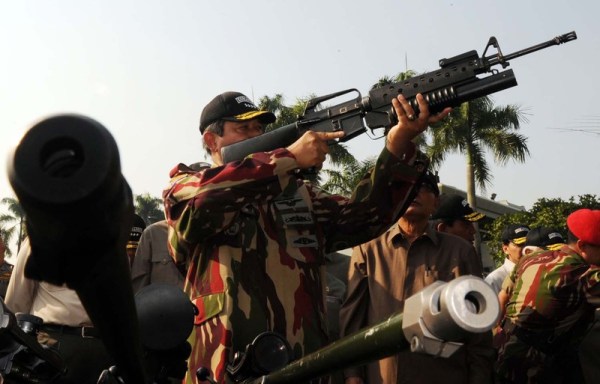
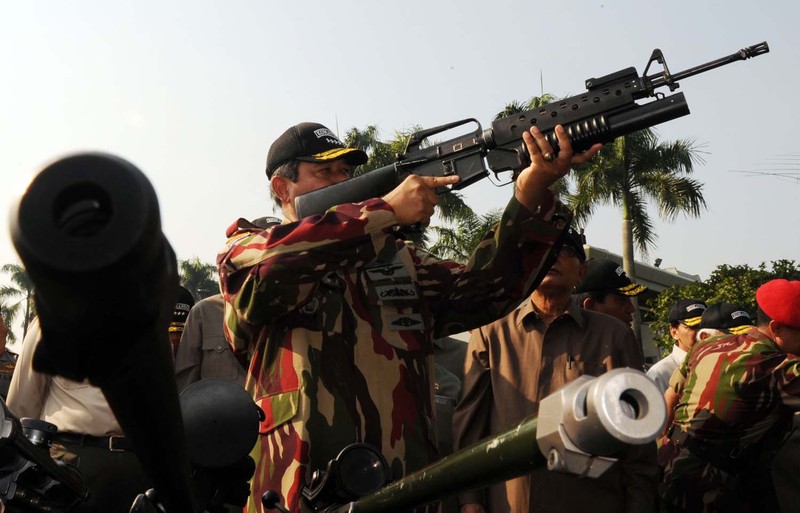
General SBY - Military approach will not solve Papua's problems

Bintang Papua, 19 February, 2012Manokwari: The holding of constructive dialogue or communications between Jakarta and Papua as mentioned by President Susilo Bambang Yudhoyono (SBY) is regarded in some circles as being part of the solution to the problems occurring in Papua.In the opinion of Mervin Komber, a Papuan member of the DPR, the Indonesian Parliament, such a dialogue should take its cue from the road map for Papua, and lead to better living conditions for the  Papuan people. According to Komber, in order to achieve this, the agenda for such a dialogue should reflect the actual conditions currently confronted by the  Papuan  people.

With regard to the leaders who should be invited to participate in such a dialogue, they should be  people with the ability to deal with all aspects of the situation, including governance, parliament, customary groups, spiritual leaders as well as including people from the ranks for ordinary Papuans who enjoy the confidence of their respective groups.

‘All of us  who are in favour of dialogue must seek to achieve something positive for Papua,’ he said in Manokwari recently.

While he supports dialogue, Komber is critical of recent steps taken by SBY in his attempts to work out the best format  for the dialogue. In his opinion, the President’s decision to ask Papuan religious leaders  for their opinion  about the format and the agenda for this dialogue was a mistake. Komber believes that the religious leaders will themselves be  part of the dialogue, which means that the President should not have discussions with them about the format of the dialogue. But the President should summon provincial and local leadeers such as members of the DPRD, the DPD and academia to get their views on the format.

Moreover, if  only some elements are asked to discuss the format, he fears that this could result in misunderstandings as a result of the various inputs received by SBY. ‘If there are disagreements between some of these leaders, the people around SBY might end up passing on erroneous information about the situation in Papua,’  said Komber  who is a former activist from the Catholic students organisation, PMKRI.

The same might also occur with regard to the final objective of the dialogue, according to Felix Wanggai, a special staff member [not clear what staff this refers to] who looks forward to seeing Papua become a zone of peace. In his opinion, this may mean that the  people at the presidential palace do not properly understand  what it is that the Papuan people want. ‘The dialogue we have in mind is only intended to accelerate development in Papue,’ he said.

Jakarta has still not take any decision about when this dialogue or constructive communication should take place. According to Komber, the Jakarta-Papua dialogue is very urgent indeed and SBY should not postpone it. He went on to say that the dialogue is closely related to the implementation of special autonomy, OTSUS which was enacted eleven years ago. This means, in his opinion, that this dialogue should take place some time before the end of 2012.

‘I very much hope  that it will take place during the course of this year because OTSUS will remain in force for only another ten years, whereas the dialogue should occur while OTSUS remains in force.’

Finally he said that as far as he is concerned, the venue of the dialogue is not  a problem . The crucial thing is that the dialogue should be inspired by the determination to achieve a long term solution for Papua. ‘The dialogue could be held in ways that accord with Papuan traditions, such as those used by customary groups, sitting in their honai, or other such places,’  this young legislator said in conclusion.

[Translated by TAPOL]

Indonesian police conduct armed sweep of treason defendants in their cells

from WestPapuaMedia sources in Jayapura

Monday February 20, 2012

Extraordinary scenes occurred at Abepura prison in West Papua on Saturday night when heavily armed police stormed the cells of non-violent Papuan leaders currently on trial for treason.

The unusual and heavy handed security sweep was carried out between 9-10 pm on Sunday night and involved 3 truckloads of armed Dalmas anti-riot paramilitary police; 2 truckloads of Brimob police, and a detachment of the fully armed prison anti-riot officers.

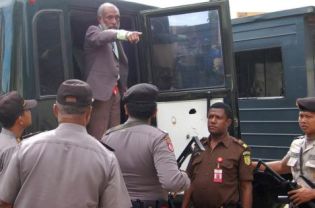
Forokorus Yaboisembut (Jakarta Globe)

The cells of a number of West Papuan political prisoners were turned over in the sweep, and all prisoners possessions were removed, including pens, paper, files, books, letters, plates, drinking glasses, cutlery knives, guitars, and music tapes, including lawyer-client privileged communications and defence notes.  Mobile phones were not found however, according to sources at the prison.

It is believed the targets were  five leaders of the Third Papuan People’s Congress that peacefully declared independence from Indonesia on October 19, 2010, sparking a brutal and bloody crackdown by Indonesian occupation forces.

Forkorus Yobeisembut, and Edison Waromi, the President and Prime Minister respectively of the Federated Republic of West Papua, together with Selpius Bobbi, Dominikus Sorabut, and Agus Kraar are all on trial for treason charges.  The hearing on Friday had to be suspended after the prisoners refused to return into the courtroom due to concerns of the conduct of witness cross-examinations.  The trial was adjourned to February 21.

Reliable sources close to the accused Congress leaders have told West Papua Media that the raids relate to rumours circulating that the five defendants will be broken apart and moved to separate prisons away from Papua. These rumours have been propagated by unknown parties, however regular prison transfers are a common tactic by the Indonesian state on Papuan political prisoners.  The Indonesian Attorney-General and the Prosecutors office have repeatedly stated publicly that the trial and prisoners would be moved from Papua if any unrest occurs, but there is significant local Papuan resistance to such a move.

Local observers also have suggested that the bizarre raids had occurred after police objected to the defendants conduct in court and sought to reassert the “authority of state” by behaving unpredictably.

According to a series of urgent text messages sent to various advocates, the head of the prison at Abepura opened up the political prisoners section to normal criminals allowing them to mix freely.  This is often a tactic utilised by prison authorities to effect violence on prisoners without prison guards having to commit the abuse personally.  The political prisoners source told West Papua Media that in a disturbingly strange move, the prison chief then invited the political prisoners to sit without resistance with in a room together with hardened murderers, robbers and rapists, many of whom are from other parts of Indonesia.

Prison authorities did not reply to any requests for clarification from West Papua Media about the events at Abepura.

Morning Star flag flew for 5 hours in Serui

Unofficial Morning Star flag, used by supporte...
Image via Wikipedia
Bintang Papua,13 February 2012Serui: The Morning Star flag , Kejora, the flag of the separatists in Papua,  was held aloft for five hours in Serui, district of Yapen islands on Saturday, 11 February.

The local chief of police said that  this had been done by people who dont want peace and tranquillity  to prevail in Serui. He also called them ‘irresponsible elements’.

The police chief, Deniel P.Dwi Atmoko,  said that they were investigating the motives of those involved. ‘However, we can conclude that these people do not want peace to prevail and always engage in activities which are in violation of the law and one of things they do is to raise the kejora flag.’

He then went on to express his thanks to all those who had assisted the police and the army (TNI)  in pulling down the flag. ‘This proves that  the majority of people in Serui are very eager for peace. This is clear from the fact that the local people waited until the security forces had pulled the flag down.

He expressed the hope that these elements would not do such a thing again. ‘Stop doing things that clearly violate the law because this can only result in difficulties for the individuals themselves as well as for their families. We must work together to develop Serui in peace and tranquillity  so as to ensure that the activities being undertaken by the local government can be achieved.’

[Abridged in translation by TAPOL]

Concerns of JPIC in Papua regarding the situation in Papua

(Reflections on the situation in 2011)

From 13 to 16 February 2012, the secretariats of the Justice, Peace and Integrity of Creation (JPIC) in Papua (Franciscans JPIC in Papua, JPIC Archdiocese of Merauke, JPIC Agats Diocese, JPIC of Timika Diocese and JPIC of Sorong Diocese) held an annual meeting in Sentani. The outcome of this meeting is summed up in the following reflections on the situation in Papua with some recommendations.

The secretariats of JPICs in Papua confirm that the pro-investment policy of the Government of Indonesia and the torture and cruel treatment by the security forces have undermined law and the dignity of the indigenous Papuans, marginalising and threatening their right to life.

Situation in Papua in 2011

The indigenous Papuans have suffered from different investment policies of the Government in Papua. We found that the development policies on investment have caused the Papuans to lose their customary lands, identity, culture, livelihood, and they threaten the right to life. They have also become the source of horizontal conflict, as shown in the MIEFFE programme in Merauke, the palm oil plantation of PT. Merdeka Plantation Indonesia, PT. Merdeka Tapare Timber, PT Freeport Indonesia in Mimika, PT. Sawita Tandan Papua and PTPN 2 in Kerom.

The indigenous Papuans live in fear. The security forces use violence, torture, cruel and inhuman treatment against the Papuans which they justify with claims that their victims are supporters of the Free Papua Movement (Organisasi Papua Merdeka – OPM), as shown in the case of violence and torture against civilians during the 3rd Papuan Congress, the case of Tingginambut, the armed conflict in Puncak Jaya and Paniai and the conflict during the regional elections.

The indigenous Papuans are confused by the attitude of the Provincial Government which is not critical but rather tends to support the policy of the Central Government, as demonstrated in the case of the adoption of the policy on the Special Unit for the Acceleration of Development for Papua and West Papua (UP4B). This situation has put the future of the indigenous Papuans at risk. They are confronted with the difficulty to fight for their basic rights. The Papuan People’s Assembly (Majelis Rakyat Papua – MRP) and the Provincial Legislative Assembly of Papua (Dewan Perwakilan Rakyat Papua – DPRP) have been made powerless. MRP and DPRP only execute the orders of the Central Government and do not defend the interest of the Papuans.

The composition of the indigenous and non-indigenous Papuans is not in balance. The population census of the Indonesian Statistical Bureau (BPS) shows that the population of indigenous Papuans in the Provinces of Papua and West Papua is 1.760.557 or 48.73% of the total population, while the non-indigenous population is 1.852.297 or 51.27% of the total population of 3.612.854. It shows that the indigenous Papuans are a minority group in their own land while four decades ago they were the majority (96.09%).

Recommendations:

1. The Government of Indonesia should stop all investment that harms the right to life and the livelihood of the Papuan and conduct an independent evaluation of the companies investing in Papua. The Government of Indonesia should foster community-based development policies.

2. The Indonesian Military and the Indonesian Police should resolve the problems in Papua without using violence and they should bring to justice all perpetrators of the conflict in the area of PT. Freeport Indonesia.

3. In dealing with political demonstrations in Papua, the Government of Indonesia and the Police/Military should respect the right to freedom of expression of the Papuan people.

4. The Papuan People’s Assembly and the Provincial Legislative Assembly of Papua should genuinely represent the aspirations of the Papuans especially in addressing the issues that are causing the Papuans to become a minority in their own land.

These are our reflections and recommendations based on our wish to improve the future of Papua and to respect the human rights of the indigenous Papuans.

Abepura, 16 February 2012

P. Emanuel Tenau, Pr (Director of JPIC Diocese of Sorong) Br. Edy M. Rosaryanto, OFM (Director of Franciscans JPIC Papua). Ms. Veronika Tri Kanem (Program Manager of JPIC Merauke Archdiocese) Fr. Saul Wanimbo, Pr (Director of JPIC Timika Diocese) Fr. Hendrik Hada, Pr (Director of Agats Diocese)

Create a website or blog at WordPress.com

Up ↑