A History of the Morning Star Flag of West Papua

by Leonie Tanggahma for West Papua Media

Historical Analysis

December 1, 2012
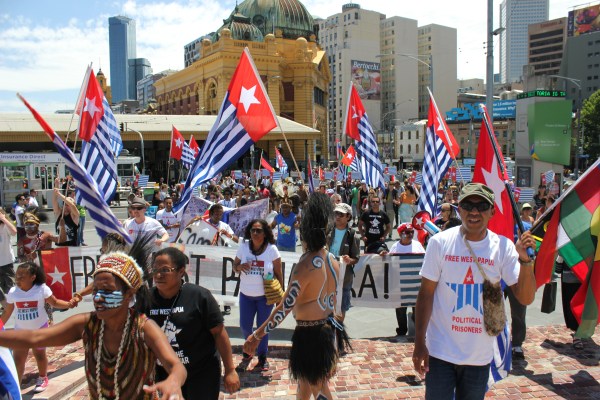
West Papuan Morning Star flags flying at Federation Square, Melbourne (Australia), December 1, 2012.  (Photo: West Papua Media)
West Papuan Morning Star flags flying at Federation Square, Melbourne (Australia), December 1, 2012. (Photo: West Papua Media)

For more than 50 years, the Morning Star Flag has been the symbol of West Papua’s unity and its quest for Freedom and Justice. Thousands have been inspired by it, as it became the main icon embodying the struggle for Independence. And this flag, just like any other flag of any other country, has a history, a proud history.

5 April 1961: Inauguration of the New Guinea Council

On 5 April 1961, a representative body for the then Dutch colony of Netherlands New Guinea was inaugurated: the New Guinea Council or Nieuw Guinea Raad[1] [1]. It was the task of the Council to make the wishes of the Papuan people known on the issue of self-determination, within a year. However, news came that the United States of America and Indonesia were putting pressure on the Dutch  to convince them to transfer its colony to the United Nations, and then to the Indonesian administration. The members of the New Guinea Council immediately gathered for an emergency session and appointed a National Committee to draft a Manifesto expressing the wishes of the Papuans which would include national symbols for the upcoming State.

19 October 1961: Flag and other national symbols officially adopted by way of Manifesto

Committee members Bonay, Jouwe, Tanggahma and Torey were asked to submit designs for the flag and arms. Mr. Torey withdrew and a choice had to be made between the designs of Messrs. Bonay, Jouwe and Tanggahma. The designs of Mr. Jouwe were accepted by 14 votes to 17 as national symbols.  After the national symbols were officially adopted, everyone was visibly moved and proud. According to official testimonies: “Then, all those present rose from their seat and while the emotion was clearly overtaking all those present the manifesto was read by the Chair of the National Committee, Mr. Willem Inury; it was subsequently unanimously accepted and signed by the National Committee. The attendees were then invited to also sign the manifesto … The national flag consists of a red vertical band along the hoist side, with a white [five-pointed] star in the center. Adjacent to the red band, is a series of [consecutive] blue and white lines, with a total of seven blue and six white lines.”[2]

This manifesto dated 19 October 1961 stated that: “in accordance with the ardent desire and the yearning of our people for our own independence, through the National Committee and our parliament, the New Guinea Council, insist with the Government of Netherlands New Guinea and the Netherlands Government that as of 1 November 1961,

a) our flag be hoisted beside the Netherlands flag;

b) our national anthem (“Hai Tanahku Papua”) be sung and played in addition to the Netherlands national anthem;

c) our country bear the name of Papua Barat (West Papua), and

d) our people be called: the Papuan people.”[3]

he Manifesto of 1961 may not have been an independence Proclamation, but its wording was strong and clear in relation to the will of the Papuan people to become independent, it was a declaration of intent, as it also stated that: “On that basis, we, the Papuan people, demand to get our place in the midst of other independent nations and peoples. In addition, we, the Papuan people, make our contribution to the preservation of peace and freedom around the world.”[4]

1 December 1961: Official inauguration of the flag as a territorial flag

The Dutch accepted most of the terms of the Manifesto except for the date of installation and the denomination of the flag: the inauguration of the flag happened on 1 December and not on 1 November as requested by the Papuans. The General Assembly of the UN was to hold a meeting in late November on the issue, and recognition by the Dutch of the symbols could have been interpreted as an endorsement of an independent West Papua by the Dutch Government. The Dutch did not want to provoke the Indonesians, even if it meant that the demand of the Papuans would not be heard. In terms of the denomination, the Dutch authorities recognized the new flag as a territorial flag (landsvlag) and not as national flag.

All the specifications concerning the flag and other Papuan symbols can be found in the so-called “Territorial Flag Ordinance” (or “Landsvlagordonnantie”) Number 68 of 1961. This Ordinance specifies among others that: “(1) The territorial flag of Netherlands New Guinea shall be a rectangle consisting of a vertical wide red striped at the hoist and seven horizontal blue stripes separated by six white stripes. In the centre of the vertical red stripe is a white five-pointed star, with one point pointing vertically upwards. The five points of the star shall each form an angle of 36 degrees. (2) The height and length of the flag shall bear to each other the proportion of 2 to 3. The width of the red stripe shall be two fifth of the height of the flag. The blue and white stripes shall be equal in height. The diameter of the circumscribed circle of the star shall be seven eighths of the width of the red stripe.” [5]  Another ordinance (Number 69 of 1961) provided for a national anthem for Netherlands New Guinea. Ordinance Number 70 of 1961, also called the “Administrative Order for the implementation of Section 2 of the Territorial Flag Ordinance”, stipulates the terms and conditions under which the flag is to be raised. And Section 5 states: “This Order, which may be cited as Flag Order, shall come into operation on December 1, 1961.”[6]

And so on 1 December it happened, for the first time, our Morning Star flag was raised, next to the Dutch flag; our national anthem (”Hai Tanahku Papua”) was played and sung together with the Dutch national anthem; our country was given the name of Papua Barat (West Papua), and our people were given a name: the Papuan people.

Nine years of international Fraud and Deception led by greed, racism and the total disrespect for human life

Just 18 days after the installation of the Papuan symbols, on 19 December 1961, the President of Indonesia, Soekarno, made his call for the infamous Tri Komando Rakyat (or TRIKORA), the People’s Threefold Command. On that day he called for a total mobilization of the people of Indonesia, (1) to destroy what he considered a Dutch-promoted Papuan State; (2) to fly the Indonesian flag over the territory of West Papua, which he erroneously called West Irian; (3) to prepare for war over what he called West Irian. For Indonesians this represented the so-called liberation of the territory from the Dutch. For Papuans the TRIKORA was the call for an illegal military aggression from a country which did not recognize its sovereignty. Military aggression was followed by legal deception as the Dutch and the Indonesians signed the New York Agreement of 15 August 1962, an agreement regarding the future of the Papuans but they themselves were never consulted. The Papuans were betrayed by those who signed this agreement which regulated the transfer of the administration of New Guinea to the United Nations. This administration lasted from 1 October 1962 to 1 May 1963. Then it was to be handed over to Indonesia for a period of six or seven years, after which the Papuans were supposed to freely choose, through a referendum, whether to join Indonesia or become an independent nation. Legal deception was followed by political fraud. In August 1969 the so-called “Act of Free Choice” was organized. At the time, West Papua had been under Indonesian rule for over six years: every expression of Papuan nationalism was systematically bloodily suppressed, possible opponents were arrested and tortured, punitive expeditions were carried out across the country and bombings and rocket attacks were conducted by the Indonesian army. The so-called “Act of Free Choice” itself was pure deception, fraud and deceit, a stage-managed play in which Indonesian officials selected 1026 Papuan electors who voted on behalf of 800,000 Papuans at the time. The electors were all carefully prepared for the Musyawarah: an Indonesian system of decision-making where there is unanimous agreement: 1025 Papuans finally decided unanimously that they wanted to belong to the Republic of Indonesia (one was sick that day). The normal one-man/one-vote principle usually applied for a referendum had not been respected as the Indonesians argued that Papuans were too primitive!

1 July 1971: the territorial flag becomes a national flag

In protest against the failure of the implementation of the “Act of Free Choice” the Free Papua Movement (OPM) proclaimed the independence of the Republic of West Papua on 1 July 1971.  Under Article 2 of UN resolution 1514: “All peoples have the right of self-determination. By virtue of that right they freely determine their political status and freely pursue their economic, social and cultural development.”  Another UN resolution, Resolution 1541, explains that exercising your right to self-determination means that you are allowed to choose between independence, autonomy or integration within an existing state. Since the beginning, the Papuans chose for independence; and they opted for that same option time and time again.

The Manifesto of 1961 was a declaration of intent; the Proclamation of 1971 was the realization of that intent. The proclamation stated: “With the help and blessing of God Almighty, we take this opportunity to declare to you all that today, 1 July 1971, the land and people of Papua have been proclaimed to be free and independent (de facto and de jure)”.

On 1 July 1971, the Papuans chose to take the Morning Star Flag which had been recognized by the Dutch as a territorial symbol. The Papuans decided to proclaim it a NATIONAL symbol; they did the same with the national anthem (Hai Tanahku Papua).


[1] Newspaper report. Sydney Morning Herald, 6 April 1961.

[2] Official government magazine Pengantara of 21 October 1961.

[3] Official government magazine Pengantara of 21 October 1961

[4] Official government magazine Pengantara of 21 October 1961

[5] Bulletin of Ordinances and Decrees of the Government of Netherlands New Guinea, 1961, No. 68, issued on 20 November 1961.

[6] Bulletin of Ordinances and Decrees of the Government of Netherlands New Guinea, 1961, No. 70, issued on 20 November 1961

Police chief calls on Papuans to ‘remain calm’ as 1 December approaches

Morning Star Moon Landing
Ironic Morning Star Moon Landing (Artwork: AK Rockefeller)


Tabloid JUBI

28 November, 2012

The police chief  of the district of Mimika, Jeremias Runtini has called on the people to ‘remain calm’ as1 December approaches. He said that people should act together to safeguard security and public order and should avoid getting involved in activities that tend towards subversion such as flying the Morning Star flag.

He said that to mark its anniversary, the OPM, Organisasi Papua Merdeka, the Papuan Freedom Movement, usually flies the Morning Star flag and other people join in this as well.

‘There is nothing special about 1 December,’ he said, adding that the police and the military will be patrolling the area, after mustering their men on Timika Indah Square,’ he told journalists, as 1 December approached.

He said that in anticipation of people flying the Morning Star flag, his men will be mounting patrols throughout the region of Mimika. ‘I very much hope that people will not get involved in activities that are in violation of the laws in force in the Unitary State of the Republic of Indonesia, ‘especially bearing in mind that flying the Morning Star flag is regarded as an act of subversion and is therefore against the law.’

Repeating his call for people to ‘remain calm’ and avoid doing anything that is against the law,  he called on people to support all the development activities that are being undertaken. ‘Let us join together and get involved in these development activities; I am ready to be a partner in these joint endeavours.’

He told journalists that during the three days approaching 1 December, the police will be at the top level of readiness during these three days.

‘All of us must think positively and refrain from doing anything that is in violation of the law, so as not to disrupt peace and tranquillity.’

[Translated by TAPOL]

(WPM NOTE: West Papua Media will be providing monitoring services for international media for December 1 events.  Please contact the editorial team to assist or report.  Donations are required to enable effective monitoring.)

Solidarity organisation calls on police not to use violence on 1 December

Bintang Papua,
26 November 2012Jayapura: Alius Asso, the deputy chairman of SHDRP,  the Papuan Civil Society Organisation for Solidarity, Law and Human Rights, has urged the police to use persuasive methods on 1 December when demonstrations will take place to mark the anniversary of 1 December.

Asso said that on that day, there will be actions by indigenous groups in seven regions that claim to be part of the Federated Republic of West Papua  in Mamta, Saireri, Bomberay, Domberay, Me Pago, Ha Amin and several other places, which will take the form of prayer meetings or flag ceremonies.

However, Asso said that it was not possible for him to tell groups not to wave the Morning Star flag  ‘because they have every right to do so’.

He said that it was up to the security force to act in a professional way during these coming events. Demonstrations on 1 December have become a regular annual feature for Papuan people to  commemorate this historic day and this has been going on for many years.

‘The police should act wisely and professionally. They should avoid repressive actions. If they fail to do so, there will be many victims among the Papuan people . In Sentani, it is likely that  the event will take place at the grave of [the assassinated Papuan leader] Theys Eluay with prayers being said.’ But Asso said  he was not sure what would happen in Jayapura.

The chief of police for Papua, Inspector-General Tito Karnavian has said that the army (TNI) and the police will be out guarding the areas because this is an integral part of their duties.. But Asso said that they should not resort to the use of violence. ‘If the demonstrators only intend to say prayers, why should this be banned by the security forces?’

He went on to say that the spirit of democracy is developing and people are expressing their aspirations in peaceful ways, but if the State goes on silencing democracy, it will be responsible for closing down the space for democracy and there will be yet more injustices and human right abuses.

‘Everyone agrees about the need for security and moreover there is a law in force which guarantees protection for the citizens. And this is quite clear in the first article of the 1945 constitution.’

[Translated by TAPOL]


FIVE MONTHS AS REFUGEES EATING ONLY SAGO WORMS AND WOOD WORMS

ELSHAM NEWS SERVICE

16 November 2012

Keerom, – It was early and the streets were not too crowded  when I started my journey from Abepura, Kota Baru District at 6.30 a.m. (Papuan time) to Arso, in Keerom which is a drive of about two hours and a half by two wheeler.

After arriving in Arso, I went on to the village of Kwor and arrived at about 9:16 a.m., and from the village of Kwor I continued the journey towards the bivouacs of the internally displaced people (IDPs) who had run into the forests, out of fear for their lives.

During the six-hour drive through the gardens, rivers and forest, I arrived at the bivouacs of the IDPs: the 38 people were scattered in four different bivouacs; they came from three villages, namely, Sawyatami (11 IDPs), Workwana (9 IDPs) and of PIR III Bagia (18 IDPs).

The group of IDPs who settled in the bivouacs in the middle of the forest, is composed of 20 men and 18 women. Among the IDPs, there are seven (7) children under the age of five (toddlers).  In addition to parents and toddlers, there are 15 students consisting of eight (8) elementary school students, four (4) junior high school students and three (3) high school students. These students have not attended school for the last five months.

In the camps, the IDPs could rely only on food collected from around the bivouacs likesago, sago worms, wood worms and wild boar. “We have stayed out here in the forest for five months, and in order to survive, the only thing we could eat were sago worms and wood worms and the only thing we could drink was water from the creek,” said LK (68yr), a traditional leaders who is also on the run.

The condition of the refugees is very deplorable: there are two pregnant women, namely the two-month pregnant Rosalina Minigir (36 yr), and the four-month pregnant Agustina Bagiasi (35 yr). Another woman, Aleda Kwambre (28 yr) gave birth to a baby girl at the shelter camp. At the present, two babies were found to be in very poor health conditions: Penina Pekikir (3 yr) and Ruth Kimber (1 yr), and if the situation persists they could turn critical.

“I am afraid of Kopassus [the Indonesian special forces]. I saw how they came with their guns, entered into the village of PIR III and started shooting. So I was afraid of going to school,” said CK (17) who ran away and stopped attending school because he did not feel safe anymore, after all the acts intimidation by the security forces.

NY (8yr) expressed the same fear as CK, as she says with a timid voice:”It’s been a long time since I attended school, I was afraid when I saw the soldiers flying over the village with their helicopters.”

MT (38yr) also expressed disappointment with the local government of the Keerom District, as it was unable to ensure safety and security for the indigenous Papuans in Keerom. “I am angry because these high officials, local government officials, regents, scholars, community leaders, traditional leaders and religious leaders,  do not care about us in this forest. I was scared when I saw these police officers, they went into the villages and they just started shooting. I was afraid so I had to run into the forest” she said, sobbing.

The refugees expressed the hope that ELSHAM Papua would return with international human rights institutions to mediate their return to their respective villages. “Christmas is near; we were not able to gather money for the celebrations. These children have not attended school for five months. So we really hope that ELSHAM can help us so we can return to our village,” said FK (50yr), filled with hope.

As reported earlier by ELSHAM, the 38 locals had fled from the three villages because they were afraid of ongoing sweeping operations conducted by the joint Indonesian military and police forces in Keerom, since the shooting of Yohanes Yanuprom, the head of the village of Sawyatami on 1 July 2012.

Up to the date of this report, the IDPs remain in the forest without proper food and adequate medicine.

Elsham News Service


LP3BH-Manokwari calls for dialogue between Papua and Indonesia

COMMENT by Yan Christian Warinussy
Executive-Director of LP3BH, Manokwari
November 14, 2012In the concluding months of 2012, there have been many more acts of violence in Papua and West Papua which reflects very badly on the government of Susilo Bambang Yudhoyono (SBY) at a time when development, good governance and security  are essential in the Land of Papua as an integral part of the Republic of Indonesia (NKRI). This is happening as a time when many countries  which are members of the UN Human Rights Council are closely watching the situation, following the  Universal Periodic Review  in May 2012, which made  180 recommendations, thirty of which were rejected by the Indonesian government.

One of the recommendations that was rejected was that arrests and detentions on the basis of Articles 106 and 110 for treason should stop. This means that the state will continue to take firm measures, possibly including the use of firearms, against peaceful actions by members of civil society who give expression to their opinions and political views which are opposed to the views of the government. Several activists of the  National Committee of West Papua (KNPB)  have been summoned and interrogated and are likely to be charged for treason. One of these activists is Alexander Nekenem, chairman of the DWP, the local parliament, who was recently summoned  by the police in Manokwari.

The Indonesian government has also rejected the recommendation regarding freedom of expression for persons who have been detained merely for taking peaceful actions, a recommendation that was made by the USA and Canada. What this means is that Filep Kara, Forkorus Yaboisembut, Edison Waromi, Selpius Bobii, Sananay Karma and Dominikus Sorabut  will continue to be deprived of their lawful right to freedom of expression.

Another very bad thing for the Papuan people is that the Indonesian government has rejected the recommendation by the Japanese government which called on Indonesia to end all violation of  human rights  by the security forces (TNI and Polri, the army and the police), because the Indonesian government claims that this is not relevant for Papua because it is not in accord with the facts, whatever they mean by the facts. In my opinion, the Indonesian government’s rejection of this means that there will continue to be an intensification of violence and hence systematic abuses of basic human rights which will continue to occur into the future in the Land of Papua.

In view of all this, as Executive Director of the LP3BH and a defender of human rights in the Land of Papua, I urge the SBY government  to open up space for dialogue  between Papua and Indonesia before the end of 2012. The SBY government should appoint a team of people to meet Father Dr. Neles Tebay, co-ordinator of the Papuan Peace Network, in order to discuss  the format of this dialogue. This would mean that by early 2013,  preparations could be started for a dialogue between the Indonesian government and the Papuan people.

In my opinion, dialogue is the best path to take, in the interests of justice, peace and dignity on both sides, as the way, according to universal standards, to resolve  the conflicting political views which have existed for such a long time, causing the deep frustration  that has borne down both on the Papuan people and the Indonesian government to this very day.

In this way, the Indonesian government would  win the respect of the international community for  having accepted that the political conflict that has lasted for such a long time should be resolved b means of dialogue.

[Translated by TAPOL]


Create a website or blog at WordPress.com

Up ↑
