Police disperse humanitarian action in Jayapura

JUBI, 19 July 2012
Note: The bulk of this posting was posted yesterday but we are re-posting it with an important addition from Andreas Harsono. TAPOL]

Note: The Papuan Solidarity  for Human Rights Victims, SKPHP, is the
organization which supports political prisoners, including Filep
Karma, in Papua. They regularly do fund raising to buy medicines for
the prisoners. In 2010, they did a specific campaign for Filep Karma,
raising around $3,000 from the streets. Now the Indonesian police
stopped them from doing that on the grounds that SKPHP has no legal
entity.

Regarding Filep Karma’s fund raising, we have now raised IDR116
million. It is enough to do the surgery in Jakarta. He will meet his
local doctor, Donald Arrongear, this week. SKPHP and Karma are still
negotiating with the Ministry of Law and Human Rights about he goes
directly to the PGI hospital in Jakarta (without going to the Jakarta
prison first). They’re also suspicious with a new prison guard from
Java Island who wants to accompany him to Jakarta.

Police disperse humanitarian action in Jayapura

JUBI, 19 July 2012

The police in Papua forcibly dispersed  a humanitarian action taking
place when Papuans were out collecting money to help political
prisoners. They were from an organisation called Solidarity  for Human
Rights Victims, SKPHP. The police said that they had dispersed the
people because the SKPHP  has not registered with the provincial
administration.

The news was confirmed by Peneas Lokbere, a member of the SKPHP, who
told JUBI that before undertaking the action they had notified the
police of their intentions in both Abepura and Jayapura. Having done
this, it meant that the police would grant permission for the action
to take place.

Nevertheless, while the action was in progress on Friday at 1pm, the
police dispersed those taking part in the action. ‘We were forcibly
dispersed,’ said Peneas. ‘They said that this was because  we had not
registered the organisation with the authorities. and therefore, we
were not allowed to continue with this collection of funds.’ He also
said that after the police came to disperse the action, they dispersed
peacefully.’We did not offer any resistance. If we had resisted, it
would have led to a lengthy process.’

Peneas said that  they would follow up their action on Friday, 20
July. ‘We will go to the police and ask for permission to continue
with action.’

The street collections were being undertaken to provide for the
medical requirements of the political prisoners and the other prisoner
who are  ill at the prisons in Abepura and Jayapura. Among those who
are ill in Abepura Prison are Filep Karma, Ferdinand Pakage and Jefrai
Murib.

Their intention was to carry out this action from 9am Thursday 19 July
until Saturday.21 July.

[Translated by TAPOL]

The article is illustrated by a photo showing a large banner which
says: ‘The government doesn’t want to pay for medical treatment for
Filep Karma and Ferdinand Pakage’.   They are carrying posters which
say: ‘The Papuan  political prisoners are not criminals.’

Statement from the International Parliamentarians for West Papua on the Escalating Violence in West Papua

West Papua flag
West Papua flag (Photo credit: lussqueittt)

P.O. Box 656, Oxford, OX3 3AP England, U.K.Date: : July 22nd 2012

Statement from the International Parliamentarians for West Papua on the Escalating Violence in West Papua

To: Mr. Susilo Bambang Yudhoyono, President, Republic of Indonesia
Mr. Andi Matalatta, Minister of Justice and Human Rights, Republic of Indonesia
Mr. Hendarman Supandji, Attorney General, Republic of Indonesia
Gen. Bambang Hendarso Danuri, Chief of National Police, Republic of Indonesia

As members of the International Parliamentarians for West Papua, we voice our concerns over the escalating violence in West Papua, especially in Wamena and Jayapura.
We are saddened by the recent murder of West Papuan independence leader Mako Tabuni and we express our sincerest condolences to his family and friends. We call on you to conduct a thorough investigation into Mako Tabuni’s death.

We are also concerned by the recent re-imprisonment of Buchtar Tabuni and his colleagues, Jufri Wandikbo and Assa Alua, and the continued imprisonment of Filep Karma, an Amnesty International recognized prisoner of conscience, who was sentenced to 15 years in prison for raising the Morning Star flag at a peaceful protest.  We ask you to release and to drop all charges against these detainees and others who have been held for peacefully expressing views. We also request your help in assuring that Mr. Tabuni and his colleague be released immediately from custody, as we have further concerns that he may be at risk of torture and other ill-treatment.

We call on you to allow foreign journalists and humanitarian organizations entry into West Papua in order to provide a comprehensive report of the human rights situation there.

As the International Parliamentarians for West Papua, we support the indigenous people’s of West Papua’s call to a genuine act of self-determination, a right which was not recognized in the 1969 Act of Free Choice. We are therefore deeply troubled by your government’s suppression of political activity in West Papua. We urge you and your government to end the violence in West Papua, by listening to West Papuans call to self-determination, rather than attempting to silence them.

Signed,

Andrew Smith, MP (United Kingdom)
Caroline Lucas, MP for Brighton Pavilion House of Commons (United Kingdom)
Lord Richard Harries (United Kingdom)
Dr. Russel Norman, MP (New Zealand)
Jamie Hepburn, MSP (Cumbernauld and Kilsyth, Scotland)
Catherine Delahunty, MP (New Zealand)
Bill Kidd, MSP (Glasgow Anniesland, Scotland)
Hon. Ralph Regenvanu, MP (Port Vila, Vanuatu)
Cllr Alex Sobe (Leeds City Council)
Eugenie Sage, MP (Aotearoa)
Cate Faehrmann, MLC Green MP (Australia)

Is Australia funding Indonesian Death Squads? Densus 88 in West Papua

Statement by the West Papua Project, Centre for Peace and Conflict Studies, University of Sydney, 16th July, 2012

Questions are being asked about the role that the partly Australian funded
and trained elite Indonesian police squad, Densus (Detachment) 88, has
played during the recent violence in West Papua. Set up in the wake of the
Bali terrorist bombings, Densus 88’s mandate was to tackle the rise of
domestic terrorism in Indonesia. Australian support might have been
motivated by revenge as well: 88 Australians were killed in the Bali attack.
While acclaimed for capturing or killing known and suspected terrorists,
Densus 88 also gained a reputation for extreme violence: many suspects being
killed rather than arrested. Now reports are suggesting that Densus 88 is
operating in West Papua, possibly clandestinely, and has been responsible
for the assassination-like killing of Papuan political activist, Mako
Tabuni, on June 14.

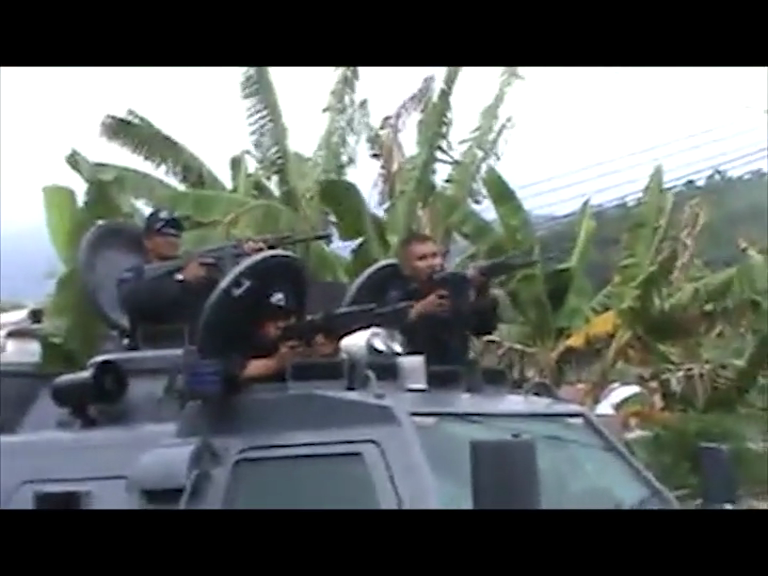
Detachment 88 troops firing live rounds at civilians during the brutal crackdown on the Third Papuan People’s Congress, October 19, 2011 (West Papua Media video still)

While Indonesian National Police spokesman, Saud Usman Nasution, has denied
Densus 88 is operating in West Papua he has left the door open for their
involvement, saying in the Jakarta Globe on June 27, “Densus will be
deployed if terrorism occurred there.” However other reports, for instance
from Kontras Papua, a local human rights organization, state that Densus 88
is already operating in West Papua “carrying out undercover activities”
(Cenderwasih Pos, June 23). Kontras Papua believes that Densus 88 was
involved in the Tabuni killing – where the victim is reported to have been
standing in the street eating betel nut when three unmarked cars pulled up
nearby. With no provocation a person emerged from one car and shot the
victim dead.

Police report that the victim had tried to snatch a weapon from the
plainclothes police involved and was killed in the resulting fracas. Police
also claim that Mako Tabuni was wanted for a series of shootings that had
occurred in Jayapura over the previous few weeks: a claim that seems
unlikely given his role as Deputy Director of KNPB (the West Papua National
Committee), which is a non-violent political organization. Tabuni had also
been publicly calling for an independent investigation into the recent
shootings of which he was accused. Nonetheless, any charges should have been
heard in court and given due legal process, now impossible with Tabuni’s
death. Other reports of Densus 88 activities in West Papua have come from
respected Papuan leaders. Reliable sources observed Densus 88 police arrest
KNPB member, Zakeus Hupla, in the lobby of the Dhanny Hotel, Entrop,
Jayapura, on the morning of June 23. Other reports indicate further arrests
of KNPB members by Densus 88 and their subsequent torture. According to
family members, no arrest warrants were issued by Indonesian police for
these arrests, and the Jayapura police deny that the KNPB members are in
their custody. Indeed it is unclear if these men have been arrested,
abducted or ‘disappeared.’

These events are of genuine interest and concern to Australia because
Australian taxpayers’ money is spent training and maintaining Densus 88.
This organization has a legitimate role to play in countering the rise of
terrorism, but it should act strictly within its organisational mandate. If
Australian taxpayers are indeed partially funding a clandestine force
involved in killings, abduction and torture of Papuan activists an
unacceptable situation has developed. These events and allegations must be
comprehensively investigated and all funding for Densus 88 frozen until
either the allegations have been disproved or the individual police officers
guilty of crimes arrested and tried in an open court. We call on the
Australian government to immediately halt the funding of Densus 88, to
investigate the claims of its misconduct, and to apologise to the Papuan
people if they are proven to be true.

Act of Terror perpetrated against the President of the Alliance of Baptist Churches

Report from Matius MuribAt around 7.30pm, on Thursday 6 July,  a group of four policemen from the elite force Brimob, Papua District, stopped the car in which the chairman of the Baptist Synod, Socrates Sofian Yoman was travelling, together with his wife and their three children, along with Matius Murib, the former deputy chairman of Komnas HAM-Papua. They were on their way home after attending prayers at Kota Raja Luar.The car door was forced open by someone, and another member of Brimob shone a torch.in the face of Revd Yoman.

Matius Murib said: ‘Why have you stopped here? Who are you? Who are you working for? If you aren’t happy about the police, dont behave like this.’

Murib later told the media that apparently they had been followed since they were driving past the town library. The police who had been travelling in a truck pointed their torch at Yoman.

In response to this unacceptable behaviour, he said: ‘I’m sorry. It wasn’t deliberate.’  But within five minutes, the police started pushing the body of this man who is  a well-known church leader, while shouting at him.

Matius Murib  thought that the  police didn’t realise that they were  talking to the President of the Synod of the Baptist Church, Revd Socrares Sofian Yoman.

At this point, a senior police officer arrived at the scene to caution the police who were terrorising the President of the Synod. They subsequently withdrew and returned to their barracks.

Matius said that this incident would be reported to the deputy police chief in Papua. ‘Go ahead and report. We aren’t afraid ‘  the four policemen replied. They then withdrew  from the scene and left, going in the direction of the police command office in  Abepura.

Matius Murib said that he hoped that  the chief of police would investigate this case and call to account the four police officers who had behaved so arrogantly  towards a well known leader of the Papuan people. The action they had taken was a deliberate act of provocation intended to arouse the feelings of the Papuan people.

‘We call for an end to such acts of terror and violence perpetrated against the indigenous Papuan people.The Papuan people will continue to press for peaceful dialogue  between Jakarta and Papua.’

Matius Murib, Director

[Translated by TAPOL]

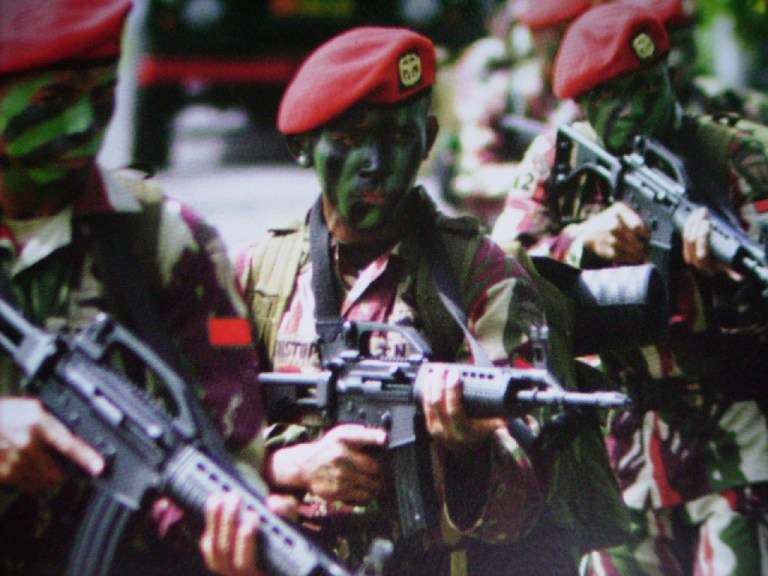
Kopassus claims to be pursuing ‘persuasive’ approach

The “persuasive” approach used by Kopassus
Bintang Papua, 4 July 2012
The commander of Kopassus, the elite strike force of the Indonesian army, Major-General Wisnu Bawa Tenaya declared during a joint training investigation with  China’s People’s Liberation Army in Shandong, China, that his men will continue to pursue the persuasive approach in its handling of the security disturbances in West Papua.He was quoted as saying: ‘We cannot the kind of actions that we would like to take but must act cautiously because in addition to security problems, other issues in West Papua need to be attended to, such as the welfare of the people.’

He also said that Kopassus forces plan to conduct expeditions in various parts of in West Papua to investigate the what is going on there and what it is that the people there actually want.’

Earlier on,  a representative of Kontras,  Indria Fernida, the chairperson of the Synod of the Kingmi Church, Revd Benny Giay and the secretary of the Working Group of NGOs in Papua, Septer Manufandu made it clear the military approach is still being prioritized in West Papua.

Moreover, the welfare approach that has for so long been proclaimed by the authorities was far from being pursued to any meaningful extent or in any way to the satisfaction of the aspirations of the Papuan people.

[Abridged in translation by TAPOL]

Create a website or blog at WordPress.com

Up ↑