“Victor, we are ready to wreak havoc and clash with all of you” : Reflections by an unrepentant leader

by Victor Yeimo

Witness: Participant Analysis

December 3, 2012

Police Captain Kiki Kurnia: “We’re Ready To Clash.”

“Victor, we are ready to wreak havoc and clash with all of you.”

Those are the words spat out by police captain Kiki Kurnia, who yesterday (December 1) led hundreds of fully-armed police officers to put a stop to the Long March of students and the people. I was very sad to hear these words so righteously issued by the police, who present themselves as being on the side of safety. Do the police want safety, or do they not?Yeimo-ditangkap
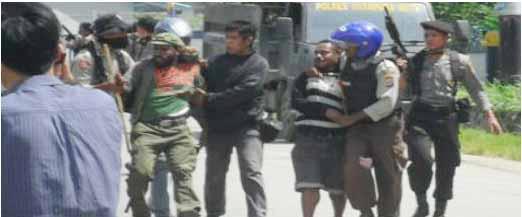
When I was the leader of the Long March headed for Expo Waena on December 1 in Sentani, police backed by the Indonesian military had already closed off access to the people of West Papua who would pray. Since the late afternoon (30/11), Theys H. Eluay field, which is the field of (great significance and sacredness to) the West Papuan national struggle, had been controlled by the military and by the national police, although all the civil society organizations had long since said that their prayers and celebrations would take place there.

On November 19, police entered a prayer room in Aula STAKIN in Sentani and tried to stop me as I was giving a reception after prayers, and then yesterday on December 1 the people wanted to worship and eat at the Theys H. Eluay field but were prohibited, blockaded and arrested by the full force of the military. The question is, why did the military and the police force deliberately take control of the field and then shamelessly hold a traditional stone cooking event (a Indonesian-appropriated Papuan Custom) with a handful of residents who were offered money?

If the police are tasked with security, why exactly is that security so insecure when facing inhabitants who are conducting prayers peacefully? Is the Theys H. Eluay field, owned by the traditional people of West Papua, only permitted for use by the Indonesian military and the police force? If the law is just, why wasn’t police captain Kiki Kurnia charged with incitement to violence? As he himself clearly  (attempted) incited the mass action I led to commit violence on the streets in front of Dian Harapan Hospital yesterday.

If the police prohibit students from campaigning to put a stop to AIDS on West Papua’s Independence Day, why must it be prohibited? Do the police not want HIV/AIDS awareness campaigns to take place? Isn’t his proof that the police are ensuring and championing ethnic cleansing in West Papua? Why do the police prevent worship on West Papua’s Independence Day? Why do the police see more political and economic motivations than the goodwill and intentions of the people who want to interpret December 1, 2012 as World AIDS Day, the opening of Christmas festivities and the Independence Day of West Papua?

I lead my people safely and with restraint. I have personally guaranteed that I will be arrested or shot if there is a criminal act committed by people, but why in the safe Long March were we forcibly dispersed and captured like animals? Actually, who was it that committed the crime? Was it the people, or the police?

The police did not only incite the violence that happened, but yesterday (1/12) the police, through (Adjunct Senior Commissioner) Alfred Papare, publicly lied. Myself and the masses did not throw rocks at the police, however it was covered by several media sources that the police chief said we did so. In an era of openness such as this, why is there a need for mutual deceit when everybody saw yesterday that the police had no reason to blockade, arrest and attack people with tear gas? After I “escaped” from Abepura Sub-District Command, I had not received a call from the Jayapura Chief of Police, the aforementioned Alfred Papare, as stated by Wakapolda Papua, Paulus Waterpau, to Tabloid Jubi.

Better for the Police to become the Social Services

The idea of Papua’s Chief of Police, Tito Karnavian, to give out groceries and distribute help the mountain people of Papua in Jayapura and the Jayapura municipality makes me wonder a little. Has the police chief already switched functions from a chief of police who must preserve security, only to become the head of the Department of Social Services who must give social support to the people? Is this country unhealthy? Money for providing support to the people is redirected into the Police Department and the Police Department takes over the functions of the Department of Social Services.

For me, the efforts of the police department to muffle and destroy the basis of the Papua Independence conflict are obviously speculative, as well as inappropriate. Go ahead, if the police department and the Republic of Indonesia believe that our ideology can be bought off with money. Tens to hundreds of millions have been redirected to the Asrama Rusnawa Uncen, since becoming the basis for conflict, and the police are very hopeful that students will regard them as righteous people, as kind people. Well, again, it is better that the Police Institution in Jayapura be renamed as the Department of Social Security or the Department of Education, so that matters concerning the improvement of the Asrama Rusnawa Uncen and student welfare can just be taken over by the police.

Does Indonesia believe that money can silence the aspiration and ideology of independence for the people of West Papua? I am convinced the people of Papua that are given money and material aid from the police are only making use of them, because within the individual West Papuan person there is a flesh-and-blood desire for Papuan Independence, however difficult it is. So, go ahead, half-dead police and a waste of money to the people of Papua. Go ahead and pan the sympathy and dreams of the people who have hated the occupation of this land. Almost half a century practicing the policies of the Republic of Indonesia, and all models of development cannot turn the people of West Papua into people of Indonesia. Papua will rise and awaken by itself alone.

Idea of Separatists and Terrorists is a project of the TNI and Police 

There are no separatists and terrorists in West Papua; only those who demand the right to self-determination as legally protected under international law. The idea of separatists and terrorists is created by the state to disgrace the legal struggle of the West Papuan people, and created by the Indonesian military and the police with a view to expanding their territory, and their wealth. For the sake of money alone, the circumvention of the state apparatus and the deception of the state apparatus, alias “bullshitting a lot” (direct translation).

My organization, the National Committee of West Papua (KNPB), struggles in peace and does not want to create chaos that will strengthen the funds of the military and the police force. Consequently, the national police force does not like peaceful action, because in a situation that is safe and peaceful, the military and the police force will be poverty-stricken. Many security institutions in Indonesia have hundreds of troops that must be paid by the state. Moreover in Papua, there are now many civilian militias formed by the state; thousands have been recruited, and must be paid. All are created with the objective of “stripping bare” the security responsibility from the Indonesian government in West Papua that fall under the name of “eradicating separatists and terrorists.”

Forgive me; my group and I will not accept food from the military or the police, so there is no need to criminalise or drop that bomb on the National Committee of West Papua to stigmatise us, so that the project money can be maintained. These ways have become commonplace, and we are bored of them. The people are smart, and getting smarter: they have already been taught these ruses by the colonialists. Ways such as this will finally tarnish the image of the Republic of Indonesia in West Papua. So it is best not to try to painstakingly search for such an image. Oh, and yesterday in Guyana, Member of Parliament told Benny Wenda: “Oppression alone will burn the spirit of the independence struggle.”

Why not kill me, or imprison me? Why was I released? Oh, it is certainly not because I cheated. I will see this for what it truly is. There are demonstrations in the streets. Now that I have planted the seeds of resistance here and the invaders sow these seeds with their own actions. I must thank the colonialists for continuously teaching us to aspire to true humanity by means of rebellion.

Victor Yeimo wrote this article immediately upon his release from police custody on Monday December 3. 

Translated by West Papua Media volunteer translators

Solidarity organisation calls on police not to use violence on 1 December

Bintang Papua,
26 November 2012Jayapura: Alius Asso, the deputy chairman of SHDRP,  the Papuan Civil Society Organisation for Solidarity, Law and Human Rights, has urged the police to use persuasive methods on 1 December when demonstrations will take place to mark the anniversary of 1 December.

Asso said that on that day, there will be actions by indigenous groups in seven regions that claim to be part of the Federated Republic of West Papua  in Mamta, Saireri, Bomberay, Domberay, Me Pago, Ha Amin and several other places, which will take the form of prayer meetings or flag ceremonies.

However, Asso said that it was not possible for him to tell groups not to wave the Morning Star flag  ‘because they have every right to do so’.

He said that it was up to the security force to act in a professional way during these coming events. Demonstrations on 1 December have become a regular annual feature for Papuan people to  commemorate this historic day and this has been going on for many years.

‘The police should act wisely and professionally. They should avoid repressive actions. If they fail to do so, there will be many victims among the Papuan people . In Sentani, it is likely that  the event will take place at the grave of [the assassinated Papuan leader] Theys Eluay with prayers being said.’ But Asso said  he was not sure what would happen in Jayapura.

The chief of police for Papua, Inspector-General Tito Karnavian has said that the army (TNI) and the police will be out guarding the areas because this is an integral part of their duties.. But Asso said that they should not resort to the use of violence. ‘If the demonstrators only intend to say prayers, why should this be banned by the security forces?’

He went on to say that the spirit of democracy is developing and people are expressing their aspirations in peaceful ways, but if the State goes on silencing democracy, it will be responsible for closing down the space for democracy and there will be yet more injustices and human right abuses.

‘Everyone agrees about the need for security and moreover there is a law in force which guarantees protection for the citizens. And this is quite clear in the first article of the 1945 constitution.’

[Translated by TAPOL]


FIVE MONTHS AS REFUGEES EATING ONLY SAGO WORMS AND WOOD WORMS

ELSHAM NEWS SERVICE

16 November 2012

Keerom, – It was early and the streets were not too crowded  when I started my journey from Abepura, Kota Baru District at 6.30 a.m. (Papuan time) to Arso, in Keerom which is a drive of about two hours and a half by two wheeler.

After arriving in Arso, I went on to the village of Kwor and arrived at about 9:16 a.m., and from the village of Kwor I continued the journey towards the bivouacs of the internally displaced people (IDPs) who had run into the forests, out of fear for their lives.

During the six-hour drive through the gardens, rivers and forest, I arrived at the bivouacs of the IDPs: the 38 people were scattered in four different bivouacs; they came from three villages, namely, Sawyatami (11 IDPs), Workwana (9 IDPs) and of PIR III Bagia (18 IDPs).

The group of IDPs who settled in the bivouacs in the middle of the forest, is composed of 20 men and 18 women. Among the IDPs, there are seven (7) children under the age of five (toddlers).  In addition to parents and toddlers, there are 15 students consisting of eight (8) elementary school students, four (4) junior high school students and three (3) high school students. These students have not attended school for the last five months.

In the camps, the IDPs could rely only on food collected from around the bivouacs likesago, sago worms, wood worms and wild boar. “We have stayed out here in the forest for five months, and in order to survive, the only thing we could eat were sago worms and wood worms and the only thing we could drink was water from the creek,” said LK (68yr), a traditional leaders who is also on the run.

The condition of the refugees is very deplorable: there are two pregnant women, namely the two-month pregnant Rosalina Minigir (36 yr), and the four-month pregnant Agustina Bagiasi (35 yr). Another woman, Aleda Kwambre (28 yr) gave birth to a baby girl at the shelter camp. At the present, two babies were found to be in very poor health conditions: Penina Pekikir (3 yr) and Ruth Kimber (1 yr), and if the situation persists they could turn critical.

“I am afraid of Kopassus [the Indonesian special forces]. I saw how they came with their guns, entered into the village of PIR III and started shooting. So I was afraid of going to school,” said CK (17) who ran away and stopped attending school because he did not feel safe anymore, after all the acts intimidation by the security forces.

NY (8yr) expressed the same fear as CK, as she says with a timid voice:”It’s been a long time since I attended school, I was afraid when I saw the soldiers flying over the village with their helicopters.”

MT (38yr) also expressed disappointment with the local government of the Keerom District, as it was unable to ensure safety and security for the indigenous Papuans in Keerom. “I am angry because these high officials, local government officials, regents, scholars, community leaders, traditional leaders and religious leaders,  do not care about us in this forest. I was scared when I saw these police officers, they went into the villages and they just started shooting. I was afraid so I had to run into the forest” she said, sobbing.

The refugees expressed the hope that ELSHAM Papua would return with international human rights institutions to mediate their return to their respective villages. “Christmas is near; we were not able to gather money for the celebrations. These children have not attended school for five months. So we really hope that ELSHAM can help us so we can return to our village,” said FK (50yr), filled with hope.

As reported earlier by ELSHAM, the 38 locals had fled from the three villages because they were afraid of ongoing sweeping operations conducted by the joint Indonesian military and police forces in Keerom, since the shooting of Yohanes Yanuprom, the head of the village of Sawyatami on 1 July 2012.

Up to the date of this report, the IDPs remain in the forest without proper food and adequate medicine.

Elsham News Service


LP3BH-Manokwari calls for dialogue between Papua and Indonesia

COMMENT by Yan Christian Warinussy
Executive-Director of LP3BH, Manokwari
November 14, 2012In the concluding months of 2012, there have been many more acts of violence in Papua and West Papua which reflects very badly on the government of Susilo Bambang Yudhoyono (SBY) at a time when development, good governance and security  are essential in the Land of Papua as an integral part of the Republic of Indonesia (NKRI). This is happening as a time when many countries  which are members of the UN Human Rights Council are closely watching the situation, following the  Universal Periodic Review  in May 2012, which made  180 recommendations, thirty of which were rejected by the Indonesian government.

One of the recommendations that was rejected was that arrests and detentions on the basis of Articles 106 and 110 for treason should stop. This means that the state will continue to take firm measures, possibly including the use of firearms, against peaceful actions by members of civil society who give expression to their opinions and political views which are opposed to the views of the government. Several activists of the  National Committee of West Papua (KNPB)  have been summoned and interrogated and are likely to be charged for treason. One of these activists is Alexander Nekenem, chairman of the DWP, the local parliament, who was recently summoned  by the police in Manokwari.

The Indonesian government has also rejected the recommendation regarding freedom of expression for persons who have been detained merely for taking peaceful actions, a recommendation that was made by the USA and Canada. What this means is that Filep Kara, Forkorus Yaboisembut, Edison Waromi, Selpius Bobii, Sananay Karma and Dominikus Sorabut  will continue to be deprived of their lawful right to freedom of expression.

Another very bad thing for the Papuan people is that the Indonesian government has rejected the recommendation by the Japanese government which called on Indonesia to end all violation of  human rights  by the security forces (TNI and Polri, the army and the police), because the Indonesian government claims that this is not relevant for Papua because it is not in accord with the facts, whatever they mean by the facts. In my opinion, the Indonesian government’s rejection of this means that there will continue to be an intensification of violence and hence systematic abuses of basic human rights which will continue to occur into the future in the Land of Papua.

In view of all this, as Executive Director of the LP3BH and a defender of human rights in the Land of Papua, I urge the SBY government  to open up space for dialogue  between Papua and Indonesia before the end of 2012. The SBY government should appoint a team of people to meet Father Dr. Neles Tebay, co-ordinator of the Papuan Peace Network, in order to discuss  the format of this dialogue. This would mean that by early 2013,  preparations could be started for a dialogue between the Indonesian government and the Papuan people.

In my opinion, dialogue is the best path to take, in the interests of justice, peace and dignity on both sides, as the way, according to universal standards, to resolve  the conflicting political views which have existed for such a long time, causing the deep frustration  that has borne down both on the Papuan people and the Indonesian government to this very day.

In this way, the Indonesian government would  win the respect of the international community for  having accepted that the political conflict that has lasted for such a long time should be resolved b means of dialogue.

[Translated by TAPOL]


KNPB activist, Klismon Woi dies from his injuries after mysterious shooting

KNPB activist, Klismon Woi succumbs to his injuries
November 6, 2012

By KNPB News

(Note: West Papua Media has again independently verified all contents of this report with contacts in Fak-Fak, and is reprinting the KNPB News report in full as WPM has confidence in this reportage).

Fak-Fak, KNPBnews – After Paulus Horik was laid to rest yesterday (5/11), another KNPB activist in Fakfak, Klismon Woi, took his last breath this afternoon (6/11) at 12 noon, at the Regional General Hospital of Fakfak in West Papua. The late Klismon was in a critical condition for  two days due to the countless bruises and serious injuries on his face and ribs.

According to information submitted to KNPBnews this afternoon by Arnold Kocu, regional coordinator of KNPB Fakfak, the body of the now deceased Klismon Woi was brought back to the funeral home. He also confirmed that Paulus Horik was buried the day before (5/11).

Klismon Woi was a member of KNPB-Fakfak.  According to information collected from the field, there are reasons to believe that Paulus and Klismon were killed by people who were especially trained by Indonesian forces that had been monitoring the activities and events led by KNPB activists in the Fakfak region.

Special operations by the Indonesian security forces against KNPB activists have been stepped up since KNPB Chairman  Mako Tabuni was shot dead on 14 June.  Search and arrest operations, raids and killings have been undertaken continuously by the Indonesian Special forces in an effort to eradicate the peaceful resistance movement led by the KNPB (wd)

[Translation by LT] http://knpbnews.com/blog/archives/1198


Create a website or blog at WordPress.com

Up ↑
