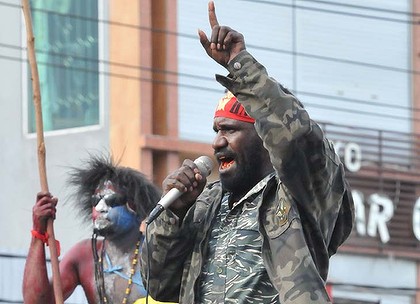
Indonesian colonial Media meddling inspires indp journalist to slam “fake journalism” in Papua

WEST PAPUA MEDIA Op-Ed:

June 30, 2012

An open letter from Victor Mambor, Head of the Jayapura Branch of the Alliance for Independent Journalists, has been circulated around Papua, highlighting the pervasive involvement of Indonesian intelligence personnel and military agendas in the Papuan press.

This letter (see below) comes at a time when the Indonesian-run colonial press in West Papua is coming under repeated attack from both Papuan and Indonesian religious and civil society figures, independent media and human rights organisations, for its unethical and blatantly false reportage of the recent upsurge in  “unknown killings” in Papua, referred to as OTK (orang tidak ketahui or unknown persons, now wryly referred to across Papua as Orang Terlatih Khusus or Specially Trained People).

Indonesian owned media outlets in Papua have long been identified with Indonesian intelligence and propaganda activities, with many outlets being directly owned by military officers for profit, and almost all media outlets coming under the control (either willing or not) of Indonesian intelligence personnel.

West Papua Media wrote a detailed section in the 2011 Pacific Media Freedom report and highlighted the issues faced with press freedom in West Papua, which detail the tactics Indonesian occupation forces use to limit factual reportage in Papua, and to dissuade journalists from doing their job.

However, as time wears on, the Indonesian colonial press is becoming even more blatant in pushing an agenda in step with the Indonesian military agenda.  This agenda is being keenly felt by members of the nonviolent civil resistance movement and Papuan civil society, particularly members of the West Papua National Committee (KNPB), who are being blamed for the OTK campaign despite no evidence being presented to prove the military assertions, with what little evidence present having been entirely fabricated by a Police to terrified to point the finger at the real perpetrators of violence in Papua – their big brothers in the military.

This spreading of falsehood has reached a crescendo around the assassination of KNPB leader Mako Tabuni, who was gunned down in an execution on June 14 by Australian trained Detachment 88 officers in Jayapura.  Justifying their criminal act, Indonesian police have variously claimed that they shot Mako in self defence, despite many witness claims that he was shot in the back while on the ground.  Indonesian police then fabricated evidence including placing a handgun on his body in the hospital, and loudly announcing that Mako was responsible with other KNPB members for the series of OTK shootings, including the shooting of a German tourist.  This is despite the unchallenged fact that all shooting were carried out with men in broad daylight who made no attempt to hide and nonchalantly drove away in the DS (Police) plated Avanzas.

This was reported uncritically by many in the colonial Indonesian press in Papua, with ironically perhaps, the truth telling in Indonesian metropolitan media coming from independent human rights journalists who went out a their limbs by telling the story of the peaceful activist and freedom fighter whom they had all met and spent time with in his attempts to non-violently raise the issue of his peoples suffering under colonial genocidal policies.

Yet the shootings continue, even with the official suspect dead, with nary a comment coming from the colonial press, a situation that is a direct repetition of the assassination of Kelly Kwalik on December 16, 2010.  Kwalik was also blamed for the OTK shootings that have plagued the giant Freeport Grasberg Gold and copper mine for many years, shootings widely blamed on a spat between Brimob police and the TNI for control of mine protection and illegal gold mining businesses.  Again, despite the assassination of Kwalik (again by Detachment 88 officers), the shootings continue, and will continue as long as the Indonesian security forces use conflict as a way of guaranteeing their presence.  A presence that’s only purpose is to exploit natural resources and make the General’s money – at the heart of why Papuan people resist the colonisation of their Land.

Leader of the indigenous Papuan Kingmi church, the Reverend Benny Giay, was this week in Jakarta to brief international diplomats about the shootings and recent massive increases in state violence against Papuan people.  In his briefing, he said that when the government has claims shootings are carried out by separatist groups, Papuans respond to those claims with their usual: “Oh itu lagu lama. The authorities are playing the old song.”

As Mambor has outlined in his letter, Giay made a series of formal complaints to the Indonesian Press Council and journalists’ associations about the lack of integrity of Indonesian so-called journalists in Papua and of their non-factual scapegoating of ordinary Papuans for separatist and violent actions.  This seems to have already threatened powerful people, as a source close to Giay had told West Papua Media that he was physically threatened by a member of the security forces during his advocacy work in Jakarta.

But this behaviour by intelligence services and their not-very-opaque “journalists” is causing many independent media to look at other tactics to regain their Papuan voices.

Just as Victor Mambor has done with his heartfelt letter, the independent Papuan citizen media outlet UMAGI News has taken a bold step in publicly naming a group of Indonesian reporters that it believes are paid intelligence officers under the command of the Cenderwasih military command.

 
PAPUAN JOURNALISTS: STOP TERROR ON PRESS REPORTERS(PHOTOS: GOOGLE via UmagiNews.com)
In an editorial, UmagiNews  have argued that most Indonesians who serve in professional Media in Papua do not carry out the tasks and functions of a journalist.  “Whether in Print, electronic or online media, (journalists should) convey information what has happened, seen, heard, felt.  To be independent means to report the events and  facts  in accordance with the voice of conscience without interference, coercion, and the  intervention  of other parties including the owners of the press,” said the Umagi editorial.
“Accurate means truthful according to the objective circumstances when the event occurs; Balanced means that all parties have equal opportunity to have their views heard; and to not act in bad faith means no deliberate and sole intent of  the detriment of others.  Yet according to KM a Papuan independent journalist, most journalists who served in Papua have always worked closely with the military, which is a violation of  the journalistic code of ethics.”
Umagi News published the names of the following reporters whom it says it has gathered evidence that shows their active collaboration as informers and/or trained agents  with civilian or military intelligence services.  Umagi claims its information has come from sources within both the security forces, and from a TNI document from the command of the XVII/Cenderawasih Military Region Taskforce 6  “datasheet of  informants/agents”, signed by one Ahmad Fikri Musmar (NRP inf Captain 11,970,044,410,576).  All suspects are ethnic Indonesians and non-Papuan.

1). M. Imran (Contributor TV One) .

2). Robert Vanwi (Suara Pembaruan).

3). Safe Hasibuan (Bisnis Papua and Radio Elshinta).

4). Alfius (Pasifik Post).

6). Rio (Radio Enarotali RPD).

7). Agus Suroto (Metro TV).

8). Evarianus M Supar (2000-2002: Journalist at Radar Kupang Timor, 2003-2006: Journalist / Editor Timika Pos Daily, 2007 – Now:  Journalist and Antara’s Timika agent).

9). Anis (SCTV Contributor, Mimika) Note: The concerned had fled from Timika since the shooting of Kelly Kwalik.

10). Odyi (RRI Sorong, Chairman PWI Sorong).

11).Jeffry (Radar and Dita Sorong Sorong).

12). Angelbertha Sinaga (Pasifik Post).

West Papua Media has sought clarification from independent journalists and human rights sources in West Papua about the veracity of these names, and our sources have concurred with the accuracy of the names given in the Umagi report, though West Papua Media has not yet been able to see the document first hand. (UPDATE: WPM has possession of the original Kodim document and has verified all names contained, independently).
However this is not a new claim. For example, On May 16, The TNI held a major meeting with Indonesian press representatives in Sorong, and encouraged soldiers and journalists to work together to ensure “balanced coverage of the affairs of the function and duties of the TNI… so that it can be beneficial for society.”  The commander of the TNI in Sorong, Colonel Inf Wiharsa Eka, even exhorted all present to monitor events together, as “it runs the full atmosphere of intimate friendship, and even a means to know each other. The journalists should exchange phone numbers, either with me or Danyon commander (Commander Batalyon),” said the Colonel.  With friends like these soldiers, how could an honest journalist possibly have any fears of reporting events factually in Papua?
Papuan people reclaiming their own media space is an inevitable next step in the struggle for self-determination.  The building a free and robust credible independent media is the basis for any democratic society  – and indeed this is the core mission of West Papua Media.  But Indonesia’s deliberate manipulation of the truth and its corruption of the principles of journalism in West Papua, together with the ongoing and constant threats to brave professional and citizen journalists in Papua for telling the truth, are giving those committed to genuine journalism more impetus every day to give voice to the voiceless, and to help the voiceless roar in Papua.
(dedicated to the brave storytellers of freedom risking their lives everyday in Papua to bring light to a darkened place).
Nick Chesterfield @West Papua Media

———-

Open letter from Victor Mambor, Head of the Jayapura Branch of the Alliance for Independent Journalists

June 28, 2012, Jayapura

Respected Colleagues and Friends,

This is related to the many people that have recently commented that I (in my capacity as head of the Jayapura city branch of the Alliance of Independent Journalists (AJI) that covers the whole Land of Papua) have complained about, given reminders or admonishments or engaged in other actions that are basically protests against the (local or national) mass media’s reporting, considering it one-sided, deceiving the public, manipulatory, biased towards those in power and reflecting the interests of politicians and the security forces. In this regard I feel the need to communicate the following points:

1. AJI is a professional organisation of independent character and so places a high value on the media’s independence.

2. Journalists and their reporting are fully the responsibility of the editorial team at the journalist’s place of work, or where the news they produce is published.

3. AJI does not assume a capacity to take action against journalists or media who are considered to have taken action such as listed above. It can only take action if a member is considered to have violated the journalist’s code of ethics and that of AJI as a professional organisation.

4. I also truly understand how many colleagues and friends feel about reporting that tends to push indigenous Papuan people into a corner, and so seems to endorse the view that indigenous Papuans are separatists and the perpetrators of recent acts of violence. For this reason I very much support the actions Benny Giay CS has taken in making complaints to press and journalist organisations in Jakarta about this problem.

5. There is no need to feel hesitant or reluctant about placing limits on journalists during press conferences or activities. If it is suspected that someone is not a journalist, do not hesitate to remove them or report them to the police. There is no way to justify or defend journalists like this. Many journalists even have a dual job, also acting as informants for interested parties and are involved in the marginalisation of indigenous Papuans and feeding the stigma that they are separatists. Pay close attention to media or journalists who often mention the name Dani Kogoya or the confiscation of Morning Star flags, bullets etc. (this is about journalists present at the scene of an incident, not those reporting from police press conferences), or those that have produced features for television about young people who are OPM members, or journalists who are able to obtain special reports about the OPM or unrest in the interior connected to the OPM. These are the journalists and media which you should be cautious about. These no-good journalists’ space to operate must be curtailed because aside from selling out their profession they are also destroying Papua and propagating the stigma of Papuans as separatists. Watch out for and be careful with such journalists. Because from my own observations, many of us are so keen to progress that we do not act with caution and we are not aware if our activities are being recorded to be later reported to certain parties, and will be used in constructing counter-opinions.

6. An attendance list is vital for activities or press conferences. It means that if a media outlet or journalist was not present at an event but then writes report on the activity or what was mentioned in the press conference, it can be reported as a form of deception or unethical activity for a journalist. Such journalistic practices cannot be justified, but find fertile ground amongst journalists in Papua.

Those were the matters which I needed to communicate,

With thanks,

Victor Mambor

Papuans allege Australian trained D88 personnel shot dead Mako Tabuni

Breaking News

West Papua Media

 21:00 (WPB) 14 June 2012

As tensions across West Papua ratchet up in the wake of the execution of KNPB leader Mako Tabuni, senior Papuan leaders accuse Australian and U.S trained Detachment 88 of being behind the slaying.

Domi Surabut, a senior Papuan Tribal Council leader from the Central Highlands sent West Papua Media the following message by sms at 21:35 tonight (AEST): “Mako Musa Tabuni was shot dead by Densus 88 with three bullets. Twice in the thigh and once in the stomach. His corpse is still being held at the Bhayangkara Police Hospital. His death will cause blood to flow. Please pray and urge peaceful intervention in Papua.”

As of 21:30 tonight the Indonesian police are still refusing to release his body to Tabuni’s family saying that they will bury him themselves.

As outrage builds church, tribal and independence leaders from the nonviolent movement are urging their followers to maintain discipline fearing that a violent reaction will give the TNI and Indonesian police all the justification they need to crush the independence movement.

In a text circulating around activist circles Selphius Bobii, a political prisoner writes “The killing of Tabuni is part of a scenario to destroy the Papuan struggle’s commitment to a peaceful path and push Papuans towards violence. So let’s control ourselves. Don’t get caught in this scenario which will only weaken our peaceful struggle that right now is echoing across our country and up to the UN.”

As armoured personnel carriers, water cannons and heavily armed troops position themselves around the streets of Jayapura tonight that commitment will be sorely tested.

WPM 22:00 (AEST) 14 June 2012

KNPB leader Mako Tabuni shot dead by Aust-funded Indonesian Detachment 88 troops; riots in Jayapura

Breaking News
West Papua Media

June 14, 2012

Angry scenes have reportedly erupted in Jayapura and across West Papua after officers from the Australian- funded and trained Detachment 88 counter-terror troops shot dead the secretary-general of the West Papua National Committee (KNPB), Mako Tabuni, during a botched arrest attempt while he was chewing betel nut at a kiosk in Abepura, West Papua early on Thursday morning.

According to credible independent church human rights sources in Jayapura that spoke to witnesses in Waena, Mako Tabuni was shot and wounded by heavily armed Indonesian police as they stormed

image
Mako Tabuni as he lie dying in Jayapura (KNPB/ westpapuamedia)

the area outside the student dormitories at the Cenderawasih University Abepura.

Mako Tabuni.

Senior members of KNPB have told West Papua Media that Tabuni had been walking with friends to buy and eat Betel Nut from a kiosk near the university.  After he separated from his friends, they heard gunshots. and  they saw a white Avanza car drive up and ambush Tabuni, according to his friends.  Tabuni was shot at least six times, according to both witnesses and journalists in Jayapura.

image
Mako Tabuni as he lie dying in Jayapura (KNPB/ westpapuamedia)

Police took Tabuni to the police hospital in Jayapura, where he reportedly died from his wounds soon after arrival.  The Kapolres (police chief) has told media outlets including West Papua Media via SMS that Tabuni was killed because he resisted arrest and attempted to seize the weapons from the Detachment 88 troops.   According to the It has been confirmed independently that the Australian-funded and trained Detachment 88 troops were in command of the arrest operation.  Tabuni was unarmed at the time of his arrest, which is a violation of the United Nations Basic Principles on the Use of Force and Firearms by Law Enforcement Officials.

KNPB contacts report that a combined team of military and POLRI, BRIMOB, Detachment 88, and Intelligence officers are raiding dormitories of Papuan students in Abepura, chiefly those of highland origin students who are the traditional support base of the KNPB.    In this sweep, security forces have confiscated books, bags, clothing, computers, phones, and cameras.  Security forces are also conducting searches across Abepura, Jayapura, Kotaraja, Waena, Sentani and several other places.  Many students have been severely beaten and arrested in dormitories in Waena and Asrama by over six companies of Indonesian army (TNI) and Police. KNPB sources have expressed fear that the students, already beaten severely and taken to Rusunawa police centre, will be tortured and possibly killed by occupation forces.

Supporters of Tabuni have reacted angrily and have taken to the streets and are allegedly burning houses belonging to military and police in the Ruko, Waena and Abepura areas, in an eerie reversal of the June 4 rampage by Indonesian soldiers in Wamena.

Security forces are reportedly on the streets with orders to shoot rioters dead on sight, and the situation is described as extremely tense.  It is not clear if those who have caused property damage are in fact  members of the pro-independence movement, or are undercover Indonesian intelligence officers.

A senior highland human rights activist in Jayapura, whom West Papua Media cannot identify for safety reasons, told West Papua Media that the entire Papuan population is living in a state of constant trauma and fear due to the escalation of Indonesian repression.

“Pro-Independence activists and Papua human rights workers have become the operating target of the (ongoing)shootings, not to mention all the KNPB activists the security apparatus are seeking,” said the source.

“Finally, I spoke with three of our members hiding in the suburbs.  If the Indonesian security forces are still after us, then they would not want or like it if we had entered the woods and hid,” he said.

” To step into the forest is for avoiding premature death.”

Papuan activists are calling for urgent international attention to the rapidly deteriorating humans rights crisis in West Papua.  A senior KNPB activist has begged: “In this case our nation is pleading for UN Intervention to be done now, because Indonesia is planning to kill all us Papuans.”

More to come

Yapen: major military sweeps and abuses against ordinary villagers intensify

June 8, 2012

by West Papua Media

Information has been received from human rights sources on Yapen Island alleging that major security sweeps and blockades of villages home to non-violent political activists are causing mass

A senior police officer in Serui told West Papuan activists that 140 more Kopassus personnel  have been deployed from Jayapura, with two more companies of Brimob paramilitary police to be sent from Biak, reinforcing a significant build-up of military strength since April aimed at smashing West Papuan non-violent resistance to Indonesian military occupation.

The district of Angkaisera, east of Serui (14 villages), has been subject to an ongoing complete blockade and village raids by Indonesian security forces from June 7, preventing freedom of movement, and causing thousands of civilians to seek refuge in the jungle without food.   This military psychological operation known by local West Papuans as a “show force”, no-one has been able to gather to express their opposition to this brutal behaviour in front of the local parliamentary office of the DPRP.

It is being reported that seven people have been arrested today, reportedly under charge of Makar (subversion).  The names and places of those arrested are not known at this stage.

On June 8 at 12pm local time, a truckload of Riot Police (Dalmas) and joined by plain clothes militia and intelligence agents, went to Wadapi village where reports of intimidation were made.  The militia and riot police went back to Wadapi at 8pm together with 3 truckloads of joint taskforce army and police, and have occupied the village.  According to West Papua Media’s stringer in the area,  the joint-force occupied the village while drunk.

Angkaisera has been surrounded with security forces for the last two days, according to local activists.  Report have also been received that several political activists have been issued with letters to demand presentation to the local Indonesian police.  Governor of the Yapen district for the Federal Republic of West Papua alternative government, Daud Abon, has been issued a second warning letter to hand himself into police.  If he does not comply he will be hunted with full force, together with all other political activists in the area, according to the letter.

At the time of writing, news was received that raids were underway across Angkaisera district by joint-forces of TNI,Police and Detachment 88, together with special forces of Kopassus, and Kostrad Strategic Reserve commandos from the Pattimura division based in Maluku, the Hassanudin divisions from Makassar, and the Siliwangi division from West Java, who have reportedly all been sent to Yapen.  It is not known if these reports indicate entire battalions or just specialist companies from each division.  West Papua Media has not been able to independently been able to verify these reports, as if correct will indicate a deployment of five battalions of fully armed combat forces, numbering some 7500 soldiers.

Further raids are expected to be carried out at 3 am local time  in Anotorey and Mantembu villages, according to activists who are reporting that local people are terrified and very alarmed for their safety.


westpapuamedia

Videos and latest figures from Wamena provide evidence of Indonesian army rampage

June 8, 2012
(updated June 10)
West Papua Media
Credible and trusted West Papua Media sources have provided video clips (below) that show the extent of destruction caused by the rampage of soldiers from the Indonesian Army (TNI) Battalion 756 in Wamena on June 6.
The soldiers, who ran amok in retaliation for the fatal beating by Wamena residents of two soldiers that killed a small Papuan boy in a motor incident, left a trail of destruction and violence across Wamena after a night of brutal and indiscriminate shootings, beatings and arson that has left at least 9 dead, 19 seriously injured, thousands homeless, and caused thousands of residents to flee to the relative safety of surrounding mountains.
According to local independent human rights activist Roni Lokbere, soldiers were firing indiscriminately at any Papuan they saw.  “Anyone in sight of police and soldiers who have the black and curly hair, it is not forgiving – just automatic firing action,” said Lokbere in a message with videos sent to West Papua Media.

“We make these reports based on true facts, the actions of the TNI and police officers who are arrogant and abusive, that ignore the principles of humanity and justice,” said Lokbere.

Human rights workers in Wamena have identified a number of victims so far, but they report there are still many victims to be identified, with military and police personnel blockading the hospital to prevent relatives access to those who sustained injuries.  This policy is causing great concern from local people that Indonesian security forces are committing further human rights abuses at the hospital in Wamena on survivors of the rampage.

According to fresh but separate unconfirmed reports received by West Papua Media, medical staff are being threatened by heavily armed military officers at the hospital, and soldiers and police including Australian-funded Detachment 88 counter-terror officers are directly interfering in the provision of treatment.

This information was provided at great risk by paramedics to Papuan human rights activists,  describing the scenes of terror and intimidation still occurring at the hospital in Wamena.

At time of writing only members of the local Nduga tribal clan had been formally identified as dead, with several other tribes including Susa people, represented amongst an unknown number of total casualties.  Many of those injured received significant wounds, and with the deliberate interference to medical treatment of the wounded by security forces, the number of dead is expected to rise.

Those formally identified are:
  1. Jairus Lokbere, Nduga tribe, an unarmed member of Battalion 34/ TPN (Tentara Pembebasan Nasional/ National Liberation Army) Komadan Inije Kodap;
  2. Kisiurt Kurungga, 21, villager;
  3. Metiuspus Telenggen, 26, villager;
  4. Elianus Bugiangge, 45, villager;
  5. Pianus Tabuni, Nduga tribe, Civil Servant
  6. Enus Lokbere, Nduga tribe,  Local legislator of DPRD;
  7. 2 children aged 12 and 13 in local school “holiday village” (boarders staying in school “village” during holidays as their families cannot afford return to rural homes)
  8. A man who died in the hospital who was not identified due to extent of facial injuries from beating with rifle butts.
In addition, over 20 Lani tribespeople have sustained serious injuries from gunshots and beatings during the rampage, though their condition is not yet known at time of publishing.  The names above are only those being treated in hospitals in Wamena and all are people from Nduga tribe.
Due to the evolving situation and ongoing repression of local people and human rights investigators by Indonesian security forces , it must be stressed that these names are not fully confirmed, however West Papua Media has received this information from trusted sources,
More information as it becomes available
Westpapuamedia

Create a website or blog at WordPress.com

Up ↑