Update on military operations in Paniai and Australian involvement

Alex Rayfield

22 December 2011

Human rights defenders in Paniai report that searches were recently carried out in the Badauwo, Geko and Kinouv area of East Paniai. Shooting was also heard in the vicinity of Mt Wege.

Local human rights defenders remain adamant that Australian and U.S trained and funded Detachment 88 police and military counter terrorism troops are still involved in the search for John Yogi, the Paniai based commander of the West Papuan Liberation Army (or TPN as it is known in Indonesian).

On Tuesday 20 December in Nabire the Head of Police (Kapolres) in Paniai, Mr Siregar urged John and Salmon Yogi to give themselves up. A local Brimob commander also told local press and community leaders gathered at the Nabire police station that Salmon Yogi had been wounded.

According to a source present at the meeting the Brimob commander said that military operations “would continue until John and Salmon Yogi and the men under their command either surrendered, were arrested or were shot dead”. The police commander also told people not to be scared; that the police would protect them and that they would be still be able to celebrate Christmas.

The Office for Justice and Peace in Paniai reports that Yogi has six men under his control and a total of two firearms. It also believed that the men’s wives and children are also with them.

The town of Enarotali is also not safe. Church leaders report that there has been shooting in Enarotali. The latest gunshots occurred on Tuesday 20 December at 6pm and again on Wednesday 21 December at 1am and 5am. A local church leader told West Papua Media that “local people are scared and in a state of panic”.  A woman whose family lives in Enarotali told West Papua Media that her uncle went to the toilet at night and was shot and wounded by a sniper.

Despite the ongoing military operations human rights defenders, church, tribal and community leaders in Paniai are publicly calling for the Indonesian military and police to cease operations.

In relation to the alleged involvement of the Australian mining company Paniai Gold, it has now come to light that there are two gold mining companies operating in the area. Komopa (or Haji ARI – the exact name is still unclear) is believed to be an Indonesian owned company located in the vicinity of the Degeuwo River. Paniai Gold, a wholly owned Australian subsidiary of West Wits, is based on Derewo River.

According to local sources at 2pm on Tuesday 21 December the police again hired a commercial helicopter to carry out military operations. In a report provided to West Papua Media it is stated that the helicopter used on the 21 December was owned by the Haji ARI Company. In the same report it is alleged that the military and police flew over a camp (a blue tent) in the forest and proceeded to shot into the camp from the helicopter.

It is not clear to what extent the two companies share the use of the helicopters used in recent military operations against the TPN, given they allegedly share the same base in Nabire.

There are many unanswered questions about the military operations and extent of Australia’s involvement.

A key question concerns whether Indonesian military and police (including Brimob) providing security services to Paniai Gold were involved in the large-scale military operations against the West Papuan Liberation Army based at Eduda, and to what extent the Australian embassy helped facilitate Paniai Gold’s operations.

And despite Canberra’s denials that Australian and U.S. trained and funded D88 troops are involved in hunting down so-called separatists, there is mounting evidence that this is exactly what D88 are doing in West Papua. Papuan human rights defenders and their supporters continue to argue that Australian and U.S. support for the Indonesian military only help “create more efficient human rights abusers”. Despite this, the Australian government conducts no independent monitoring and evaluation of Australian taxpayer’s money provided to the Indonesian military.

There are also concerns about the role of the local and central government. Papuans are asking questions about who is funding the military operation. What is the role of the local Bupati and local government? Why won’t the Indonesian President, Susilo Bambang Yudhuyono cease operations when it is clear that ordinary villagers are dying as a result and that Yogi and his men have only two modern weapons between them?

West Papua Media, an independent media outlet working with a local network of citizen journalists, will continue to monitor the situation.

Australia Involved in Military Operations in Paniai, West Papua

EXCLUSIVE REPORT FROM WEST PAPUA MEDIA

21 December 2011

Alex Rayfield

Human Rights Defenders in West Papua accuse the Australian Government and an Australian-owned mining company, Paniai Gold, of being involved in ongoing military operations in Paniai, West Papua.

Mr Ferry Marisan alleges that the Australian-trained Indonesian counter-terrorism unit Detachment 88 (also known as Densus 88 or D88), is involved in ongoing military operations in Paniai.   According to Marisan, the Director of Elsham Papua, the Institute for the Study and Advocacy of Human Rights in West Papua, the  joint police and military D88 have been embedded in the Second “Coconut” (Kelapa Dua) paramilitary Police Force (Brimob) sent from West Java for military operations against suspected members of the West Papua Liberation Army (or TPN), based at Eduda, Paniai.

According to Mr Yones Douw, a human rights defender based in Paniai, D88 are currently being deployed against members of the TPN in a jungle warfare operation. John Yogi – the Paniai based commander of the TPN – and his men, believed to number a few dozen, fled into the jungle following an attack on his base in Eduda by the Indonesian military and police between the 12-15 December.

Marisan says that in total 30 people have died during the latest round of violence in Paniai Seventeen people were shot dead during the military operations in Eduda.  Only ten of these victims were members of the TPN, according to Marisan.   Between the 9th and 14th of December a further three people died, all from exposure related sickness.  Amongst the dead were two children aged two and four. Prior to the military operations Brimob also shot dead eight Papuans. Yogi’s men responded by killing two Brimob soldiers, an event that triggered the recent military operations.

In addition Elsham Papua reports that the following six villages were burnt to the ground: Toko, Badawo, Dogouto, Obayoweta, Dey, and Wamanik. As a result of the violence Marisan says that up to 20,000 people have fled their homes. ”They are living in government care centres, or staying with family and friends.  Many have also fled to the forest” says Marisan.

SBS Radio reported that a spokesperson from the Department of Foreign Affairs and Trade says that the “Australian Government does not train or fund Indonesia’s security forces to counter separatism.”

Irrespective of the training that both the Australian and U.S government’s say they provide to D88 , both Douw and Marisan claim that group is being used in military operations against so-called separatists.  “Many of the victims in these operations” says Marisan, “are not members of the TPN, they are ordinary Papuan villagers who are supposed to be protected by the state”. D88 was also allegedly involved in the killing of six Papuans at the conclusion of the Third Papuan Congress on October 19.

D88 is not the only link between Australia and the recent wave of violence.

According to both Douw and Marisan, helicopters used at the Derewo River Gold (DRG) project were utilised by the Military and Police in these latest military operations. DRG is operated by Paniai Gold, a fully owned subsidiary of Melbourne based gold mining company West Wits Mining. A local source, requesting anonymity, told West Papua Media that the helicopters are those used by the mining company. “They are white with blue and red markings” the sources said. “They are defiantly mining company helicopters.”

The person responsible for Paniai Gold’s operations is Mr Vincent Savage, a Non-Executive Director of West Wits. According to publicly available company documents “Mr Savage has been intimately involved in all governmental and regulatory issues involving the Derewo River Gold Project as well as working closely with the Company’s local Indonesian partners.”

These same documents state that “security [for the DRG Project] will be provided by the local Paniai police and Brimob (Indonesian paramilitary police) under the supervision of a Company Security Officer”.

West Papua Media attempted to contact Mr Savage for comment, but he was not available.

The 2011 November-December military operations are not the first military operations in the area. Paniai was the scene of widespread military operations between 1963-1969, 1977-1978, and again in 1981-1982. During this period U.S. supplied Bronco aircraft were used to bomb villages while helicopters strafed Papuans with machine gun fire.

“People don’t forget these things easily” says Douw.

SBY: Non-organic troops to withdraw from Papua, UP4B Suspended

Albert Insaf Tarigan – Okezone

Saturday, December 17, 2011

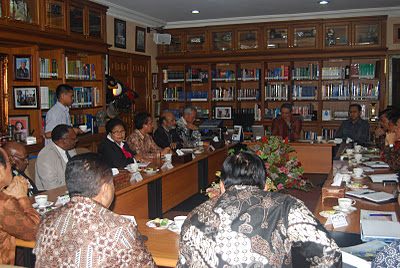
The atmosphere in the Library Meeting SBY in Cikeas.  (Frederika Korain / PGI)

The atmosphere in the Library Meeting SBY in Cikeas. (Frederika Korain / PGI)

JAKARTA – The Indonesian government has promised to withdraw non-organic troops from non-organic provinces of Papua and West Papua.

The promise was delivered directly by the President Susilo Bambang Yudhoyono during a meeting with Papuan church leaders at his residence, Puri Cikeas, Bogor, West Java, on Friday (12/16/2011) night.

The religious leaders present were:

  • Chairman of the Papua GKI Synod, Yemima Kret
  • Chairman of the Baptist Church of Papua, Socrates Sofyan Yoman
  • Chairman of the Kingmi Synod, Benny Giay
  • Martin Luther Wanma
  • Rika Korain

President Yudhoyono was accompanied by Vice President Boediono and several ministers, including Coordinating Minister for People’s Welfare Agung Laksono, Public Works Minister Djoko Kirmanto, National Police Chief Pol Gen Pradopo East, Armed Forces Commander Admiral Agus Suhartono, and Coordinating Minister for Political, Legal and Security Djoko Suyanto.

In a press conference at the office of the Guild of Churches in Indonesia (PGI), Jakarta, this afternoon, the religious leaders expressed appreciation for the government’s intentions.   Moreover, in December, most of the people of Papua  will celebrate the feast of Christmas.

“I convey to the President, this month the month of peace, in love, people should be calm. I asked for the violence to stop, it’s time we embraced each other, ” said Chairman of the Synod to Legal Kingmi Benny Giay, on Saturday (17/12/2011).

Hearing the request, said Benny, the President immediately asked the Police Chief and Commander of the TNI in order to stop the violence,  “President command to the Chief of Police and the Armed Forces (TNI) to stop the violence in Paniai, at least during the month of Christmas, “he added.

Pastor Gomar Gultom, also present at the meeting, explained that the President did not mention a specific deadline for withdrawal of non-organic troops. However, it is still regarded as an important step to begin the process of dialogue between Jakarta and Papua.

“The President ordered all non-organic troops to be withdrawn and stop the security approach as preparation for dialogue, (which) is not possible if there is a security approach,” he said.

Gultom referred to the (military) assault by Army and Police in Paniai from 12 to 15 December 2011 that has killed (at least) 15 people.  The official explanation by police is that they seized and occupied the headquarters of the TPN/OPM (National Liberation Army of West Papua). {West Papua Media note: independent human rights activists and church officials have accused TNI and Police of village burnings, helicopter attacks and massive displacement of 20,000 civilians in the campaign – which is still ongoing}.

According to Gultom, dialogue can not happen if at the same time there are security operations in the territory of Papua.   Until now, it is unknown the exact number of non-organic troops stationed in Papua.  Imparsial, a human rights organisation last August claimed there are approximately 30 thousand troops in Papua.  Of these, 14,000 are organic forces under the control of the Cenderawasih region military command.

Gultom said the two sides have not yet determined the dialogue format, nor points to be discussed, as a new opening meeting last night heard similar views. Furthermore, religious leaders are scheduled to meet again in mid-January 2012 in order to formulate the program in more detail.

However, in general, the President outlined the government’s position in the dialogue within a five point framework, namely the integrity of Indonesian territory and sovereignty integrity and sovereignty of Indonesia, Special Autonomy, Acceleration and expansion of development, with special act for affirmative action, and upholding the rule of law against all who violate the law.

“Affirmative action was meant as long as there is injustice against the people of Papua.  So later given the opportunity to them, for example, sitting in the government and so forth, ” he said.

Gultom added, President  SBY also expressed in the meeting his views about the role of the Unit to Accelerate Development of Papua and West Papua (UP4B) led by Lt. Gen. ( ret) Bambang Darmono. The Religious leaders view was that UP4B was formed unilaterally, and without hearing the aspirations of the Papuan people.

“There is a meeting point agreed upon last night.   All points will be evaluated together, and  UP4B will be stopped until results of the joint evaluation are available,” he said.

The religious leaders (repeated their) call for international third-party facilitated dialogue. In addition, they asked the government to release all political prisoners, and to repeal Government Regulation Number 77/2007 that regarding the prohibition of  the use of “separatist” symbols in Aceh, Maluku and Papua.  This regulation is the government’s basis to prohibit raising the banned Morning Star flag, despite Papuan people being legally allowed to fly the flag by the government of former President Abdurrahman Wahid. (ugo/edited by WestPapuaMedia)

http://news.okezone.com/read/2011/12/17/337/543723/pasukan-non-organik-ditarik-dari-papua-up4b-dibekukan

West Papua Media Note:  this significant news was confirmed on December 18 during telephone conversations with participants and observers at the meeting and this article is was written at the request of observers, however comment has been sought from other parties.  

West Papua Media Editorial comment:  At the face of it, this appears to be  a hughely positive step and announcement.  However, by refusing to set specific deadline, or measurable and achievable guarantees, it remains to be seen whether this is yet more window dressing whilst still refusing to address the root causes of violence in Papua today: which is the behaviour of Indonesian security forces, and suppression of West Papuan peoples basic human rights to self-determination and freedom from persecution, and their desires for West Papuan independence.

Please contact West Papua Media for contact details for meeting participants.

Papuan Church Leaders request dialogue during meeting with Indonesian President

SATURDAY, DECEMBER 17, 2011

by Andreas Harsono

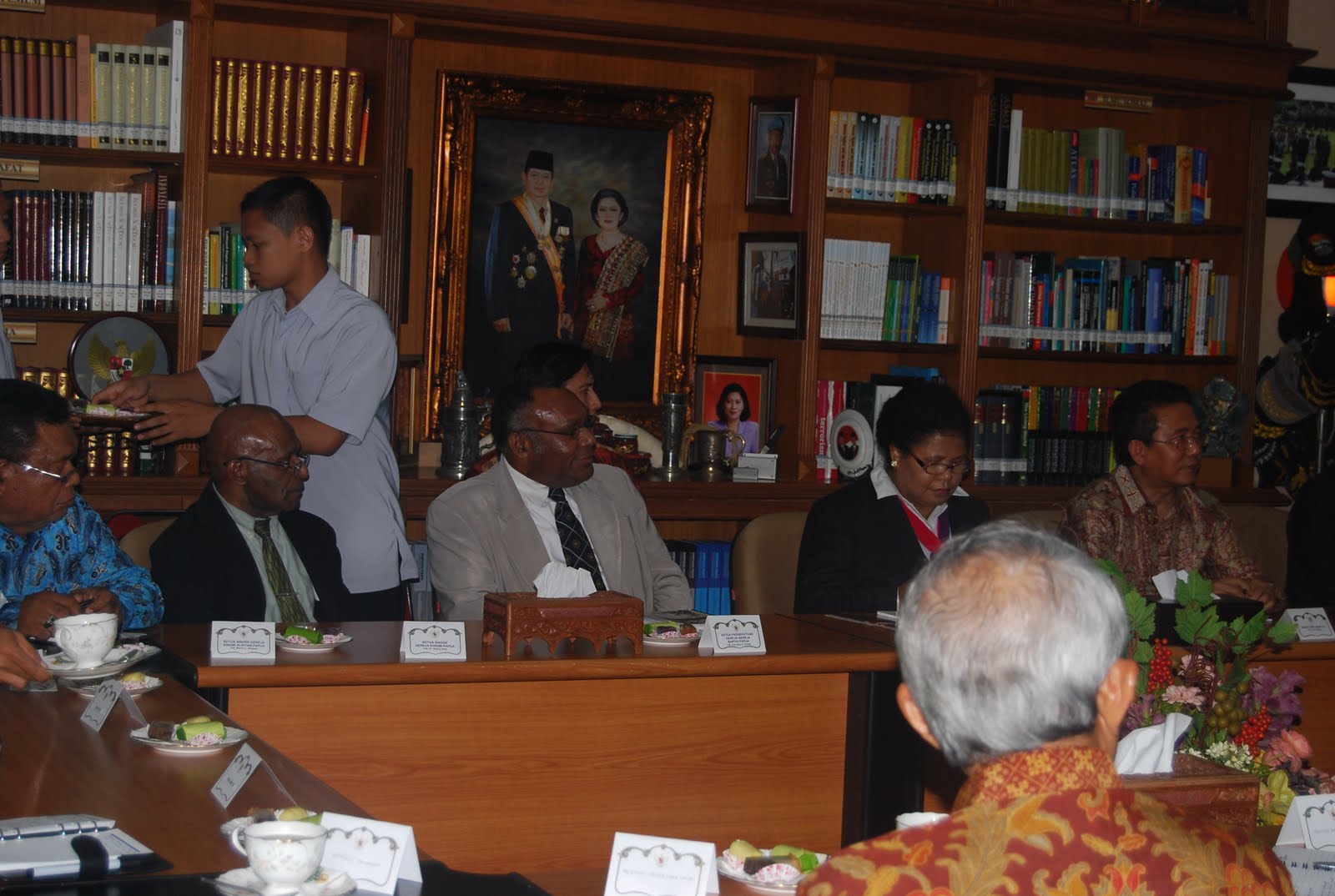
President Susilo Bambang Yudhoyono and Vice President Boediono met four Papuan church leaders in Yudhoyono's private library on Dec. 16, 2011. The Papuan priests presented a letter with several recommendations to Yudhoyono. ©Frederika Korain

FOUR PAPUAN church leaders met Indonesian President Susilo Bambang Yudhoyono, Vice President Boediono and several cabinet members as well as Indonesia’s military commander and its police chief in President Yudhoyono’s private residence in Cikeas, outside Jakarta, on Friday Dec. 16.

They included Rev. Jemima M. Krey (chairwoman of the Evangelical Christian Church in Papua or Gereja Kristen Injili di Tanah Papua), Rev. Benny Giay (chairman of the Kingmi Gospel Tabernacle Church or Gereja Kingmi di Tanah Papua), Rev. Socratez Sofyan Yoman (chairman of the Alliance of Baptist Churches in Papua or Persekutuan Gereja-Gereja Baptis Papua) and Rev. Martin Luther Wanma (chairman of the Indonesian Christian Bible Church or Gereja Kristen Alkitab Indonesia). Frederika Korain, a Papuan human rights activist and an Australian National University student, also joined the delegate.

The meeting was initiated by the Communion of Churches in Indonesia (Persekutuan Gereja-gereja di Indonesia) whose board members also took part in the meeting: Rev. Andreas Yewangoe (chairman), Rev. Gomar Gultom (secretary general) and Rev. Phil Erari (deputy chairman).

The church leaders handed over a seven-page letter to President Yudhoyono, asking the Indonesian government to have a dialogue with the people of Papua. They also asked Yudhoyono stopping the Matoa Operation in Paniai, Papua, which had caused 14 dead and some burned villages on Dec. 12.

Other recommendations included retrieving non-organic troops from Papua, releasing Papuan political prisoners and annulling the Government Regulation No. 77/2007 which bans the Morning Star flag.

They also declared that the 2001 Special Autonomy in Papua had failed. They questioned the establishment of the Unit to Accelerate the Development of Papua and West Papua provinces (UP4B) without the participation of the Papuans, calling such a move “non democratic.”

Benny Giay told me Saturday that the meeting was taking place for more than two hours. “It really hurt me when knowing our church members were attacked, their villages being burned, while we’re here in Jakarta.”

Giay came from the village Onago on Lake Tigi in Paniai, near Edadu, where the Indonesian military and police have been organizing a joint military operation since Dec. 13.

They also told President Yudhoyono that most native Papuans have suffered from Indonesian rule since Indonesia took over New Guinea in 1962. Violence created much suffering on the people. They said most Papuans aspired to be separated from Indonesia.

In front of his guests, Yudhoyono immediately asked Indonesian police chief Gen. Timur Pradopo to stop the Matoa Operation. He also mentioned that U.S. President Barack Obama and State Secretary Hillary Clinton had raised the issues of human rights violations in Papua.

Yudhoyono welcomed such a dialogue but he reminded his guests that as president he has to keep the territorial integrity of Indonesia. He promised to enforce the law in Papua and to stop human rights abuses. Yudhoyono promised to have another dialogue with the four reverends in the third week of January.

Rev. Martin Luther Wanma, chairman of the Indonesian Christian Bible Church or Gereja Kristen Alkitab Indonesia (blue batik), Rev. Benny Giay, chairman of the Kingmi Gospel Tabernacle Church or Gereja Kingmi di Tanah Papua (black jacket), Rev. Socratez Sofyan Yoman, chairman of the Alliance of Baptist Churches in Papua or Persekutuan Gereja-Gereja Baptis Papua (light grey jacket) and Rev. Jemima M. Krey, chairwoman of the Evangelical Christian Church in Papua or Gereja Kristen Injili di Tanah Papua (black blazer) and Rev. Gomar Gultom of the Communion of Churches in Indonesia (brown batik) talked straight to Indonesian leaders. ©Frederika Korain


The meeting began at 9pm and ended at 11.30pm at Yudhoyono’s private library. Gomar Gultom organized a press conference at the office of the Communion of Churches in Indonesia Saturday morning.

Both Yoman and Giay are under the Indonesian military watch list. An Indonesian military document leaked in August 2011 revealed that Kopassus agents were closely monitoring Giay and Yoman.

Another leaked letter dated April 30, 2011, from the Indonesian military commander in Papua, Maj. Gen. Erfi Triassunu, to the provincial governor, Barnabas Suebu, also shows a military interference in civil society in Papua.

The letter accuses Rev. Benny Giay’s Kingmi Gospel Tabernacle Church of trying to build an exclusive organization based on Papuan ethnicity, which Major General Triassunu viewed as a potential separatist movement, and suggests having the military mediate a conflict between the Kingmi Church (Gereja Kemah Injil or Kingmi Church) and the Indonesian Gospel Tabernacle Church (Gereja Kemah Injil Indonesia or GKII). The letter also urges that if deliberations cannot resolve the conflict, “immediate action” should be taken. Since the letter came to light, Major General Triassunu has publicly apologized for accusing the church of being a separatist organization, claiming a faction of the church had asked for assistance from the military.

Yawan Wayeni

Giay told me that Yudhoyono was surprised when seeing the photo of a dying Papuan activist Wayan Wayeni on the letter. They told him that Imam Setiawan, the Indonesian police officer who led the attack against Yawan Wayeni on Serui Island, in August 2009, was later promoted to be the police chief of Jayapura. In his new position, Setiawan used excessive forces when cracking down the Papuan Congress in October 2011 and arrested around 300 Papuans. But Setiawan got another promotion despite a written warning for his abusive behavior. He’s now the deputy director of traffic in Papua.

Original Letter from West Papuan church leaders on presented at President Yudhoyono’s private residence in Cikeas, outside Jakarta, on Friday Dec. 16, asking the Indonesian government to have a dialogue with the people of Papua. (Bahasa Indonesia: English translation currently unavailable) :

Australia must act after more conflict in West Papua: Greens

Media Release
http://richard-di-natale.greensmps.org.au/content/media-release/australia-must-act-after-more-conflict-west-papua-greens

Dr. Richard Di Natale
Greens Senator for Victoria

16/12/11

Greens’ spokesperson for West Papua, Senator Richard Di Natale, has called for urgent action in response to reports of conflict, deaths and displacement in the Paniai region of West Papua.

“Australia can no longer stand silent while West Papua burns,” said Senator Di Natale.

“There are reports of villages being raided and razed by Indonesian forces, which may have been trained and armed by Australia.

“In addition to 15 deaths from shootings, thousands of West Papuans are reportedly displaced and some have died from an outbreak of diarrhoea in an overcrowded refugee care centre.

“The Australian Government must urge Indonesia to end the violence immediately, withdraw all military forces from the region and enter into a peaceful dialogue with the Free West Papua movement.

“We must also push for access to be given to the Red Cross so that much needed aid and care can be given to the Papuans in the region. Opening up the area to journalists and human rights organisations is needed so that we can monitor events like these.

“Australia must consider its military links to Indonesia and suspend all ties while such violence continues.

“We cannot stand idly by while this conflict escalates and human rights are being abused on our doorstop.”

Media contact: Andrew Blyberg 0457 901 600

Create a website or blog at WordPress.com

Up ↑