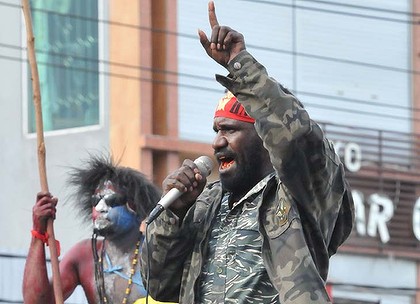
Police torture students after brutal attack on Abepura university dormitory

Scores beaten, arrested, tortured and injured in major raid by Indonesian Police, Army and allegedly Australian Funded counterterror unit Detachment 88 on Yakuhimo Dormitory at Cenderawasih University, Abepura.

by West Papua Media

August 28, 2012

URGENT CORRECTION: Despite robust processes of cross-checking, armed attacks by security forces on civilians sometimes creates confusion on casualty figures.  NEW information has come to hand in the clear light of day, and two confirming witnesses have retracted their confirmation early Wednesday morning.  Only 1 person, Yalli Walilo, is confirmed dead, and he died after being set upon by a group of men believed to be transmigrants or plain clothes intelligence.  The other two victims were part of the group that received significant torture at the hands of police, but it is now NOT independently confirmed if these people are dead or severely injured.  More info as it becomes available.  West Papua Media apologises for the distribution of erroneous information.

(Jayapura)  Brutal scenes occurred at a highland students dormitory in Abepura early on Sunday night (26 August) as a massive assault was carried out on  students from the Liborang Asrama (dormitory)  by a joint force of Army (TNI) and Police.

The students were allegedly targeted because they come from the same tribal group as many members of the West Papua National Committee (KNPB), who have been consistently engaging in peaceful civil resistance in protest at the increasing terror tactics of the Indonesian security forces, which has escalated significantly since May 2012..

1 person been independently confirmed by West Papua Media sources as killed, and at least two are believed but not confirmed to have died from torture wounds inflicted in custody by police, according to human rights sources.  35 people were arrested, and 11 people remain in custody at time of writing undergoing significant and brutal beatings, and acts of torture.

This slideshow requires JavaScript.

Independent human rights sources have alleged that the torture has been carried out by members of Detachment 88, the counter-terror unit funded, armed and trained by the Australian Government, however West Papua Media has not been able to verify this, although D88 has been present at every other dormitory raid this year.

According to credible witnesses the trouble began when a man named Yalli Walilo (26) was calling a friend in front of a shop and the Indonesian transmigrant owner of the shop came and angry him.  Walilo replied to  the colonist “what is my problem, i just want to buy (a) cigarette”.  He then sought refuge at the house of Ms. Nehemia Mabel, a member of the Majelis Rakyat Papua (Papuan People’s Assembly), 5 metres from the shop.  Walilo then tried to go home, when he was brutally set upon by a group of Indonesian transmigrants with one killing him, and more people again came to kick him until he was dead.

The exact circumstances of how police came to be involved is still unclear, but after Walilio’s killing, the Kepala Desa (neighbourhood chief) came and took his body to the Limborang dormitory.  Police were alerted by the Kepala Desa amid confusing allegations surround the death of an elderly man who died from a heart attack.  It is unconfirmed if these deaths were related.

At around 10 pm, Some of Walilo’s friends at the dormitory went to investigate the commotions at the shop, but were ambushed by the large group of transmigrants outside the shop.  The students retreated to their dormitory, known also as the Yakuhimo Asrama as large numbers of Yakuhimo highland students live there.

One hour later, Police and many troops arrived en masse at the dorm and attacked boarders without negotiations, and also severely beat of minors.  Independent witnesses have claimed that men in masks were also present.

Victor Yeimo, KNPB Chairman, told West Papua Media that many students in Asrama Liborang had “already been killed, intimidated and terrorised under Indonesian police troops yesterday (27/08). This morning, I have been in the place and I found how Indonesian police kill and intimidate them. I was there while some of them arrived from Papua Police in Jayapura and we have interview some victims and the chief (spokesperson) of the Students”.

According to Yeimo many police and troops began attacking the Asrama Liborang with tear gas and water cannon (fire hoses?)  inside at 11.00 PM on Sunday night.  Police stormed the building and smashed up facilities inside and arrested, and tormented the students, according to both Yeimo and other independent witnesses.

Yeimo alleged that the “Police talked to them and relate them (make threats to them) about the killing of Mako Tabuni (on June 14) . Police blamed them as being friends of Mako Tabuni.”

On Tuesday evening, Australian ABC television program “7.30 Report” aired an investigation into Mako Tabuni’s killing by Detachment 88, and the intensifying repression of peaceful political free expression by West Papuan activists seek an end to violence and impunity, and a referendum on the disputed territory’s future.  The Australian Foreign Minister, Bob Carr, has conceded Detachment 88 is being used on non-violent activists, and has claimed it is acting outside its mandate.

The victims names (at time of writing) are confirmed as:

1. Alex Sambom (Fractured Skull by police. Strangled around neck with metal chains. and repeatedly electrocuted in custody, in critical condition)
2. Usman Ambolon ( Killed after beatings in the head with lacerations and severe contusion)
3. Petru Lintamon ( Police kicked his eyes and head, shot dead with gun)
4. Yaton Lintamon ( Police beat him to death with rubber mallet)
5. Septinus Kabak (Fingernails removed with pliers at the police office)
6. Orgenes Kabak (Beaten severely in stomach, internal injuriess)
7. Awan Kabak (Police stabbed him with bayonets in the leg and thigh)
8. Other Victims to still be identified

More photos, video and information as it becomes processed/translated and available.

westpapuamedia

AMNESTY STATEMENT: Security forces block peaceful demonstration in Papua

AMNESTY INTERNATIONAL
PUBLIC STATEMENTIndex: ASA 21/031/2012
10 August 2012

Indonesia: Security forces block peaceful demonstration in Papua

Amnesty International calls for an independent and impartial investigation into reports that police used unnecessary and excessive force to disperse a peaceful demonstration in Papua province commemorating International Day of the World’s Indigenous People on 9 August 2012.

If the investigation finds that the security forces committed human rights violations, then those responsible, including persons with command responsibility, should be prosecuted in proceedings which meet international standards of fairness, and victims provided with reparations.

At least seven people were arbitrarily arrested during and after the demonstration and are being held at the Yapen District police station. They should be released immediately and unconditionally if they have been arrested solely for the peaceful exercise of their right to freedom of expression.

Police Mobile Brigade (Brimob) and military from the 1709 District Military Command (Kodim) led by the Yapen District Police Chief blocked hundreds of peaceful protesters as they marched on the morning of 9 August 2012 in Serui, Yapen Island.

According to local sources, the Indonesian security forces then fired their guns into the air to disperse the protesters, causing many to flee in fear. At least six protesters were arbitrarily arrested during the demonstration and some were reportedly beaten by security forces during their arrest. The police then travelled to Mantembu village to arrest one of the demonstration organizers, a local political activist. When they could not find him they arrested his wife, who is reportedly eight months pregnant.

The actions of the security forces fly in the face of statements made by President Susilo Bambang Yudhoyono in February 2012 that he wanted an end to repressive actions by the military and police in Papua.

The rights to freedom of expression and peaceful assembly are guaranteed in Articles 19 and 21 of the International Covenant on Civil and Political Rights (ICCPR), to which Indonesia is a state party. Moreover, these rights are protected under Indonesia’s Constitution. However, Amnesty International has documented dozens of other cases of arbitrary arrest and detention in past years of peaceful political activists in Papua.

Amnesty International continues to receive credible reports of human rights violations committed by the security forces in the provinces of Papua and West Papua, including torture and other ill-treatment, unnecessary and excessive use of force and firearms by the security forces and possible unlawful killings. Investigations into reports of human rights violations by the security forces are rare and only a few perpetrators have been brought to justice.

During a 2008 gathering to commemorate International Day of the World’s Indigenous People in Papua, peaceful demonstrator Opinus Tabuni was discovered dead with a bullet wound clearly visible in his chest, after police opened fire at the crowd. Despite a police investigation, to date no one has been held to account for his death.

Giay: West Papua – Land of Mourning, Bloodshed (Peace?) and Humanitarian Intervention

From Kingmi Church  – Papua

edited by WPM for clarity

Also at Numbay Media — posted on Engage Media website

June 28, 2012

Rev. Benny Giay
Diplomatic Briefing, Hotel Trefa
Jakarta, June 27, 2012

Papua Land of Mourning And Bloodshed (Peace????) And Humanitarian Intervention[1]

Rev. Benny Giay

Since May 2012 until June there has been a series of shootings in Jayapura in the context of our struggle to fulfill our “Papua land of peace” dream. The government has claimed the shooting has been carried out by separatist groups. Papuans respond to such claim is as usual: “Oh itu lagu lama. The authorities are playing the old song.”

One way to respond to that “old song” is to look at the root cause of shootings that ended with the killing of Mako Tabuni on 14 June, followed by the arrest of other members of KNPB in Papua a few days ago. In my view this development has something to do with (a) first of all how 2 different actors (Indonesia and Papua) that belong two {separate} cultures (Malay and Melanesia) view themselves and their past. Indonesia’s view is that Papua has become part of Indonesia and has been in contact since 8th century with them. Therefore Papuans are brothers.

Papuans on the other hand believe that it might be true that Papuans has been dealing with the ancestors of the rest Indonesians for several centuries, but that contact occurred in context of domination, slave trade and oppression. The contact between the two parties was one of master – slave  relations. Therefore, Papuans see their past relations with Indonesia (Tidore, Ternate and Maluku etc.) as history of robbery, slavery, destruction of their villages and burning of Papuan community settlements.

Secondly since 1960s when Indonesia took over Papua,  Papuans were viewed {By Indonesians} (and have been viewed until now) as primitives, backward, uncivilized people; and therefore Jakarta since that time promoted itself as the guru, the teacher of new civilization to “lift up socio-economic welfare of Papuans”. Jakarta then formulated what an Indonesian scholar call: migrant biased development policy (which in brief is a policy made by central government to guarantee the interest, safety and future of Indonesian migrants in Papua, while ignoring Papuan identity, culture and their future.) Papuans have no place in such a development scheme. Papuans are non humans. Second class citizens. This Indonesian neo-colonial policy (if we can use that term) was from the beginning up to now has been guarded by security institutions. Papuans who resisted this undemocratic policy has been dealt with by security forces.

Thirdly, as a result Papua has become “site of mourning”, “site of collective trauma”, and a site of oppression and mourning”. Three days of mourning that we had (June 14-16) as we gathered in Post 7 Sentani after the killing of Mako Tabuni, was not a new thing.  We only repeat what our past generation went through since 1960s. Facing such migrant biased development (or Indonesian colonial policy) as shown above, we, Papuans since 1960s are like the Javanese of 1900s Central Java, who were treated as second class citizens by the Dutch (as Indonesian history books say today); or Black South Africans of 1940s who suffered under apartheid policy. In fact this “migrant biased development policy” I think is “an Indonesian version of apartheid racial policy” toward Papuans. Theologically speaking Papuans of today and in the past have  been living under modern Pharaoh or modern Goliath, supported by the international community and multinational companies who had come to Papua and robbed the natural resources, killing off the Papuans.

Fourthly, the killing of Mako Tabuni by Indonesian Police has to be seen in the light of history of Papuan resistance to Jakarta’s migrant development policy pointed out above. Mako Tabuni and other civilians who voiced their right and grievances have been and are stigmatized as separatist. Mako, who was leading a civilian {civil society} group using peaceful means in demanding Referendum, has been seen as a threat to Indonesian political interest. This strategy to stigmatize was used by Erfi Triassunu, former Military Chief, in March 2011. He issued a confidential document saying that Papuan Christian Church (Kingmi – of which I am the Chairman of its Synod) is a religious arm of the Papuan Liberation organization (OPM). Other Church leaders of Papua in September 1966 were accused by security forces in Papua as an umbrella organization of OPM. Similarly Papuan NGOs who {promote advocacy around} human right abuses in the past have been seen in the same light.

The question now is who is behind the shootings that started May? According to Government it is Mako of KNPB, and Mako or KNPB is OPM. I can see the shootings from the point of view 3 actors, each of with their agendas.  First party is Mako or KNPB who represent Papua demanding referendum to deal with new modern Pharaoh. Second actor is a small and insignificant group of international solidarity group with agenda for democracy and promotion Papuan human right. Third actor is Jakarta: who fears the threat of disintegration and panic; not willing to change the approach to Papua; hold on to the sacred doctrine “territorial integrity” with the support of international community”. And that it is OK to use military or Police force to kill or annihilate separatist group to maintain “the territorial integrity”. Looking at the history of civilian’s resistance the shooting since May of this year was carried out by agents of Government to weaken the civilians struggle for referendum using means of non violence. Jakarta’s fear that is the international solidarity groups would promote the cause of Papuan civilians at the international niveau (level).

Jakarta is now on safer ground. They have has shot dead Mako Tabuni whom they accused as OPM agent. But the dream for “Papua: Land of Peace” remains a dream. Police and military are still searching for the members of KNPB. Military and Police are in control. Papua is still a land of mourning, a land of trauma and bloodshed. Modern Pharaohs and Goliath are in control in Papua today.  It is here that we need “third party” as it is in the case of Israelites and Pharaoh (Exodus 3:7-9). Papua need a moratorium”. Now is the time for Papua and Jakarta to formulate “new Indonesia”. But to do this we need a “humanitarian intervention”.

Toch, perpetrators of Human right violations in Papua will never be taken to court. They in fact will be promoted. Paulus Waterpauw (Deputy Police Chief of Papua) and Bigman Lumban Tobing (Papua Police Chief) will follow the footsteps of Col. Hartomo, the Kopassus commander who ordered the abduction and the killing of the late Theys Hiyo Eluay in November 2001; he was promoted last week as another high ranking military elite in Jakarta.

Jakarta, June 27, 2012

Rev. Benny Giay

Ketua Synode Kingmi di Tanah Papua

(Papuan Christian Church)


[1] I am dedicating this reflection to pastors and the ministers of the Lord, in Papuan Church History who were shot dead by Indonesian Security Officers in the past out allegation that they were agents of Papua Liberation Organization.

HRW: Indonesia – Lift Restrictions on Reporting, Access to Papua

HRW

HUMAN RIGHTS WATCH

Indonesia: Lift Restrictions on

Reporting, Access to Papua [1]

Invite UN Rights Experts to Increasingly Violent Eastern Provinces
June 13, 2012

(New York) – The Indonesian government should allow foreign media and civil society groups access to Papua to report on violence and rights violations since May that have left at least 14 dead.

Human Rights Watch urged Indonesia to accept calls made at the United Nations Human Rights Council to permit access to the province and to issue standing invitations to UN human rights experts.

“By keeping Papua behind a curtain, the Indonesian government is fostering impunity among military forces and resentment among Papuans,” said Elaine Pearson, deputy Asia director at Human Rights Watch. “It needs to let the media and civil society shine a light on conditions in the province.”

Human Rights Watch said that the Indonesian government has failed to hold to account those responsible for recent violence in Papua. On June 6, 2012, a crowd stabbed one Indonesian soldier to death and seriously injured another after their motorcycle struck a Papuan child in Honai Lama District in Wamena, a city in Papua’s Central Highlands.

In retaliation, hundreds of soldiers from the 756th battalion swept through Honai Lama and elsewhere in Wamena, beating and stabbing residents and burning homes. A Papuan civil servant, Elianus Yoman, reportedly died from bayonet wounds. Seven other Papuans were injured and hospitalized. The soldiers set numerous buildings and motor vehicles on fire, causing many villagers to flee into surrounding forest.

An Indonesian military spokesman in Jayapura, Papua’s capital, initially denied that soldiers had injured any Papuans. But Indonesia’s president, Susilo Bambang Yudhoyono, later conceded [4] that the Indonesian security forces overreacted in their response.

There have been a number of other violent incidents reported recently in Papua’s capital. Since May 23, unknown gunmen shot dead several non-Papuan migrants. A German tourist was shot on May 29 and was sent for treatment to a hospital in Singapore. The police forcibly broke up a protest on June 4 by the National Committee for West Papua (Komite Nasional Papua Barat or KNPB), a militant Papuan independence group, reportedly killing three student members. A KNPB member was also reported shot to death earlier on May 1.

The response of the national government to the growing violence in Papua has been inadequate, Human Rights Watch said. Yudhoyono told reporters on June 12, “The action [attacks in Papua] can be said to have happened on a small scale with limited victims.… The figure is far [lower] than the violence in the Middle East, [where] we can witnesses, every day, attacks and violence with huge numbers of deaths.”

“President Yudhoyono should stop making excuses for his government’s failure to investigate the violence,” said Pearson. “Allowing full access to the province for UN rights experts, the press, and other monitors could curtail the rumors and misinformation that often fuel abuses.”

The Indonesia government sharply restricts access to its easternmost provinces, Papua and West Papua. Military forces have been deployed there since 1963 to counter a long-simmering independence movement. Foreigners are required to obtain a special permit to visit the areas. Such permits are routinely denied or the processing delayed, hampering efforts by journalists and civil society groups to report on breaking events.

During the Universal Periodic Review of Indonesia at the UN Human Rights Council on May 23, France called on Indonesia to ensure free access for civil society and journalists to Papua and West Papua. The United Kingdom noted the “increase in violence” in Papua and “encouraged Indonesia to tackle violence against minority faiths and accept visit requests by Special Rapporteurs.” Austria, Chile, the Maldives, and South Korea called on Indonesia to accept standing invitations to the UN rights experts and groups known as special procedures. Mexico specifically asked the Indonesian government to invite the special rapporteurs to Papua.

The previous UN Special Rapporteur on extrajudicial, summary or arbitrary executions, Philip Alston, made a request to visit Indonesia in 2004 and again in 2008, to which he never received a response.

“Several states registered concerns at the UN Human Rights Council about Indonesia’s failure to invite UN experts to the country,” said Pearson. “If Indonesia wants to be taken seriously in Geneva, it shouldn’t continue to ignore this request.”


Links:
[1] http://www.hrw.org/news/2012/06/13/indonesia-lift-restrictions-reporting-access-papua
[2] http://twitter.com/share?url=http%3A%2F%2Fwww.hrw.org%2Fnews%2F2012%2F06%2F13%2Findonesia-lift-restrictions-reporting-access-papua&count=horizontal&via=&text=Indonesia%3A%20Lift%20Restrictions%20on%20Reporting%2C%20Access%20to%20Papua&counturl=http%3A%2F%2Fwww.hrw.org%2Fnews%2F2012%2F06%2F13%2Findonesia-lift-restrictions-reporting-access-papua
[3] http://www.facebook.com/plugins/like.php?href=http%3A%2F%2Fwww.hrw.org%2Fnews%2F2012%2F06%2F13%2Findonesia-lift-restrictions-reporting-access-papua&layout=button_count&show_faces=false&action=recommend&colorscheme=light&width=150&height=21&font=&locale=
[4] http://www.thejakartaglobe.com/news/sby-sanctions-for-papua-law-enforcers-committing-inappropriate-actions/523951

© Copyright 2012, Human Rights Watch

KNPB leader Mako Tabuni shot dead by Aust-funded Indonesian Detachment 88 troops; riots in Jayapura

Breaking News
West Papua Media

June 14, 2012

Angry scenes have reportedly erupted in Jayapura and across West Papua after officers from the Australian- funded and trained Detachment 88 counter-terror troops shot dead the secretary-general of the West Papua National Committee (KNPB), Mako Tabuni, during a botched arrest attempt while he was chewing betel nut at a kiosk in Abepura, West Papua early on Thursday morning.

According to credible independent church human rights sources in Jayapura that spoke to witnesses in Waena, Mako Tabuni was shot and wounded by heavily armed Indonesian police as they stormed

image
Mako Tabuni as he lie dying in Jayapura (KNPB/ westpapuamedia)

the area outside the student dormitories at the Cenderawasih University Abepura.

Mako Tabuni.

Senior members of KNPB have told West Papua Media that Tabuni had been walking with friends to buy and eat Betel Nut from a kiosk near the university.  After he separated from his friends, they heard gunshots. and  they saw a white Avanza car drive up and ambush Tabuni, according to his friends.  Tabuni was shot at least six times, according to both witnesses and journalists in Jayapura.

image
Mako Tabuni as he lie dying in Jayapura (KNPB/ westpapuamedia)

Police took Tabuni to the police hospital in Jayapura, where he reportedly died from his wounds soon after arrival.  The Kapolres (police chief) has told media outlets including West Papua Media via SMS that Tabuni was killed because he resisted arrest and attempted to seize the weapons from the Detachment 88 troops.   According to the It has been confirmed independently that the Australian-funded and trained Detachment 88 troops were in command of the arrest operation.  Tabuni was unarmed at the time of his arrest, which is a violation of the United Nations Basic Principles on the Use of Force and Firearms by Law Enforcement Officials.

KNPB contacts report that a combined team of military and POLRI, BRIMOB, Detachment 88, and Intelligence officers are raiding dormitories of Papuan students in Abepura, chiefly those of highland origin students who are the traditional support base of the KNPB.    In this sweep, security forces have confiscated books, bags, clothing, computers, phones, and cameras.  Security forces are also conducting searches across Abepura, Jayapura, Kotaraja, Waena, Sentani and several other places.  Many students have been severely beaten and arrested in dormitories in Waena and Asrama by over six companies of Indonesian army (TNI) and Police. KNPB sources have expressed fear that the students, already beaten severely and taken to Rusunawa police centre, will be tortured and possibly killed by occupation forces.

Supporters of Tabuni have reacted angrily and have taken to the streets and are allegedly burning houses belonging to military and police in the Ruko, Waena and Abepura areas, in an eerie reversal of the June 4 rampage by Indonesian soldiers in Wamena.

Security forces are reportedly on the streets with orders to shoot rioters dead on sight, and the situation is described as extremely tense.  It is not clear if those who have caused property damage are in fact  members of the pro-independence movement, or are undercover Indonesian intelligence officers.

A senior highland human rights activist in Jayapura, whom West Papua Media cannot identify for safety reasons, told West Papua Media that the entire Papuan population is living in a state of constant trauma and fear due to the escalation of Indonesian repression.

“Pro-Independence activists and Papua human rights workers have become the operating target of the (ongoing)shootings, not to mention all the KNPB activists the security apparatus are seeking,” said the source.

“Finally, I spoke with three of our members hiding in the suburbs.  If the Indonesian security forces are still after us, then they would not want or like it if we had entered the woods and hid,” he said.

” To step into the forest is for avoiding premature death.”

Papuan activists are calling for urgent international attention to the rapidly deteriorating humans rights crisis in West Papua.  A senior KNPB activist has begged: “In this case our nation is pleading for UN Intervention to be done now, because Indonesia is planning to kill all us Papuans.”

More to come

Create a website or blog at WordPress.com

Up ↑