The Coverage of Gunfire in Nabire is Public Deception

Tabloid Jubi

September 25, 2012

by Victor Mambor

Jayapura, (25/9) The coverage about gunfire between police and armed civilian groups in Urumusu, Nabire Regency on Monday (24/9) that was reported by national and local media, has been described as ‘public deception’ by human rights activists in Nabire. A resident called Kristian Belau/Zonggona, named by police, was shot in the gunfire.

This allegation of public deception was asserted by the Nabire Kingmi Klasis Church Bureau of Justice and Peace in a chronological report of events received by tabloidjubi.com , on Tuesday (25/9). The Bureau of Justice and Peace of the Nabire Kingmi Klasis Church, which undertook an investigation into this incident says that this was actually a case of police shooting the victim, Kristian Belau/Zonggonau, because of road-blocking elated activity on the Interior Trans-Nabire road, not because of gunfire between police and armed civilian groups.

From the chronolgy collected by the Bureau of Justice and Peace, on Tuesday 25 September 2012, at approximately 6:00am CDT, a group of Moni Youth were road-blocking on the roadside of the Interior Trans-Nabire Road next to the Wadio Atas Elementary School, Gerbang Sadu Villiage, in the West Nabire District of Nabire Regency. Unfortunately, when these young people stopped an Inova type car that was heading inbound and requested money from the passengers, it turned out there was a police officer in the car. The police officer then fired into the air three times, which made all the Moni youth run to safe themselves. But three other Moni youth used a motor bike to travel to the rubbish dump in Wadio Atas and continued their road-blocking actions. The police officer that fired the shots directly reported to Nabire Police District Command (Polres) that there were people carrying out road-blocking in Wadio Atas.

Kristian Belau lying down awaiting the operation to remove the bullet

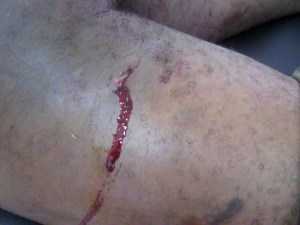
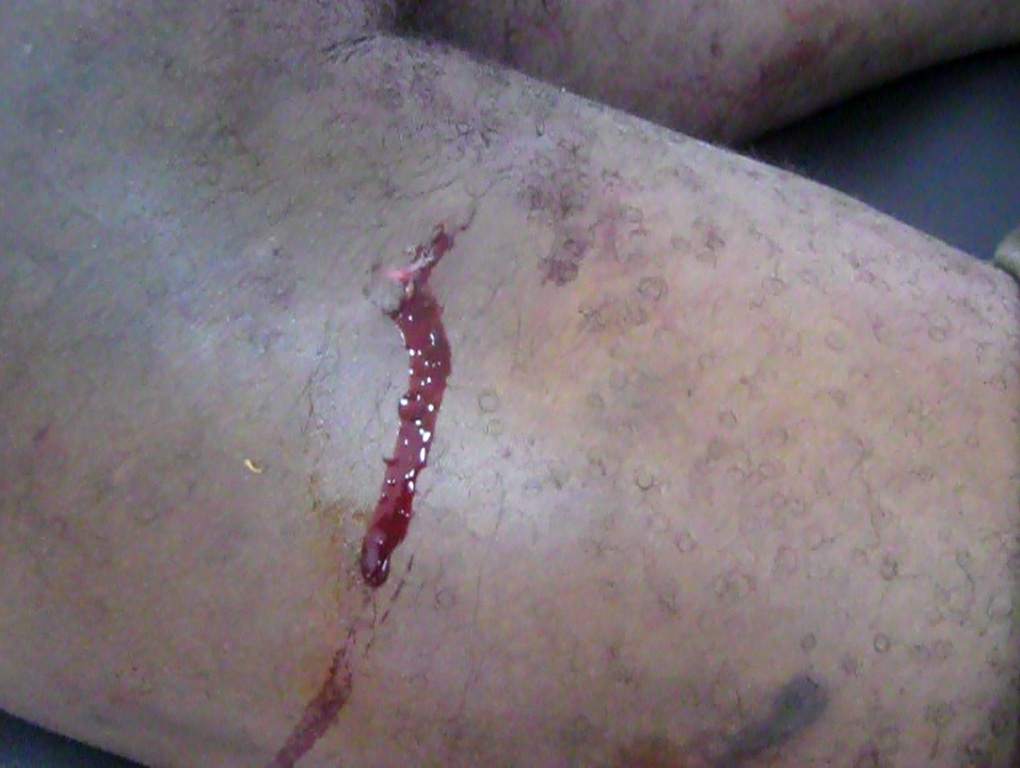
After morning assembly, police from Nabire District Command took one track heading towards Wadio Atas and checked a spot that is often blocked. Upon arriving at the rubbish dump in Wadio Atas, Gerbang Sadu Villiage, Nabire West District, police met with the three Moni Youth. When the police attempted to arrest the three, two escaped. However, one of them, Kristian Belau/Zonggonau, instead advanced towards police. At the time, Kristian Belau/Zonggonau is suspected of being drunk because all night he was drinking heavily. When he advanced towards the police officers, he was shot in the right thigh. Kristian was then lifted to the police patrol car to be taken to the Siriwini Hospital Emergency Room, Nabire. Currently, the victim is in custody at Nabire Police District Command for questioning. According to several citizens in around Gerbang Sadu villiage, road-blocking on the Interior Trans-Nabire Road happens every night. It has been occurring for quite a while. Although police have repeatedly arrested road-blockers, there still are those who road-block. Usually every vehicle that travels inbound is billed according to the type of vehicle. Taxis are billed RP 50,000, private vehicles are billed RP 50,000 and trucks are billed RP 100,000. This issue makes the police angry, to the point that they carried out the shooting of Kristian Belau/Zonggonau.

In the reporting that followed, police said they could not avoid exchanging fire with armed civilian groups in the mentioned location. ‘Because a member was shot, in the end returning fire could not be avoided, one person of the armed group was named Kristian Belau/Zonggonau was shot in his left thigh. Other members of the armed group successfully escaped into the forest whist continually firing at police with revolvers and SS1 type guns’, explained Lieutenant Colonel Gede Sumerta to tabloidjubi.com (25/9),

Based on the investigation carried out, given to tabliodjubi.com the Nabire Kingmi Klasis Church Bureau of Justice and Peace disputes the police explanation. According to them, statements of gunfire between police and armed civilian groups that use revolver and SSQ type weapons is information that has been distributed by irresponsible parties and constitutes public deception. ‘Gunfire between police and armed civilian groups that use revolver and SSQ type weapons is an announcement that is irresponsible and public deception’, said Yones Douw, an activist from Nabire Kingmi Klasis Church Bureau of Justice and Peace to tabloidjubi.com (25/9).

‘Because the Urumusu location is far from the Interior Trans-Nabire road, entering Topo District, Nabire West Regency, a distance from the incident of approximately 45 kilometres. This morning, our human rights activists met with Kristian’s elder sibling and the Moni community in Wadio Atas. They said their children (the three youths who were road-blocking) do not own weapons. If they get drunk and road-block, it’s possible’, continued Yones Douw. (Jubli/Victor Mambor).

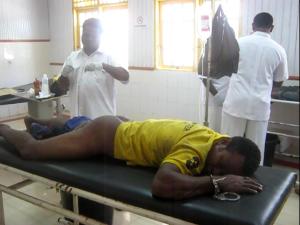
a policeman with his weapon guards Kristian Belau

Kristian Belau awaiting operation

right thigh hit by bullet

Journalists face difficulties when trying to report about the trial of Buchtar Tabuni

JUBI
25 September 2012[Photo at the top of the report shows several of the police on guard, all of whom are heavily armed.]

The police who guarded the courthouse during the trial of Buchtar Tabuni made it difficult for some of the journalists wanting to cover the case to gain access to the court.

Benny Mawel of JUBI said: ‘I showed my press card but the police  insisted that I open my bag and take everything in it out for them to examine’ He said that access to the court had been made difficult.

Journalists were interrogated and the police demanded to see the contents of their cases. ‘This happened not only to me but to other journalists,’ said Benny Mawel, ‘even though we had clearly displayed our press cards.’

This did not happen during the earlier hearings of the trial.

A journalist  from Papua Pos Daily, Rudolf,  also said he had been heavily investigated. His bag had also been searched. He said that before entering the court, he hung his press cord round his neck but even so, the police examined the contents of his bag.

While on the one hand regretting the  measures taken against journalists by the police, Viktor Mambor, chairman of the Jayapura branch of the Alliance of Independent Journalists, AJI. said he hoped that journalists would understand what the police were doing.

”They certainly acted excessively and this should not be necessary this if journalists have clearly shown their press cards. But at the same time,’ he said,  ‘I could understand what they were doing because during an earlier discussion I had with the chief of police, there was concern about the fact that the credentials of some of the journalists were suspect because of recent indications about the involvement of certain pressmen in the recent violent conflict  in Papua.’

He went on to say that some time around July this year, a journalist had been interrogated by the police because he had reported that the Morning Star Flag had been flown on some occasions. In Papua, such reports only complicate matters because it stigmatises people, thereby legitimising excessive measures taken by the security forces. As Papuans, we have to understand this,’ he said.

Translated by TAPOL]

Buchtar Tabuni sentenced to eight months; tight security round the courthouse.


Bintang Papua
24 September 2012
The former chairman of the KNPB – National Committee for West Papua – was sentenced to eight months in prison, having been charged with inflicting damage on the prison where he was held. The sentence was  less than the demand of the prosecutor who wanted the accused to be sentenced to one year. The eight month sentence will be reduced by the time the accused has already spent behind bars.Aggravating circumstances were that he had previously  been sentenced and that his actions caused anxiety among the people, while the mitigating factor was that he had behaved politely in court.

Following the announcement of the verdict, the defence team said that they had not yet decided whether to launch an appeal against the sentence. ‘We are still thinking about how we will respond,’ said Gustav Kawar.

The defence team said that the sentence was light and the accused should have been released. However, according to Gustav Kawar. the panel of judges had  given him a sentence as the result of external interference.
———————

Bintang Papua, 25 September 2012

After further consideration, the defence team said that the verdict had not been decided independently and had been seriously influenced by the authorities, Gustav Kawar told  journalists. This influence had come from the security forces, that is to say the army and the police This was the factor that had caused the judges to hesitate before reaching their verdict. There were also doubts because of the fact that the testimony from several of the witnesses was contradictory. Nor had it been proven that the accused had been acting  in consort with others.

According to Gustav Kawar, the Criminal Procedural Code (KUHP) stipulates that  if  any element in the charge has been proven to be invalid, the entire charge must be declared invalid. The accused as well as his defence team said that they would consider what to do in the coming seven days.

Security measures round  the court

On the day the verdict was announced, around 230 security forces from the local and district forces, including personnel  from the police intelligence unit, Brimob  were among those standing guard.

The chief of police said that several  elements of the security forces had taken part in security at the time of the various hearings.  He asserted that  they had discovered sharp weapons among the crowd of people outside the courthouse following the earlier hearings but after measures had been taken, this did not occur during the latter hearings.

[Translated by TAPOL]


WEST PAPUA: NZ Super Fund ends investment in Freeport mine over human rights breaches


Wednesday, September 26, 2012

Item: 8112

WELLINGTON (Radio NZ International / Pacific Media Watch): Human rights breaches have prompted the New Zealand Superannuation Fund to end its investment in the huge Freeport McMoRan copper and gold mine in Indonesia’s West Papua region.

Until now, the fund, of just over US$15 billion, has had just over a US$1 million directly invested in the Grasberg mine, and had rejected calls that this was an inappropriate investment of public money.

But the manager for responsible investment, Ann-Maree O’Connor says the fund has become concerned at a recurrence of security issues at the mine and she says human rights breaches are a key factor.

“The context is such that there have been fatalities at the mine, that there have been reports by MSCI and other sources of information that these have breached human rights standards so we believe that the situation is one that could continue well into the future, and those are the standards that we look at when we considering reviewing the behaviour of companies.”

– The New Zealand Superannunation Fund’s manager for responsible investment, Ann-Maree O’Connor.

The NZ Green Party co-leader, Russel Norman said this was a very positive development.

“The people of West Papua will, I think, receive the information very gratefully, the fact that the New Zealand government, the New Zealand Super Fund is taking a stand against the terrible practices at this mine. I think it’s great news.”

Dr Russel Norman said it was “great” that the Super Fund was taking a stronger ethical stance.

PMW editor: The NZ Superannuation Fund’s involvement in the controversial Freeport mine was challenged in a major investigative article in Metro magazine last December.

The article, written by AUT communication studies student and photojournalist Karen Abplanalp, featured a long-running strike at the mine and the shooting of miners in “suspicious circumstances”.

The allegations were widely reported by Pacific Media Watch.

PMW article on the Super Fund issue


http://www.pmc.aut.ac.nz/pacific-media-watch/west-papua-nz-super-fund-ends-investment-freeport-mine-over-human-rights-breache


All the ingredients for genocide: is West Papua the next East Timor?


By Jim Elmslie, University of Sydney

September 21, 2012

Allegations that Australia is funding death squads in West Papua have brought the troubled province back to Australian attention.

Blanket denials by both Indonesian and Australian governments – standard policy for such reports in the past, no longer cut the mustard.

The players respond

The killing of Papuan activist Mako Tabuni by Indonesian police was for Jakarta a legitimate operation against a violent criminal shot while evading arrest. That Tabuni bled to death from his untreated wounds while in police custody did not rate a mention.

The Australian response was more measured. Foreign Minister Bob Carr took the allegation that Tabuni had been assassinated seriously because the partially Australian funded and trained elite anti-terrorist organisation, Densus 88, was accused of playing a role in the killing.

Bob Carr raised the issue of human rights with foreign minister Marty Natalegawa in June this year in his first official visit to Indonesia EPA/Adi Weda

For once there was a direct Australian connection to the human rights abuses that have been happening in West Papua for decades. Australian taxpayers may indeed be helping to fund Indonesian death squads. Carr called on the Indonesians to make a full enquiry into the affair.

The Indonesian response was to appoint Brigadier General Tito Karnavian as Papua’s new Police Chief. This sends the clearest possible message that Jakarta intends to deal with the Papuan separatists’ insurgency with lethal force, rather than diplomacy and negotiation.

Many activists have been arrested and a concerted effort is underway to break the back of the urban based, non-violent Papuan rights organisations, such as Tabuni’s KNPB (Komite Nasional Papua Barat).

Independence

Most Papuans would favour independence over Indonesian occupation. This is a recipe for ongoing military operations, repression and human rights abuse as the Indonesian military and police hunt down “separatists”.

This seems to suit most players. West Papua is the Indonesian military’s last zone of exclusive control after the loss of Aceh and East Timor. It’s a fabulous prize to control as extensive (legal and illegal) logging, huge mining projects and massive development funds provide rich pickings for those in control, while incoming migrants are drawn in by economic opportunities unavailable elsewhere. It is really only the Papuans who are suffering in this massive free-for-all.

The plight of the Papuans is slowly but surely seeping into the global consciousness. While modern technology allows West Papua’s riches to now be exploited, it also allows the stories and images of Papuan suffering to emerge. Increased Indonesian militarisation and repression only exacerbate this trend.

A new East Timor?

This is the same trajectory that East Timor’s long struggle for freedom followed: an overwhelmingly dominant military on the ground but a growing sense of outrage within the international community, especially in the Western nations. This led Indonesia to be treated almost as a pariah nation and underpinned East Timor’s rapid shift to independence in the wake of Suharto’s fall.

While no other nation supports West Papuan independence, except Vanuatu sporadically, and the rule of the Indonesian state appears unassailable, a dangerous dynamic is developing.

As the situation in West Papua deteriorates, human rights abuses will continue, with the very real prospect of a dramatic increase in violence to genocidal levels.

The ingredients are there: stark racial, religious and ideological differences coalescing around a desire for Papuan resources and Papuans’ land, on one hand, and independence on the other. Indeed many Indonesians, as well as the Indonesian state, already view Papuan separatists as traitors.

This should rightly concern Australians: we are in a quasi-military alliance with Indonesia through the 2006 Lombok Treaty. We are a player, albeit minor, in these events. When there is a divide in the opinion of the political, military and bureaucratic elite, and that of the wider population, as occurred in Australia over Indonesia’s occupation of East Timor, the majority view tends to eventually prevail. And the majority view, formed by such programmes as the ABC 7.30 report, is moving to one of sympathy for the Papuans and antipathy towards Indonesia for what many see as a re-run of East Timor’s disastrous occupation. This does not bode well for relations between the two countries.

Words or bullets?

Indonesia runs the risk of having its widely heralded democratisation process stained by the Papuan conflict. There is also the fact that while West Papua remains a military zone the Indonesian army will continue to be unaccountable and largely outside of civilian control, stymieing anti-corruption efforts not just in Papua but through out the country. The consequences for the Papuans are abundantly clear: no basic rights and a life lived in fear.

While there are no quick or easy solutions to this conundrum, one choice is manifestly clear: does the answer lie in more words or more bullets?

Jakarta has so far rejected meaningful dialogue in favour of a beefed up security approach. Australia, and Australians, should forcefully criticise this as being against our own, and Indonesia’s (let alone the Papuans’) long-term interests.

If the West Papuan conflict continues to follow the East Timor trajectory this problem will continue to grow, relations will become strained and tensions rise. It’s worth remembering that Australia and Indonesia very nearly came to blows over East Timor. Let’s learn from the past and encourage, and promote, meaningful dialogue between all parties.

Jim Elmslie does not work for, consult to, own shares in or receive funding from any company or organisation that would benefit from this article, and has no relevant affiliations.

The Conversation

This article was originally published at The Conversation.
Read the original article.


Create a website or blog at WordPress.com

Up ↑