Papuan Voices: The Papuan Serving of Culture, Video and Change

Wempie talks to KBR 68H about Papuan Voices
Wempie talks to KBR 68H about Papuan Voices (Photo credit: EngageMedia.org)


The BAKAR BATU Papuan Voices Launch in Goethe-Institute, Jakarta on October 13, 2012 provided an eye-view of the struggle and inspiration in West Papua, brought to you by Papuan video activists from Jayapura and Merauke.


dancers2As the Merauke dancers waltzed into the Goethe-Haus theatre, the people who turned up for the Bakar Batu Papuan Voices Launchknew they were in for an evening of West Papuan culture which was filled with more than just the usual sad stories, but more so with hope and inspiration.Master of ceremony and Papuan Voices filmmaker Cyntia Warwewelcomed the audience, giving a bit of a philosophical explanation of the event.“Bakar Batu (literally translates to earth oven in Indonesian) or ‘barapen’ is an event where Papuans gather for a special occasion,” said Cyntia. “And this is a special event indeed, we’ve cooked up nine videos proudly, and we want to serve them to you, our friends.”

The theatre was packed. The Sisir Bambu acoustic group followed the dancers. Lead singer Sem Awom sang his work and also Mambesak songs to celebrate the cultural struggle of Papua.

“Years ago, there was a guy named Arnold Ap who worked very hard to keep the Papuan culture alive through the group Mambesak,” Sem said. “Unfortunately, his great work was deemed separatist by the then regime, and in the end he was arrested and killed.”

The award-winning filmmaker Wenda Tokomonowir kicked off the film screening  with the acclaimed “Surat Cinta Kepada Sang Prada’ (Love Letter to the Soldier). There were a total of 11 films screened. It was an emotional roller coaster as the films showed the tough lives many Papuans have to face, but encouraging as the same peoples are also not back down and fighting hard for survival. A video called ‘Salam Bilogai’ about a traditional Bilogai click handshake lit up the theatre with laughter as the audience demonstrated the handshakes with one another.

Papuan Voices co-producer, Wensi Fatubun, said that even though the project that ran since 2011 was a video initiative, both EngageMedia and Church group JPIC MSC have encouraged the participants in Jayapura and Merauke to design and use the videos for change.

“Papuan Voices is a cultural struggle,” said Wensi. “We want people to see Papua through the eyes of the Papuans themselves.”

Winning accolades was not the intention, but we are grateful of that. But to change and inspire is a lot more important.”

Web Launch

The evening was also about the unveiling of the dedicated Papuan Voices website – www.papuanvoices.net. This particular site compiles the nine Papuan Voices videos, along with various background information about the places and issues raised in the videos, a study guide that teachers/educators can use to trigger discussions, a screening guide and a take action page that provides information on groups to join and resources to read more about West Papua.

At the end of the screening, the audience were led outside to eat the sago and betel nut made by the indigenous market traders in the video ‘Awin Meke’.

pack

One audience said: “Thanks for letting me take a peek to the window of lives in West Papua for the first time. I hope folks in the TNI (the Indonesian Armed Forces) and the Government can have the opportunity to take a look at the videos also.”

The Papuan Voices Compilation DVD can be purchased here.


Plans to commomorate the death of Theys Eluay in November

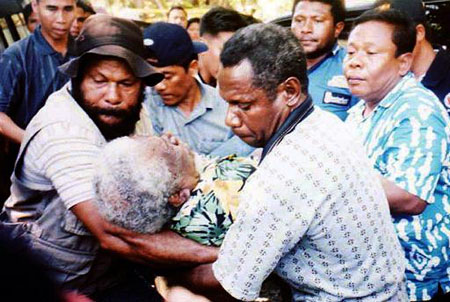
Theys Eluay‘s body being removed after his murder by Kopassus officers, November 11, 2001 (supplied)
 JUBI,
16 October, 2012
It was ten years ago [actually eleven years ago] when Megawati Sukarnoputri was the president of Indonesia, that the Papuan leader, Theys Hiyo Eluay was murdered on 10 November 2001. Theys was kidnapped and murdered because he was regarded as a danger to Indonesia’s territorial integrity.
However, the Papuan people regard Theys Eluay as a Papuan leader who was able to  unite all Papuans from Sorong to Merauke.  He was also a man who called upon people to treat Papuans with decency and respect.This is why Papuans have decided to commemorate the death of Theys Eluay.

‘We are shortly planning to mark the anniversary of the death of this great Papuan leader,’ said Thomas Syufi, president of the Militant Papuans Students Federation.
‘He was a Papuan leader who struggled for his people to be treated with decency and respect.  He did not resort to violence but the Megawati government regarded him as a threat.

He went on to say in a press conference in Jayapura, that there has been no justice yet for the death of Theys Eluay.  ‘The senior army officer who had been involved in the death was allowed to go free. [A few low-ranking Kopasus officers involved in the abduction were given short sentences which they almost certainly never served.] ‘That is why we regard Theys Eluay as a martyr ,’ the students said.

[The facts about Theys’ death are as follows: Shortly before his death he had been elected the chairman of the Papuan  Presidium Council. He was tricked into meeting some members of the army’s elite corps Kopassus on 10 November 2001, kidnapped and driven to an unknown destination. On the following day, his body was discovered in Skouw, a Papuan village near the border with PNG, more than 50 kms from where he had been abducted. He appeared to have been strangled to death; an autopsy concluded that he had died of suffocation. See Tapol Bulletin, December 2001/February 2002.]

The call made at the time by Human Rights Watch for an impartial inquiry into what was seen as a ‘well-planned assassination’ was never  responded to by the authorities.]

To mark the forthcoming anniversary of his death, Papuans were called on to gather at the grave of Theys. The government, the military and NGOs were called on not to raise banners at the grave, ‘out of respect for the fallen leader’.

Plans to move the body have been rejected by Papuans. The anniversary of his death will be marked by prayers  and other activities that have not yet been revealed.

[Translated by Tapol]

Forkorus calls for two flags to be flown side by side

JUBI,
15 October 2012

On the occasion of the first anniversary of the declaration of the Federal Republic of West Papua, the President, Forkorus Yaboisembut has sent a letter to the President of the Republic of Indonesia calling on him to take a step of guidance towards the restoration of the Federation in accordance with the determination declared at  the IIIrd Papuan People’s Congress.

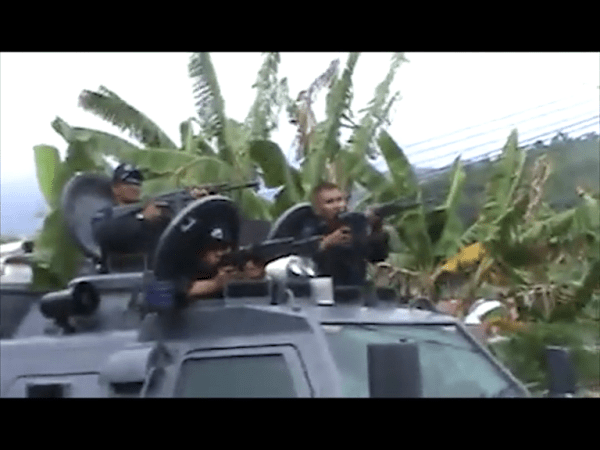
Detachment 88 troops firing live rounds at civilians during the brutal crackdown on the Third Papuan People’s Congress, October 19, 2011 (West Papua Media video still)

‘We will peacefully report this and also seek support as we celebrate the first anniversary of Papuan independence with the Federal Republic of  West Papua, which will take place on 19 October this year’ said the President. which was the first point in his letter to the President of the Republic of Indonesia, copies of which were handed out to journalists during a press conference.

The second point he made was  to compile material for negotiation which would include an act of recognition of the Federal Republic of West Papua. ‘We willconvey the conditions for dialogue between the Papuan people and the Republic of Indonesia, for recognition and the transfer of administrative powers from the Republic of Indonesia to the Federal Republic of West Papua.’

He said that the Indonesian government should convey its willingness to hold peaceful negotiations by unfurling the Morning Star flag alongside the red-and-white flag of Indonesia. ‘The two flags should be flown alongside each other as from 19 October 2012 at seven places,’ he said.

In addition to making these points, Forkorus invited a representative of the Indonesian government to attend the celebration of the first anniversary of the declaration of the Federal Republic of West Papua on 19 October.

He also proposed that pre-negotiations and negotiations should occur from August 2012 (sic) until 1 May 2013, bringing to an end the annexation of West Papua.’

[Translated by TAPOL]

Video Documentary about the Third Papuan Congress (West Papua Media)


Security forces urged not to resort to violence on the anniversary of KRP-III

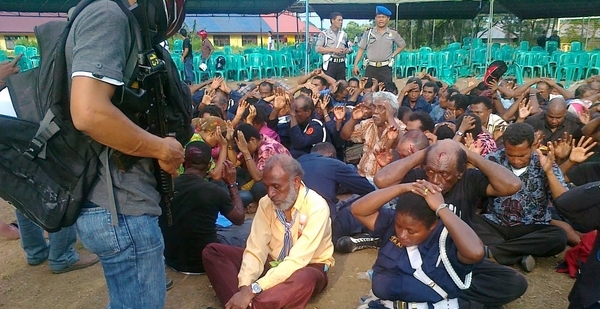
The plan by a group of people to commemorate the events that occurred last year at the time of the Third Papuan People’s Congress (KRP III)  when several people lost their lives has been described by the Papuan Provincal Legislative Assembly (DPR Papua) as a legitimate expression of Papuan concerns. It called on the security forces to refrain from again resorting to violence on this occasion.

‘It is quite legitimate for Papuans to commemorate the KRP-III within the framework of our system of democracy. Every citizen has the right to give expression to their aspirations, as long as they do so by lawful means,’ said Ruben Magai, chairman of Commission A of the DRP Papua.’ He was speaking in response to questions from the press.

He said that the security forces should not  resort to the use of violence in dealing with the aspirations of the people. ‘Dont keep using violence  because this only  traumatises the Papuan people. In any system of democracy, it is quite natural for people to give expression to their aspirations.’

He said that KRP III was now part of Papua’s history which means that commemorating the event is quite legitimate.

He went on to say that  the government in Papua is behaving undemocratically in many ways. Activists are facing a lot of intimidation. ‘If it continues to ignore democratic principles, the problem of Papua will never be solved.’

He said that the way to resolve the problem is to enter into dialogue. ‘It is only through dialogue that this problem should be handled. The use of violence will only attract the attention of the international community and will deeply wound the feelings of the Papuan people.’

He said in addition that if greater pressure is exerted against Papuan people, they will make their voices heard loud and clear. The more that pressure is used, the louder they will shout.’ he said.

He also said that the special autonomy law for Papua (OTSUS) adopted eleven years ago has proved worthless because it has failed to protect the interests of the Papuan people. ‘OTSUS means nothing any more because it has failed to protect the  interests of the Papuan people. An example was the way the governor was  chosen.  This problem has now been returned to the KPU – election commission. which means that there is nothing special at all about OTSUS.

Translated by Tapol


A Papuan who writes prolifically to promote the identity of his people

Bintang Papua
5 October 2012 Papuan leader  keen to affirm the identity  of his people

The Rev. Socrates S. Yoman is well known for his prolific writings about his people’s struggle. He was recently interviewed by Bintang Papua at his home.

The problem of West Papua has for a long time stagnated,  spreading fear among the Papuan people who are confronted by a brutal governmental system that lacks any sense  of humanity. This is why the Rev. Yoman spends most of his time writing books that are often very controversial. Some of his books have been banned in Indonesia.  He said that the Papuan leader who has inspired him for years is Arnold Ap, the anthropologist who was murdered in 1984 by Kopasanda (now called Kopassus). He was well known for the Mambesak songs  he composed.

The songs were all about promoting the identity of the Papuan  people and were intended to foster the spirit of the Papuan people. His songs called on the Papuan people to use their own language  and to revive their own culture. Although Ap was murdered many years ago, he is still an inspiration  for his people.

‘As for me, I am not able to sing  but God has given me another talent, the ability to write for which I thank the Almighty.’

The support from his wife and children  and all those who are part of the Alliance of Baptist Churches in Papua has been a source of inspiration for him, encouraging him to produce a number of books, some of which are now well known in other countries.

His intention has always been to call on his people to be true to their own identity in face of the attempts by Indonesia to bury it.

While other clerics give sermons from the pulpit, he has decided  to write books to spread his message. ‘Whether or not people can accept them is of less importance to me because my intention above all else is to persuade my people that they have an identity of their own.’

‘I also try to tell my people that they are the legitimate owners of the land. My message to  those Indonesians who have now settled in Papua is that you have been mis-informed by your government. about the Papuan people. ‘

He said that some of his books are now in the library of the US Congress. ‘They wrote to me two years ago and asked me to send them some of my books.’ His latest book is now being edited in preparation for printing and is being sought by people here in Indonesia as well as in other countries.

The Dutch author, Pieter Grooglever, has said: ‘People should read the books by Rev. Yoman. ‘His is a voice full of sadness which no  one should ignore.’

The title of his latest book is The Voice of a Shepherd who Opposes the Crimes against Humanity in the Land of  Papua. He has also received an offer  of money to pay for the book to be translated into English.

And moreover, he has already written two other books that are likely to be published quite soon.

[Translated by TAPOL]


Create a website or blog at WordPress.com

Up ↑