Breaking News: Police in Jayapura forcibly prevent commemoration of 3rd Papuan Congress brutality from going ahead, ban free speech

October 19, 2011

by West Papua Media

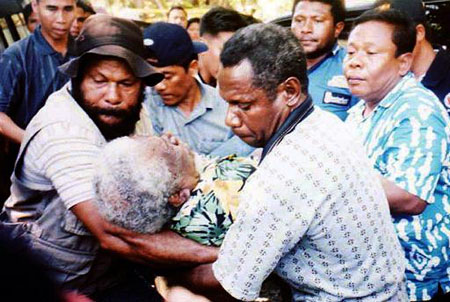
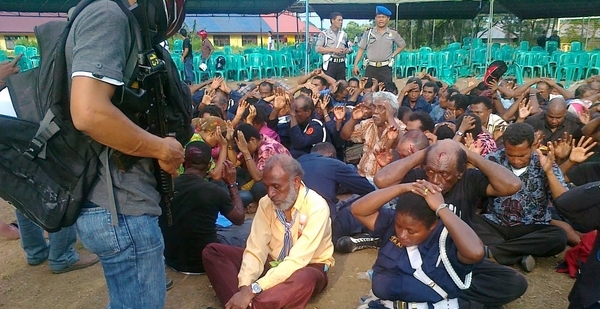
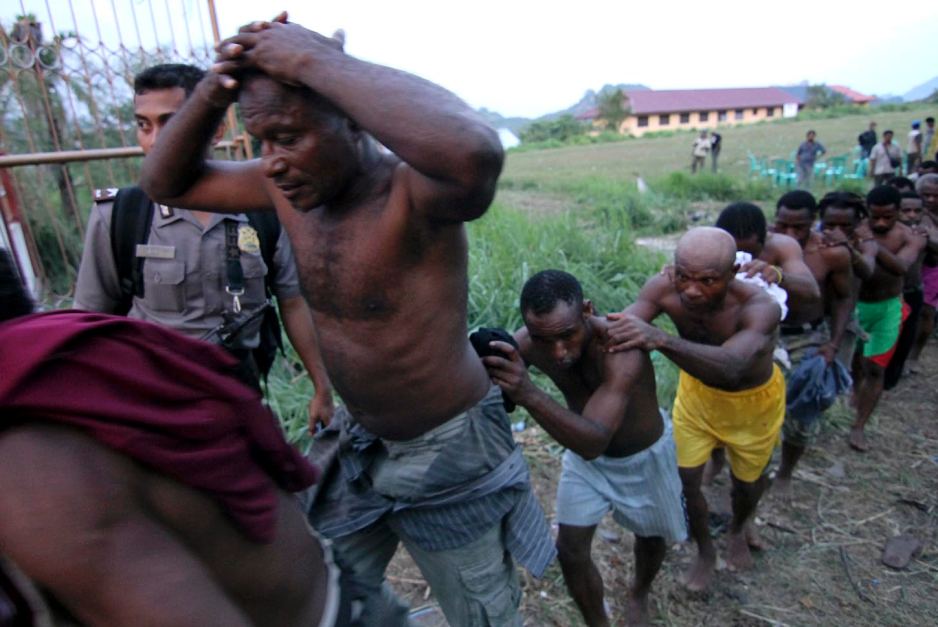
(Abepura) Indonesian Brimob Riot Police have forcibly broken up attempts to hold a memorial commemoration at the graveside of slain independence hero Theys Eluay today, where a prayer service was planned in remembrance of the first anniversary of a brutal crackdown by Indonesian security forces on the 3rd Papuan People’s Congress.

Despite the Jayapura police issuing a permit on October 8 allowing a gathering at the sacred cemetery site, the literal touchstone for civil mobilisations in support of Papuan justice issues, police reneged on their agreement with organisers for the memorial prayer service to go ahead.

Up to 1000 people braved a threatening environment in spite of an ongoing crackdown by Indonesian occupation forces across West Papua on organisers of peaceful free expression.

The event had been planned by the National Federated Republic of West Papua, the body set up immediately prior to the violent dispersal by Australian funded Detachment 88 troops on October 19 last year.  Prayer services and commemorations were also planned to be held in memorials in Wamena, Merauke, Fakfak, Sorong, Timika, Manokwari, and Serui.

Just before 10 am local time, several hundred heavily armed members of the Indonesian security forces had gathered outside Expo Waena shopping centre adjacent to the gravesite, causing many people to stand back from the already gathered mass.  6 trucks full of Brimob, 4 trucks of Army (TNI), 1 Gegana anti terror police unit and 3 trucks of Dalmas public order riot police (including members of Detachment 88) had deployed in a “show force” manoeuvre.  According to witnesses in the crowd, almost 100 plain clothes armed intelligence officers had also deployed throughout the mass of ordinary Papuans around the shopping complex threatening to kill anyone that spoke against Indonesia.

At 10 am, Police issued a verbal warning on megaphones that the gathering was illegal and would be dispersed.  However the right to engage is peaceful free expression is guaranteed both under the Indonesian Constitution and the 2001 Special Autonomy law in Papua.  Witnesses reported the police commdander on the ground as saying, “we already warned you, there will not be any democratic space for you guys to speak out about the significance of todays commemoration,” relayed over a megaphone immediately prior to the dispersal.

Police have reportedly banned the services from displaying any West Papuan independence attributes or cultural symbols, and have also banned the mention of the word “merdeka” (freedom) or any mention of the NFRWP, demands for independence or referendum – conditions subject to immediate dispersal if broken.

Up to 1000 people has begun to gather at the pendopo (traditional ceremony hut) at the gravesite of Eluay, when police stormed the gravesite in contempt of traditional customs, and forced people to disperse by pushing people heavily with riot shields.  Participants then regrouped and began to march down the street adjacent to the cemetery.

Early reports have been unable to confirm if any injuries were sustained.  At this stage there have been no reports of live fire being used or casualties.

At last report heated verbal confrontations between organisers and police were occurring, with police being angrily accused of being liars for reneging on their agreement, according to sources on the ground.  Committee organiser Pastor Ketty Yabansabra called on participants to stand firm, stay together, and to not disperse until the event was to be closed with a prayer.  At time of writing the event is currently ongoing.

No updates have yet been received from other venues at this stage.  Significant concerns are held for the service in Serui, who had been threatened with violent dispersal by the head of police on Yapen should strict topics of speech be broken.

More to come – this is a developing story.

West Papua Media

AHRC: Police arbitrarily arrested five Papuan activists and copy documents related to their political activities

ASIAN HUMAN RIGHTS COMMISSION – URGENT APPEALS PROGRAMME
Urgent Appeal Case: AHRC-UAC-185-2012
The Asian Human Rights Commission (AHRC) has received the information regarding the arbitrary arrest of five Papuan activists in Jayapura, Papua on 12 October 2012. The five activists were arrested on the allegation of involvement in importing or distributing explosive materials. The police did not have any evidence to arrest and detain them and they were later released. The police, however, copied several documents belonging to the activists related to their political movement.
CASE NARRATIVE:
According to the information we obtained from Yasons Sambom himself, he and his friends Denny Hisage, Anike Kogoya, Feliks Bahabol and Linus Bahabol were on their way to Nabire by the Lapobar ship when the police arrested them at around 9.20pm. They were initially put under the custody of the Sea Harbour Security Execution Unit (KP3 Laut) Jayapura before being moved to the Papua Regional Police Station at around 11-12pm for interrogation. The interrogation of some of the activists started at 1am on the next day and lasted until 4am whereas the remainder were questioned from 2.30am until 6am. It is not until 11 on 13 October 2012 that the five activists were released. None of the activists were given the opportunity to contact any legal counsel to accompany them during the questioning
The five activists were arrested for allegedly violating Article 187bis of the Penal Code concerning their alleged involvement in importing explosive materials to Indonesia territory. Several weeks before the arrest, two bombs were found at the secretariat of the West Papuan National Committee (Komite Nasional Papua Barat, KNPB) in Wamena and the police suspected Yasons along with his friends to be linked to it. The allegation, however, could not be proven and the police later released the activists after their 24 hours of arrest. According to the transcript of the police interview with the arrested persons, the police considered Yasons as the suspect of the bomb case in Wamena, Denny is merely a witness, whereas the status of the rest three is still unclear.
Yasons Sambom and Denny Hisage are well known for their activities in favour of Papuan independence, whereas the three other arrested people are university students. There is an allegation that their arrest was actually more likely to have been caused by their political activities instead of the suspicion that they were involved in the import of explosive materials. On the day of the arrest, the police seized several belongings of the activists which contained confidential and important information regarding their political activities. Those belongings include a laptop, four USB flash disks and one CD containing several documents – none are related to the import of illegal explosive materials which was the crime the activists were alleged to be involved in. Although the police returned all of these items to Denny Hisage and his friends, they managed to copy the documents before releasing the activists.

ADDITIONAL INFORMATION:

Prosecution, trial and punishment of activists in Papua are ongoing human rights issues taking place in the region. The use of articles concerning treason or treason-related activities (Article 106, 110 and 160) against the activists is typical that it has been a concern of several states involved in the UN Universal Periodic Review (UPR) on Indonesia last May. Leaders and members of pro-independence groups or those who are in favour of the independence movement had also been prosecuted with other criminal provisions which in many cases they had not breached. In the past, Yason himself was arrested twice. He was firstly arrested in 2009 due to his involvement in a peaceful protest asking the government to stop the violence and abuses in Papua. Later in May 2011 he was arrested without a clear charge and several documents on his political activities saved on his laptop were also copied by the police.

Victims of fabricated charges might seek compensation to the court once the legal proceedings against them prove they are not guilty. Yet the officers responsible for such abuse are unlikely to be criminally punished due to the absence of a law provision criminalising the fabrication of charges by law enforcement officials. The only specific prohibition on fabrication of charges is found in Article 6 letter (k) of Government Regulation No. 2 Year 2003 concerning the Discipline Rule for Members of Indonesian National Police whose one of articles sets out ‘in exercising their duties, the members of the Indonesian National Police are prohibited to manipulate cases’.

A complain to the Security and Profession Division (Propam), an internal oversight mechanism of the police, may be lodged by the victims yet the sanctions to be imposed will only be disciplinary. The similar government regulation sets out that any police officers who has manipulated a case may be sentenced to a maximum of 21 days of isolation which in some cases may be extended up to a further seven days.

The Criminal Procedure Code gives authority to the police to seize goods as well as to perform document checks. Goods to be seized and documents to be checked, however, have to be related to the crimes allegedly committed by the suspects. Article 39 of the Code sets out five general categories of seize-able goods: those which are products of a crime, used for a crime, used for halting the investigation of a crime, created specifically for a crime, and other goods that are directly related to the crime.

SUGGESTED ACTION:

Please write to the listed authorities below asking them to ensure investigation on the arbitrary arrest, seizure and fabrication of charges of the five Papuan activists to take place.
The AHRC is writing a separate letter to the UN Special Rapporteur on the promotion and protection of the right of opinion and expression as well as the UN Special Rapporteur on the rights to freedom of peaceful assembly and of association.

To support this appeal, please click here: 
SAMPLE LETTER:
Dear ___________,
INDONESIA: Police arbitrarily arrested five Papuan activists and copied documents related to their political activities
Name of victim: Denny Hisage (26 year old), Yasons Sambom (22 year old), Anike Kogoya (24 year old), Feliks Bahabol (23 year old), Linus Bahabol (23 year old)
Names of alleged perpetrators: Papua Regional Police officers
Date of incident: 12 October 2012
Place of incident: Jayapura, Papua
I am writing to voice my concern over the arbitrary arrest of five Papuan activists in Jayapura harbour on 12 October 2012. I was told that Yasons Sambom, Denny Hisage, Anike Kogoya, Feliks Bahabol and Linus Bahabol were on their way to Nabire by the Lapobar ship when the police arrested them on the allegation of their involvement in the import of explosive materials as prohibited under Article 187bis of the Indonesian Penal Code. The police suspected Yasons and his friends are somehow related to two bombs found at the secretariat of West Papua National Committee (Komite Nasional Papua Barat, KNPB) in Wamena last month. After being put under custody and questioned for 24 hours, Yasons Sambom and his friends were released by the police due to lack of evidence. There is a possibility, however, that the police have not changed Yasons’s status of suspect. The police seized several belongings of the activists which include a unit of laptop, four USB flash disks and one CD containing several documents.
This case has been my particular concern as I allege the politicisation of the criminal proceeding here. Yasons Sambom and Denny Hisage are well known in Papua, for their activities in favour of the independence of the region. As proved by the release of the five activists, the police did not actually have any evidence or basis to arrest them for illegal import of explosive materials. The police suspected them, mainly Yasons and Denny, to be responsible for the bombs found in Wamena due to their political activities. The political nuance in this case can also be concluded from the fact that the police did not seize any belongings related to the alleged crime but, instead, those related to Yasons Sambom and friends’ political activities.
I am concerned with the ongoing prosecution and punishment of individuals in Papua who are in favour of the independence of the region. I wish to emphasise that one’s political view is protected under the freedom of opinion and their activities to express such view is guaranteed by the notion of freedom of expression. Criminal proceeding against individuals for their dissenting opinion with the government is therefore unacceptable and in violation of those rights which are protected both in Indonesian 1945 Constitution as well as in the International Covenant on Civil and Political Rights to which Indonesia is a state party.
In this opportunity, I would also like to express my concern regarding the absence of law provision criminalising fabrication of charges by law enforcement officials in Indonesia. I am aware that a victim of arbitrary or false arrest, detention, prosecution or trial may initiate legal proceeding to district court to seek compensation. When the false arrest or detention was committed by the police, it is also possible for the victim to lodge a complaint to the internal oversight mechanism within the police, the Security and Profession Division. The punishment to be given to the police officers if they were convicted, however, is only those with disciplinary and not criminally nature. I therefore call you to make framing or fabrication of charges a crime falling under the jurisdiction of civilian courts.
In addition to the halt of prosecution and persecution towards Papuan activists as well as the criminalisation of charges, I request you to provide compensation to Denny Hisage, Yasons Sambom, Anike Kogoya, Feliks Bahabol and Linus Bahabol. Independent investigations towards the allegation of the fabrication of charges should also take place.
I look forward to your swift and positive response in this matter.
Yours sincerely,
—————-
PLEASE SEND YOUR LETTERS TO:
1. Mr. Susilo Bambang Yudhoyono
President of Republic of Indonesia
Jl. Veteran No. 16
Jakarta Pusat
INDONESIA
Tel: +62 21 345 8595
Fax: +62 21 3483 4759
E-mail: presiden@ri.go.id
2. Ms. Harkristuti Harkrisnowo
General Director of Human Rights
Ministry of Law and Human Rights
Jl. HR Rasuna Said Kav. 6-7
Kuningan, Jakarta 12940
INDONESIA
Tel: +62 21 525 3006, 525 3889
Fax: +62 21 525 3095
3. Marzuki Alie
Speaker of the Indonesian House of Representatives
Gedung Nusantara III DPR RI
Jl. Jend. Gatot Subroto
Jakarta 10270
INDONESIA
Tel: +62 21 575 5048, 575 6041, 575 6059
Fax: +62 21 575 6379
E-mail: set_tu_ketua@dpr.go.id, baleg@dpr.go.id
4. Gen. Timur Pradopo
Chief of the Indonesian National Police
Jl. Trunojoyo No. 3
Kebayoran Baru, Jakarta Selatan 12110
INDONESIA
Tel: +62 21 384 8537, 726 0306
Fax: +62 21 7220 669
E-mail: info@polri.go.id
5. Insp. General Pol. Tito Karnavian
Chief of the Papua Regional Police
Jl. Dr. Samratulangi No. 8 Jayapura
INDONESIA
Tel: +62 967 531 014, 533 396
Fax: +62 967 533 763
6. Mr. Ifdhal Kasim
Chairman of the National Human Rights Commission
Jl. Latuharhary No. 4-B
Jakarta 10310
INDONESIA
Tel: +62 21 392 5227
Fax: +62 21 392 5227
E-mail: info@komnasham.go.id

Thank you.
Urgent Appeals Programme
Asian Human Rights Commission (ua@ahrc.asia)


Plans to commomorate the death of Theys Eluay in November

Theys Eluay‘s body being removed after his murder by Kopassus officers, November 11, 2001 (supplied)
 JUBI,
16 October, 2012
It was ten years ago [actually eleven years ago] when Megawati Sukarnoputri was the president of Indonesia, that the Papuan leader, Theys Hiyo Eluay was murdered on 10 November 2001. Theys was kidnapped and murdered because he was regarded as a danger to Indonesia’s territorial integrity.
However, the Papuan people regard Theys Eluay as a Papuan leader who was able to  unite all Papuans from Sorong to Merauke.  He was also a man who called upon people to treat Papuans with decency and respect.This is why Papuans have decided to commemorate the death of Theys Eluay.

‘We are shortly planning to mark the anniversary of the death of this great Papuan leader,’ said Thomas Syufi, president of the Militant Papuans Students Federation.
‘He was a Papuan leader who struggled for his people to be treated with decency and respect.  He did not resort to violence but the Megawati government regarded him as a threat.

He went on to say in a press conference in Jayapura, that there has been no justice yet for the death of Theys Eluay.  ‘The senior army officer who had been involved in the death was allowed to go free. [A few low-ranking Kopasus officers involved in the abduction were given short sentences which they almost certainly never served.] ‘That is why we regard Theys Eluay as a martyr ,’ the students said.

[The facts about Theys’ death are as follows: Shortly before his death he had been elected the chairman of the Papuan  Presidium Council. He was tricked into meeting some members of the army’s elite corps Kopassus on 10 November 2001, kidnapped and driven to an unknown destination. On the following day, his body was discovered in Skouw, a Papuan village near the border with PNG, more than 50 kms from where he had been abducted. He appeared to have been strangled to death; an autopsy concluded that he had died of suffocation. See Tapol Bulletin, December 2001/February 2002.]

The call made at the time by Human Rights Watch for an impartial inquiry into what was seen as a ‘well-planned assassination’ was never  responded to by the authorities.]

To mark the forthcoming anniversary of his death, Papuans were called on to gather at the grave of Theys. The government, the military and NGOs were called on not to raise banners at the grave, ‘out of respect for the fallen leader’.

Plans to move the body have been rejected by Papuans. The anniversary of his death will be marked by prayers  and other activities that have not yet been revealed.

[Translated by Tapol]

Security forces urged not to resort to violence on the anniversary of KRP-III

The plan by a group of people to commemorate the events that occurred last year at the time of the Third Papuan People’s Congress (KRP III)  when several people lost their lives has been described by the Papuan Provincal Legislative Assembly (DPR Papua) as a legitimate expression of Papuan concerns. It called on the security forces to refrain from again resorting to violence on this occasion.

‘It is quite legitimate for Papuans to commemorate the KRP-III within the framework of our system of democracy. Every citizen has the right to give expression to their aspirations, as long as they do so by lawful means,’ said Ruben Magai, chairman of Commission A of the DRP Papua.’ He was speaking in response to questions from the press.

He said that the security forces should not  resort to the use of violence in dealing with the aspirations of the people. ‘Dont keep using violence  because this only  traumatises the Papuan people. In any system of democracy, it is quite natural for people to give expression to their aspirations.’

He said that KRP III was now part of Papua’s history which means that commemorating the event is quite legitimate.

He went on to say that  the government in Papua is behaving undemocratically in many ways. Activists are facing a lot of intimidation. ‘If it continues to ignore democratic principles, the problem of Papua will never be solved.’

He said that the way to resolve the problem is to enter into dialogue. ‘It is only through dialogue that this problem should be handled. The use of violence will only attract the attention of the international community and will deeply wound the feelings of the Papuan people.’

He said in addition that if greater pressure is exerted against Papuan people, they will make their voices heard loud and clear. The more that pressure is used, the louder they will shout.’ he said.

He also said that the special autonomy law for Papua (OTSUS) adopted eleven years ago has proved worthless because it has failed to protect the interests of the Papuan people. ‘OTSUS means nothing any more because it has failed to protect the  interests of the Papuan people. An example was the way the governor was  chosen.  This problem has now been returned to the KPU – election commission. which means that there is nothing special at all about OTSUS.

Translated by Tapol


A Papuan who writes prolifically to promote the identity of his people

Bintang Papua
5 October 2012 Papuan leader  keen to affirm the identity  of his people

The Rev. Socrates S. Yoman is well known for his prolific writings about his people’s struggle. He was recently interviewed by Bintang Papua at his home.

The problem of West Papua has for a long time stagnated,  spreading fear among the Papuan people who are confronted by a brutal governmental system that lacks any sense  of humanity. This is why the Rev. Yoman spends most of his time writing books that are often very controversial. Some of his books have been banned in Indonesia.  He said that the Papuan leader who has inspired him for years is Arnold Ap, the anthropologist who was murdered in 1984 by Kopasanda (now called Kopassus). He was well known for the Mambesak songs  he composed.

The songs were all about promoting the identity of the Papuan  people and were intended to foster the spirit of the Papuan people. His songs called on the Papuan people to use their own language  and to revive their own culture. Although Ap was murdered many years ago, he is still an inspiration  for his people.

‘As for me, I am not able to sing  but God has given me another talent, the ability to write for which I thank the Almighty.’

The support from his wife and children  and all those who are part of the Alliance of Baptist Churches in Papua has been a source of inspiration for him, encouraging him to produce a number of books, some of which are now well known in other countries.

His intention has always been to call on his people to be true to their own identity in face of the attempts by Indonesia to bury it.

While other clerics give sermons from the pulpit, he has decided  to write books to spread his message. ‘Whether or not people can accept them is of less importance to me because my intention above all else is to persuade my people that they have an identity of their own.’

‘I also try to tell my people that they are the legitimate owners of the land. My message to  those Indonesians who have now settled in Papua is that you have been mis-informed by your government. about the Papuan people. ‘

He said that some of his books are now in the library of the US Congress. ‘They wrote to me two years ago and asked me to send them some of my books.’ His latest book is now being edited in preparation for printing and is being sought by people here in Indonesia as well as in other countries.

The Dutch author, Pieter Grooglever, has said: ‘People should read the books by Rev. Yoman. ‘His is a voice full of sadness which no  one should ignore.’

The title of his latest book is The Voice of a Shepherd who Opposes the Crimes against Humanity in the Land of  Papua. He has also received an offer  of money to pay for the book to be translated into English.

And moreover, he has already written two other books that are likely to be published quite soon.

[Translated by TAPOL]


Create a website or blog at WordPress.com

Up ↑