Call for Brimob persnnel to be withdrawn from Paniai

JUBI, 16 November, 2011

The shooting which is believed to have resulting in the deaths of eight local residents in Bayabiru who were illegally panning for gold in Degeuwo in the district of Bogobaida, Paniai, took place three days after Brimob troops arrived in Enarotali from Timika. Full details of the incident along with a chronology and the reasons for the shooting are not yet known.

‘If this is true, no one can accept what happened. We herewith demand that the Brimob troops be withdrawn from Paniai,’ said Yakobus Dumupa, a member of the MRP, the Majelis Rakyat Papua.

The chairman of the Paniai district Customary Council (Dewan Adat Daerah Pania)i, John NR Gobai, asked in a press release what was the reason for sending 120 Brimob troops to Paniai where the security situation can be described as conducive. ‘We are seeking an explanation about this from the local Brimob chief as well as the chief of police in the district.’ He said that the Brimob troops that had been deployed to Enarotali had for the first three days caused a great deal of anxiety and trauma among the local people.’There needs to be some campaigning and advocacy from the NGOs and we need to set up a fact-finding committee to prove that this is true,’ he said.

‘Someone must take institutional responsibility for what happened. This is not just a matter of some rogue member of the unit. If there is no response from the institution itself, then the people will have to make an issue of this. The MRP will set up its own team to investigate the shooting of eight local people.’ he said.

He strongly condemned the brutal action that of the security forces in Bayabiru, Degenwo.It happened at a time when a number of things had occurred that require special attention from the government.’These serious violations of human rights are putting a heavy strain on efforts to hold a dialogue between the Papuan people and the central government, And they suggest that it is the TNI and the police who are the ones who are the separatists the ones who are trying to cause disunity within the NKRI.’

Prof. Ikrar Nusa Bhakti: Papua has become a Military Training Ground

JUBI, 10 November 2011

Papua has become a Military Training Ground

The senior Indonesian political commentator, Professor Ikrar Nusa Bhakti, said that the Indonesian military is keen to defend Papua as a military training ground. This is because, apart from Aceh, Papua is the only other natural place that is suitable for this purpose.

‘If Papua goes on being defended for this purpose, it is quite immoral,’ he said during a discussion at the Tembaga Hotel in Timika.

‘My reasoning is quite simple, because this not only turns the Papuans into enemies of the military or police but also provides the opportunity for outsiders to conduct what people refer to as humanitarian intervention. This could start with their just levelling criticisms but if things get “too ferocious”, the responsibility to protect principle can be used by these external forces.

‘And do you know what responsibility to protect means? It can easily be used as a shield for countries like the US or European countries to go ahead and do whatever they like in a country which they regard as being attractive economically or politically.’

Other countries where this has happened were, he said, Libya, Iraq, Afghanistan and Egypt. So, the problem is: why has the government allowed the process to happen and not do what any government ought to be doing?

All this, he said, makes him, as a political commentator, ask whether it is not too hasty to accuse the OPM of being behind everything that is occurring in connection with Freeport. ‘It is also going too far for the Minister-Coordinator for Legal, Political and Security Affairs to say that the only one who can reach a solution for the land of Papua is God Almighty!’ That is to say, if this quotation in Metro TV and TV One is indeed correct. ‘Why is this so? According to me, the Minister-Coordinator should stop doing this. Why? Because, as I have already said, although the Papuan question is quite complex, it is not really all that difficult! In other words, there’s no need for all this shooting – bang, bang, bang – to happen because if we invite them (the Papuans) to hold talks, that is exactly what they want, isn’t it?’

Professor Ikrar then drew attention to the views of some Papuan leaders such as the minister of shipping, Freddy Numberi who has urged everyone not to regard the question of NKRI as being ‘harga mati’ (the bottom line).

Ikrar went on to say that Numberi is not the only one; there is also Professor Dr Yuwono Sudarsono, the former minister of defence who once said that NKRI is not something ‘indisputable’. Independence for the Papuan people is not ‘harga mati’ but ‘harga hidup’, in other words something that can be negotiated. ‘If Papuans have ever said that independence is ‘harga mati’, I cannot understand why the central government just follows suit.’

According to Prof. Ikrar, in politics there is no such thing as ‘harga mati’. Why do people also talk about a bargaining position’. This applies too to all those political experts who are to be heard in discussions on television.

This is why Prof. Ikrar who has on several occasions been asked for his opinion about the Papuan question, has said that he supports what Dr. Neles Tebay, the (Papuan) writer, has said who has proposed dialogue as the way to solve the Papuan problem.

Ikrar went on to say that Dr Tebay has spoken about the three components who bear arms, calling on them to put an end to their activities which are only causing difficulties for the people in Papua.But this means that on the side of the people, they need to reach agreement among themselves about who will be the
spokesperson for the Papuan people. ‘Don’t do what happened in the case of a peace seminar that was once held, which led to the appointment of all people from abroad.’

‘I think that the government should also open the way for dialogue because at the first stage, there will surely be some people who keep on shouting,’ Prof. Ikrar said in conclusion.

UN Declares Indonesia’s Detention Of Filep Karma A Violation Of International Law, Calls For Immediate Release

In response to a petition filed by Freedom Now and Hogan Lovells LLP, the United Nations Working Group on Arbitrary Detention has issued its opinion that the Government of Indonesia is in violation of international law by detaining Filep Karma. The Working Group calls on the Government of Indonesia to immediately release the human rights advocate.

Mr. Karma is a prominent Papuan human rights advocate and former civil servant arrested on December 1, 2004 for raising the Papuan Morning Star flag at a political rally in commemoration of Papuan independence from Dutch rule. Although Mr. Karma has explicitly denounced the use of violence, he was convicted for crimes of hostility against the state and sedition in a trial that fell far below international standards of due process. He now languishes in prison serving a fifteen-year sentence, despite health concerns and calls for his release by numerous NGOs and government officials. In August, 2011, 26 members of the U.S. Congress urged President Yudhoyono to release Mr. Karma. Forty members of Congress signed a similar letter in 2008. This week, President Obama will be in Indonesia attending the 2011 ASEAN Summit—which takes place November 17-19 in Bali—where many hope such human rights discussions will take place.

Freedom Now Executive Director Maran Turner stated: “The United Nations Working Group on Arbitrary Detention has found Indonesia’s actions a clear violation of international law. Mr. Karma is a nonviolent advocate who was arrested for his views and convicted in a trial marred by judicial bias, denial of appeal without reason, and intimidation tactics. I urge President Obama to raise Filep Karma’s case with President Yudhoyono and to call for Indonesia’s compliance with the UN opinion by releasing Filep Karma.”

The United Nations Working Group determined that Mr. Karma’s arrest was due to his exercise of the fundamental rights of freedom of expression, peaceful assembly, and association. According to the UN, provisions used to convict and detain Mr. Karma—including declaring “feelings of hate”—were “drafted in such general and vague terms that they can be used arbitrarily to restrict the freedoms of opinion, expression, assembly and association.” Such a detention violates the International Covenant on Civil and Political Rights, a multi-party treaty by which Indonesia is bound, as well as the Universal Declaration of Human Rights. The Working Group also censured the Government of Indonesia for violating Mr. Karma’s right to a fair trial.

The opinion concluded by calling the Government’s attention to broader human rights violations in Indonesia, for which Filep Karma’s situation is emblematic, stating, “The Working Group will remind The Republic of Indonesia of its duties to comply with international human rights obligations not to detain arbitrarily, to release persons who are arbitrarily detained, and to provide compensation to them.”

Freedom Now, a non-profit, non-partisan organization that works to free prisoners of conscience, and Hogan Lovells LLP, an international law firm, welcome the UN’s decision. They call on the Indonesian government to uphold its commitments under international law and immediately release Mr. Karma.

Source: Freedom Now

SBS: Calls for scrutiny on Papua human rights

Indonesian police officers man a security check point near the Freeport mine in Timika, Papua province. (AAP)

Amnesty International is calling on Prime Minister Julia Gillard to use upcoming meetings with Indonesia to address alleged rights abuses in Papua.

Amnesty International is calling on Prime Minister Julia Gillard to use meetings at the East Asia Summit in Bali to press Indonesia into addressing concerns of abuse and violence in Papua.

Ms Gillard is also expected to meet with Indonesian President Susilo Bambang Yudhoyono following the conclusion of the summit.

Amnesty International spokesman Josef Benedict told Aileen Phillips, while trade and development will be on the agenda, he hopes there is room for discussions on human rights.

Shocking video confirms Indonesia’s brutal suppression of West Papuan rally ahead of US visit

16 November

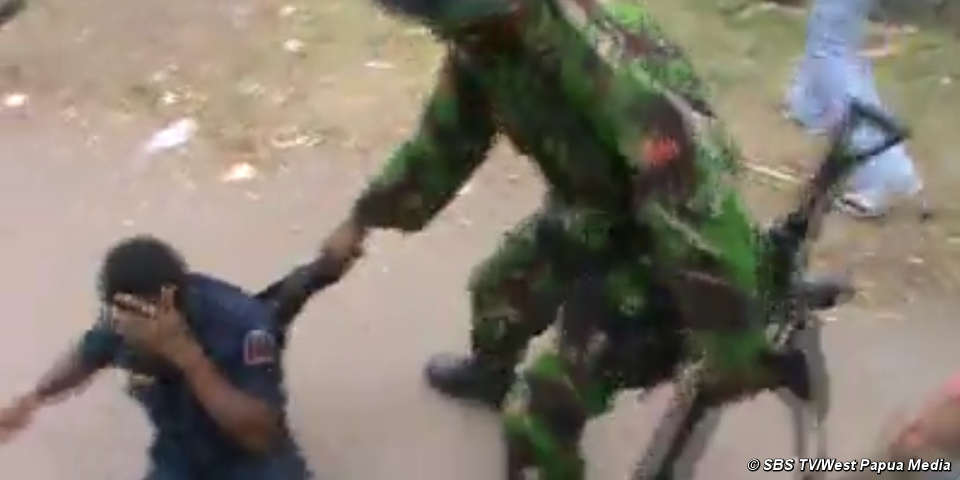
The shocking footage shows Indonesian soldiers beating West Papuans
© SBS TV/West Papua Media

Alarming video of Indonesian forces shooting, beating and kicking civilians at a peaceful rally in West Papua has emerged ahead of a US visit to the region.

Ten people are believed to have died when Indonesian security forces broke up the rally of independence activists last month.

Watch footage of the attacks (©SBS TV/West Papua Media,WARNING: DISTURBING CONTENT):

Indonesia’s brutal attack on West Papuan rally
Shocking scenes of Indonesia’s brutal suppression of a West Papuan rally on October 19 2011©SBS TV/West Papua Media

The video comes ahead of a visit to Bali by the US President and Secretary of State, for a regional summit. The US has applauded its ‘new partnership’ with Indonesia, but only last week Hillary Clinton criticized its human rights abuses.

The disturbing footage was smuggled out of West Papua exactly one year after scenes of Indonesian soldiers torturing Papuan mencaused worldwide revulsion.

These latest clips allegedly show a local police commander giving the order to break up the rally on the outskirts of Jayapura – and the brutal and unprovoked violence that ensued.

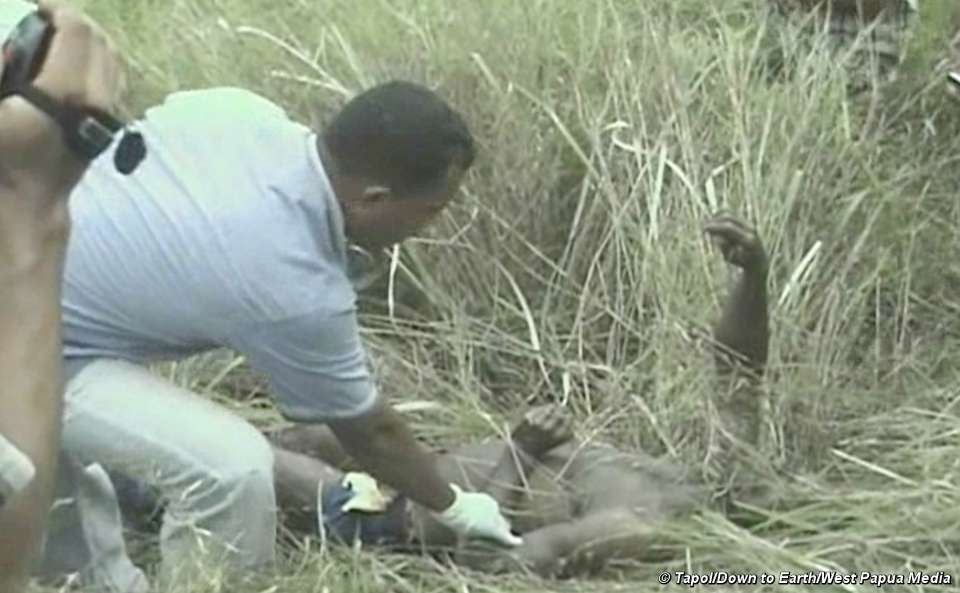
Victim is found after Indonesia's violent crackdown on West Papuan Congress
Victim is found after Indonesia’s violent crackdown on West Papuan Congress
© Tapol/Down to Earth/West Papua Media

Indonesian security forces, many in plain clothes and wearing crash helmets, are seen randomly firing their weapons and arresting scores of people, many of whom are punched, kicked, beaten or forced to crawl along the ground.

Reverend Benny Giay from West Papua says violence has escalated since the Congress was dispersed. ‘I think maybe this is the Indonesian military and police’s response to the international pressure.  The response is that they are being sent to Papua to kill, terrorize and abduct Papuans, but please do keep on the international pressure. Please tell people what is happening here for the sake of our future, our lives, our culture, our identity and our very existence.’

West Papua has been ruled by Indonesia since 1963, and more than 100,000 civilians are believed to have been killed during its occupation.

Survival’s Director Stephen Corry said today, ‘Indonesia’s brutal occupation of West Papua is a catalogue of some of the worst human rights abuses and violations of tribal peoples in recent times. Hillary Clinton should use her visit to the country to highlight the horrific violence that Indonesia is wreaking on all those who dare to oppose its rule.’

Note to Editors:

A Survival campaigner who has been to West Papua is available for interview.

More clips are available for download from West Papua Media

Create a website or blog at WordPress.com

Up ↑