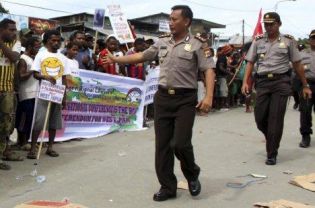
Call for Brimob persnnel to be withdrawn from Paniai

JUBI, 16 November, 2011

The shooting which is believed to have resulting in the deaths of eight local residents in Bayabiru who were illegally panning for gold in Degeuwo in the district of Bogobaida, Paniai, took place three days after Brimob troops arrived in Enarotali from Timika. Full details of the incident along with a chronology and the reasons for the shooting are not yet known.

‘If this is true, no one can accept what happened. We herewith demand that the Brimob troops be withdrawn from Paniai,’ said Yakobus Dumupa, a member of the MRP, the Majelis Rakyat Papua.

The chairman of the Paniai district Customary Council (Dewan Adat Daerah Pania)i, John NR Gobai, asked in a press release what was the reason for sending 120 Brimob troops to Paniai where the security situation can be described as conducive. ‘We are seeking an explanation about this from the local Brimob chief as well as the chief of police in the district.’ He said that the Brimob troops that had been deployed to Enarotali had for the first three days caused a great deal of anxiety and trauma among the local people.’There needs to be some campaigning and advocacy from the NGOs and we need to set up a fact-finding committee to prove that this is true,’ he said.

‘Someone must take institutional responsibility for what happened. This is not just a matter of some rogue member of the unit. If there is no response from the institution itself, then the people will have to make an issue of this. The MRP will set up its own team to investigate the shooting of eight local people.’ he said.

He strongly condemned the brutal action that of the security forces in Bayabiru, Degenwo.It happened at a time when a number of things had occurred that require special attention from the government.’These serious violations of human rights are putting a heavy strain on efforts to hold a dialogue between the Papuan people and the central government, And they suggest that it is the TNI and the police who are the ones who are the separatists the ones who are trying to cause disunity within the NKRI.’

Prof. Ikrar Nusa Bhakti: Papua has become a Military Training Ground

JUBI, 10 November 2011

Papua has become a Military Training Ground

The senior Indonesian political commentator, Professor Ikrar Nusa Bhakti, said that the Indonesian military is keen to defend Papua as a military training ground. This is because, apart from Aceh, Papua is the only other natural place that is suitable for this purpose.

‘If Papua goes on being defended for this purpose, it is quite immoral,’ he said during a discussion at the Tembaga Hotel in Timika.

‘My reasoning is quite simple, because this not only turns the Papuans into enemies of the military or police but also provides the opportunity for outsiders to conduct what people refer to as humanitarian intervention. This could start with their just levelling criticisms but if things get “too ferocious”, the responsibility to protect principle can be used by these external forces.

‘And do you know what responsibility to protect means? It can easily be used as a shield for countries like the US or European countries to go ahead and do whatever they like in a country which they regard as being attractive economically or politically.’

Other countries where this has happened were, he said, Libya, Iraq, Afghanistan and Egypt. So, the problem is: why has the government allowed the process to happen and not do what any government ought to be doing?

All this, he said, makes him, as a political commentator, ask whether it is not too hasty to accuse the OPM of being behind everything that is occurring in connection with Freeport. ‘It is also going too far for the Minister-Coordinator for Legal, Political and Security Affairs to say that the only one who can reach a solution for the land of Papua is God Almighty!’ That is to say, if this quotation in Metro TV and TV One is indeed correct. ‘Why is this so? According to me, the Minister-Coordinator should stop doing this. Why? Because, as I have already said, although the Papuan question is quite complex, it is not really all that difficult! In other words, there’s no need for all this shooting – bang, bang, bang – to happen because if we invite them (the Papuans) to hold talks, that is exactly what they want, isn’t it?’

Professor Ikrar then drew attention to the views of some Papuan leaders such as the minister of shipping, Freddy Numberi who has urged everyone not to regard the question of NKRI as being ‘harga mati’ (the bottom line).

Ikrar went on to say that Numberi is not the only one; there is also Professor Dr Yuwono Sudarsono, the former minister of defence who once said that NKRI is not something ‘indisputable’. Independence for the Papuan people is not ‘harga mati’ but ‘harga hidup’, in other words something that can be negotiated. ‘If Papuans have ever said that independence is ‘harga mati’, I cannot understand why the central government just follows suit.’

According to Prof. Ikrar, in politics there is no such thing as ‘harga mati’. Why do people also talk about a bargaining position’. This applies too to all those political experts who are to be heard in discussions on television.

This is why Prof. Ikrar who has on several occasions been asked for his opinion about the Papuan question, has said that he supports what Dr. Neles Tebay, the (Papuan) writer, has said who has proposed dialogue as the way to solve the Papuan problem.

Ikrar went on to say that Dr Tebay has spoken about the three components who bear arms, calling on them to put an end to their activities which are only causing difficulties for the people in Papua.But this means that on the side of the people, they need to reach agreement among themselves about who will be the
spokesperson for the Papuan people. ‘Don’t do what happened in the case of a peace seminar that was once held, which led to the appointment of all people from abroad.’

‘I think that the government should also open the way for dialogue because at the first stage, there will surely be some people who keep on shouting,’ Prof. Ikrar said in conclusion.

TNI / POLRI kills unarmed Papuan civilians in Paniai

TNI / POLRI kills unarmed Papuan civilian in Paniai

Thursday 17 November: Media Alert

Local human rights defenders report that Matius Tenouye, a farmer from Tagaya Degeuwo Village , Bogobaida District, Paniai Kabupaten, Papua was killed by the Indonesian security forces on the 13 November.

According to reports received by West Papua Media Mr. Tenouye (39 years old) was crossing a bridge when he was struck by a bullet in the back. He then fell into the Degeuwo River and drowned. Relatives have been unable to retrieve his body.

The killing comes days after Jubi, an independent online media organisation in Papua, reported eight people being shot dead in Degeuwo by members of the security forces. There have also been reports of destruction of civilian property in Kogekotu village, Camp Bapouda, Camp Ipakiye and Camp Madi, all close to a gold mining area that has been the scene of long-standing conflict over land rights, corruption and control of mining activity.

The area is off limits to local and foreign journalists, and due to its remote location human rights workers are having difficulty safely accessing the scene.

Paramilitary Brimob police from the Paniai garrison, armed by the  Australian government, on Sunday(10am local time) launched an unprovoked  attack on traditional Mee tribal gold miners in Degeuwo, near Enaratoli.

Local human rights activist Servius Kedepa told Jubi that he  was unable to ascertain any apparent cause for the shooting.  However local observers have long pointed to a deep involvement of Brimob officers in the mining conflict in the regency.

Papuan community members from Degeuwo Paniai are reportedly seeking refuge in the jungle.

The Victims (and cause of death) are:

1. Matias Tenouye (30 yr) Bullet through Right thigh, femoral bleed ,

2. Simon Adii (35 years) The bullet penetrated ribs and exited through abdomen,

3. Peter Gobay (40 years) Shot in Chest.

4. Joel Ogetay (30 years) shot through the head

5. Benjamin Gobay  (25 years) massive chest trauma through shooting, rear exit wound.

6. Marius Maday (35 years) massive chest trauma through shooting, rear exit wound.

7. Matias Anoka (40 years )massive chest trauma through shooting, rear exit wound.

8. Yus Pigome (50 years massive chest trauma through shooting, rear exit wound.

The causes of death are consistent with standard rifle use shoot-to-kill training by aiming at the central body mass.


Thousands of West Papuans demand Referendum in Jayapura 14 Nov 2011

Several thousand West Papuan people took the streets in Jayapura on November 14 to  calling for a Referendum to demand their right of self determination.

This slideshow requires JavaScript.

In another show of mass civil resistance since the brutal crackdown by Indonesian security forces on the 3rd Papuan Peoples Congress,  the demonstration organised by the West Papua National Committee also called for the Government of Indonesia to take responsibility for its increased unjustified violence towards West Papuan people.

Indonesian police attempted to block the march, but protestors pushed through peacefully to continue to the offices of the DPRP, the provincial parliament building.

Demoted former Papuan Police chief Iman Setiawan attempts show of force (Reuters)

Protest organisers earlier expressed grave fears that security forces would attempt to repeat the violence on unarmed and peaceful protestors, but international monitoring and effective citizen media on the ground contributed to the restraint shown by security forces.

Participants rejected dialogue or talk with Jakarta until violence ended and maintained their position that a referendum was the only just pathway towards fulfilling Papuan rights.

“Give us the space for a referendum so that we can choose what we want.  We don’t want dialogue doing the bidding of UP4B, or other policy of Special Autonomy;  We don’t need money, we don’t need to be with  Indonesia, let us be free on our land,” said speakers, referring to the Special Development unit set up by Indonesian President Yudoyhono to dilute Papuan calls for independence.

[youtube http://www.youtube.com/watch?v=X4jVXagcUlM]

“The Papuan people have asked for an immediate referendum for self-determination. We reject any dialogue with Jakarta,” protest coordinator Mako Tabuni said.

“The referendum is non-negotiable.”

Mass Action Jayapura, 14 Nov 2011 (Af Wensi)

UN Declares Indonesia’s Detention Of Filep Karma A Violation Of International Law, Calls For Immediate Release

In response to a petition filed by Freedom Now and Hogan Lovells LLP, the United Nations Working Group on Arbitrary Detention has issued its opinion that the Government of Indonesia is in violation of international law by detaining Filep Karma. The Working Group calls on the Government of Indonesia to immediately release the human rights advocate.

Mr. Karma is a prominent Papuan human rights advocate and former civil servant arrested on December 1, 2004 for raising the Papuan Morning Star flag at a political rally in commemoration of Papuan independence from Dutch rule. Although Mr. Karma has explicitly denounced the use of violence, he was convicted for crimes of hostility against the state and sedition in a trial that fell far below international standards of due process. He now languishes in prison serving a fifteen-year sentence, despite health concerns and calls for his release by numerous NGOs and government officials. In August, 2011, 26 members of the U.S. Congress urged President Yudhoyono to release Mr. Karma. Forty members of Congress signed a similar letter in 2008. This week, President Obama will be in Indonesia attending the 2011 ASEAN Summit—which takes place November 17-19 in Bali—where many hope such human rights discussions will take place.

Freedom Now Executive Director Maran Turner stated: “The United Nations Working Group on Arbitrary Detention has found Indonesia’s actions a clear violation of international law. Mr. Karma is a nonviolent advocate who was arrested for his views and convicted in a trial marred by judicial bias, denial of appeal without reason, and intimidation tactics. I urge President Obama to raise Filep Karma’s case with President Yudhoyono and to call for Indonesia’s compliance with the UN opinion by releasing Filep Karma.”

The United Nations Working Group determined that Mr. Karma’s arrest was due to his exercise of the fundamental rights of freedom of expression, peaceful assembly, and association. According to the UN, provisions used to convict and detain Mr. Karma—including declaring “feelings of hate”—were “drafted in such general and vague terms that they can be used arbitrarily to restrict the freedoms of opinion, expression, assembly and association.” Such a detention violates the International Covenant on Civil and Political Rights, a multi-party treaty by which Indonesia is bound, as well as the Universal Declaration of Human Rights. The Working Group also censured the Government of Indonesia for violating Mr. Karma’s right to a fair trial.

The opinion concluded by calling the Government’s attention to broader human rights violations in Indonesia, for which Filep Karma’s situation is emblematic, stating, “The Working Group will remind The Republic of Indonesia of its duties to comply with international human rights obligations not to detain arbitrarily, to release persons who are arbitrarily detained, and to provide compensation to them.”

Freedom Now, a non-profit, non-partisan organization that works to free prisoners of conscience, and Hogan Lovells LLP, an international law firm, welcome the UN’s decision. They call on the Indonesian government to uphold its commitments under international law and immediately release Mr. Karma.

Source: Freedom Now

Create a website or blog at WordPress.com

Up ↑