Names of 23 Papuan political prisoners submitted to Komnas HAM
3 December 2001
Solidarity for Humanitarian and Human Rights Violations has submitted information regarding 23 political prisoners to Komnas HAM (the National Human Rights Commission).
Earlier, Komnas HAM planned to set up a team to resolve the cases of political detainees and convicted political prisoners in Papua. The spokesman for SKP Papua, Mathius Murib, said that information regarding the prisoners, including their arrest, the time they have spent in custody and their conditions in prison was submitted. He said that in many cases, there was no legal basis for their being charged for treason and that their imprisonment was in violation of their human rights
“We have supplied data relating to a number of prisoners being held in prisons in Papua. Detailing how many prisoners there are and for how many years they have been held. Altogether, we have submitted such information regarding 23 political prisoners. We greatly appreciate this support and the action.”
Earlier on, Komnas HAM planned to set up a team to resolve the cases of political detainees and convicted political prisoners in Papua. The purpose was to review the status of those being held in prison. This would include considering a reduction in the length of their sentences.
Komnas HAM is seeking Clemency for Papuan Political Prisoners
4 December 2012
Komnas HAM, the National Human Rights Commission intends to struggle to ensure that all political detainees and convicted political prisoners in Papua are granted clemency or a reduction in sentence.
The chairman of Monitoring and Investigating Human Rights Violations, Natalius Pigai, said that Komnas HAM plans to set up a special team next January to identify the cases of political detainees and convicted political prisoners in Papua, together with the Ministry of Law and Human Rights.
“This special team will also be entrusted with the task of granting clemency or reduction of sentences for political detainees and convicted political prisoners in Papua. We will be undertaking this in collaboration with the Ministry of Law and Human Rights,” said Natalius.
He went on to say that this special team would do everything possible to improve the general environment and facilities in all the prisons in Papua. This will include ensuring that every tapol/napol receives whatever healthcare is required.
Law and Human Rights Ministry to check status of around 20 Papuan political prisoners
4 December 2012
The Ministry of Law and Human Rights plans to check the status of around twenty political prisoners in Papua. This decision follows their intention to resolve the cases of political detainees and convicted political prisoners.
A spokesman of the Ministry of Law and Human Rights, Martua Batubara, said that those who are serving sentences will be given remissions (a reduction of sentence) in accordance with the law.
As for the Komnas HAM, it can only make recommendations.
“We intend to check in the prisons as well as to check with the Ministry of Law and Human Rights to find out which prisoners are serving sentences and which are prisoners whose cases are still being processed. We don’t know which prisoners they are talking about (gap with question mark perhaps indicating something that is illegible) or whether it is true that Komnas HAM only has the authority to investigate and then make recommendations to the authorities in charge of the prisoners.”
Previously, Solidarity for Humanitarian and Human Rights Violations in Papua submitted information about 23 political prisoners to Komnas HAM. This was done to complete the information available to Komnas HAM, following a plan to set up a team to resolve the cases of political detainees and convicted political prisoners in Papua. The purpose is for there to be a review of the status of all those who are currently being held in detention. This would also include seeking a reduction in the sentences now being served by all those who are currently being held in prison in Papua.
4 December 2012 Local KNPB activist arrested and maltreated
KNPBNews
Another activist of the KNPB (National Committee of West Papua) has been arrested by Indonesian Police. This time, it was the secretary-general of the Lanny Jaya branch of the KNPB.Athys Wenda was arrested while sitting in the waiting room of Wamena Airport. He was arrested at 7am on 1 December. He was seized by the police, taken to the police station in Lanny Jaya and maltreated there.
Dules Wamimbo, the chairman of the KNPB in the district of Lanny Jaya, said that Athys was also badly mistreated while in a cell of the local police command in Jayawijaya.
In a short message, Dules said that while being held by the Wamena police, Athys ‘was beaten until he was black and blue all over.’
Athys had been trying to peacefully mediate a conflict among the people of Lanny Jaya.
Athys and several of his KNPB colleagues are being closely watched by Densus88 (Detachment 88, the Australian, US, And UK funded elite counter-terror unit that is being used against peaceful political activists outside its funding mandate). Dules said that when an armed conflict broke out between the TPN (the military wing of the OPM) and the Indonesian military, KNPB activists tried to mediate this conflict but they were treated as if they were the military.
Dules said: ‘ We very much hope that the police will stop arbitrarily arresting people without clear evidence.’
Reports have been received from human rights investigators detailing a torture incident that occurred in Serui on October 17, 2012, under the command of notorious Serui Police Chief Roycke Harry Langie.
Arrests occurred in Serui in the lead up to planned demonstrations commemorating the 1st anniversary of the 3rd Papuan People’s Congress, the brutal crackdown by Indonesian security forces on the event, and the establishment of the self-declared Federated Republic of West Papua.
Those now held as political prisoner in Serui now include:
Edison Kendi
Yanpiet Maniamboi
Jon Niantian
Jamal Omrik Manitori
On Wednesday evening after 6:00pm, activist Lodik Ayomi was captured by Police at Serui General hospital whilst visiting his ill father. Whilst Lodik’s father was lying in hospital bed, he watched helplessly with tears as his son was being hand-cuffed, hit with a rifle-butt on the head and dragged out of the hospital, according to human rights investigators.
Mr Ayomi, in his early 30’s, is a father with a child and a political activist. He is listed on the Daftar Pencarian Orang (DPO- Wanted List) by the Police in Serui, alongside with several other political activists who are now in hiding for their safety. Mr Ayomi was falsely accused by Serui police of an incident in May, which Police claimed to be an ‘attempt-to-shoot’ a police officer at Angkaisera Police station.
Lodik’s one kilometre journey from the hospital to the Police Prison left him with a fractured skull and swollen eyes, and one witness described that “he can’t even open his eyes”. He was also beaten upon his arrival at the Serui Prison, where a witness saw ten police officers in uniform “push him out of the police car and onto the ground violently with ongoing brutal acts of kicking, punching, and hitting with the butt of their rifle for several minutes.”
Another witness at the prison saw Ayomi couldn’t move whilst he was lying on the ground. “I thought he was dead, but thankfully, a new officer who just started his shift came for Lodik’s rescue and stop the other officers from hitting him,” said the witness. Mr Lodik sustained a fractured skull with three cracks on his head, according tohe witness, who has not been identified for his protection.
The witness saw a “blood-bath all over” and massive swelling on his face and body. He was then physically dragged into his cell and later at 8:15pm, the prison guards allowed four Indonesian intelligence officers, who blind-folded his head in a bag and tortured him.
Before he was dragged away, other inmates could hear him screaming loudly “help, help, help, Lord help me”, for several times. The inmates heard the interrogators yelled at him to ‘stand-up’ when he fell onto the concrete floor, and continuously kicked him until he was crying and Ayomi was begging for the police officers to “please don’t paralyze my legs, please don’t break my legs”.
After that another five officers came in and took him away into the interrogation room, where he continued to scream for ‘help’, according to witnesses at the prison. He was tortured and interrogated for over six hours, from 8:15pm until 2:00am. He was later put in a septic tank for 2 hours with head blind-folded and hand-cuffed. The other inmates saw him “like a disabled person”.
On Thursday morning, around 8am, he was taken away from the prison and until now, no one knows his whereabouts, including the other inmates. Grave concerns are held for his safety.
The witnesses who saw the police officers who beat him know the identities of the police officers names. Thee names of the police officers who conducted the beating are:
Indonesian Special Forces officers have redoubled their efforts to hunt down non-violent womens’ and environmental rights activist Fanny Kogoya, after a failed attempt to capture her and Papuan student activists from the West Papua National Committee at a university dormitory on Tuesday night.
Fanny Kogoya was also elected the head of the Papua desk for the Indonesian branch of Friends of the Earth (WAHLI) on June 13, the day before her close friend Mako Tabuni, former KNPB leader,was extrajudicially executed by Detachment 88 troops in Jayapura.
Kogoya, also a women’s rights defender from the grassroots Papuan women’s network TIKI, has been been placed on a Papua wide wanted persons list (Daftar Pencarian Orang or DPO) by the Australian-trained and funded Detachment 88 anti-terror investigators. This is despite Kogoya having resigned from pro-independence activities, according to established credible sources in Jayapura. Kogoya is also accused by police of having knowledge of the whereabouts of activists from the pro-independence civil resistance group, West Papua National Committee (KNPB).
KNPB activists are in hiding after being ruthlessly hunted by security forces, in order to break the back of the civil resistance movement against Indonesian brutality in occupied West Papua. This harassment campaign has gained significant pace ahead of planned Papua-wide mobilisations against Indonesian colonial violence on October 23 – rallies widely expected to be subject to major Indonesian state violence.
The latest crackdown has seen brutal intelligence gathering techniques employed by security forces, including officers identified by witnesses as being from Detachment 88, arbitrarily targeting for beatings, kidnappings, arrests and torture on students and civilians from the highland tribes of Yakuhimo and Dani people – seen by many observers as the backbone of the KNPB effort to use civil power to defeat Indonesian state violence.
Confirmed reports from human rights activists in Jayapura have described heavily armed plain clothes officers – believed by witnesses to be members of either Kopassus or Detachment 88 – violently threatening highland students and civilians in a bid to hunt down members and associates of the KNPB.
Raids on student accommodation around Abepura and Jayapura have intensified ahead of a planned mass mobilisation across Papua on October 23rd by KNPB, which is calling for an end to these illustrated acts of Indonesian state violence – a move seen as makar (subversion) by the new Papua Police chief Tito Karnavian , the former head of the Australian- funded Detachment 88.
Attempts to contact Karnavian or his Papua Police spokespeople for comment for this article have been so far rebuffed and unsuccessful.
Additionally, witnesses and survivors have described a chronology of what is being described as a “fishing operation” by Indonesian intelligence officers. Attempts to capture Fanny Kogoya had been ongoing for several days, with police Avanzas permanently stationed outside houses and haunts of both Kogoya and her extended family and friends.
According to a detailed and disturbing testimony provided by Yakuhimo man and citizen media worker Simson Yohame to independent human rights monitors in Jayapura, the officers have heavily monitored highland students in the greater Jayapura area in a bid to isolate KNPB activists from their base.
Yohame, a friend of Kogoya, was himself kidnapped and tortured by suspected Detachment 88 officers on October 9 after accidentally leaving his motorbike helmet at a Javanese restaurant in Waena, near Abepura. He had been tailed for several days by intelligence officers, who suspected his friendship with Fanny would lead them to their quarry.
Upon leaving the restaurant, he was set upon by plain clothes police intelligence agents, whom he believed to be Detachment 88 officers. They bundled him in to the back of a black police Avanza car, whilst soldiers who were stationed outside the Yakuhimo regencies student dormitory at Waena stood guard. An intelligence officer from Makassar hit him repeatedly with a butt of a pistol, and other officers punched him systematically in the chest using a silat (traditional Javanese martial arts favoured by Kopassus) technique that can easily cause cardiac arrest.
He described being taken in a six car high speed convoy, initially to the back of an unknown facility close to the Jayapura police headquarters, before being subjected to psychological torture on a drive around the greater Jayapura area, and was hypnotized to disorientation. Yohame described the brutal interrogations where he was threatened with knives, swords and cocked and loaded firearms by Detachment 88, according to his testimony. Interrogators also subjected him to psyops by playing loud torture music and sound on headphones they held on his head, while they were sticking knives and pistols into his body.
Giving fascinating if chilling insight, Yohame has detailed the processes that Intel attempted to use to turn him to spy on his friend Fanny. He refused eventually, but not before documenting the techniques utilized.
After the torture, the Detachment 88 officers allegedly moved onto “Stage 3” as Yohame described it, a combination of the classic good cop / bad cop routine. “They (intel) began to ask me the core question: ‘Do you know Fanny Kogoya? This picture is FK, FK stay close to you. You do not deny it. If you deny we will kill you.’”
“I asked why are you looking for FK? Intel said to me that ‘because the cases of murder that Mako Tabuni was doing involved FK. FK participated in designing all events Mako and comrades were doing’. Yohame reported the police as saying.
The police continued: ‘FK loves the money Mako and his friends had over the years. FK is the girlfriend of Danny Wenda. Wenda is now the number 1 Papua Police DPO’,” the interrogators said.
The interrogators then changed tactics, offering a payment. “In addition, if you (SY) can inform on where FK is, we will pay you (SY) Rp 10 million for initial operations,”. They demanded the locations of Danny Wenda, the Chairman of KNPB, Victor Yeimo, Tinus Yohame, Buktar Tabuni, Victor Yeimo, Assa Asso, and also fellow Yakuhimo clansmen allegedly involved in KNPB, alternatively offering payment, and threatening to kill him if he denied knowledge of their whereabouts. Yohame was then trained in demonstration and civil resistance disruption and sabotage techniques, and fieldwork techniques employed by intelligence informants.
Yohame described how his tasking had traumatised him greatly, and he refused internally to carry out the actions. After his release having agreed to be an Indonesian agent, he was secretly informing Fanny Kogoya about the massive operation in effect to capture her and warning her to move outside the town to avoid arrest or disappearance.
Fanny Kogoya, who like other civil society activists on the DPO list is constantly moving from house to house, has so far eluded capture due to the diligence of the now underground non-violent independence movement in Papua.
—
For the whole night of October 12, a Cenderawasih University (UNCEN) dormitory in Waena was under siege by a large group of plain clothes armed and masked security forces, who surrounded the dormitories. During the night, the police overran the dormitories in their search for Fanny Kogoya, according to witnesses.
Three students who living at the UNCEN hostel – UL (32), IK (36), and PK (22) – said they had been beaten and terrorized by the police. “Police pry the door and entered. They say ‘we find the DPO who live here,'” the students explained in the human rights report. “They say the name of FK and Danny Wenda (DW).”
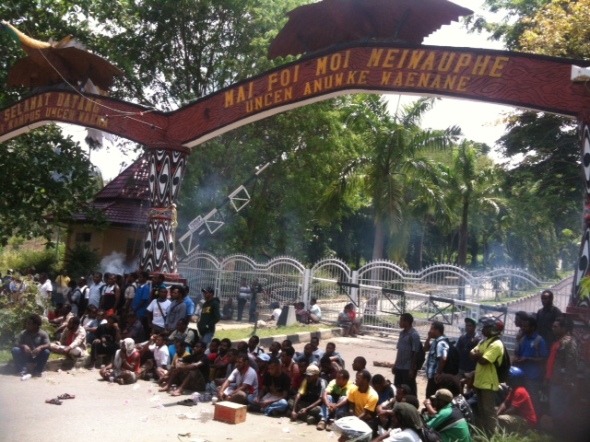
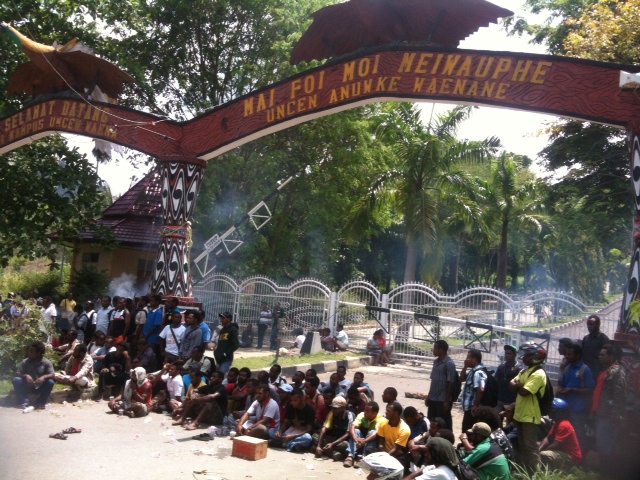
The Yakuhimo students at the dormitory were angered by the event, but held a peace blockade outside the gates of the Uncen campus in Waena, independent sources at the campus told West Papua Media. No reports were received of any forced dispersal, however tension is high and all West Papuan students are in fear that that they could be arrested or disappeared at any moment, according to human rights sources.
Yakuhimo students and supporters blockade outside Uncen Waena after the Detachment 88 raids, October 12 (West Papua Media)
These actions came after a campaign of arrests from late September of at least eight people in the highland town of Wamena after police targeted homes and offices of KNPB members, accusing them of involvement in bombings and terrorism, despite KNPB being committed to non-violent civil resistance tactics.
In a statement, UK based human rights group Tapol said that “The targeting of KNPB activists appears to have intensified after the killing of the KNPB leader Mako Tabuni, on 14 June 2012. Officers of Indonesia’s counter-terrorism unit, Special Detachment 88 (Densus 88), funded and trained by Australia, the US and the UK, are thought to have been involved in the killing of Mako Tabuni and the arrest of the KNPB members in Wamena.”
Tapol has called for Indonesian authorities to “end the campaign of terror, intimidation and violence against human rights defenders and political activists, particularly members of KNPB,” and to guarantee the safety of Fanny Kogoya, Viktor Yeimo, and others who have been targeted.
Tapol has also called on Jakarta to “end the deployment of Densus 88 to Papua, investigate all allegations of human rights violations by Densus 88 officers and other security forces personnel and bring those responsible to justice.”
Whilst tension remains high during the crackdown, KNPB activists have also warned their members not to be taken in by SMS messages that are being spread by intelligence personnel attempting to incite violence and horizontal conflict. Activists have circulated a list of mobile numbers that are responsible, and are urging all recipients to document any numbers that continue to spread these messages.
Many people have reported to West Papua Media of an upsurge in Special Forces activity, even around those who are not active on Papuan independence issues. There has been a significant increase on the presence of intelligence officers on the street. Selfius Bobii, the former Front Pepera leader serving out a three sentence at Abepura prison on a treason conviction for his role in the 3rd Papuan People’s Congress of October 2011, still maintains close and effective communications with a network of activists throughout Papua.
In an SMS sent to West Papua Media, Bobii described how the TNI “have stooped to making themselves out to be civilians, to carry out undercover operations in order muffle the independence aspirations.”
“Some are posing as Bakso (Beef offal noodles) Sellers on roadsides, some are posing as motorbike repair people and so on,” Bobii said.
Bobii described the following factual account: On 11 Oct at 2303 hours in Nabire, Yance Agapa was heading home and was given a lift by an ojek (motorbike taxi) rider to the front of the Indonesian Air Force Quarters in front of the ‘Glory’ internet cafe. When they arrived at Malompo he gave the driver Rp20000 (approx. AUD$2) who hurriedly put it into the pocket of the black jacket he was wearing. Then a pistol fell out of his jacket. Yance startled in fright to which the driver responded “Brother don’t be frightened because I’m from Ambon but my mother is from Sentani. I’ll tell you straight, I’m a member of DENSUS 88 sent from Central to get the government program happening. So let our people from the community know to be careful using hire motorbikes. ”
West Papua Media has independently verified this account.
KNPB activists, most living underground currently, have expressed significant fears for their safety and survival from the crackdown. Yohame begged in his testimony, “the condition of our current times is so dire, (we need) all my friends and the international support groups to be able to monitor our current situation. Virtually all KNPB activists are threatened at this time. “
It is unclear whether these intensified crackdown tactics will work on those close to DPO suspects to give up not just Fanny Kogoya, but other non-violent activists who are simply attempting to raise their universal human rights of self-determination and freedom of expression.
Certainly these hunting parties have confirmed one thing: that Australian trained counter-terrorism troops are without any doubt being used to suppress peaceful political activity, outside their legal mandate of counter-terrorism. This should be deeply concerning for Australia in its quest for advocating internationally the Rule of Law – and at the moment that it has just taken up a position on the UN Security Council it might prove to be an inconvenient turning of a blind eye.
The Australian Greens have today questioned the mixed messages the Australian Government is sending Indonesia about human rights in West Papua.
“The Australian Government needs to take a consistent stance in defence of human rights in our region, not just pay them lip service,” said Australian Greens Leader and Foreign Affairs spokesperson, Senator Christine Milne.
“Why is Stephen Smith signing a new ‘Defence Co-operation Agreement’ with Indonesia this week, when just last week Bob Carr was calling for an inquiry into the alleged involvement of the Indonesian military in the assassination of an indigenous West Papuan leader?”
The Australian Greens spokesperson for West Papua, Senator Richard Di Natale, questioned how Stephen Smith could have ‘no concerns’ about West Papua.
“The human rights abuses in West Papua were exposed on ABC’s 7:30 Program just last week. For Minister Smith to say that he has no concerns regarding West Papua is a clear case of wilful ignorance,” said Senator Di Natale.
“How can Australia turn a blind eye to the allegations that troops we have funded and trained are carrying out human rights abuses against the indigenous peoples of West Papua?
“Australia should require assurances that our military support will not lead to further violations of human rights. And we must call for West Papua to be opened up to foreign journalists and human rights monitors so that we can hold those assurances to account.
“The lives and human rights of our West Papuan neighbours should be a priority in our dealings with Indonesia. And it should certainly warrant a lot more attention and respect from Australia’s Foreign and Defence Ministers than just a discussion ‘in passing’.”





 West Papua Media Alerts