Indonesian senior minister will not be attending Papuan Congress

Bintang  Papua, 17 October 2011Although Selpius Bobii, chairman of the Third Papuan People’s Congress recently announced that President Susilo Bambanf Yudhoyono had decided that the minister-coordinator for  political affairs and law would be representing the Indonesian government at the congress and would be the opening speaker and  that the government would provide financial assistance to the congress, it has now been announced that minister-coordinator Djoko Suyanto will not after all be attending the congress.

Third Papuan Congress to go ahead despite efforts to obstruct it

(Note – the Congress is currently underway, more reports to come)
Bintang Papua, 14 October 2011

[Abridged in translation by TAPOL]

Although the Third Papuan Congress is due to start in two days time, it is not yet known where it will take place. Selpius Bobii, chairman of the organising committee, said that plans to hold the congress at Cenderawasih University are facing obstacles because permission for the UNCEN auditorium has not yet been granted even though, he said, notification of the congress had already been submitted some time ago. Permission to hold the congress at GOR Cenderawasih has also not been received.

Bobii said that those organising the congress believe that there are forces who are exerting pressure to ensure that neither of these locations will be made available. He went on to say that however that may be, the congress will go ahead as planned because Papuan people throughout the territory fully support it.

Bobii said that they were still waiting for permission (STTP) from the police.The main issues to be discussed are the basic rights of the Papuan  people in a situation where Papuans are being violated and intimidated. The intention is to discuss the things they are experiencing  and what measures they need to take to uphold their rights.

The congress will go ahead without any support from the central government; all expences will be covered by the Papuan people themselves, transportation, food and drink will be provided thanks to contributions from Papuan people.

While there are elements who are trying to prevent the congress from taking  place and spreading all kinds of stories to discredit it,, Bobii said this was simply a reflection of the democracy now in place. He said that what was most important was that 273 Papuan tribes would be attending the congress, covering their own costs and even helping out with financing the congress as a whole. ‘There is nothing that will stand in our way,’ he said. Also, security will be guaranteed by a force of about 4,000 people. If anyone moves to prevent the congress from taking place, he said, they will expose the forces who are behind these attempts.

More than 8,000 people have already arrived. As for the location, if not in the UNCEN auditorium, it may take place in Theys  Square in Sentani or at the  graveside of Theys Eluay, as the final alternative.

As for the police permit, this will not be a problem because the central government has already given the green light. Bobii also said that they had received a letter  from the minister of political and legal affairs in Jakarta which, he said, had arrived by fax. This means, he went on, that ‘neither the military commander or the chief of police can prevent us from proceeding with our agenda’.

LP3BP: The Papuan people have the right to self Determination

Press Release issued by LP3BH on 12 October 2011The Institute for Research, Recognition and Development of Legal Aid, in Manokwari was set up on 12 October 1996 in order to provide judicial services to  Papuan people who are lacking in social, economic and political capacity. It was set  up by NGO activists, human rights  activists, traditional leaders, spiritual leaders , the Catholic Church and the GPKAI in Manokwari.

The basic viewpoint of the founders at that time was that many legal and human rights abuses were not being resolved in accordance with the principles of justice and fairness and there was the need for a body to be set up that was in favour of upholding law and human rights in Manokwari and West Papua [which was known at the time as Birds Head.]

On the occasion of its XVth anniversary on 12 October 2011, the  LP3BH wishes to make public its attitude on a number of social and political problems, as follows:

1. The LP3BH is profoundly aware of and in agreement with the opinion that the Papuan  people who for almost forty years, under both the old and the new order  governments, have never had the opportunity to assemble and consult each other about their fate  and their future as a community of people who have the right to self-determination.

2. The LP3BH believes that the political history of Papua as a result of integration needs to be rectified  in accordance with the message adopted at the second Papuan Congress to enter into peaceful dialogue with the Indonesian government, with international mediation.

3. The LP3BH understands and continues to believe that the many criminal actions such as murders, emergency executions  and shootings in and around Jayapura, in the districts of Ilaga-Papua and Puncak Jaya as well as the shootings that continue to occur around the Freeport-Indonesia mine are a clear indication // of the involvement of certain elements of  the security forces of the Indonesian army (TNI), and must therefore be handled by criminal investigations undertaken by the Indonesian police force which is the only force with the legal and judicial powers to do so.

4. The soial and political situation in Papua has greatly improved as a result of the Papuan people deciding to pursue the path of peace in their efforts to solve the conflict in the Land of Papua.

5.  Acts of violence continue to occur in the Land of Papua and take the form of  physical violence as well as armed conflict.

Based on the situation described above, the LP3BH/Manokwari makes the following  demands:

1. The Indonesian Government should put an end to all overt military operations as well as intelligence operations which continue to be conducted against the background and paradigm of security disturbances without being based on political State policies adopted by the Indonesian Parliament/DPR-RI

2. The Indonesian Government should respond wisely and diligently to each and every  offer by the Papuan people to enter into peaceful dialogue free from violence in order to seek a solution to the conflict in the Land of Papua.

3. The Indonesian Government should adopt a more democratic approach, without any movement of espionage, to build a Land of Papua which is more humane. and just and is at all times ready to listen to the innermost feelings of the Papuan people

DAP chairman calls for the withdrawal of police and army from around Freeport

JUBI, 13 October 2011In connection with the shooting dead of Petrus Ayamiseba  who worked at the catering department for workers at Freeport, the Dewan Adat Papua  has declared that  it is essential to withdraw army and police troops from area around the Freeport mine.

Speaking on behalf of DAP, Dewan Adat Papua, Forkorus Yaboisembut said that the chief of the Indonesian police, the chief of police in Papua and the commnder of the XVII Cenderawasih Command should withdraw all their troopa who are currently deployed in the vicinity of the mine. He said that it was important for the police and the security forces to stop exerting pressure on the company. They should also be ordered to stop exerting pressure on the workers.

‘The security forces should stop interfering in any way with the company,’ he said. ‘The two sides involved in a dispute must find a solution together. If they are subjected to pressure, the dispute will never be solved,’ he said.

He also said that the Indonesian govrnment should urge the company to provide a clarification about its  revenues. ‘If the government can convince the company to review the wages that they  pay to the workers, the dispute can be speedily resolved,’ he said.

Meanwhile, the lawyer, Yan Christian Warinussy said that the shooting of Petrus Ayamiseba was a gross violation of human rights, and he hoped that the Papua branch of the National Human Rights Commission would speedily hold a meeting with  the chief of police in Papua, Police Inspector-General  Bigman Lukkaman Tobing to press for this shooting incident to be resolved in the human rights court. He said that if this does not happen,  the police will claim that this was nothing more than a criminal act.

He want on to say that the shooting to death was a breach of Law 39/1998 regarding safeguarding actions undertaken by the people.

Warinussy also said that  the company should halt all their provocative actions. ‘The company and the workers should sit down together to discuss the rights of the workers.’

Warinussy said that he was currently in Timika and was carrying out his own investigations and he said that he would be having a meeting with the chief of police in Mimika and with the company. The results would be conveyed to the chairman of the  Papuan branch of the National Human Rights Commission. Matius Murib.

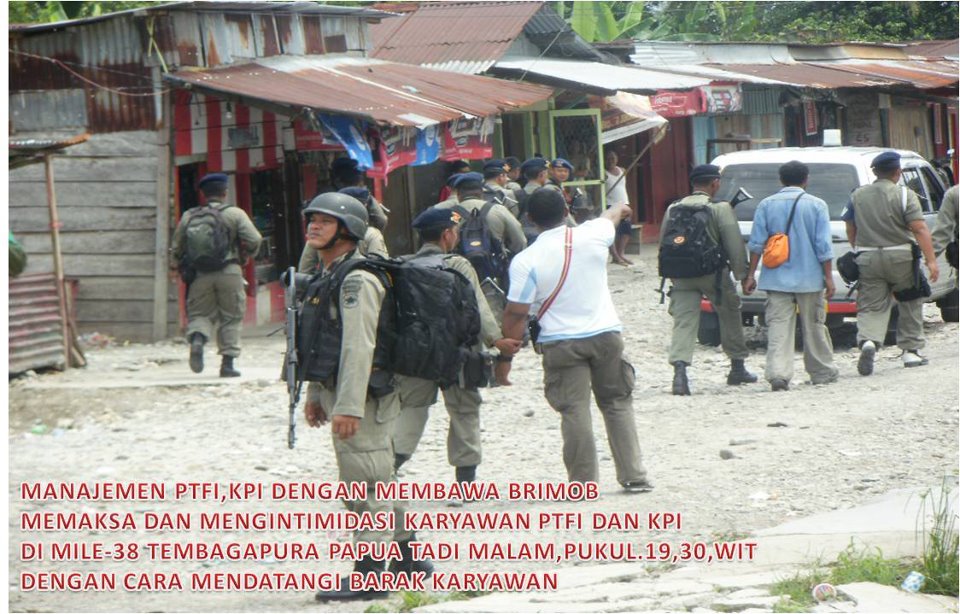
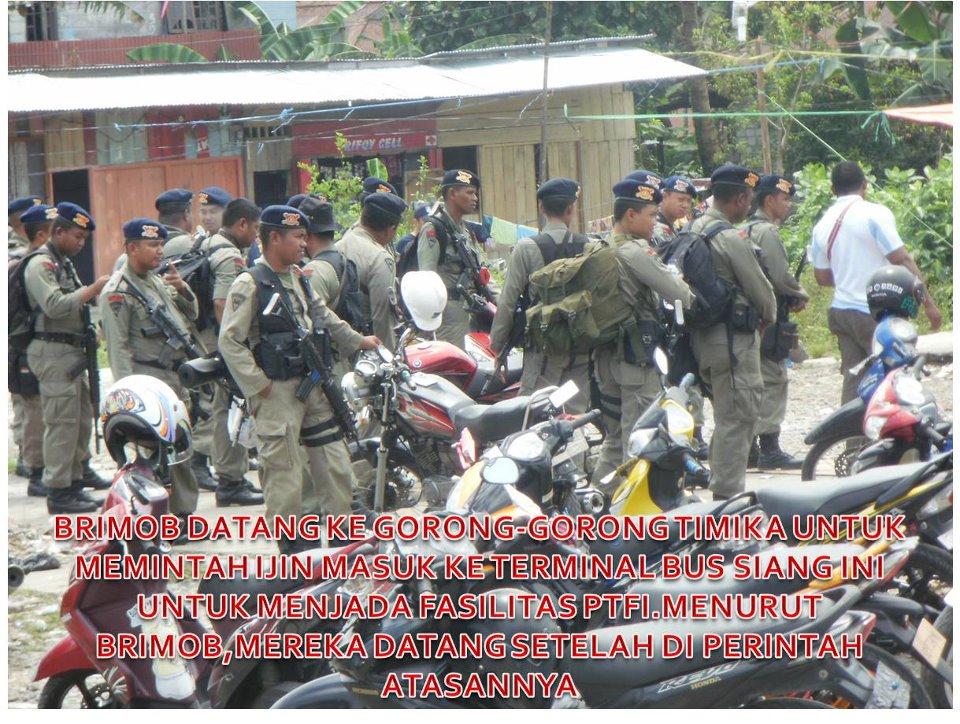
Petrus Ayamiseba who was 36 years old died when he was struck by a burning rod of tin belonging to the police while he was taking part in a demonstration at the Gorong-Gorong Terminal.

During the incident, another person was also killed, namely  Jamil, a member of Brimob.

UN wants to send Special Rapporteur to Indonesia to investigate MIFEE


Bintang Papua, 12 October 2011The UN Commission to Combat Racial Discrimination and Protect the Rights of Indigenous People has sent a letter to the Indonesian ambassador to Geneva, Anwar Kemal, regarding several matters.

In the first place, to agree to invite the UN Special Rapporteur on Human Rights to visit Indonesia in connection with MIFEE, the Merauke Integrated Energy and Food Project in West Papua. In the second place to hold talks with CERD for this matter to be discussed at the forthcoming meeting of the Committee in Geneva from 13 February – 13 March 2012. And thirdly, to to make available comprehensive information regarding all the matters contained in the afore-mentioned latter.

This was made  public following a meeting by a number of NGOs in Jayapura on 12 October which was attended among others by Foker-NGO-Papua, Sawit Watch, Greenpeace, Justuce and Peace Commission/Jayapura, Walhi and Sorpatom in Jayapura on 12 October.

The Coalition of NGOs said that the response of the UN to the MIFEE project had exerted pressure on the Indonesian government to halt all activities related to the MIFEE project and to invite the UN Special Rapporteur on Human Rights to investigate this project before 13 January 2012.

The coalition said that MIFEE would have a strategically significant inpact on the availability of foodstuffs and energy resources in Indonesia.

This project will cover an area of 1.6 million hectares which will be used to produce millions of tons of rice, corn, beans and sugar as well as promote cattle-rearing. Dazzled  by this massive project, they have closed their eyes to a huge problem that will confront the population of Merauke whose land will be consumed by the MIFEE.project.

The MIFEE project is a highly ambitious mega  project of the Indonesian Government based on a slogan to produce food for the whole world. They intend to take control of an area of 1.6m ha of land for agri-business purposes. The resultant food will be exported, meaning that MIFEE is directed towards the export market. Thirty-six companies have already been attracted by the MIFEE project with investment capital to the value of Rp 18.9 trillion, along with domestic capital.

Research undertaken by various organisations has identified a number of problems.

First of all, this project which will cover a total area of  altogether 2m ha of land belonging to the indigenous people will have a direct impact on the traditional rights of the these people.

Furthermore,  this expansion will cut down forests belonging to indigenous people in order to grow  palm oil and will result in the influx of a huge number of people from outside the area, threatening the local people’s livelihoods and destroying their traditional economic practices.

These developments will exert huge pressure on the Malind people and their traditions in particular, and the Papuan people in general, turning them into a minority people in their own land.

In addition, these developments which are supported by various state forces will require the protection of the Indonesian army.

Fourthly, the decisions regarding exploitation of natural resources are hugely dependent on the central government and are being developed in accordance with national laws that ignore the indigenous people, despite the adoption of the Special Autonomy law in 2001, the aim of which was to decentralise decision-making to the provincial level with regard to a number of issues, while nothing has happened regarding the introduction regulations.for the implementation of this law.

Fifthly, it is understood that most of the MIFEE area has been classified as ‘forest’ and placed under the jurisdiction of the forestry department, whose interpretation of the forestry laws impinge on the rights of the indigenous people.

Finally, there are reports that local communities have been manipulated by investors and government officials so as to secure their signatures  to provide the legal basis for certificates affirming their right to the land of the indigenous people.

Create a website or blog at WordPress.com

Up ↑