MIFEE: Latest News Reports

via AWASMifee

January 7, 2013

Representatives of the Lembaga Masyarakat Adat (Customary People’s Association), together with other people affected by the MIFEE mega-agriculture project, made a visit to Papuan provincial capital Jayapura just before Christmas. In meetings with Papuan media, they explained the new problems local communities in the Merauke Area are facing as different companies rush to develop oil palm and sugar cane plantations.

Here is a selection of articles published in local media Tabloid Jubi and Alliance for Democracy In Papua(ALDP).  Amongst the issues the delegation raises are the companies’ broken promises about the facilities they said they would provide or the compensation for the land, pollution, lack of information about the legal status of the land and coercive behaviour from the military that back up the companies.
When they have accepted work in exchange for giving up their forests, wages have been too low to provide for daily needs. They also ask for all company permits to be revoked, as local people have not been involved in decisions about development.

Company’s promise to build education facilities were lies.

Source: http://www.aldp-papua.com/?p=8009

A company’s promise to build health and education facilities for local land owners around its investment site in Muting, Elkobel and Ulilin districts in Merauke Regency, has still not come to fruition.  “It was all lies, we’ve waited until now but there has been no answer. Blueprints have been drawn up, but they remain no more than sketches,” said the head of the Malind Bian Customary People’s Association (Lembaga Masyarakat Adat LMA), Sebastianus Ndiken in Jayapura last Friday.

According to him, when the company was informing the indigenous clans that own the land in Muting District of its plans some time ago, they had promised employment and also to improve education, including giving scholarships to local youth. “We have already asked when this will be, but the company has said not yet, we have no idea when it will actually happen, but they have been operating on our land for some time,” he said.

Mr. Ndiken related that one of the companies operating in Muting is PT Agriprima Cipta Persada (ACP) After about four months of operation, we are starting to see logging of the people’s forests in the area. “Look, here’s the plans I’ve brought with me. It shows plans for a school. The plans are well-drawn, but the school has never materialised,” he repeated.

Amongst the big companies that are developing oil-palm plantations in Merauke are PT Korindo Tunas Sawaerma, PT Bio Inti Agrindo, PT Berkat Cipta Abadi and PT Papua Agro Lestari.

When they move in, the companies say they are only borrowing the land on a 35 year contract, and after that it will return to its owners. “We believed that. But now we have found out that one oil palm company, PT Bio Inti Agrindo, has already obtained a permit for commercial use (HGU). We realised that in principle, HGU rights mean that after 35 years of commercial use the land will be returned to the state. To us this means that the company has failed to settle the issue of our customary rights as the true owners of the land”, he explained.

He is asking for the company to immediately fulfil it’s promises. “We don’t want problems, don’t let what happened in Mesuji occur in the land of Malind Anim. [awasMIFEE note: at least nine farmers, maybe more, have been killed in clashes with oil palm companies in the Mesuji area of Sumatra in the last two years]. We want progress, but progress that doesn’t deceive the people”, he concluded.

The most recent data from the Merauke government was that 10 of the 46 companies with investment plans were actively pursuing their operations in early 2012.

The project location is the local indigenous people’s only source of wood, animals and staple foods. Merauke Regency covers 4.7 million hectares, of which 95.3 percent is classified as forest.

Customary People’s Association wants big companies out of Merauke.
Source: http://www.aldp-papua.com/?p=8004

The Malind Bian Customary People’s Association (LMA) has requested the government to revoke and cancel all location permits of companies in the plantation sector in Merauke Regency, including oil palm.

“We have witnessed ourselves how companies are felling our customary forests that we have always protected and looked after. Destroying the forest has also caused the loss of several varieties of traditional medicine,” said the head of the Malind Bian LMA Sebastianus Ndiken on Friday.

He told of how it is becoming increasingly difficult for people to find sago, animals to hunt, materials for traditional clothing and other traditional items that had previously been found easily in the forest. For them, the damage to the customary forest is also the loss of the Malind Anim culture.

“Companies come to the village but never give us full, clear and true information. The company also doesn’t involve indigenous people and landowners from the outset. Similarly, information about regulations and permits is not given openly,  clearly and in detail, including information about the potential impacts to our  customary land that could arise from those company permits”, he said.

There has never been full involvement of all clans in the process of informing about plans, consultation and verification of which clans own which land, Mr. Ndiken continued. The company only talks to the clan chiefs and community leaders, including district government officials, so the customary lands can be evicted and destroyed. The kind of involvement the LMA would like to see would include attending the process of compiling environmental impact assessments, and consultations and evaluations about those environmental impact assessments.

“The LMA which is comprised of representatives of indigenous communities, has frankly not been involved. Neither have landowners whose land has not yet been evicted and destroyed. This means that not all our desires and aspirations have been properly conveyed”, he said.

According to him, the government, which should have a duty and obligation to protect, respect and advance the people’s rights, is not on the side of the indigenous landowners.

Amongst the large companies operating in the oil palm sector in Merauke are PT Korindo Tunas Sawaerma, PT Bio Inti Agrindo, PT Berkat Cipta Abadi and PT Papua Agro Lestari.

When the companies moved in, the government said that customary land would only be borrowed for 35 years and then returned to its owners. “We believed that. But now we have been told that one oil palm company operating on our land, PT Bio Inti Agrindo, has obtained a permit giving the company commercial use rights (HGU). We realised that in principle, HGU rights mean that land is returned to the state after 35 years of commercial use. To us this means that the company has failed to settle the issue of our customary rights as the true owners of the land”, he
explained.

He also said that this means that the company has deliberately deceived and disregarded the people and erased their customary rights by gaining agreement for commercial use rights. “So we must make clear that if the company wishes to continue using customary land then it must ask for our agreement as landowners and must ensure that the land will be returned to the clans that are the customary landowners once the company’s tenure is finished”, Mr Ndiken said.

He said that the LMA is also demanding the immediate cancellation of all location permits on customary land. The companies must also take responsibility for restoring the forest and giving compensation to people along the Bian river as far as Kaptel. “The government also needs to take action and start tackling the disruption and environmental pollution that the company’s activities have caused.

Yeinan People Reject Oil Palm Company
Source: http://tabloidjubi.com/?p=7652

The Yeinan ethnic group in Merauke Regency, Papua, reject the oil palm company which wishes to operate in their area. This oil palm company is part of the Wilmar Group.

A Yeinan man, David Dagjiay, said to reporters in Abepura on Friday (21/12) that he was currently negotiating with PT Wilmar Group that are trying to start an oil palm plantation in the Yeinan area. “We are still trying to agree some trade-off where we could agree to the company’s presence. On the whole people reject oil palm companies”, he said.

PT. Wilmar Group plans to plant 40,000 hectares with oil palm. However, until now they have not commenced clearing because local landowners have not agreed to surrender their lands. According to David, the Yeinan people inhabit six villages: Poo, Torai, Erambu, Kweel, Bupul and Tanas.  “Out of these six villages, two have agreed to release their land to the company. The other four have not yet agreed”, he stated.

The people don’t want to be lied to. The Malind people have learnt from the  experience of oil palm companies already operating on Malind Anim lands in Merauke. Now they (the Malind Anim people, which includes the Yeinan), are suffering as a consequence of oil palm. They have lost their livelihoods. It is difficult to hunt deer in a forest when the trees have all been cut down by the company. People can also not consume river water nearby because it is contaminated by waste from the oil palm company.

David stated that there was already one company operating in Yeinan, PT Hardaya, which is planting sugarcane. “For us, one company is enough, no need for any more. We accepted the sugar cane company because sugar cane does not need a long time to grow. Oil palm on the other hand, needs a long time. Then it depletes the land leaving it barren and dry”, he said.

State Security Forces are still backing up companies in Merauke.
Source: http://www.aldp-papua.com/?p=8037

To secure logging areas in Merauke Regency, several companies are using the services of Indonesian state security forces.

“And that’s been kept secret, and we want to let people know that. They are involved from the moment when plans are first presented to the people right up until the development starts in the field”, said Paustinus Ndiken, the Secretary of Malind Bian Customary People’s Association in Jayapura.

According to him, the involvement of security forces personnel has meant that it has been easier for the companies to persuade people to surrender their land. “There have been times when they have also been there asking the people to give their land over to the companies, a prominent community member was once even beaten up while the company was presenting its plans. The situation was tense at that moment, I don’t know why, and then a customary leader was suddenly struck by a member of the security forces”, he stated.

He added that the people didn’t agree with police or military intervention in the process of discussions to transfer land rights. “If they want to keep the area secure, fair enough, but don’t get involved in this process – that’s the business of  customary landowners, the government and the companies and no-one else”, he said.

The head of the Malind Bian LMA, Sebastianus Ndiken said that the companies had contracted their land at low prices. In 2007, land was released for 50,000 rupiah per hectare ($6), later it rose to 70,000 Rupiah ($8) and is now 350,000 rupiah per hectare ($40). “We are being very strongly affected. We demand the price rise to 5,000,000 rupiah per hectare ($600). But the company doesn’t agree”, he related.

He also said that the companies had promised to build health and education facilities. “But these agreements have not been met, promises are still just promises”, he said.

David Dagijay, a Yeinan man from Merauke, said that the Malind Anim people do not want to be lied to. “We doubt that the company will ever build a school. Meanwhile, the land contract lasts for 35 years. Don’t let it become the company’s property after that”, he concluded.

The Yeinan area includes Toray, Poo, Erambu, Tanas and Kweel villages.  Yeinan is part of the larger Malind Anim ethnic group.

Workers Frustrated because wages are insufficient.
Source: http://www.aldp-papua.com/?p=8047

Hundreds of employees of PT Berkat Cipta Abadi in Merauke are frustrated because the company is not paying a fair wage for the work they are doing.  Employees are working for a daily wage of 62,000 Rupiah ($6.40).

“That is extremely low, while we are working in the heat. We ask for wages to rise to 80,000 or 100,000 rupiah a day”, said Melkias Masik-Basik, an employee of Berkat Cipta Abadi, in Jayapura.

He said that he has been working in the tree nursery for six months, without being absent a single day. “But it’s physical work. Yeah, this is money we would use for our daily needs”, said the 27-year-old man.

According to him, the company should pay the wages that have been established by law. Only receiving 60,000 a day means that Melkias gets on average 1.8 Million Rupiah a month ($190). If compared with what the company management recieves, it is far less. “That’s what is so frustrating for us, we want a raise”, he said.

PT Berkat Cipta Abadi (BCA) is involved in the oil palm plantation business. Apart from BCA, PT Korindo Tunas Sawaerma, PT Bio Inti Agrindo and PT Papua Agro Lestari are also operational. For Example PT Korindo puts thousands of people to work on oil palm plantations covering tens of thousands of hectares. Korindo is a joint venture between Korea and Indonesia which controls land between Boven Digoel and Merauke Regencies [awasMIFEE note: PT Berkat Cipta Abadi is also a subsidiary company of Korindo].

Neles Tuwong, an activist with the Justice and Peace Secretariat of Merauke Diocese adds that it is the company’s responsibility to provide security for its workers. “This on its own is a problem which must be overcome. I believe that landowners should be getting a bigger share”.

KNPB: Regional Police Chief Must Wipe Clean ‘Wanted Persons’ (DPO) list

Tabloid Jubi

Editor : Victor Mambor

January 6th, 2013

A spokesperson for the West Papua National Committee (KNPB) has claimed that the detention of a number of KNPB activists and the addition of more KNPB members’ names to the Wanted Persons List has been done purely in the interests of the Papuan political elite.

Photo caption: Wim Medlama (in blue hat) with Hakim Pahabol, West Papua National Parliament member, and KNPB members during their press conference.

KNPB stated that the political elite, along with the Regional Police Chief, are trying to place the blame activists and the broader Papuan community [for the lack of democracy].

“Papuan police are suppressing democracy in order to favour the Papuan political elite. It is in the elite’s interest that the people of Papua are being victimised. Many members of society and of KNPB have had their names added to the Wanted Persons List,” KNPB’s spokesperson Wid Medlama said during a press conference on Saturday (5/1), at the Cafe Prima Garden, Abepura, Jayapura, Papua.

KNPB are urging the Regional Police Chief to free a number of KNPB activists and remove their names from the Wanted Persons List. “Clear the names of all KNPB members and activists from the wanted list, and free those detained without clear evidence,” Wim said.

According to the KNPB, the people of Papua wish to have the freedom to fulfil their aspirations and to go about their lives without anyone having to suffer. Space for the people to express themselves collectively must be made available by the government. Without this space, the government cannot talk about a ‘democratic country’ or a ‘democratic society’.

“A democratic space is needed for the people of Papua. Without it, there is no point in [calling ourselves] a democratic nation. What is the meaning of becoming a democratic nation if there is no democracy for the people?” added Hakim Pahabol, a member of the West Papua National Parliament.

(Translated by West Papua Media translators)

ELSHAM: Reverting to the DOM era: Papua back to being a Zone of Military Operations

PRESS RELEASE FROM ELSHAM PAPUA

December 19, 2012

ELSHAM PAPUA
Lembaga Studi dan Advokasi Hak Asasi Manusia
(Institute for Human Ri ghts Study and Advocacy of Papua)

Reverting to the DOM era: Papua back to being a Zone of Military Operations

There was a significant increase in the intensity of the conflicts and violence in Papua between August 2011 and December 2012. ELSHAM Papua reported on several incidents that had resulted in serious casualties and although the growing severity of the incidents was disturbing, these did not prompt the Government to react.  These events include the overwhelming offensive called “Operasi Aman Matoa I 2011”, terror actions and shootings by unidentified perpetrators (OTK), cases of internal displacements,  as well as cases of extrajudicial killing of civilians by the police.

“Operasi Aman Matoa I 2011” is the designation for an armed crime prevention operation that was set up in the areas of Puncak Jaya and Paniai. This operation was under direct command  of the Chief of Police, and was run by the Operations Task Force (Satgas Ops) through police telegram letter No. STR/687/VIII/2011 dated 27 August 2011.

The Operations Task Force for Operasi Aman Matoa I 2011 was led by Drs. Leo Bona Lubis, the Commissioner of Police. During the execution of Operasi Aman Matoa I 2011 in the Paniai Regency, a number of grave human rights violations were perpetrated, which include:

(a) the taking of the lives of two civilians, Salmon Yogi (20) and Yustinus Agapa (30) who died as a direct result of the armed conflict,
(b) the inflicting of injuries to at least four civilians: Yulian Kudiai (22), Melkias Yeimo (35), Yohanis Yogi (25) and Paskalis Kudiai (21), who became victim as a result of the armed conflict,
(c) great material loss due to the armed conflict in Eduda District which includes 78 houses that were burnt by the Operations Task Force; educational activities at 8 elementary school (SD) and 2 Junior High School (SMP) that had to be halted; religious and worship services could no longer be ensured in eight Catholic churches, seven Kingmi churches and four GKII churches; hundreds of machetes, knives, saws, hammers, bows and arrows were confiscated;
(d) villagers no longer felt secure in their own homes and they fled. As many as 37 people perished while in displacement: 13 toddlers, 5 children, 17 adults and 2 elders;
(e) communities from the Districts of Komopa, Keneugida, Bibida, East Paniai and Kebo have endured material loss due to their displacement.  The villagers were forbidden from going to their gardens by the members of the Operations Task Force. As a result, this primary source of livelihood for the communities was left neglected and unattended. Prior to the evacuation, 1581 heads of livestock were forcibly slaughtered, including  as many as 478 pigs, 3 cows, 11 goats, 132 rabbits, 381 ducks, and 576 chickens. After returning to their homes and villages, the residents experienced severe food shortage. Members of the Operations Task Force had also damaged the fences built by the residents, as they used those as firewood.

Violent acts committed by the security forces, both the military and the police, are still common and they are in flagrant violation of a number of international humanitarian standards and principles. Some of the cases that we note are as follows:

a. The heavy-handed assault carried out by the police against Persipura fans at Mandala Stadium on 13 May 2012, which led to 18 people suffering from respiratory problems due to tear gas that had been fired indiscriminately and six others being detained arbitrarily.
b. The shooting of four people in Degeuwo by the police on 15 May 2012, by which one person was killed and the other three were seriously wounded.
c. The assault against civilians in Honai Lama Wamena on 6 June 2012, by members of the Indonesian army (TNI) Battalion 756 Wimane Sili, which resulted in one person dead and 14 others seriously injured.
d. The arbitrary arrest and torture by the police of 10 people in the town of Serui, as they were commemorating the International Day for Indigenous People on 9 August 2012.
e. The forced disbanding by the police of a KNPB-led demonstration that was about to start in front of the campus of the State University of Papua in Manokwari on 23 October  2012. A total of 15 people were detained by the police, nine of them were tortured, and 2 others suffered gunshot wounds.

Summary executions by the police of pro-democracy activists who are active within the West Papua National Committee (KNPB) continue to occur. The extrajudicial shooting of Mako Tabuni (34), First Chairman of the KNPB on 14 June 2012, is clear evidence of acts of police brutality against civilians. A similar killing occurred in Wamena on 16 December 2012, when the police shot dead Hubertus Mabel (30), militant KNPB Chairman for the Baliem region.

Other violent acts such as terror acts and shootings by unknown assailants increased, both in 2011 and 2012. From 5 July to 6 September 2011, there were 28 shooting incidents where 13 people were killed and at least 32 people were wounded. Meanwhile, throughout 2012, there were 45 attacks by unknown assailants, killing 34 people, injuring 35 people and causing severe trauma to 2 people.

One of the worrisome events that received very little attention from the Government was the crisis which lasted from July to November 2012 in the Keerom where villagers fled their homes as they no longer felt secure because of activities conducted by the security forces. A joint effort between ELSHAM Papua and the Keerom Catholic Church enabled the return to their homes of 38 internally displaced people (IDPs) who had fled into the jungle.

Various cases of violence and human rights violations that occurred in Papua totally escaped the attention of the central Government and that of local Papuans. Conditions such as these indicate that the status of Papua as an autonomous region has turned into a status of “Special Operations Region”, similar to what was experienced in the decades between 1970 and 2000 when Papua was designated as a Military Operations Area (DOM). Legal impunity for the perpetrators of the violence becomes flagrantly visible as the perpetrators of such violence are practically never brought to justice, nor do they receive fitting sentences.

Prohibiting international humanitarian organizations, international journalists and foreign researchers from accessing the Papuan region inevitably gives way to the increasing acts of violence by security forces in that region. Elite units, such as Anti-Terror Special Detachment 88, are conducting activities that are contrary to their mandate as they themselves are the ones creating terror against activists of the pro-democracy movement in Papua.

Bearing in mind the socio-political conditions faced by Papuans today, ELSHAM Papua is calling for:

1. the Indonesian Government, to open access to international humanitarian agencies, international journalists and foreign researchers to the region so they can freely visit and monitor the human rights situation in Papua;
2. the police of the Republic of Indonesia, to immediately reveal to the public the identity of those responsible for the numerous attacks and mysterious shootings that have occurred lately in Papua;
3. the Indonesian Government and groups opposing the Government, to choose dialogue as a way to end the conflict and the ongoing violence in Papua;
4. the military and the police, to uphold and respect the universal principles of human rights that have been ratified by the Government of the Republic of Indonesia.


A History of the Morning Star Flag of West Papua

by Leonie Tanggahma for West Papua Media

Historical Analysis

December 1, 2012

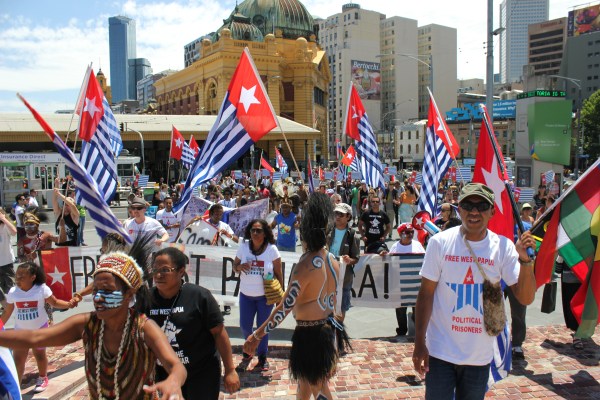
West Papuan Morning Star flags flying at Federation Square, Melbourne (Australia), December 1, 2012.  (Photo: West Papua Media)
West Papuan Morning Star flags flying at Federation Square, Melbourne (Australia), December 1, 2012. (Photo: West Papua Media)

For more than 50 years, the Morning Star Flag has been the symbol of West Papua’s unity and its quest for Freedom and Justice. Thousands have been inspired by it, as it became the main icon embodying the struggle for Independence. And this flag, just like any other flag of any other country, has a history, a proud history.

5 April 1961: Inauguration of the New Guinea Council

On 5 April 1961, a representative body for the then Dutch colony of Netherlands New Guinea was inaugurated: the New Guinea Council or Nieuw Guinea Raad[1] [1]. It was the task of the Council to make the wishes of the Papuan people known on the issue of self-determination, within a year. However, news came that the United States of America and Indonesia were putting pressure on the Dutch  to convince them to transfer its colony to the United Nations, and then to the Indonesian administration. The members of the New Guinea Council immediately gathered for an emergency session and appointed a National Committee to draft a Manifesto expressing the wishes of the Papuans which would include national symbols for the upcoming State.

19 October 1961: Flag and other national symbols officially adopted by way of Manifesto

Committee members Bonay, Jouwe, Tanggahma and Torey were asked to submit designs for the flag and arms. Mr. Torey withdrew and a choice had to be made between the designs of Messrs. Bonay, Jouwe and Tanggahma. The designs of Mr. Jouwe were accepted by 14 votes to 17 as national symbols.  After the national symbols were officially adopted, everyone was visibly moved and proud. According to official testimonies: “Then, all those present rose from their seat and while the emotion was clearly overtaking all those present the manifesto was read by the Chair of the National Committee, Mr. Willem Inury; it was subsequently unanimously accepted and signed by the National Committee. The attendees were then invited to also sign the manifesto … The national flag consists of a red vertical band along the hoist side, with a white [five-pointed] star in the center. Adjacent to the red band, is a series of [consecutive] blue and white lines, with a total of seven blue and six white lines.”[2]

This manifesto dated 19 October 1961 stated that: “in accordance with the ardent desire and the yearning of our people for our own independence, through the National Committee and our parliament, the New Guinea Council, insist with the Government of Netherlands New Guinea and the Netherlands Government that as of 1 November 1961,

a) our flag be hoisted beside the Netherlands flag;

b) our national anthem (“Hai Tanahku Papua”) be sung and played in addition to the Netherlands national anthem;

c) our country bear the name of Papua Barat (West Papua), and

d) our people be called: the Papuan people.”[3]

he Manifesto of 1961 may not have been an independence Proclamation, but its wording was strong and clear in relation to the will of the Papuan people to become independent, it was a declaration of intent, as it also stated that: “On that basis, we, the Papuan people, demand to get our place in the midst of other independent nations and peoples. In addition, we, the Papuan people, make our contribution to the preservation of peace and freedom around the world.”[4]

1 December 1961: Official inauguration of the flag as a territorial flag

The Dutch accepted most of the terms of the Manifesto except for the date of installation and the denomination of the flag: the inauguration of the flag happened on 1 December and not on 1 November as requested by the Papuans. The General Assembly of the UN was to hold a meeting in late November on the issue, and recognition by the Dutch of the symbols could have been interpreted as an endorsement of an independent West Papua by the Dutch Government. The Dutch did not want to provoke the Indonesians, even if it meant that the demand of the Papuans would not be heard. In terms of the denomination, the Dutch authorities recognized the new flag as a territorial flag (landsvlag) and not as national flag.

All the specifications concerning the flag and other Papuan symbols can be found in the so-called “Territorial Flag Ordinance” (or “Landsvlagordonnantie”) Number 68 of 1961. This Ordinance specifies among others that: “(1) The territorial flag of Netherlands New Guinea shall be a rectangle consisting of a vertical wide red striped at the hoist and seven horizontal blue stripes separated by six white stripes. In the centre of the vertical red stripe is a white five-pointed star, with one point pointing vertically upwards. The five points of the star shall each form an angle of 36 degrees. (2) The height and length of the flag shall bear to each other the proportion of 2 to 3. The width of the red stripe shall be two fifth of the height of the flag. The blue and white stripes shall be equal in height. The diameter of the circumscribed circle of the star shall be seven eighths of the width of the red stripe.” [5]  Another ordinance (Number 69 of 1961) provided for a national anthem for Netherlands New Guinea. Ordinance Number 70 of 1961, also called the “Administrative Order for the implementation of Section 2 of the Territorial Flag Ordinance”, stipulates the terms and conditions under which the flag is to be raised. And Section 5 states: “This Order, which may be cited as Flag Order, shall come into operation on December 1, 1961.”[6]

And so on 1 December it happened, for the first time, our Morning Star flag was raised, next to the Dutch flag; our national anthem (”Hai Tanahku Papua”) was played and sung together with the Dutch national anthem; our country was given the name of Papua Barat (West Papua), and our people were given a name: the Papuan people.

Nine years of international Fraud and Deception led by greed, racism and the total disrespect for human life

Just 18 days after the installation of the Papuan symbols, on 19 December 1961, the President of Indonesia, Soekarno, made his call for the infamous Tri Komando Rakyat (or TRIKORA), the People’s Threefold Command. On that day he called for a total mobilization of the people of Indonesia, (1) to destroy what he considered a Dutch-promoted Papuan State; (2) to fly the Indonesian flag over the territory of West Papua, which he erroneously called West Irian; (3) to prepare for war over what he called West Irian. For Indonesians this represented the so-called liberation of the territory from the Dutch. For Papuans the TRIKORA was the call for an illegal military aggression from a country which did not recognize its sovereignty. Military aggression was followed by legal deception as the Dutch and the Indonesians signed the New York Agreement of 15 August 1962, an agreement regarding the future of the Papuans but they themselves were never consulted. The Papuans were betrayed by those who signed this agreement which regulated the transfer of the administration of New Guinea to the United Nations. This administration lasted from 1 October 1962 to 1 May 1963. Then it was to be handed over to Indonesia for a period of six or seven years, after which the Papuans were supposed to freely choose, through a referendum, whether to join Indonesia or become an independent nation. Legal deception was followed by political fraud. In August 1969 the so-called “Act of Free Choice” was organized. At the time, West Papua had been under Indonesian rule for over six years: every expression of Papuan nationalism was systematically bloodily suppressed, possible opponents were arrested and tortured, punitive expeditions were carried out across the country and bombings and rocket attacks were conducted by the Indonesian army. The so-called “Act of Free Choice” itself was pure deception, fraud and deceit, a stage-managed play in which Indonesian officials selected 1026 Papuan electors who voted on behalf of 800,000 Papuans at the time. The electors were all carefully prepared for the Musyawarah: an Indonesian system of decision-making where there is unanimous agreement: 1025 Papuans finally decided unanimously that they wanted to belong to the Republic of Indonesia (one was sick that day). The normal one-man/one-vote principle usually applied for a referendum had not been respected as the Indonesians argued that Papuans were too primitive!

1 July 1971: the territorial flag becomes a national flag

In protest against the failure of the implementation of the “Act of Free Choice” the Free Papua Movement (OPM) proclaimed the independence of the Republic of West Papua on 1 July 1971.  Under Article 2 of UN resolution 1514: “All peoples have the right of self-determination. By virtue of that right they freely determine their political status and freely pursue their economic, social and cultural development.”  Another UN resolution, Resolution 1541, explains that exercising your right to self-determination means that you are allowed to choose between independence, autonomy or integration within an existing state. Since the beginning, the Papuans chose for independence; and they opted for that same option time and time again.

The Manifesto of 1961 was a declaration of intent; the Proclamation of 1971 was the realization of that intent. The proclamation stated: “With the help and blessing of God Almighty, we take this opportunity to declare to you all that today, 1 July 1971, the land and people of Papua have been proclaimed to be free and independent (de facto and de jure)”.

On 1 July 1971, the Papuans chose to take the Morning Star Flag which had been recognized by the Dutch as a territorial symbol. The Papuans decided to proclaim it a NATIONAL symbol; they did the same with the national anthem (Hai Tanahku Papua).


[1] Newspaper report. Sydney Morning Herald, 6 April 1961.

[2] Official government magazine Pengantara of 21 October 1961.

[3] Official government magazine Pengantara of 21 October 1961

[4] Official government magazine Pengantara of 21 October 1961

[5] Bulletin of Ordinances and Decrees of the Government of Netherlands New Guinea, 1961, No. 68, issued on 20 November 1961.

[6] Bulletin of Ordinances and Decrees of the Government of Netherlands New Guinea, 1961, No. 70, issued on 20 November 1961

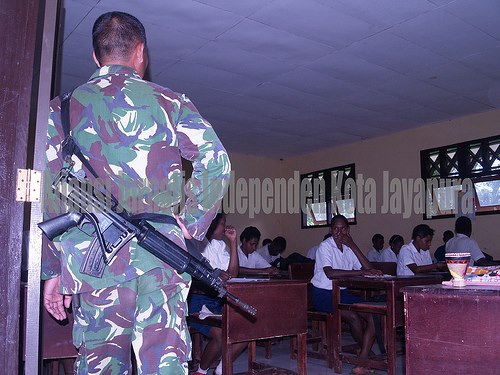
No primary schools in over a thousand kampungs in Papua

JUBI,

28 November 2012

Jayapura: The head of  the Education, Youth and Sports Service in the province of Papua, James Modouw, said that there are at least one thousand kampungs (villages) spread across the province where there is no primary school.

‘Of the more than four thousand kampungs in Papua,’ he said, ‘ it is thought that around 1,047 do not have a primary school. It is also the case that throughout the district of Suru-Suru in the Regency of Asmat, there are eight kampungs, none of which has a primary school. This does not include the regency of Yahukimo about which no data has yet been received.’

He said that the kampungs without a primary school are mainly in the mountainous regions of Papua. ‘In the whole of the Bintang Highland Regency, there is not a single primary school,’ he said. The same is true throughout the regencies of Lany Jaya, Puncak Jaya and Nduga. ‘This is a matter that requires the attention of the local governments in these areas,’ he said.

He said that the problem of the lack of availability of primary education in Papua should be resolved. ‘We call on the local and municipal  administrations to  insist that adequate funds are made available for primary schools everywhere in the 2013 budget.so as to deal with the lack of schools and the widespread illiteracy among the Papuan people. He said that is calculated that thirty percent of Papuan children get no education at all.

[Translated by TAPOL]

[COMMENT: Over the years, we have read so many reports about the non-availability of teachers as well as healthcare workers in so many parts of West Papua. This is clearly an extremely serious matter indeed, a situation that clearly has not improved since the enactment of the Special  Autonomy Law in 2001, more than eleven years ago. No wonder Papuans are being thrust aside as more and more better-educated migrants from other parts of the country outnumber Papuans and take control of the territory’s economy and administration. As is so often the case, Papuans are frequently described as being ‘terbelakang’ or ‘backward’. So whose fault is that?! TAPOL]


Create a website or blog at WordPress.com

Up ↑