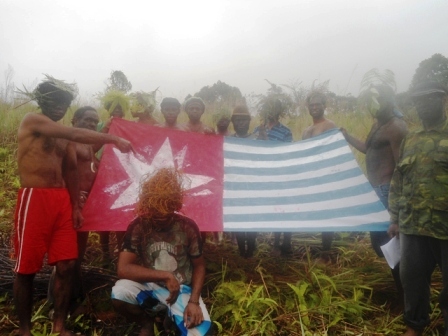
In a risky and symbolic act of defiance, unidentified West Papuan pro-independence activists raised the banned symbol of West Papuan liberation, the Morning Star flag, atop a foggy Mount Syclop, Sentani near Jayapura during the Indonesian Independence day on August 17 this year “as a form of celebration and rejection of the presence of Indonesian Papua, ” according to involved activists who spoke with West Papua Media (WPM) stringers.
West Papuan Flag Raising on August 17, 2013, atop Mount Syclop outside Sentani, rejecting Indonesian independence celebrations. (Photo: supplied directly to West Papua Media)
The flagraisings came amid a tit-for-tat psychological operations campaign ahead of August 17 by Indonesian occupation forces to raise the Merah Putih (Red/White) Indonesian national flag on prominent landmarks across Papua, and increase demands on Papuans to fly it publicly demonstrate their loyalty to Indonesia, according to a wide variety of human rights and church sources in Papua.
Organisers told WPM the act, on a mountain that could be seen from most the Papuan capital Jayapura, was about questioning the legitimacy of Indonesian occupiers to claim that all Papuans supported integration with Indonesia, and Jakarta’s claim that “Papua returned to the embrace of the Homeland.”
“Any person who was born and raised in Papua has been brought up with (the official line of the) ‘Victorious Political Integration in the NKRI, (and has) of course heard the above phrase repeatedly. This phrase has become a powerful force in the politics of integration. The Indonesian government and military believed and are so convinced that the political integration of West Papua is “absolute” they cannot answer the questions that the people of Papua ask,” the activists told WPM.
They continued their statement: “On behalf of the Nature of Papua, on behalf of the bones of revolutionary heroes who have gone before us, on our behalf and on behalf of our children, we strongly reject the claims of an Indonesian Papua. Indonesian historians were so convinced that West Papua was breathing into the territory of several ancient empires of Srivijaya, Majapahit, Sultanate of Tidore, until the time of the Dutch East Indies. Indonesia believes it is the absolute truth, the validity of its claims of West Papua as an integral part of Indonesia. But on the other hand, shame records that the history that Indonesian historians were not able to show the valid, complete and accurate data to prove the truth of what they believe it.”
“As a form of resistance we Papuans assert our Independence of the illegal Indonesian colonial occupation of our land Papua, then we burn the flag and hoisted the flag of our “Morning Star” in the mountain region Syclop,” said the activists to WPM’s stringer.
“We do this not for Indonesian attention , nor to requested positions, (those) certain positions in the country’s NKRI (colonial) bureaucracy…. (but as) a form of resistance against colonial occupation of Indonesia (who are) illegally on our land. That we demand and fight for “Self-determination” through an international mechanism that is Referendum,” the flag raisers said.
West Papuan Flag Raising on August 17, 2013, atop Mount Syclop outside Sentani, rejecting Indonesian independence celebrations. (Photo: supplied directly to West Papua Media)
Although traditionally raised on December 1 – the anniversary of the 1961 thwarted declaration of West Papua’s independence from the Dutch, and the first flying of the flag – activists claim that it was flown atop Mount Syclop to “remind Indonesia that the people of West Papua(n) nation (have) rejected the (Indonesian) pro-independence and did not participate in the anniversary celebrations.”
Indonesian colonial forces regularly attempt to enforce compulsory celebrations of Indonesia’s independence day by West Papuan people, an act many Papuans believe is designed to suppress Papuan cultural identity.
Flag raising is seen by Indonesia as a deeply political act that determines the degree of a citizen’s loyalty to the nation. Failure to display the Merah Putih was regularly used throughout Indonesian history as a justification to extreme political violence, for example the killings of close to 2 million Indonesians during the 1965-1969 bloodbath in the first days of former dictator Suharto’s New Order regime, and the scorched-earth campaign on East TImor ending in 1999 when Indonesian security forces and militias murdered well over 180,000 civilians. Civilians in Military operations areas (whether declared or not) across Indonesia and its colonies are regularly warned by security forces to display the Red and white in order to avoid sweep operations targeting their homes. Public buildings are draped in it, private businesses are threatened by security forces if they fail to display it, and school children are bedecked in Red and White uniforms and forced to salute the flag daily.
Display of any cultural symbols or expression in opposition to the Merah Putih are interpreted by Jakarta as acts of makar (treason, subversion or rebellion) instead of acts of free expression guaranteed under the Indonesian Constitution. However, Article 6 of Government Regulation 77/2007, prohibits the display of the Morning Star, the South Maluku Republic Benang Raja flag in Ambon and the Crescent Moon flag in Aceh – despite the provision of the law in the Indonesian Criminal Code (KUHP) being been declared unconstitutional for prohibiting free expression, by the Indonesian Constitutional Court.
Indonesian security forces, since their invasion of West Papua, have imprisoned thousands of people for their involvement in raising the banned Morning Star flag, and have violently broken up almost every display of the Morning Star, resulting in thousands of deaths over the last 50 years. Each December 1 – traditionally the anniversary of West Papua’s thwarted declaration of independence in 1961, Over 90% of the current 56 political prisoners in Papuan gaols are imprisoned under makar for non-violent acts involving the Morning Star flag, including most famously Filep Karma, one of Papua’s longest serving political prisoners, who was gaoled for 15 years for his role in organising the December 1, 2004 flagraising in Abepura.
Tito Karnavian’s so-called Puncak Jaya summit Indonesian flag raising ceremony to conquer Papua. Note the flat ground on the Grasberg mine site where the ceremony was held, and the several hundred metres of Papua’s highest mountain Nemangkawi looming above the alleged “summit ceremony” (Photo: POLRI)
On August 14, Indonesia’s colonial police chief in Papua Tito Karnavian (the former commander of the notorious Detachment 88 “Counter-terror” death squad supported by Australia,the US and UK), drove a group of Indonesian police, military,and management of the giant Freeport McMoRan Grasberg mine in heated luxury four-wheel drives, claiming they held a ceremony atop Papua’s highest peak, the 4844-metre high Nemangkawi (known by the Indonesians as Puncak Jaya), in order to raise Indonesia’s flag of conquest over Papua. Participants in the ceremony claiming to be Papuans were families of senior Freeport employees, an Indonesian army unit known as the “Pasukan Koteka Papua” and soldiers wearing blackface make-up. However the ceremony did not occur at the peak of Nemagkawi, rather in the grounds of the Grasberg mine site some 800 metres below the peak. The Merah Putih still does not fly atop the famous summit (one of the “Seven Summits”), according to independent sources in TImika contacted by WPM.
Papua’s banned Morning Star flag, flown by climber Christian Welponer of South-Tyrol in Italy, from the top of the highest mountain of West Papua in late 2011, one of the “Seven Summits” (screen grab C. Welponer/ WPM file)
On December 1 2011, Christian Welponer, a world famous mountaineer from the autonomous South Tyrol region of the Italian-Austrian Alpine border regions, released a video of him raising the Morning Star flag atop Nemangkawi. The act was deeply significant to West Papuan people, who sustained many casualties from Indonesian state violence inflicted on peaceful ceremonies across Papua that day. The act infuriated Indonesian officials in the Freeport surrounds, who failed to prevent Welponer from carrying out the symbolic solidarity action.
Markus Yenu was arrested at the side of the road in from of Daniel Sakwatorey’s house (former political prisoner in Papua, 2008) at Sanggeng Manokwari West Papua. The arrest was by Manokwari’s Criminal Police Unit at 11.32am West Papua time, on the order of Manokwari’s Criminal Police AKP. KRISTIAN SAWAKI. The Manokwari Criminal Police officers were driving a black Inova with the number plate DS.9977.
According to Markus Yenu’s evidence (he’s the Executive Governor of the West Papua National Authority District 2 Manokwari) after he was arrested and taken to the police station at Manokwari, he was immediately taken to an interrogation room and asked to give information about a peaceful demonstration on the 17th January 2013 during which the morning star flag was flown. There were various sized flags flown, and also biased political speeches from several leaders from the Free Papua movement who were inciting people to overthrow the legitimate government.
Markus Yenu also gave evidence that when he was in the interrogation room at the Manokwari Police Station he was visited by Kombes (Pol) Yakobus Marzuki former chief of police in 2008 and now Director of Papuan Police Intelligence. Marzuki told Yenu:
Comprehensive data from the Police indicated Markus Yenu was involved with provoking the acts of arson and destruction that three police officers faced on the 5th December 2012 following the shooting of Thimotius Ap.
In the near future police plan to meet with Kesbangpol to get rid of all organisations that don’t support the Ideology of a United Republic of Indonesia (NKRI)
Eight people are already dead, but police and TNI will be pursuing and removing any subversive groups both in the forest and the city.
Whereas for Markus Yenu there was an order from police headquarters to disable him.
According to Yenu, the Director of Papuan Police Intelligence said many other things indicating a threat to human rights and democracy activists in Papua.
Yenu said that, ‘After me, the police will arrest another six people who have been identified as suspects
5 December 2012Jayapura: ‘I was arrested because of my having once been held as a political prisoner (tapol),’ said Yusak Pakage, a Papuan activist. who said that the charge against him was a frame-up, alleging that he was dangerous just because he was carrying a knife.
He made this statement to suarapapua.com on 4 December, following a hearing at the Class 1A district court in Jayapura He said that as soon as he was arrested on 27 July this year, he was taken to a police command post and questioned about his behaviour towards a court official, Sefnat Fonataba.
‘Soon after, Fonataba came to the police station and told the police there that there was no problem with me and apologised to me for what he had done.’ The policeman asked Pakage to write a statement saying that there was no problem between him and the policeman which is what he did.
When he was about to sign the statement, the chief of police in Abepura came along and said that he had other instructions about how to handle this case.
‘Shortly afterwards, I was taken to the police station where I was interrogated for quite a long time about the knife. I said that it was a very cheap knife, the kind of knife that you can find in any traditional market in Jayapura. It is just something I carry about with me for my everyday needs. I didn’t buy it in order to do something criminal, as the security people seemed to think.’
‘ I have never heard anything about needing a special permit to carry an ordinary knife.The law in Indonesia is very confusing and I don’t know about any rule governing the carrying of a knife. The chief of police said that he didn’t know who I was and wanted the case to be handled in the usual way.’ But according to Pakage, the police officer knows very well who he is and that he had previously been held as a tapol. ‘He was lying,’ said Pakage.’He just wanted it to be known that I had formerly been held as a tapol, when I was arrested along with Filep Karma in 2004 for carrying the Morning Star flag.’
‘I frequently make statements about the human rights situation in Papua and take a leading part in many demonstrations, so of course he knows very well who I am.’
Pakage also said that during his interrogation, all his personal belongings were taken away, even including his ballpoint, and none of these things have been returned to him.
On 19 August, he was transferred to the prison in Abepura and he is now waiting for his case to be completed and to hear the verdict of the judge.
Pakage used this occasion to warn his activist friends to be very careful and keep control of their feelings when they are doing anything to struggle for the rights of the Papuan people.
‘I tell them not to get too emotional and to learn from my own experiences which show that I can be arrested for something very trivial.’
Siman Pattiradjawane, the lawyer who is defending Pakage told reporters that the verdict in the case will be announced on 11th December.
Jayapura: The ‘chief of the general staff’ of TPN/OPM, ‘Major-General’ Terianus Santo said that his organisation had celebrated 1 December with prayers and ceremonies to unfurl the Morning Star flag at their headquarters deep in the forest.
‘We marked the occasion by holding the flag aloft from early morning and conducted military training sessions and education . If you wish, we can send you a photo by email, to see the flag while we were conducting military training.’
Terianus Santo was appointed chief of staff of the TPN/OPM at a summit conference which was held in Perwomi Biak in May this year.
‘We carried out the ceremony as a mark of respect for our history and our movement’s dedication to continue the struggle for freedom,’ he said.
He went on to say that they want to press the UN to immediately provide an opening for a dialogue between the Dutch Government, the Indonesian Government, the UN and representatives of the Papuan people ‘because some of these elements were involved in the unlawful annexation of Papua.’
Elly CH Sirwa, the secretary of the National Council of the Federal Republic of West Papua, said that ceremonies to celebrate December 1 have taken place every year since 1961 to mark the emergence of an independent Papuan nation, with status equal to other nations in the world.
He said that the ceremony had proceeded peacefully and with great enthusiasm by all those who took part , as is evident from the fact that a number of activities took place in various parts of West Papua. ‘We hope that next year, these ceremonies will be held with even greater enthusiasm,’ he told Bintang Papua, during an interview at the office of DAP, the Council of Indigenous Papuans.
He also used the occasion to give thanks for all the sacrifices that had been made during the ceremonies to mark the 51st anniversary of 1 December. ‘What happened on this day exceeded expectations.’ Although the occasion occurred at a time when relations with some other nations were still strained, he said that they had given thanks for the ceremonies this year even though they had not been given to permission to hold the ceremonies.
‘We Papuan people do not feel disappointed or upset , even though in some places in West Papua, our ceremonies were dispersed forcibly by forces who were bearing firearms. In some places, some of our people were arrested.’
He said that restricted ceremonies had been held among other places in Imbi Square Jayapura, Buper Waena, at the Sports Stadium in Jayapura and at the Theys Eluay Burial Ground in Sentani. Stones were burnt and people were able to partake of a meal together.’
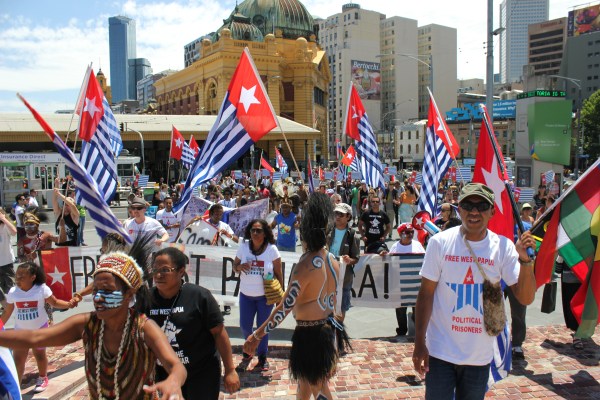
West Papuan Morning Star flags flying at Federation Square, Melbourne (Australia), December 1, 2012. (Photo: West Papua Media)
For more than 50 years, the Morning Star Flag has been the symbol of West Papua’s unity and its quest for Freedom and Justice. Thousands have been inspired by it, as it became the main icon embodying the struggle for Independence. And this flag, just like any other flag of any other country, has a history, a proud history.
5 April 1961: Inauguration of the New Guinea Council
On 5 April 1961, a representative body for the then Dutch colony of Netherlands New Guinea was inaugurated: the New Guinea Council or Nieuw Guinea Raad[1] [1]. It was the task of the Council to make the wishes of the Papuan people known on the issue of self-determination, within a year. However, news came that the United States of America and Indonesia were putting pressure on the Dutch to convince them to transfer its colony to the United Nations, and then to the Indonesian administration. The members of the New Guinea Council immediately gathered for an emergency session and appointed a National Committee to draft a Manifesto expressing the wishes of the Papuans which would include national symbols for the upcoming State.
19 October 1961: Flag and other national symbols officially adopted by way of Manifesto
Committee members Bonay, Jouwe, Tanggahma and Torey were asked to submit designs for the flag and arms. Mr. Torey withdrew and a choice had to be made between the designs of Messrs. Bonay, Jouwe and Tanggahma. The designs of Mr. Jouwe were accepted by 14 votes to 17 as national symbols. After the national symbols were officially adopted, everyone was visibly moved and proud. According to official testimonies: “Then, all those present rose from their seat and while the emotion was clearly overtaking all those present the manifesto was read by the Chair of the National Committee, Mr. Willem Inury; it was subsequently unanimously accepted and signed by the National Committee. The attendees were then invited to also sign the manifesto … The national flag consists of a red vertical band along the hoist side, with a white [five-pointed] star in the center. Adjacent to the red band, is a series of [consecutive] blue and white lines, with a total of seven blue and six white lines.”[2]
This manifesto dated 19 October 1961 stated that: “in accordance with the ardent desire and the yearning of our people for our own independence, through the National Committee and our parliament, the New Guinea Council, insist with the Government of Netherlands New Guinea and the Netherlands Government that as of 1 November 1961,
a) our flag be hoisted beside the Netherlands flag;
b) our national anthem (“Hai Tanahku Papua”) be sung and played in addition to the Netherlands national anthem;
c) our country bear the name of Papua Barat (West Papua), and
he Manifesto of 1961 may not have been an independence Proclamation, but its wording was strong and clear in relation to the will of the Papuan people to become independent, it was a declaration of intent, as it also stated that: “On that basis, we, the Papuan people, demand to get our place in the midst of other independent nations and peoples. In addition, we, the Papuan people, make our contribution to the preservation of peace and freedom around the world.”[4]
1 December 1961: Official inauguration of the flag as a territorial flag
The Dutch accepted most of the terms of the Manifesto except for the date of installation and the denomination of the flag: the inauguration of the flag happened on 1 December and not on 1 November as requested by the Papuans. The General Assembly of the UN was to hold a meeting in late November on the issue, and recognition by the Dutch of the symbols could have been interpreted as an endorsement of an independent West Papua by the Dutch Government. The Dutch did not want to provoke the Indonesians, even if it meant that the demand of the Papuans would not be heard. In terms of the denomination, the Dutch authorities recognized the new flag as a territorial flag (landsvlag) and not as national flag.
All the specifications concerning the flag and other Papuan symbols can be found in the so-called “Territorial Flag Ordinance” (or “Landsvlagordonnantie”) Number 68 of 1961. This Ordinance specifies among others that: “(1) The territorial flag of Netherlands New Guinea shall be a rectangle consisting of a vertical wide red striped at the hoist and seven horizontal blue stripes separated by six white stripes. In the centre of the vertical red stripe is a white five-pointed star, with one point pointing vertically upwards. The five points of the star shall each form an angle of 36 degrees. (2) The height and length of the flag shall bear to each other the proportion of 2 to 3. The width of the red stripe shall be two fifth of the height of the flag. The blue and white stripes shall be equal in height. The diameter of the circumscribed circle of the star shall be seven eighths of the width of the red stripe.” [5] Another ordinance (Number 69 of 1961) provided for a national anthem for Netherlands New Guinea. Ordinance Number 70 of 1961, also called the “Administrative Order for the implementation of Section 2 of the Territorial Flag Ordinance”, stipulates the terms and conditions under which the flag is to be raised. And Section 5 states: “This Order, which may be cited as Flag Order, shall come into operation on December 1, 1961.”[6]
And so on 1 December it happened, for the first time, our Morning Star flag was raised, next to the Dutch flag; our national anthem (”Hai Tanahku Papua”) was played and sung together with the Dutch national anthem; our country was given the name of Papua Barat (West Papua), and our people were given a name: the Papuan people.
Nine years of international Fraud and Deception led by greed, racism and the total disrespect for human life
Just 18 days after the installation of the Papuan symbols, on 19 December 1961, the President of Indonesia, Soekarno, made his call for the infamous Tri Komando Rakyat (or TRIKORA), the People’s Threefold Command. On that day he called for a total mobilization of the people of Indonesia, (1) to destroy what he considered a Dutch-promoted Papuan State; (2) to fly the Indonesian flag over the territory of West Papua, which he erroneously called West Irian; (3) to prepare for war over what he called West Irian. For Indonesians this represented the so-called liberation of the territory from the Dutch. For Papuans the TRIKORA was the call for an illegal military aggression from a country which did not recognize its sovereignty. Military aggression was followed by legal deception as the Dutch and the Indonesians signed the New York Agreement of 15 August 1962, an agreement regarding the future of the Papuans but they themselves were never consulted. The Papuans were betrayed by those who signed this agreement which regulated the transfer of the administration of New Guinea to the United Nations. This administration lasted from 1 October 1962 to 1 May 1963. Then it was to be handed over to Indonesia for a period of six or seven years, after which the Papuans were supposed to freely choose, through a referendum, whether to join Indonesia or become an independent nation. Legal deception was followed by political fraud. In August 1969 the so-called “Act of Free Choice” was organized. At the time, West Papua had been under Indonesian rule for over six years: every expression of Papuan nationalism was systematically bloodily suppressed, possible opponents were arrested and tortured, punitive expeditions were carried out across the country and bombings and rocket attacks were conducted by the Indonesian army. The so-called “Act of Free Choice” itself was pure deception, fraud and deceit, a stage-managed play in which Indonesian officials selected 1026 Papuan electors who voted on behalf of 800,000 Papuans at the time. The electors were all carefully prepared for the Musyawarah: an Indonesian system of decision-making where there is unanimous agreement: 1025 Papuans finally decided unanimously that they wanted to belong to the Republic of Indonesia (one was sick that day). The normal one-man/one-vote principle usually applied for a referendum had not been respected as the Indonesians argued that Papuans were too primitive!
1 July 1971: the territorial flag becomes a national flag
In protest against the failure of the implementation of the “Act of Free Choice” the Free Papua Movement (OPM) proclaimed the independence of the Republic of West Papua on 1 July 1971. Under Article 2 of UN resolution 1514: “All peoples have the right of self-determination. By virtue of that right they freely determine their political status and freely pursue their economic, social and cultural development.” Another UN resolution, Resolution 1541, explains that exercising your right to self-determination means that you are allowed to choose between independence, autonomy or integration within an existing state. Since the beginning, the Papuans chose for independence; and they opted for that same option time and time again.
The Manifesto of 1961 was a declaration of intent; the Proclamation of 1971 was the realization of that intent. The proclamation stated: “With the help and blessing of God Almighty, we take this opportunity to declare to you all that today, 1 July 1971, the land and people of Papua have been proclaimed to be free and independent (de facto and de jure)”.
On 1 July 1971, the Papuans chose to take the Morning Star Flag which had been recognized by the Dutch as a territorial symbol. The Papuans decided to proclaim it a NATIONAL symbol; they did the same with the national anthem (Hai Tanahku Papua).
[1] Newspaper report. Sydney Morning Herald, 6 April 1961.
[2] Official government magazine Pengantara of 21 October 1961.
[3] Official government magazine Pengantara of 21 October 1961
[4] Official government magazine Pengantara of 21 October 1961
[5] Bulletin of Ordinances and Decrees of the Government of Netherlands New Guinea, 1961, No. 68, issued on 20 November 1961.
[6] Bulletin of Ordinances and Decrees of the Government of Netherlands New Guinea, 1961, No. 70, issued on 20 November 1961






 West Papua Media Alerts