Makar accused reject charges, and Indonesian jurisdiction over Papua in adjourned trial (Photo Report)

January 31, 2012

By Nick Chesterfield from West Papua Media with local sources

(Jayapura) The treason trial against the leaders of the Third Papuan People’s Congress in Jayapura was adjourned on Monday until February 8, after a short hearing that Indonesian authorities moved at the last moment preventing many supporters from attending.

The five defendants, President of the Federated Republic of West Papua (FRWP)  Forkorus Yaboisembut, Prime Minister Edison Waromi, together with Congress organisers Selpius Bobii, Dominikus Sorabut and Agus Sananay were charged with makar or treason under Article 106 of KUHP (the Indonesian Criminal Code) for their declaration of an independent West Papua at the close of the Third Papuan People’s Congress on October 19 last year.
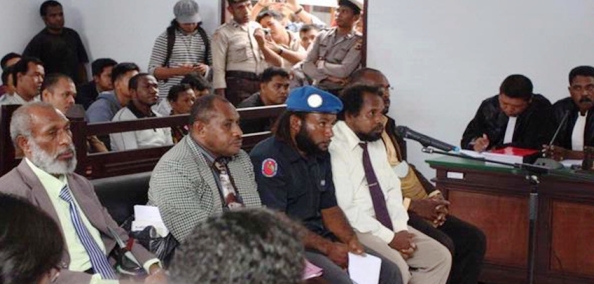
Papuan leaders accused of treason on trial in Jayapura, January 30, 2012

The historic Congress was violently broken up by Indonesian security forces using live fire and excessive violence, with at least seven people killed, hundreds beaten and tortured, despite official permission for the event to be held.  Indonesian security officers involved were given minor disciplinary sanction, with most perpetrators of violence enjoying complete impunity despite footage of the Indonesian security force violence being broadcast internationally.

Initial reports from witnesses inside the trial early in the day claimed that the team of judges argued with the defence legal team about the need to know the political position of the defendant’s, despite the fact that in a treason trial this would be self-evident.  Yaboisembut and Waromi then fundamentally rejected the charges against them, arguing that their actions were not treason“.

Forkorus Yobeisembut (Jakarta Globe)

According to Forkorus as reported by the Jakarta Post, “What we have been doing is seeking our own independence. Thus, we have cheated no one,”.  Forkorus argued that Indonesian occupation of his homeland was the real issue, and that ”this problem is not the problem of separatism and rebellion or treason”.  Both Forkorus and Waromi said that the issue of Papua should be tried in international courts as the Indonesian state did not have jurisdiction over Papua.
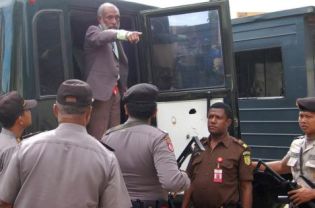
Forkorus Yaboisembut (Jakarta Globe)

in a short statement sent to West Papua Media, the defendant’s legal team said that the judge asked Forkorus and the accused understood the indictment.  “He answered that, yes, he understood what the prosecutors read but did not understand the charges of treason against them.”

“Forkorus then asked for time to read a statement to the assembly to process the rejection of the  law, (the request of) which was then approved by a judge.   Our attorneys will do the rebuttal (exception) to the indictment dated 8th February 2012,” according to the legal team led by Hamadi.

(Photo: Efraim Joteni)

Bintang Papua reported that another one of the lawyers for the accused, Gustaf Kawer,said that up to 32 lawyers from across Papua and Indonesia had offered pro-bono defence of the treason accused.  He said: ‘I am convinced that  the large number of lawyers who are attracted by the case is a good sign  of interest in the need to find a solution to the problem of Papua.’

Forkorus Yaboisembut and Edison Waromi media interview after trial.(Photo: Efraim Joteni)

The Panel of Judges hearing the trial are Chairman of the Jayapura District Court of Class IA, Jayapura, Papua, Jack John Octovianus, SH. MH,;  assisted by I Ketut Nyoman S, SH. MH. Syor Mambrasar, SH. MH. Orpah Marthina, SH. and Willem Marco Erari, SH.

Outside the court hearing, almost 400 hundred heavily armed riot police and a similar number of Army and Kopassus personnel were guarding the courthouse venue from dawn (0600) with close to a dozen armoured assault vehicles, mounted with heavy machine guns, according to participants.
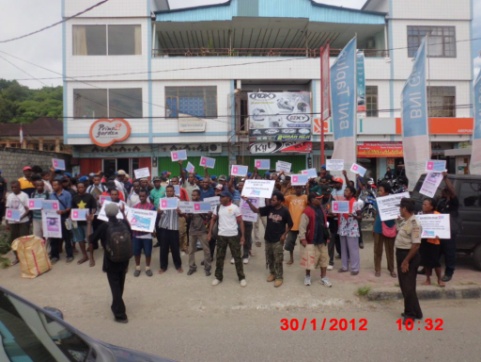
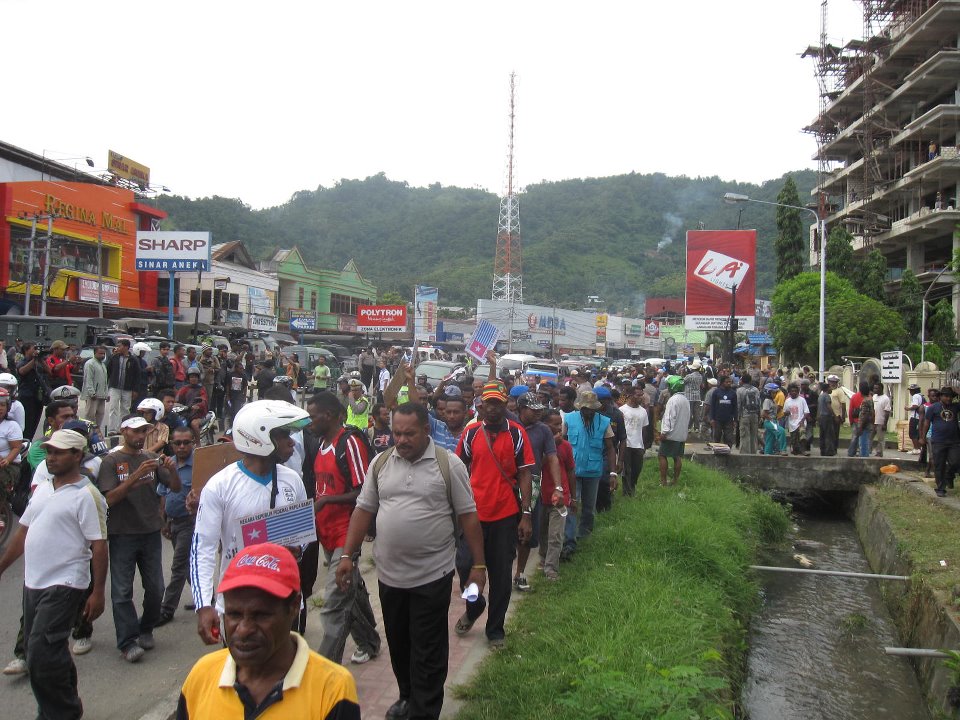
Protest in support of West Papuan leaders in trial for treason (Photo: Efraim Joteni)

Participants in the protest claimed to West Papua Media via SMS that security forces were acting in a heavy-handed manner, describing their actions as “wild and aggressive”.    “This display of armour  makes thousands of ordinary people in Jayapura traumatized and afraid to come to action,” said Jack Wainggai, the spokesman for the Prime Minister of the FRWP, Edison Waromi, on trial for treason today.  Organisers had aimed for several thousand people to attend, but amid heavy  Indonesian security that discouraged solidarity protests by West Papuan supporters of the defendants, only 500-600 braved the heavy armour and “state intimidation” outside the court.

Protest in support of West Papuan leaders in trial for treason (Photo: Efraim Joteni)
Brimob outside makar trial (Photo: West Papua Media)
one of almost a dozen armoured vehicles securing outside court venue Jan 30 2012 Jayapura (Photo: West Papua Media)

Despite promises by Indonesian authorities that the trials would be open, the presiding judges secretly started proceedings at 8.30 am before supporter could arrive.   In a press statement before the trial, Bintang Papua reported that Olga Hamadi of Kontras Papua said, “The five men will face charges under Article 106 of the Criminal Code for subversion. Based on past experience, there are concerns regarding security during the trial which will be open to the public, meaning that anyone wishing to attend the trial will be able to do so.”  Hamadi urged all present to restrain themselves and ensure that conditions surrounding the trial are conducive.

Speculation has mounted amongst local observers that the trial may be moved from Jayapura to metropolitan Indonesia to reduce any potential political flashpoint it will cause amongst pro-independence forces in Papua, with the prosecutor’s office formally warning of such a move should unrest occur.   Conversely though, any shift would create more opportunities for international observers to be present at the trial, a basic condition called for by the defence and international human rights monitors.

After the adjournment, the few hundred that did attend were able to disperse peacefully without an Indonesian security force crackdown, but tension still remains high in Jayapura as armed troops are still deployed on the streets the following day.

Elsewhere in Papua, solidarity actions were held with the treason trials against the Congress leaders.   In Manokwari, orations were held calling for international peacekeepers to be deployed to protect West Papuan people from Indonesian state violence.  Calls were also made in Manokwari  for neutral international mediators for dialogue between Jakarta and the Federated Republic of West Papua.

Westpapuamedia.info

A Christmas Message to SBY from Papuan Churches

by Andreas Harsono

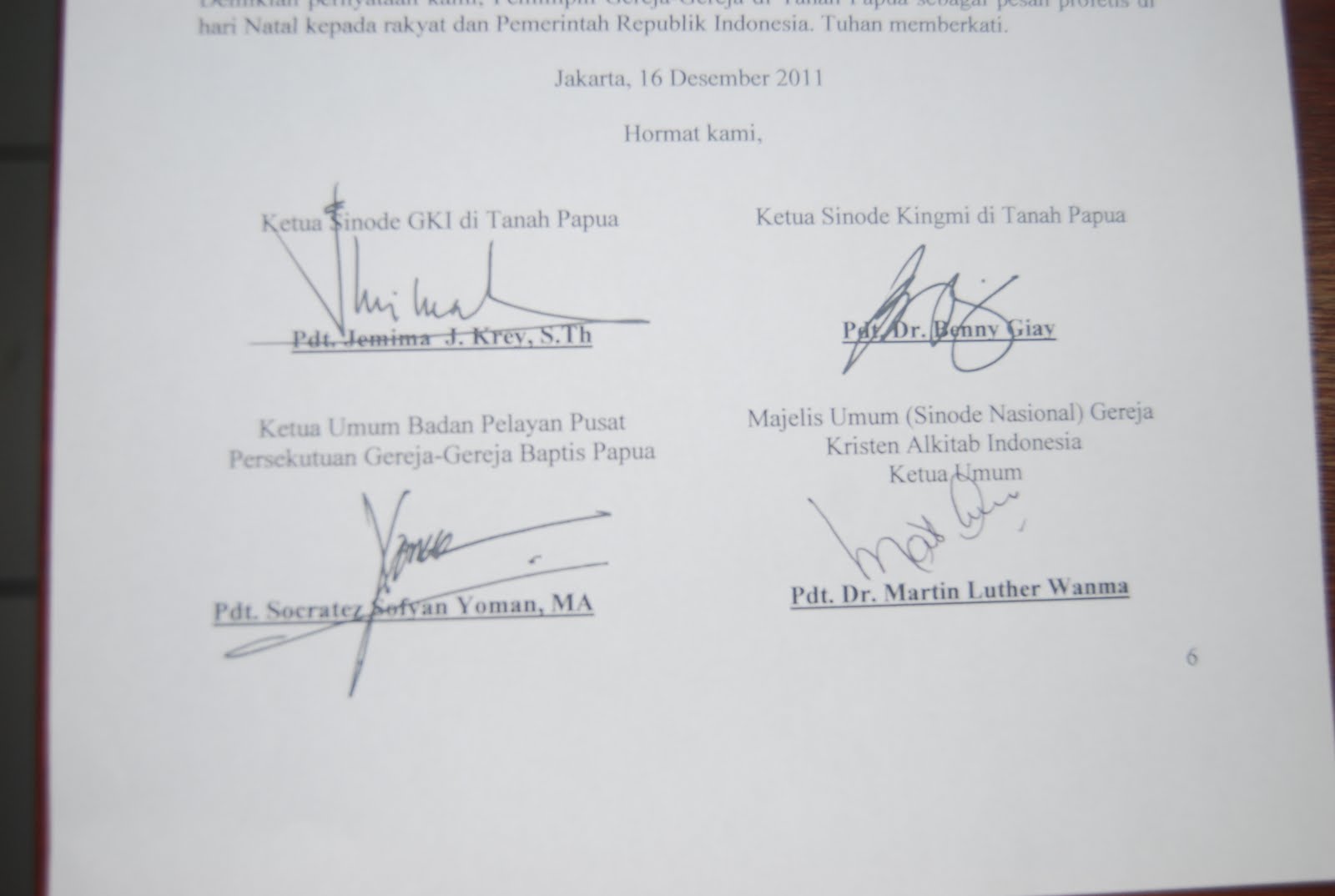
FOUR PAPUAN church leaders drafted and debated about their letter to President Susilo Bambang Yudhoyono while they’re in Jakarta this week. They met Indonesian Coordinating Minister on Politics and Security Djoko Suyantoon Monday, Dec. 12. They spent the next four days to draft the seven-page letter. It was finally signed at about 4pm at the office of the Communion of Churches in Indonesia. They handed over the letter to President Yudhoyono on Friday night at his private residence in Cikeas.They titled the letter, “Pesan Profetis Gereja-Gereja se-Tanah Papua” or the “Prophetical Message from the Churches in the Land of Papua.”

Frederika Korain, a Papuan human rights researcher, thought that it was an important, and histotical moment. She decided to record the moments when the letter was signed.

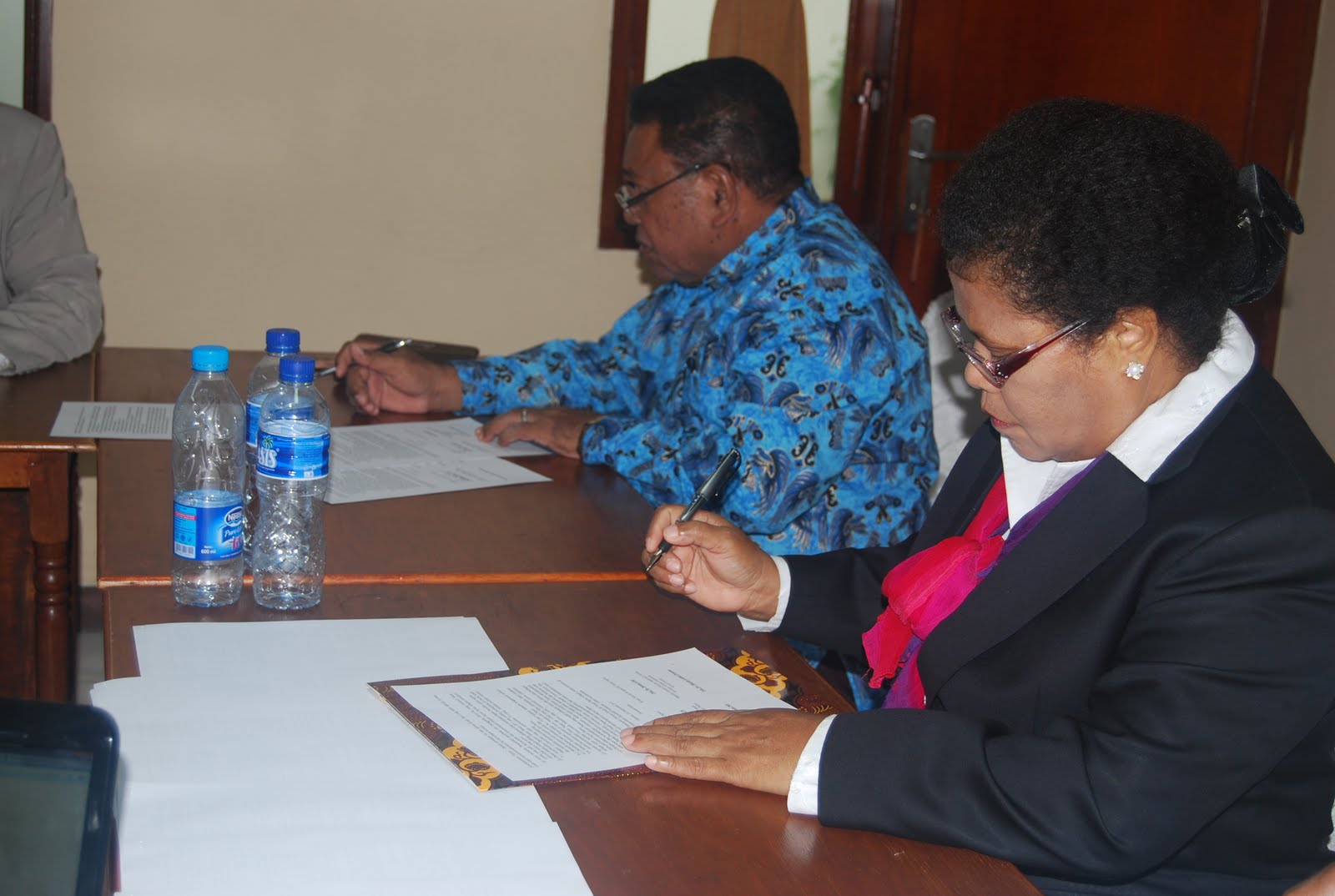
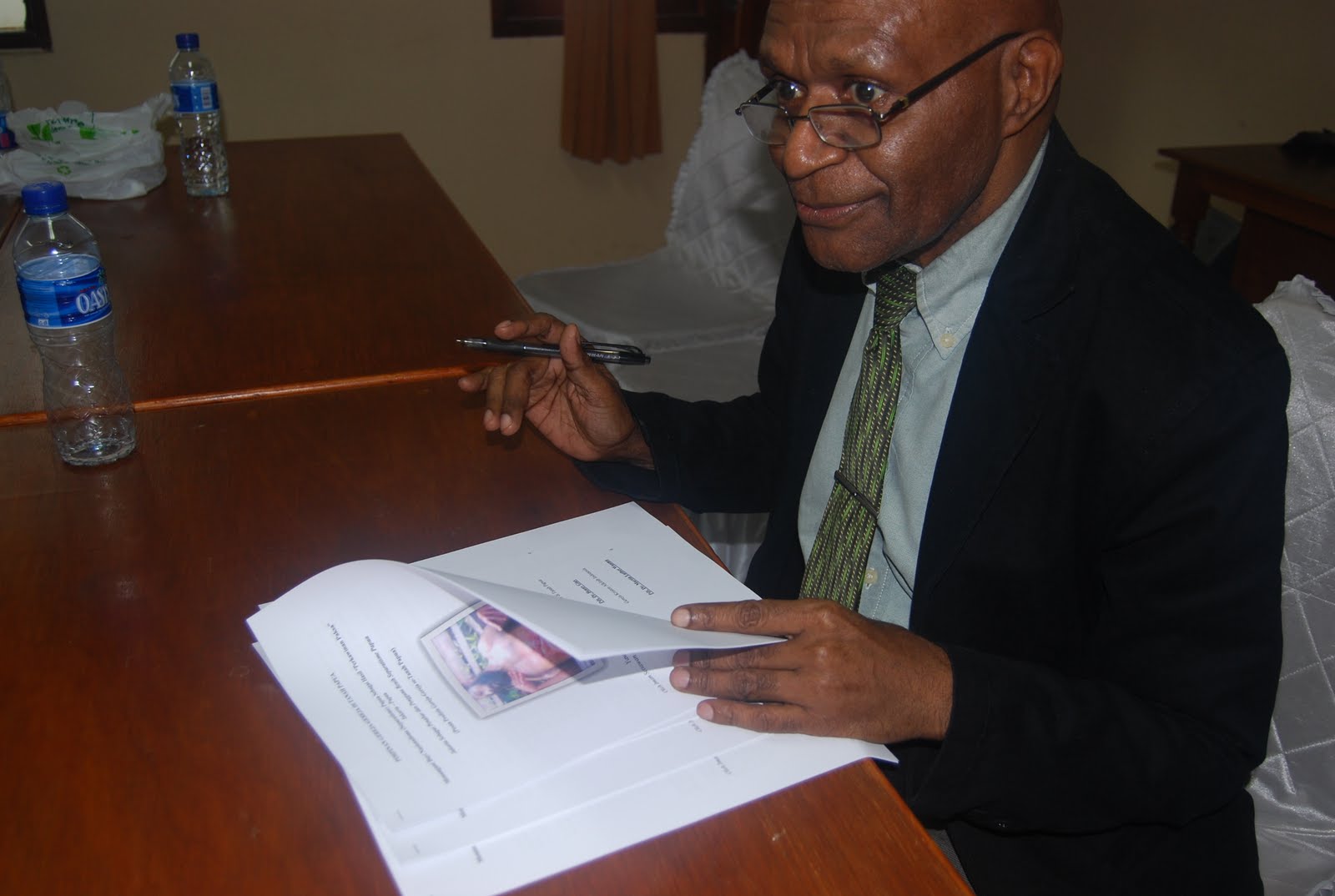
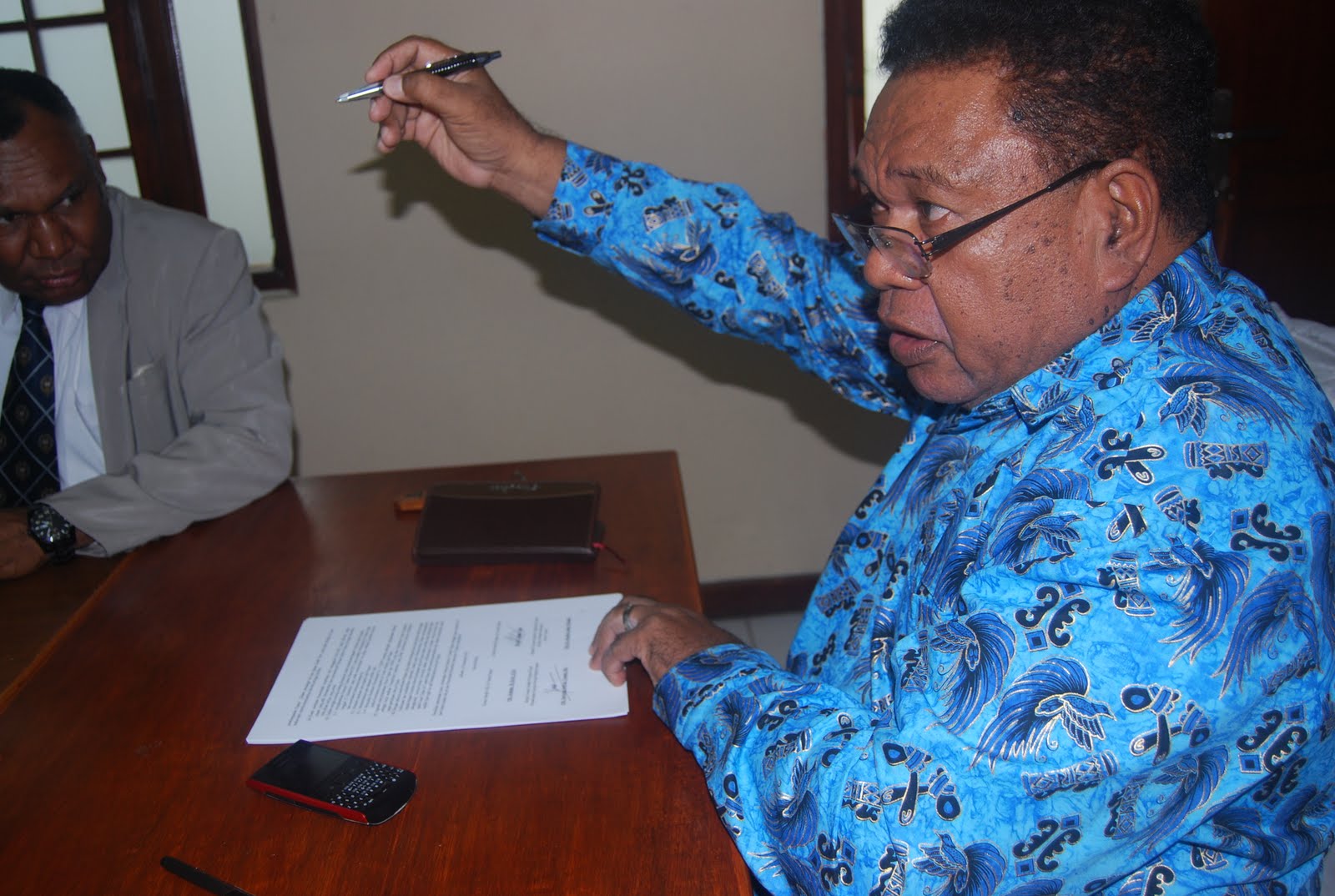
Rev. Martin Luther Wanma, chairman of the Indonesian Christian Bible Church (blue batik) and Rev. Jemima M. Krey, chairwoman of the Evangelical Christian Church in Papua (black blazer and red scarf) signed the seven-page letter. ©Frederika Korain
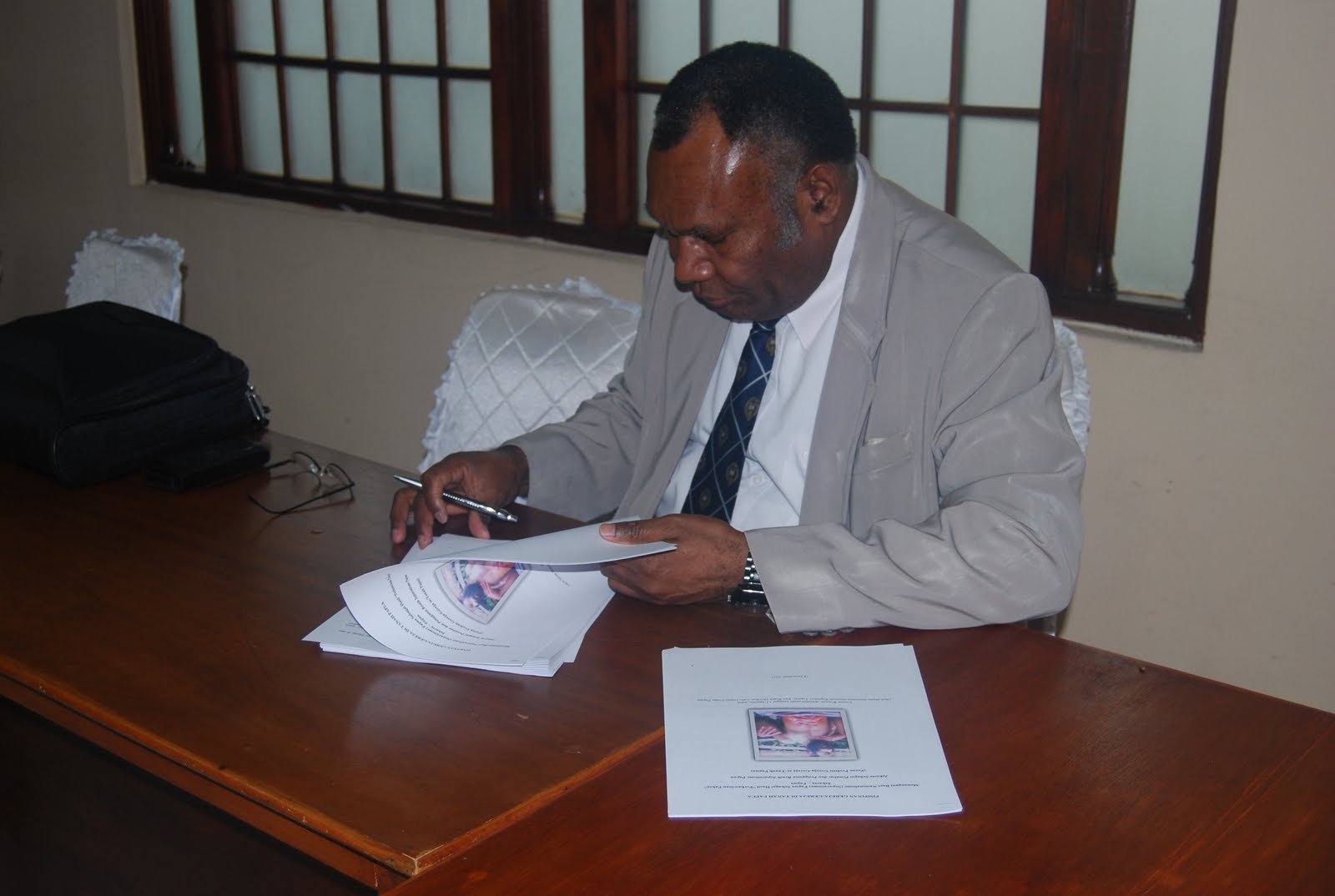
Rev. Socratez Sofyan Yoman, chairman of the Alliance of Baptist Churches in Papua signed the seven-page letter. Yoman is also an author. The Indonesian General Attorney Office bans two of his books, Kucuran Air Mata Umat Tuhan di Papua Barat Harus Diakhiri and Pemusnahan Etnis Melanesia. ©Frederika Korain

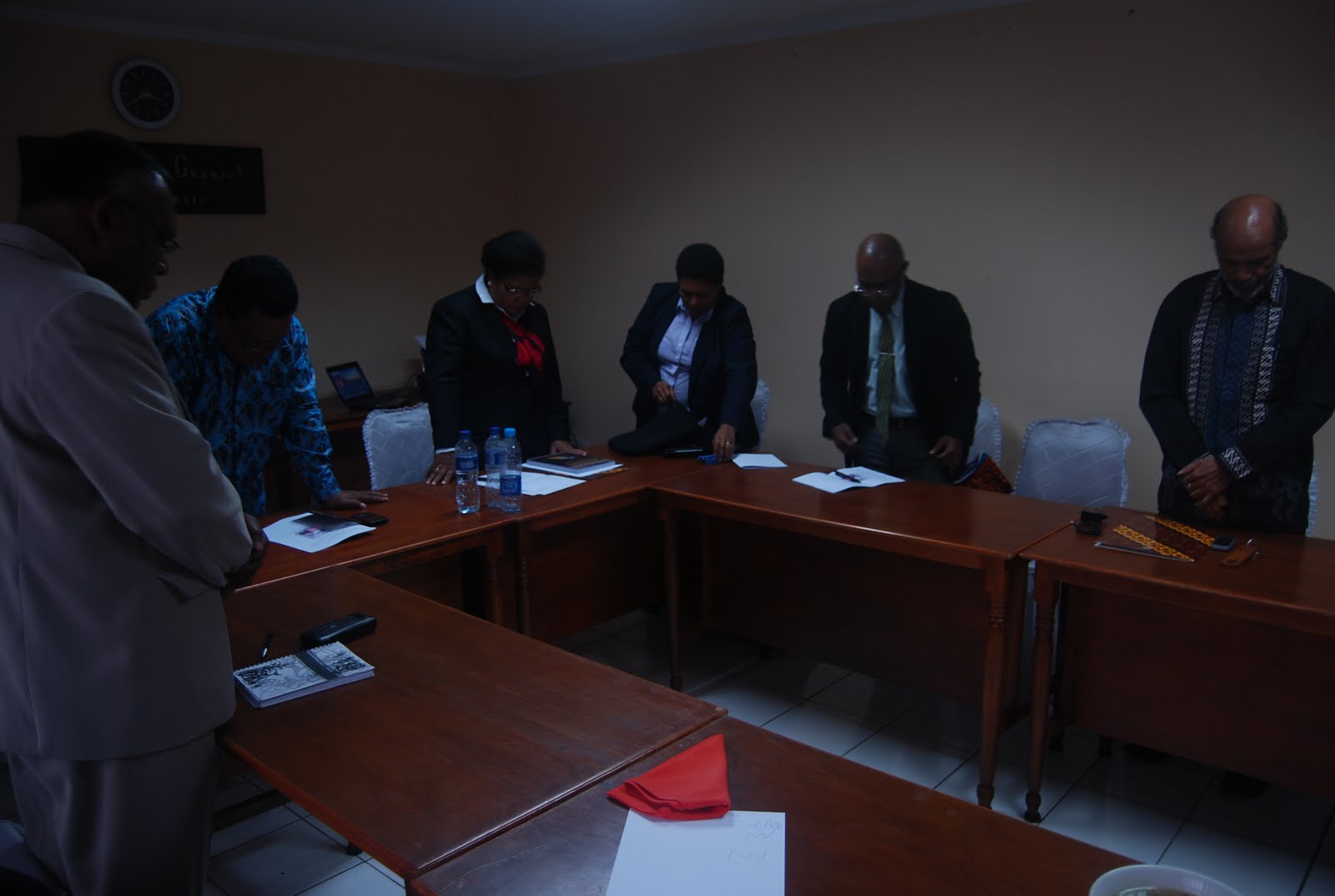
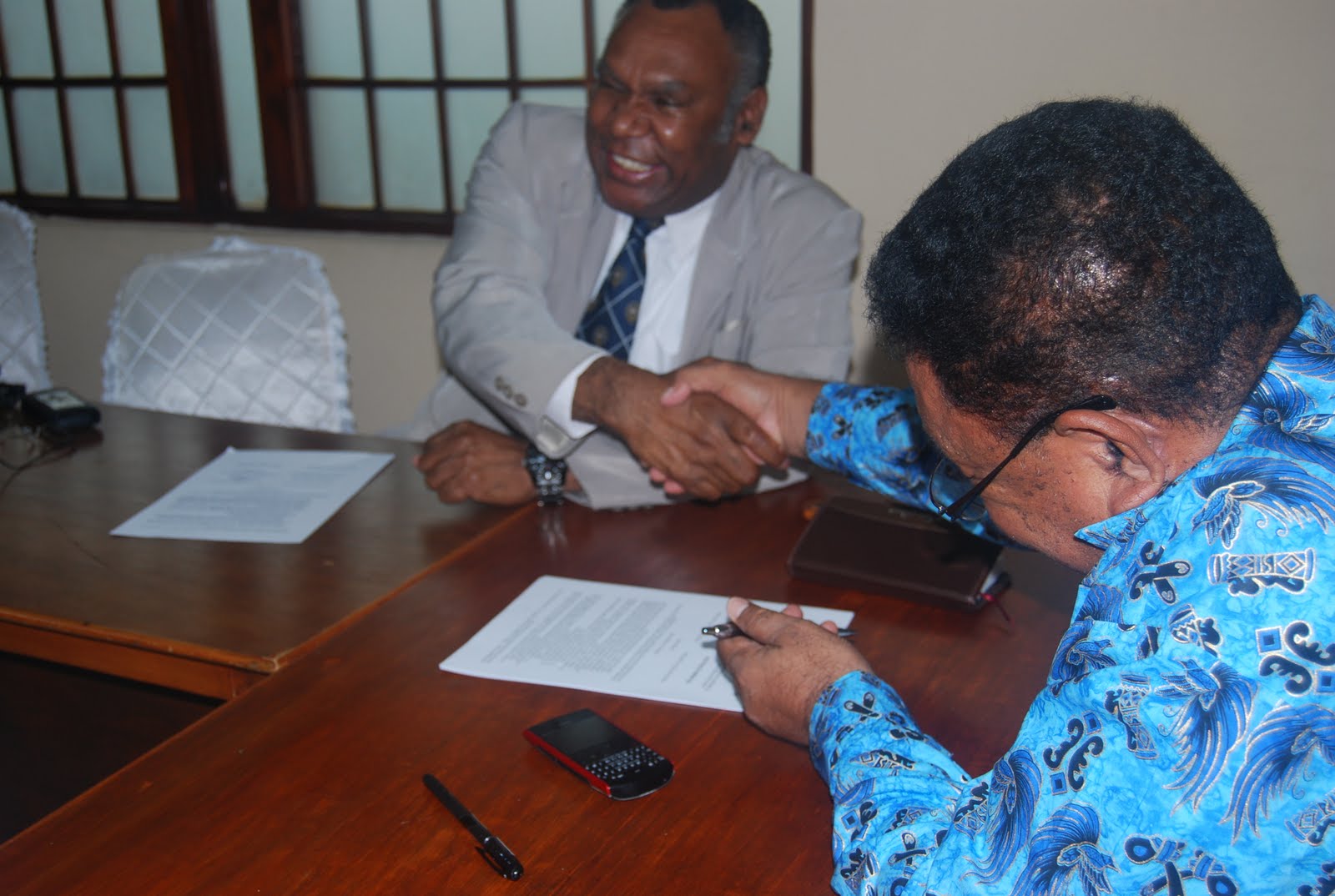
They prayed and shook hands after signing the seven-page letter. They spent most of their time in the office of the Communion of Churches in Indonesia on Salemba Street, Jakarta. It has a Papua Desk dedicated solely on helping Papuan churches doing their businesses in Jakarta. Rev. Phil Erari, a Papuan priest, an environmentalist and a board member at the Communion of Churches in Indonesia, also attended the signing event.

Rev. Benny Giay, chairman of the Kingmi Gospel Tabernacle Church, spent days to discuss the letter with his colleagues. Giay is also an anthropologist educated at the Vrije University in Amsterdam. When meeting Giay, President Susilo Bambang Yudhoyono, himself a Ph.D, asked Giay in what field he wrote his Ph.D thesis. ©Frederika Korain
Rev. Martin Luther Wanma, chairman of the Indonesian Christian Bible Church, gestured to Rev. Socratez Yoman when signing his letter. Rev. Wanma is based in Manokwari unlike the other three church leaders with their offices in Jayapura.©Frederika Korain


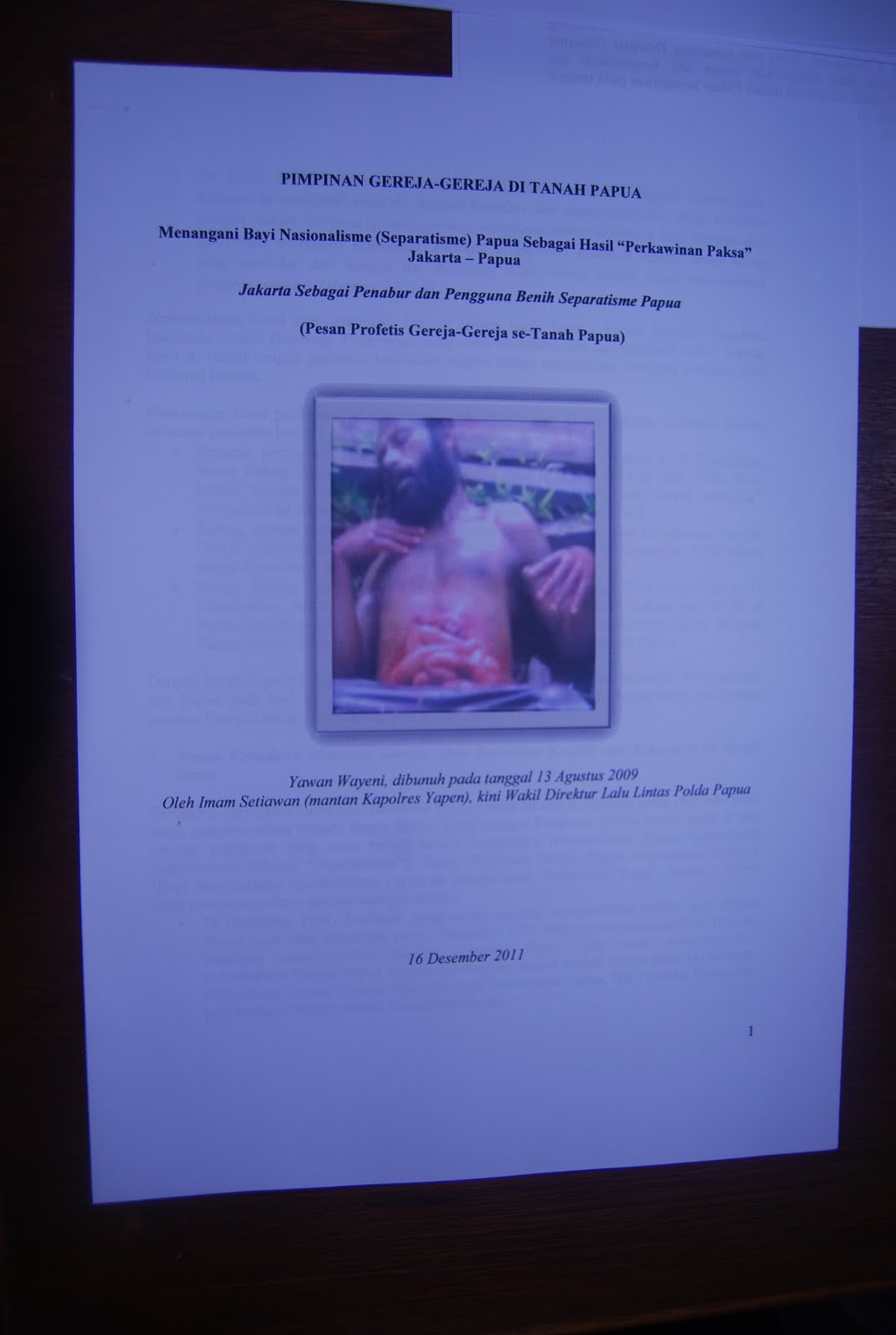
The seven-page letter has the picture of a dying Papuan freedom fighter, Yawan Wayeni. It says that Indonesian police officer Imam Setiawan had killed Wayeni on Aug. 9, 2009 on Serui Island. Setiawan got a promotion. He became the police chief of Jayapura. On Oct. 13, 2011 he led the use of excessive force to crack down the Papuan Congress after one of the leaders read out the 1961 Papua Declaration of Independence. Setiawan is now the deputy director of traffic management at the Papuan police department.

Shoot to kill threat over defiant Papuan flagraisers

THURSDAY, DECEMBER 1, 2011

IN the aftermath of October’s brutal crackdown by Indonesian police on the Third Papuan People’s Congress, local pro-independence committees have organised mass civil resistance in most towns across West Papua to commemorate its 50th anniversary of Independence, tragically cut short by Indonesia’s invasion in 1963.

The banned symbol of West Papua’s independence, the Morning Star flag, will be raised in provocative actions that occupying Indonesian security forces have deemed as an act of rebellion, and have threatened to shoot to kill anyone participating.

Flagraising ceremonies are scheduled to be held in almost twenty centres across Papua and West Papua provinces, including Jayapura, Wamena and Timika.  Massive shows of force have been reported from Indonesian forces to prevent local people from taking part in planned events.

Tensions are high across the Bird’s Head Penninsula of West Papua as hundreds of  paramilitary police (Brimob) seconded to the area exchanged gunfire with local units of National Liberation Army (TPN) and conducted heavy handed searches of homes and villages.

Shots were exchanged from 3pm local time on November 29 in the farming and gold panning village of Markus Eduda between Brimob personel and the village based unit of the National Liberation Army (TPN), led by Jhon Yogi. An estmiated 300 Brimob personel, who are not usually based in the area, are currently stationed in the western villages of Dagouto, Pasir Putih and Bibida.

On November 30 Indonesian soldiers were stationed at the location in the nearby city of Nabire nominated as the venue for a peaceful “praise and worship only” commemeration ceremony, with no flag raising.

Other previously unreported events in the area include escalating fear in villages, since combined military and police forces opened fire in the village of Madi Paniai on August 15, 2011.

Local human rights workers say that since the August shooting, residents of Madi Paniai and the neighbouring villages of Ugi, Weya and Aga have been living in fear, especially people who had fled to the area from other parts of Papua because of its relative safety.

They added that armed personnel were searching homes, rummaging through people’s belongings supposedly looking for sharp tools, and confiscating needles, knives, shovels, arrows and machetes.

They added that the continued presence of the police and military forces and the intimidating and invasive searches were causing widespread distress and prompting people to move to other villages.

According to latest reports the residents of Dagouto, Muyadebe, Uwamani and Badauwo have fled, deserting the villages.

Massive troop buildup

Around Jayapura, several thousand Papuans are expected to attend the 50th anniversary celebrations in Sentani, at the grave of slain independence leader Theys Eluay, who was murdered by Kopassus special forces officers in 2001.

Negotiations with police are still ongoing to allow a gathering and prayer fellowship after organisers were prohibited to raise the Morning Star  At time of writing, Permission had still been refused by Jayapura Police to allow any gatherings.

Local sources have described urban centres across Papua as being like cemetaries with people staying off the streets whilst security force personnel are conducting shows of force.

In Manokwari, a prayer vigil and flagraising is planned together with a nonviolent mass demonstration, but statements from hardline leaders from the guerrilla National Liberation Army (TPN/OPM) have threatened to play into hands of Indonesian security forces planning a crackdown on flagraisers.

On Wednesday night, Manokwari was described as a “Blood Danger Zone” by organisers of independence celebrations after Richard Jouweni, a commander of the TPN,  declared he would use violence against security forces to ensure the banned Morning Star would fly.  Indonesian military commanders in Manokwari have prohibited local organisers from carrying out flagraisings, however these calls are likely to be defied.  The location of the ceremonies are still unknown, while civilians in nearby villages have already started arriving in Manokwari town centre for the events.

Concerns are mounting of significant bloodshed in Serui and Waropen.  Papuan and Indonesian media and human rights workers have reportedly been barred from the centres off the north coast, and the head of police has issued warnings to anyone engaging in political expression.  The police chief in Serui, Daniel Pryo Dwiatmoko, Kepala Kapolres (+6282198480889, +6282198683246) said on November 29 in a interview on Radio Republic Indonesia “If Papuans wish to talk about independence of a nation-state, find another place to talk… We will permit no event regarding flag raising, if there is, its shoot to kill on sight”.

This statement is an eerie echo of Ali Murtopo, the architect of Suharto’s military takeover of West Papua, who in 1969 told the 1025 imprisoned delegates to the contentious Act of “free” Choice – the disputed process by which Indonesia took over West Papua – “We do not want you Papuan’s, we just want your land.  If you want a country of your own, you can go to the moon.  Vote for Indonesia,’ or we will cut out your accursed tongues”.

In Nabire and Biak, prayer gatherings will take place instead of flag raising due to fear.

In Merauke, on the edge of the Torres Strait, 1600 troops from the Indonesian army were airdropped down on November 29,  and unconfirmed reports have filtered through of flagraising actions near the vast Merauke Integrate Food and Energy Estate.

The Australian trained Indonesian special force unit Kopassus is also deploying significantly across Papua to crackdown on peaceful free expression.  Confirmed reports from disgruntled Kopassus sources to West Papua Media are describing 213 troops (2 companies) being deployed in Keerom and Jayapura, and another two companies  of Kopassus have been deployed in Yakuhimo regency in the Highlands.  Local human rights sources have described these Kopassus groups as “waiting around for a chance to crackdown”.

International media and human rights organisations are banned from Papua by Jakarta, however close monitoring of the situation is occurring through international media in conjunction with citizen media sources.

The Australian Government, while deepening ties with the Indonesian military despite widespread international condemnation of it’s human rights abuses, claimed to West Papua Media that Australia and Indonesia regularly exchange views on the situation in Papua.  According to a spokesperson for the Australian Foreign Minister Kevin Rudd, “The Australian Government closely follows developments in the Papuan provinces … and encourages all concerned to act with restraint”.  No mention was made of the need for Indonesian forces to allow peaceful political expression to occur without escalation.

West Papua Media will be monitoring this developing situation closely, and encourages other journalists to maintain close contact with us. 

Mpur Peoples and development: a film by Mnukwar


with support from DownToEarth

This new film explores the views of the Mpur community, West Papua, on development plans for their region which will affect their land, livelihoods and culture.

[vimeo http://vimeo.com/32076025]

Mpur Peoples and Development from Down to Earth on Vimeo.

About Mnukwar: bringing about change through film-making

Armed with medium-size video cameras and other film-making paraphernalia when they are out and about making films in different areas of West Papua, the Mnukwar crew often attracts local people’s attention. Knowing their background in environmental activism, some people think they are just showing-off with expensive gadgets and their interest will wane once the novelty wears off.

Set up in 2007 by several environmental and social justice activists, Mnukwar (a type of the Bird of Paradise as well as the name of the old capital of Manokwari) focuses on facilitating change through making film. Mnukwar staff are not too bothered by such cynical comments because the target for Mnukwar is not the film itself.

Being grassroots activists, the Mnukwar crew are very much aware of the urgent need for local people to be able to express themselves freely and without fear of intimidation. For many years, Papuans have been living under the threat of being stigmatized as rebels, making communications  with communities difficult. Communication, as the communities know from previous experience, can sometimes mean interrogation.

Mnukwar uses a variety of methods to build a rapport with a community, including showing other films to villagers as a way of introducing what can be done in film. More often than not, once a rapport is built, curiosity about the gadgets and the process of film-making itself overcome people’s anxiety about talking. Then people start to engage.

Working with people is never easy. On a number of occasions, villagers have turned NGOs away from carrying out any activity in their place because, based on past experience, ‘NGOs do not keep their word’, ‘NGOs are good at taking data but never share it with the villagers, let alone giving anything back or being accountable for what they do’, ‘ NGOs who come to villages with short-term or one-off projects with no future perspectives only make villagers confused’.

Mnukwar has learned a great deal from others’ experiences. At the beginning of any programme, Mnukwar always tries to make it clear that they are not organisation which provides grants or income generation projects, but a group of people who are attempting to facilitate learning about peoples’ rights and citizenship through film-making. During the film-making, the Mnukwar crew works closely with the people involved, to avoid the situation where the people are only the object of the film. Knowledge is reproduced in film format and the people are consulted. Film is also a powerful form of communication and an important means of learning in a society where interest in reading is very low.

Films about Climate Change

Through various work and activities on the issue of climate change, the Mnukwar crew has learned that climate change is not a phenomenon that is easy to capture on film. When asked straight questions such as “what is climate change or what signs of climate change have you observed?”, people are puzzled. Climate change is simply a foreign idea.  The observations about climate people can share are about the inconsistency of the seasons and the impact of this on their livelihoods.

What about ‘global warming’ and ‘climate justice’? For many communities, these are just sound bites with little meaning.

There is a long way to go before we will be able to see people in Papua linking global phenomena to their day-to-day living. And yet, it is never too late to learn and one can start using whatever tools are to hand. This is the principle of Mnukwar in making-film too: there is no need to wait until you have the proper equipment, which is often expensive, to make a film. The Mnukwar crew have been teaching people how to use any media able to record moving images, such as a simple mobile phone, to create a film. Empowering people does not need to be expensive.

Website: www.mnukwar.or.id

LP3BH: Police and army chiefs must be held responsible for attacks on Papuan Congress participants

Statement by Yan Christian Warinussy, executive-director of LP3BH/Manokwari

The attack by members of the Indonesian Police/Polri  and the Indonesian Army against partiipants at the Third Papuan People’s Congress on  19 October was a gross violations of human rights because it was perpetrated against ordinary civilians who were unarmed  and were not involved in any acts of resistance.This is abundantly clear from video which I and the LP3BH-Manokwari have in our possession and which have been shown to  government officials and members of the European Parliament as well as to members of the German Parliament last week in Berlin.

The videos clearly show that the attacks that were launched by members of Polri and the TNI were acting under the command of the chief of police in Papua and in Jayapura. There were no acts of resistance whatever by members of the public or by any of the participants at the Congress, including members of the special defence group for the Congress, the PETAPA.

The videos also show a number of persons in civilian clothing, wearing short pants and shirts  who are clearly intelligence agents of the police and the army, who can be seen holding  pistols as well as rifles and who can be seen firing their weapons into the air, and even show some members of the security forces firing in the direction of the large crowd of people who were running away towards the mountains or to places in Abepura, in fear of their lives.

The discovery of six dead bodies following the tragedy of the Third People’s Congress is a clear indication of the use of ammunition being aimed against the mass of people.

As a human rights activist in the Land of Papua, I saw no actions aimed at dispersing the people or attempts to prevent chaos. The Congress was already over and  one hour later, members of the security forces who were under the command of  Police Commissioner Imam Setyawan SIK can be seen trying to prevent a  vehicle which was driving along Jalan Yakonde with the lawyer Edison Waromi on board, which  was damaged by the security forces who pulled the people of the vehicle and started beating them and then pushed them into a  police van to be driven to police headquarters where they are now being held in custody.

Following the arrest of Waromi, the security forces starting firing their weapons and chasing participants of the Papuan Congress as they were leaving the location of that event.

I herewith, as Executive Director of LP3BH/Manorkwari and a human rights defender in the Land of Papua, urge Komnas HAM, to investigate the matter and to bring formal charges against the Papua chief of police and the police chief in Jayapuara, as well as the commander of the 1702 military command in Jayapura  who were in command of the operation to be held fully accountable for the bloody incident that occurred on 19 October 2011

Create a website or blog at WordPress.com

Up ↑