Indonesia conducts more culpable targetting of leading Papuan politicians

 PRESS RELEASE – FEDERATED REPUBLIC OF WEST PAPUA

1 May 2012

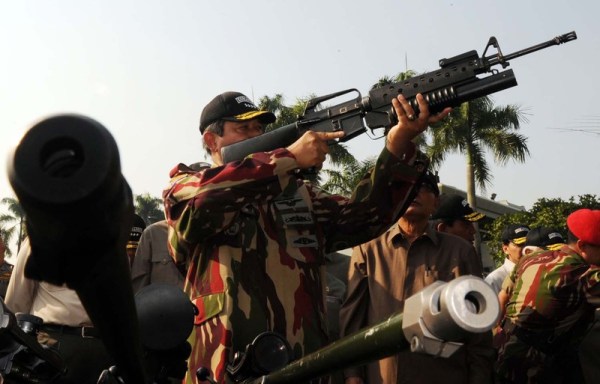
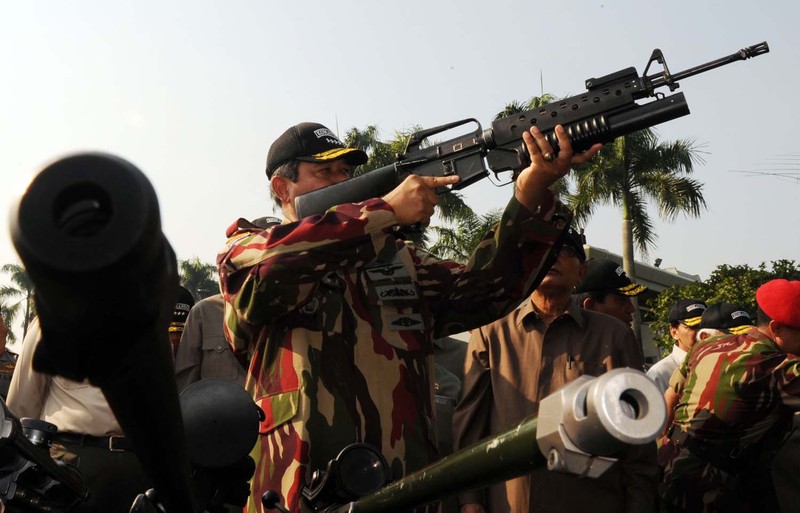
The Indonesian Republic’s top-level intelligence of its special forces (KOPASSUS) held a secret meeting in Manokwari on Friday 27 April 2012 to finalize plans for the kidnapping and assasination of key leaders of the Federated Republic of West Papua.

The leak shows those named for elimination as President Forkorus Yaboisembut and Prime Minister Edison Waromi.  Other listed are Aluis Aso and Sius Ayemi; Hendrik Warmetan, Edison Kendi and Daud Abon from Serui;  Markus Yenu and Billy Auparay from Manokwari.

At its inauguration on 19 October 2011, the Federated Republic of West Papua outlined its intention—and policy—of charging politicians as well as military commanders for war crimes.

Today on 1 May 2012, in non-violent rallies across the territory, the Republic is demanding concerted action by the Netherlands, the United States, and the United Nations in down-grading the level of Indonesian militarism and governance in West Papua.

Head of Police in Serui Regency, Roycke Harry Langie S.IK MH, refused permission for the Federated Republic of West Papua to hold its rally, even while citing rights under Indonesian regulation No. 9/1998 concerning free speech in public spaces.

“The Police Commander’s order not only violates Regulation No. 9, but also Article 28 of the Indonesian Constitution 1945” said Jacob Rumbiak.

“The Indonesian government is jammed between the political sophistication of the Papuan Republic and the Australian, American, and British governments fiscal support for its Special Autonomy projects” he added.

Interviews available (English, Indonesian) – Please contact West Papua Media

(West Papua Media has spoken with Markus Yenu, one of those targeted, and he has confirmed that he has personally seen the intelligence documents, and is fearful for his safety.)

Rallies calling on Ban Ki-Moon to protect Papuans to be held across Papua and Australia, on March 19

Reprinting Press Release 19 March 2012 from FRWP spokesperson

 
RALLY:  Federated Republic of West Papua
TUESDAY, 19 MARCH 2012, 11:30am-1:30pm
State Library, 328 Swanston St (cnr Swanston and La Trobe Sts), MELBOURNE
complementing rallies in Jayapura, Sorong, Biak, Yapen-Waropen, Manokwari, and Fak Fak
West Papuan independence advocates are questioning the UN Secretar
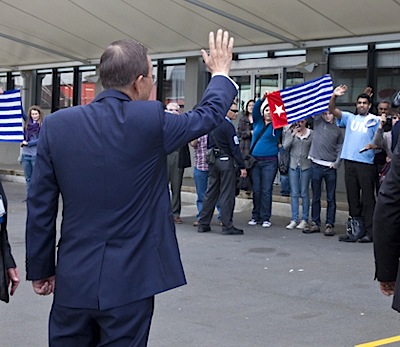
Ban Ki-moon waves to protestors for West Papua, PIF NZ Sept 2011
y-General’s presence—as a keynote speaker—at The Jakarta International Defence Dialogue, hosted by the Indonesian Ministry of Defence on 21 March 2012.
“We would like Mr Ban Ki-moon to attend to our defence while he’s in Jakarta” said Herman Wainggai, the West Papuan independence advocate based in the United States.
“The Indonesian government brands us as separatists, and then hosts international fora to escalate support for what it says are ‘non-war military operations’ against us”.
Forkorus Yaboisembut, President of the Federated Republic of West Papua, currently incarcerated, requests the Secretary-General to recognise the leadership of the Federated Republic of West Papua elected at the Congress in October in 2011.
“The United Nations recognizes West Papua’s right to self-determination, and is therefore responsible for organising properly constituted peace talks, with itself mediating between the Federated Republic of West Papua and the Indonesian government.”
Edison Waromi, Prime Minister of the Federated Republic of West Papua, also incarcerated last week for another three years (he was also a political prisoner 1989—1999, 2001, 2002, 2003-2004) says the Secretary-General must actively insert himself into the West Papuan issue.
“The 564,126 missing Papuans since 1962, more than half-a-million people, should galvanize UN intervention.  And I believe the Secretary-General should also, while visiting Jakarta’s new Peacekeeping Centre this week, negotiate the release of all political prisoners in Indonesia.”
Many international observers believe that Indonesian political fears, that their republic will dissemble in the face of West Papuan self-determination, is misplaced.
“Holland didn’t fall over when Indonesia became independent, and neither will Indonesia when we do” said Wainggai. “Bali principles, Lombok treaties, Peace centres in West Java….these are all meaningless while Indonesia continues to escalate its troops and its judiciaries against us”.
Media Inquiries and Interviews
Please contact West Papua Media for direct contacts on the ground in the follwoing locations:
MELBOURNE, SORONG, BIAK, YAPEN WAROPEN, MANOKWARI, JAYAPURA , and FAK FAK.
PLEASE NOTE: RALLIES TO ALSO BE HELD BY WEST PAPUA NATIONAL COMMITTEE (KNPB) ACROSS PAPUA AND INDONESIA: DETAILS FORTHCOMING

Rallies reject Indonesian status quo in Papua, and demand referendum

This slideshow requires JavaScript.

February 22, 2012

By Nick Chesterfield at WestPapuaMedia.info with local sources

Thousands of people took part in peacful rallies across West Papua on Monday, February 20,  rejecting attempts by Indonesia to impose new development policies on Papua, and demanding an internationally supervised referendum as the key step towards solving the Papua problem.

The rallies, organised by the West Papua National Committee (KNPB), took place in Jayapura, Biak,  Manokwari, Timika, Nabire, Wamena, Yakuhimo and Merauke.  According to initial reports, all rallies remained peaceful despite standard Indonesian security force threats to forcibly break up proceedings.

This slideshow requires JavaScript.

In Jayapura, a long march was held from Abepura to the offices of the Papuan People’s Assembly (Majelis Rakyat Papua or MRP) with the crowd of close to a thousand people shouting “we want referendum”; “Special autonomy has failed, why start it again”; and “We reject the dialogue between Jakarta and Papua and demand a Referendum”.

Mako Tabuni, on behalf of the KNPB, told the gathering that the the plans by Indonesian President Susilo Bambang Yudhoyono to impose a new body U4PB (or Program to Accelerate Development of Papua and West Papua) to implement the failed Special Autonomy package is not a solution to the problems in Papua and was thoroughly rejected by West Papuan people.  Only a Referendum would address those grievances, and it must be. held soon.  U4PB, with authority over all of Papua, is to be headed by former army intelligence chief Bambang Darmono, himself subject to numerous allegations of human rights abuses whilst stationed in Aceh.

Tabuni expanded: “when in Papua, there are two paths of narrow and wide roads. Papuan Special Autonomy the road is paved with a lot of money, including UP4B, but the road is narrow.  The road to independence is a wide open road, like the road to referendum being fought KNPB”.

Former Political Prisoners Yusak Pakage and Saul Bomay echoed the KNPB concerns and demanded that Indonesia just try to listen to the will of the people and stop trying to implement policies proven to have been a failure, like Special Autonomy.

The demonstrators dispersed peacefully with a promise of escalation of mass actions.

westpapuamedia

Presidential palace still fails to understand the situation in Papua

General SBY - Military approach will not solve Papua's problems

Bintang Papua, 19 February, 2012Manokwari: The holding of constructive dialogue or communications between Jakarta and Papua as mentioned by President Susilo Bambang Yudhoyono (SBY) is regarded in some circles as being part of the solution to the problems occurring in Papua.In the opinion of Mervin Komber, a Papuan member of the DPR, the Indonesian Parliament, such a dialogue should take its cue from the road map for Papua, and lead to better living conditions for the  Papuan people. According to Komber, in order to achieve this, the agenda for such a dialogue should reflect the actual conditions currently confronted by the  Papuan  people.

With regard to the leaders who should be invited to participate in such a dialogue, they should be  people with the ability to deal with all aspects of the situation, including governance, parliament, customary groups, spiritual leaders as well as including people from the ranks for ordinary Papuans who enjoy the confidence of their respective groups.

‘All of us  who are in favour of dialogue must seek to achieve something positive for Papua,’ he said in Manokwari recently.

While he supports dialogue, Komber is critical of recent steps taken by SBY in his attempts to work out the best format  for the dialogue. In his opinion, the President’s decision to ask Papuan religious leaders  for their opinion  about the format and the agenda for this dialogue was a mistake. Komber believes that the religious leaders will themselves be  part of the dialogue, which means that the President should not have discussions with them about the format of the dialogue. But the President should summon provincial and local leadeers such as members of the DPRD, the DPD and academia to get their views on the format.

Moreover, if  only some elements are asked to discuss the format, he fears that this could result in misunderstandings as a result of the various inputs received by SBY. ‘If there are disagreements between some of these leaders, the people around SBY might end up passing on erroneous information about the situation in Papua,’  said Komber  who is a former activist from the Catholic students organisation, PMKRI.

The same might also occur with regard to the final objective of the dialogue, according to Felix Wanggai, a special staff member [not clear what staff this refers to] who looks forward to seeing Papua become a zone of peace. In his opinion, this may mean that the  people at the presidential palace do not properly understand  what it is that the Papuan people want. ‘The dialogue we have in mind is only intended to accelerate development in Papue,’ he said.

Jakarta has still not take any decision about when this dialogue or constructive communication should take place. According to Komber, the Jakarta-Papua dialogue is very urgent indeed and SBY should not postpone it. He went on to say that the dialogue is closely related to the implementation of special autonomy, OTSUS which was enacted eleven years ago. This means, in his opinion, that this dialogue should take place some time before the end of 2012.

‘I very much hope  that it will take place during the course of this year because OTSUS will remain in force for only another ten years, whereas the dialogue should occur while OTSUS remains in force.’

Finally he said that as far as he is concerned, the venue of the dialogue is not  a problem . The crucial thing is that the dialogue should be inspired by the determination to achieve a long term solution for Papua. ‘The dialogue could be held in ways that accord with Papuan traditions, such as those used by customary groups, sitting in their honai, or other such places,’  this young legislator said in conclusion.

[Translated by TAPOL]

Statement from 5 Makar accused at KP3 treason trial

STATEMENT BY FIVE PAPUANS WHO WENT ON TRIAL IN JAYAPURA ON 30 JANUARY 2011[This hand-written statement is signed by the five Papuans who went on trial in Jayapura on 30 January 2012, and is translated in full by
Carmel Budiardjo, TAPOL]

Fully understanding and conscious of our basic human rights as Papuans of the negroid race, part of the Melanesian race who live in the land of the country of West Papua, inheritors from our ancestors, we herewith firmly declare  that WE FIRMLY REJECT THE TREASON TRIAL AND OTHER SUCH TRIALS that has been mounted against the five of us, and we speak on behalf our colleagues and the entire nation of the Papuan people of the Nation of West Papua.

We call for an understanding of this declaration, a declaration of independence, in accordance with the principles of PUBLIC INTERNATIONAL LAW, a law which should be lawfully accepted. And in this case, this declaration will bring us substantial  happiness if it gains the recognition of the international community.

In order to gain substantial and dignified recognition from the international community, we have requested our international team of lawyers to  notify and register  our legal status along with the question of the annexation of the TERRITORY OF THE STATE OF WEST PAPUA at the International Court, with the Secretary-General  of the United Nations, Amnesty International and all member states of the United Nations, as well as other competent authorities.

We herewith categorically state that we are not prepared to make any statements or answer any questions that are based on the laws and accusations of treason by  the Unitary State of the Republic of Indonesia, during the current trial for treason. It is very clear indeed that this is a matter between two nations and two states, that is to say, between the Papuan nation and the Indonesian nation, between the Federal State of West Papua  and the Unitary State of the Republic of Indonesia.

The following are the reasons for our rejection of the trial for treason or any such trial:

[NB: The copy of the statement which we have received jumps at this point from page 2 to page 4 which suggests that the copy we have is incomplete.]

1.    Our struggle and the struggle of those who have gone before us and the nation of West Papua  and all members of the Papuan people up to the present day is a struggle for the restoration of independence and sovereignty of the Papuan Nation as one of our most basic political rights.

2.    Bearing in mind that the Unitary State of the Republic of Indonesia annexed and continues to annex, the people and nation of the Papuan people since the TRIKORA command which was proclaimed by the former president of Indonesia, President Sukarno on 19 December 1961 in the city of Jogyakarta and which was followed up by  the Indonesian military, from 1962 to the present day, by a variety of measures aimed at preserving the annexation.

3.    Our struggle is not aimed as damaging or destroying any country in the world.

4.    We do not intend to damage or destroy the Unitary State of the Republic of Indonesia.

5.    We feel that our dignity has been defiled, that our basic political  rights have been violated in our country, West Papua, which we inherited from our ancestors.

6.    No one, for whatever reason, has the right to make accusations against us or to convict us in a treason trial or any such trial. This is because we have become the subjects of our own laws  as citizens of the nation and state of the Federal Republic of West Papua.

7.    Based on the values of basic human rights, of democracy and the following universal laws:

a. The  first article in the Preamble to the1945 Constitution  of the Republic of Indonesia.
b. Article15 of the Universal Declaration of Human Rights of the United Nations adopted on 10 December, 1948.
c. Article 1, para 1 of the Covenant on Civil and Political Rights adopted as UN Resolution 2200 (xxi) which has been in force since 23 March 1976,.
d. The Declaration on Granting of Independence to Colonial Countries and Peoples in UN Resolution 1514 (xv) on 14 December 1960.
e. The basic principles of decolonisation , namely possidetis juris and the legal succession of the state to the colonial territories  of the  Dutch East Indies (Dutch Papua) since 19 October 1961.
f. ILO Convention No. 169, 1989 on the Rights of Indigenous and Tribal People.
g. The UN Declaration on the basic rights of indigenous peoples of 13 September 2007.
h. The Papuan Independence Manifesto of 19 October 1961 adopted by the Papuan National Committee.
i.  Stipulations adopted by the Grand Congress (MUBES) of the Papuan people in 2000.
j. The Eleven Recommendations of the Second  Papuan Peoples’ Congress and Indigenous Papuan People  in 2010.
k. The decisions of the Second Papuan Peoples Congress in 2000.
l.  The decisions of the Third Papuan Peoples Congress of 2011.

8.    The Statement by the Indigenous Papuan People and the Papuan people is a truth based on analytical and practical categories. The analytical category means that the indigenous P apuan people are the Papuan nation, a negroid race of the Melanesian race, located in the South Pacific. Whereas the practical category is a political statement which was enunciated in the Manifesto of Papuan Independence of the Papuan National Committee on 19 October 1961 in Hollandia, the State of West Papua.

9.     We democratically restored the independence and sovereignty of the Papuan people on 19 October 2011, at the Third Papuan Peoples  Congress with the establishment of the Federal Republic of West Papua  which was announced by the DECLARATION OF THE PAPUAN NATION IN THE STATE OF WEST PAPUA.

10.    The government of the Republic of Indonesia and the governments of all other members of the United Nations, should without discrimination recognise and respect the democratic processes of the Papuan people at the Third Papuan Peoples Congress on 19 October 2011 in the form of the Declaration of the West Papuan Nation and State.

11.     The application of the treason law against the Papuan people must be categorised as a violation of the basic and legal political rights of the Papuan nation.

We hereby call on to the Honourable Judges in this forum to annul the trial held in order to accuse us of TREASON and make similar charges against us. The solution to the independence of the Papuan nation which is our most basic political right must be sought by means of international mechanisms between the Federal Republic of West Papua and the Unitary State of the Republic of Indonesia, mediated by the United Nations.

In order to regulate the transfer  of sovereign powers from the Unitary State of the Republic of Indonesia to the Federal Republic of West Papua, we intend to initiate a new phase of cooperation  based on the principles of democracy,  justice, peace, mutual respect and dignity. As is customary between independent and sovereign nations and states on Planet Earth.

Herewith our statement of REJECTION OF THE TRIAL BEING HELD TO ACCUSE  US OF TREASON AND SIMILAR CHARGES.

Jayapura, 30 January 2012

Signed:

1. Forkorus Yaboisembut, President of the Federal State of West Papua.
2. Edison G. Waromi, SH, Prime Minister of the Federal State of West Papua.
3. Agust M. Sananai Kraar, SIP,human rights activist/staff
4. Selpius Bobii, activist/staff
5. Dominikus Subarat, activist/staff
Create a website or blog at WordPress.com

Up ↑