Wikileaks – US Government blames Jakarta for unrest in West Papua

Article by Philip Dorling and Nick McKenzie
Link to article in The Age

THE United States fears that Indonesian government neglect, rampant corruption and human rights abuses are stoking unrest in its troubled province of West Papua.

Leaked embassy cables reveal that US diplomats privately blame Jakarta for instability and “chronic underdevelopment” in West Papua, where military commanders have been accused of drug smuggling and illegal logging rackets across the border with Papua New Guinea.

A September 2009 cable from the US embassy in Jakarta says “the region is politically marginalized and many Papuans harbor separatist aspirations”. An earlier cable, from October 2007, details claims by an Indonesian foreign affairs official about military influence in West Papua.

“The Indonesian official] claims that the Indonesian Military (TNI) has far more troops in Papua than it is willing to admit to, chiefly to protect and facilitate TNI’s interests in illegal logging operations,” says the cable, obtained by WikiLeaks and made available exclusively to The Age.

“The governor … had to move cautiously so as not to upset the TNI, which he said operates as a virtually autonomous governmental entity within the province,” the cable says.

It notes that because the allegations are coming from an Indonesian official rather than a non-government organisation, they “take on an even more serious cast”.

A 2006 cable details a briefing from a Papua New Guinea government official who said that the armed forces were ”involved in both illegal logging and drug smuggling in PNG”.

In another cable from 2006, the US embassy records the reaction of Indonesian authorities to a riot in West Papua that left four officials dead. “While the gruesome murder of three unarmed policemen and an air force officer at the hands of angry mob is unconscionable, the authorities’ handling of the aftermath has merely added a new chapter to the history of miscarriages of justice in Papua,” it says.

“It is clear that the police rounded up a miscellany of perceived trouble-makers and random individuals and that the prosecutors and judges then railroaded them in a farcical show trial.”

Cables from throughout 2009 blame the Indonesian government’s neglect of West Papua – including the failure to ensure revenue generated by mining is distributed fairly – for continuing unrest. “Most money transferred to the province remains unspent although some has gone into ill-conceived projects or disappeared into the pockets of corrupt officials,” a September 2009 cable says.

”Many central government ministries have been reluctant to cede power to the province. As a result, implementation of the [Special Autonomy] law has lagged and Papuans increasingly view the law as a failure.”

The Special Autonomy Law was introduced by Jakarta in 2001 in a bid to dampen the push in Papua for independence, to address past abuses in the region, including by the Indonesian military, and to empower local government entities.

While the US embassy cables detail some improvements in the conduct of the Indonesian military and police in the region in recent years, several cables also detail serious misconduct.

The US cables also record allegations of corruption involving local officials.

After NGO Human Rights Watch released a report last year alleging that military officers had abused Papuans in the town of Merauke, the US embassy in Jakarta wrote that the incident was isolated and may have involved soldiers following orders from local official Johanes Gluba Gebze.

“An ethnic Papuan, Gebze presides over a regional government where allegations of corruption and brutality are rife,” the 2009 cable says. It quotes advisers to Papua Governor Barnabas Suebu saying Gebze is ”out of control” and has made numerous illegal forestry deals with Chinese and Korean companies.

In early 2006, a senior manager of the Papuan mining operation run by US minerals giant Freeport-McMoRan privately told the embassy that “rampant corruption among provincial and regency officials has stoked Papuans’ disenchantment”.

Freeport is the biggest taxpayer in Indonesia and its mine is frequently and, according to the US embassy, unfairly accused of acting unethically. According to a March 2006 cable, a senior mine official said that “average Papuans see few benefits from the royalty and tax payments by Freeport and other extractive industries that should go to the province under the Special Autonomy law … This corruption hurts Freeport’s image with Papuans as well.”

The documents also reveal candid disclosures by senior Freeport executives about how the company pays members of the Indonesian military and police officers who help secure its operations. The payments caused controversy after they were detailed in a 2006 article in The New York Times.

A January 2006 cable states that Dan Bowman, Freeport Indonesia’s senior vice-president, said the “main allegations about direct payments by the company to military and police officials are true but misleading … the military and police did not have institutional bank accounts into which Freeport could deposit funds, so they were forced to make payments directly to the commanding officers responsible for security at the mine.”

An April 2007 cable says that Freeport continues to pay “voluntary support allowances” to police who help protect the mine, although does so using safeguards to prevent the money being corruptly diverted.

In October 2007, Freeport officials told the embassy that police who guarded the company’s mine were being bribed by illegal miners, who the company says are responsible for environmental damage.

“Freeport officials allege that the illegal miners have bribed Mobile Brigade officers to allow their activities. They also charge that Mobile Brigade personnel sell food and other supplies to the miners.”

West Papua human rights defender arrested by police

West Papua human rights activist Sebby Sambom has been arrested by police at Sentani Airport in Jayapura yesterday morning. He was on his way to a meeting with the Asian Human Rights Commission.

Sebby was released from prison last year after serving 1 year of a 2 year sentence following a legal glitch. He has since been living in hiding after him and his family received death threats.

It is not clear what offence he is alleged to have committed. Witnesses said he was in the boarding lounge of the airport when Indonesian intelligence officers and police arrested him.

In other developments, police last night shot dead Miron Wetipo at Abepura Prison leading to a riot by prisoners. High profile political prisoners Filep Karma and Buctar Tabuni have now been moved to Papua police hearquaters from Abepura prison by police. There are reports of intimidation towards remaining prisoners.

Situation tense in Jayapura as police and military launch operations

Report from KNPB, Jayapura

I inform you directly from Jayapura West Papua that the people of West Papua is now on emergency under Indonesia military forces. Until this night TNI (the national army of Indonesia) and Police are still blockading every places in Abepura. I got accurate information from my people near Tanah Hitam that Indonesian military shot dead a farmer at Abe Gunung when this man was in garden. One man namely Miron Wetipo shot on 6.18 PM this afternoon and his body was in Bhayangkara Hospital.

Last night on 03.00 AM Indonesia military forces destroyed all of the West Papua people’s houses near Abe gunung and arrested 2 man. One of them was a shepherd. From the morning till this night police and TNI arrested people without any reasons. According to the witness, they are looking for Dany Kogoya. He is an activist and also advocate for the OPM and TPN.

According to Danny’s neighborhood, TNI and Police intentionally put the gun and bullet near the Danny’s house to publish out that it was Danny’s gun and bullet so that they could carry out everything they want.

Here is the name that were arrested:
1. Ev. Yesmin Yikwa
2. Yupiter Tabuni
3. Tenius Yikwa
4. Manu Kogoya
5. Lambert Siep
6. Nalius Karoba
7. Yumbuk Yikwa
8. Yotan Kogoya

According to the chef of Police in Jayapura, the reason was to arrest the perpetrators of the shooting that happening some days ago. But I inform you that the Indonesian army and the police are carrying out shooting and arresting without any interrogation against them. They have intimidated, terror and tortured the civil of West Papua brutality. In fact, they are not the perpetrators. Police and TNI also were blockaded near the barracks of Uncen (Cenderawasih University).

Tonight, many shooting sounds are still continue.
Victor F. Yeimo
The international Spokesperson for KNPB

Bintang Papua: Rejection of OTSUS intensifies DPRP should convene plenary session

[All items abridged in translation]

Bintang Papua, 1 November 2010

Rejection of OTSUS intensifies
DPRP should convene plenary session

The rejection of OTSUS, the Special Autonomy Law of 2001,  has intensified  with a demonstration outside the office of the regional legislative assembly, the DPRP calling for it to convene a plenary session to discuss  the eleven recommendations adopted recently by the MRP which included the rejection of OTSUS.

‘We declare that the OTSUS law adopted in 2001 has resulted in no significant  improvements in the living conditions of the Papuan people, and we state that OTSUS has failed.’

The chairman of Pepera PB, Selpius Bobii said that OTSUS provided for a system that sides with the Papuan people, and which protects and empowers them. But in the nine years since the enactment of the law, not a single special regulation as required under the law has been adopted. There have been inconsistencies between the attitude and the actions of the central government.

The chairman of the Customary Youth  of Papua, Wilson Uruway, presented a joint statement to the deputy chairman of the DPRP who was urged to make a statement in response. He said that all the aspirations of the people submitted to the assembly had been discussed. Those concerning the central government would be quickly forwarded to the government in the same way that the eleven recommendations of the MRP has been forwarded.

The joint statement was supported by a large number of groups and NGOs.

Hardly any of the OTSUS funds  has not been used in ways that would assist and help indigenous Papuans but had been misdirected as ‘fictive funds’. The central government was accused of thwarting the MRP at all levels of its activities, as a result of which it has be incapable of struggling for the rights of the Papuan people.

Among the indicators of the problem was the tardiness in adopting special regulations – Perdasi and Perdadus – regarding management of the administration and  for economic development. Dualism between provincial and districts administrations has occurred in their adoption of different regulations

Before demonstrating in front of the DPRP, the crowd gathered at Expo Waena, where they waited for a group from Sentani Customary Council to join them.

One speaker called on the government  to speak out against acts of intimidation, threats and killings of Papuans perpetrated by the TNI/Army and the Police.

A group led by the chairman of DAP Forkorus Yaboisembu arrived at the DPRP travelling on several trucks.

The demonstration was surrounded by two special Brimob units and members of the local police. Nevertheless, the action proceeded peacefully

—————————

Historic Papua day commemorated

Bintang Papua, 19 November 2010

19 November 1969  is a historic day for the Papuan people, a day regarded as been sacred by many sections of the people struggling for independence. On this day in 2010,  groups gathered to recall the historic event when the  Papuan issue was discussed in the US Congress, although it did not clearly stated that the US Congress fully supports Papuan sovereignty.

At a gathering held to socialise the events at the US Congress, Wilson Waimbo Uruwaya  announced that they would hold a peaceful demonstration calling for the peaceful solution of Papua’s status which was discussed by the UN General Assembly in 1969.

Wilson said that all elements of the Papuan struggle were united in their determination to socialise the results of the US Congress on which occasion, a discussion took place about crimes against humanity and the need to seek a solution to the difficult problems that were being faced by the Papuan people to the present day.

The discussions in the US Congress which had occurred for the first time have taken the Papuan people a step forward in their history of struggle.

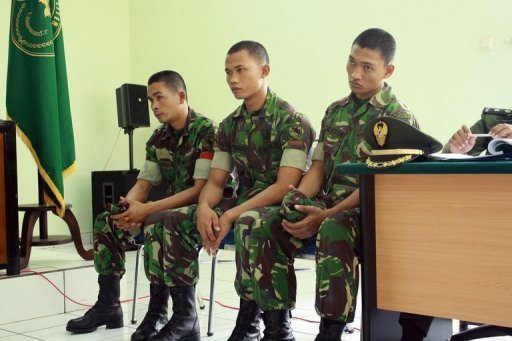
Indonesian soldiers receive 5 month prison sentences for torture that shocked the world; human rights groups label trial a ‘farce’

AFP
Indonesia on Thursday sentenced four soldiers to between five and seven months in jail for “minor disciplinary infringements”, after they were filmed abusing Papuan civilians.

The soldiers sentenced were not those filmed burning an elderly Papuan man’s genitals, but ones captured kicking a group of villagers around the head. The soldiers involved in the more horrific footage have not been located, leading to human rights groups demanding an international enquiry into allegations of widespread torture across West Papua.

A military tribunal gave three privates five months each for breaching the military code of conduct and their platoon commander seven months for allowing the abuse to occur.

“The defendants kicked the detainees’ heads and backs and hit their heads with helmets,” chief judge Lieutenant-Colonel Adil Karokaro told the tribunal in Papua provincial capital, Jayapura.

The sentences were heavier than military prosecutors’ recommendation of three months.

Critics of the Indonesian military say the case would never have gone to court had a video of the abuse, which occurred in the Punjak Jaya area of Papua in March, not appeared online.

Human rights workers labelled the trial a farce after senior military officials said it would deal with soldiers involved in the gruesome and far more serious torture of two Papuan detainees in May.

A video of the May incident also found its way to human rights workers, who released it online ahead of visits to Jakarta by the leaders of Australia and the United States, two key backers of the Indonesian military.

Indonesian President Susilo Bambang Yudhoyono promised “no immunity” for the perpetrators but no charges have been laid.

Human rights activists accuse the Indonesian military of killings, murder, torture and abuse of Papua’s ethnic Melanesian majority.

Papuan separatists have fought a low-intensity war for independence for decades, claiming that a vote by a small group of tribal elders which ceded the massive territory to Indonesia in the 1960s was a sham.

Peaceful Papuan political activists are regularly given lengthy jail terms for crimes such as possessing outlawed rebel flags. One such person is Filep Karma, currently serving a 15 year jail sentence for his part in a peaceful flagraising ceremony.

Create a website or blog at WordPress.com

Up ↑