Presidential palace still fails to understand the situation in Papua

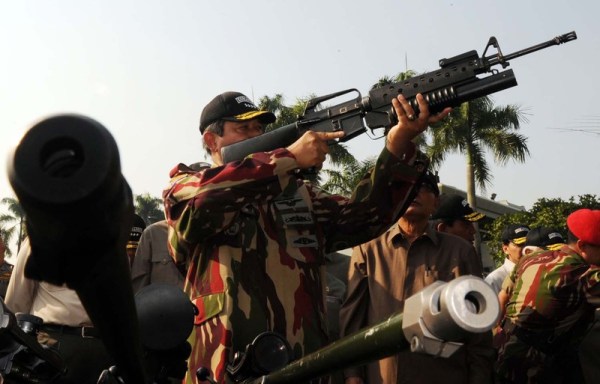
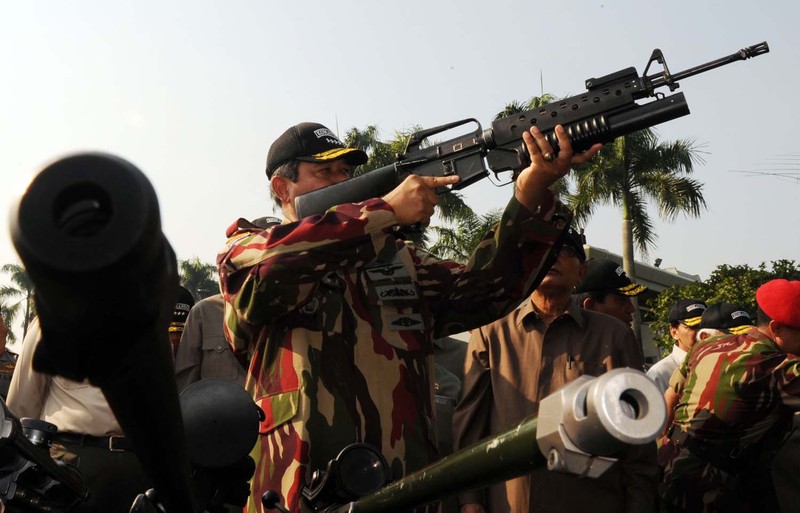
General SBY - Military approach will not solve Papua's problems

Bintang Papua, 19 February, 2012Manokwari: The holding of constructive dialogue or communications between Jakarta and Papua as mentioned by President Susilo Bambang Yudhoyono (SBY) is regarded in some circles as being part of the solution to the problems occurring in Papua.In the opinion of Mervin Komber, a Papuan member of the DPR, the Indonesian Parliament, such a dialogue should take its cue from the road map for Papua, and lead to better living conditions for the  Papuan people. According to Komber, in order to achieve this, the agenda for such a dialogue should reflect the actual conditions currently confronted by the  Papuan  people.

With regard to the leaders who should be invited to participate in such a dialogue, they should be  people with the ability to deal with all aspects of the situation, including governance, parliament, customary groups, spiritual leaders as well as including people from the ranks for ordinary Papuans who enjoy the confidence of their respective groups.

‘All of us  who are in favour of dialogue must seek to achieve something positive for Papua,’ he said in Manokwari recently.

While he supports dialogue, Komber is critical of recent steps taken by SBY in his attempts to work out the best format  for the dialogue. In his opinion, the President’s decision to ask Papuan religious leaders  for their opinion  about the format and the agenda for this dialogue was a mistake. Komber believes that the religious leaders will themselves be  part of the dialogue, which means that the President should not have discussions with them about the format of the dialogue. But the President should summon provincial and local leadeers such as members of the DPRD, the DPD and academia to get their views on the format.

Moreover, if  only some elements are asked to discuss the format, he fears that this could result in misunderstandings as a result of the various inputs received by SBY. ‘If there are disagreements between some of these leaders, the people around SBY might end up passing on erroneous information about the situation in Papua,’  said Komber  who is a former activist from the Catholic students organisation, PMKRI.

The same might also occur with regard to the final objective of the dialogue, according to Felix Wanggai, a special staff member [not clear what staff this refers to] who looks forward to seeing Papua become a zone of peace. In his opinion, this may mean that the  people at the presidential palace do not properly understand  what it is that the Papuan people want. ‘The dialogue we have in mind is only intended to accelerate development in Papue,’ he said.

Jakarta has still not take any decision about when this dialogue or constructive communication should take place. According to Komber, the Jakarta-Papua dialogue is very urgent indeed and SBY should not postpone it. He went on to say that the dialogue is closely related to the implementation of special autonomy, OTSUS which was enacted eleven years ago. This means, in his opinion, that this dialogue should take place some time before the end of 2012.

‘I very much hope  that it will take place during the course of this year because OTSUS will remain in force for only another ten years, whereas the dialogue should occur while OTSUS remains in force.’

Finally he said that as far as he is concerned, the venue of the dialogue is not  a problem . The crucial thing is that the dialogue should be inspired by the determination to achieve a long term solution for Papua. ‘The dialogue could be held in ways that accord with Papuan traditions, such as those used by customary groups, sitting in their honai, or other such places,’  this young legislator said in conclusion.

[Translated by TAPOL]

Treason Trials: Panel of judges reject demurrer by defendants

14 February 2012[Abridged in translation by TAPOL]

At the fourth hearing of the trial of Forkorus Yaboisembut and his colleagues which was held on 13 February, the panel of judges chaired by Jack Jacobus Octavianus SH announced that they could not accept the demurrer of the defendants which was submitted on  30 January, arguing that it was not in conformity with the law.

But the panel of judges failed to take into consideration the opening statement of the defendants which analysed the social, political and economic circumstances currently prevailing or the roots of the conflict in the Land of Papua at this time.

It was clear that the judges  only take into consideration  the thoughts and actions of the security forces such as the army, the police and the prosecutor and are only seeking those aspects of the law  which  restrict the right to freedom of expression of the majority of the Papuan people.

The defendants’ team of lawyers  went on to say that  the judges hearing the case are under pressure from forces outside the court of law as is clear from the fact that the head of the  Prosecutor’s Office along with the military commander of the Cenderawasih military command, the chief of police in  Papua and the prosecutor’s office  were approached prior to the hearing on 8 February and prior to the hearing held yesterday.

Our impression is, they said, that the powers that be in Indonesia  are very keenly following every aspect of the trial,  as is evident from the  extra tight security arrangements; the fact that access for the press to attend the trial  is very much restricted  while members of the public are not being allowed to enter the courtroom because it is packed with intelligence agents and members of various elements of the army and the police who are busy taking photographs and recording everything happening from very corner of the courtroom.

Forkorus, speaking on behalf of all the defendants, stood up and challenged the judges, saying that the judges will not be able to prevent him as the president of the NRFPB, the Federal Government of West Papua from reading out their rejection, a copy of which was then handed to the panel of judges

Responding to the statement of the defendants, Yan Christian Warinussy, a member of their legal team, said that the panel of judges should not at the forthcoming hearing try to restrict the defendants from expressing their views but should use those elements in the Criminal Code by simply noting the reports of the interrogations of the defendants (BAP).

The judges decision rejecting the defendants demurrer also called forth a strong statement from Yan Christian Warinussy who said that he did not agree with the viewpoint of the judges which only reflects the difference of opinion between the judges and the prosecutors and the legal team of the defendants, and he went on to say that it was wrong to say that their demurrer is not based on the law.

The team of lawyers also said that  the trial should be accessible to the international community and members of the diplomat corps in Jakarta so that they are able to follow developments in the trial.

The panel of judges then announced that the next hearing would take place on Friday, 17 February, when witnesses for the prosecution would be heard, most of whom are members of the police force which was involved in the attcks against the defendants and the mass of people, following the closure of the Papuan Peoples Conference (KRP III) on19 October last year.

Identity Politics in Papua

Unofficial Morning Star flag, used by supporte...
Image via Wikipedia

JUBI, 27 January 2012

In the days before the special autonomy law for Papua (OTSUS), identity politics in Papua was focussed primarily on culture. It was his awareness of the richness of Papuan culture that encouraged Arnold Ap to set up his Mambesak group in the 1970s. [Not to mention the fact that he paid with his life for his activities.]

Brother Budi Hernawan, a human rights activist, said that the identity politics movement  had made some progress and was in the process of further development. ‘In fact,’ he said, ‘there are certain impacts of the inconsistency of the central government’s attitude towards the identity politics movement among the Papuans.’

He said that Papuan identity politics  emerged alongside the Indonesian identity politics movement  in the 1940s. But the way of defining Papuans referred to their tendency to being slender in build, dark skinned and with fuzzy curly hair as part of the Melanesian race; this led to the stagnation of this process.  At the core of the issue is the interaction between cultural and social issues, according to Brother Budi.

Cressida Hayes writes, in the 2007 Stanford Encyclopaedia of  Philosophy, that identity politics  has a far broader definition  and the theory has a far broader definition with regard to injustices that are encountered by people in certain social groups.

Rather than their being organised on the basis of ideology or party affiliation, identity politics is related to the group’s identity and of its not being marginalised  as a group as well as the question of belonging to the group in a much broader sense.

Demographically speaking, Papuans are no longer dominant in the land of Papua.  This has been reinforced by the role of capital  and limitations within the political sphere. While procedures are set in place to ensure that the head of region is an indigenous Papuan, no affirmative action has been taken by any legislative body to protect the interests of the indigenous Papuan people.

Apart from this, he said, Jakarta always bases its policies on economics and politics.The result is that there has been no comprehensive or ‘calm’ definition. ‘The word “calm”  is used here in the sense that the Dewan Adat Papua should be able to draft a definition of Papua-ness without being accused of being separatist or accused of subversion.’

Back in the days of President Abdurrachman Wahid,  the space being given to identity politics was broadening. Gus Dur, as he was affectionately known, granted permission for the Morning Star flag to be flown, which is regarded by Papuans as a cultural symbol, while at the same time stipulating that it should be held ten centimetres lower that the Red-and-White flag. But this has never been backed up by any government regulation.

Rev Erari: Jakarta continues to violate the basic rights of the Papuan people

JUBI, 24 January, 2012

The Indonesian government’s inconsistencies in implementing a whole number of policies since West Papua was integrated as part of Indonesia have had a significant impact on the political movement of identity.  Jakarta has even continued to violated the basic rights of the indigenous Papuan people

These comments were made by the Rev. Phil Erari, deputy chairman of the Alliance of Churches in Indonesia  (GKI).

‘The special autonomy law , known as OTSUS,  is just one example of the inconsistency in its policy towards Papua,’ he said.

In Erari’s opinion, the Papuan people have virtually no confidence the authority of the Indonesian government. Papuans regard Jakarta as being incapable of introducing a number of reforms on security, health and education or mapping the infrastructure of Papua. Added to all this is the incompetence of the bureaucracy which ‘stinks of corruption’.

The politics of identity which emerged in the second half of the twentieth century was intended to enable the organisation of the masses  so as to ensure that  the mass of people can identify themselves as part of the group to which they belong. The group is generally speaking  based on the same identity of those within the group.

‘The political movement of identity in Papua  is an integral part of the people’s affirmative position which must be respected. For many years, Jakarta has failed to include this as part of the curriculum; this is an example of  the violation of the right of the Papuan people to get a decent education,’ said Erari.

Meanwhile, Kahar Nobara of Garda-P, the Papuan Democratic People’s Movement, told JUBI that Jakarta has hardly changed at all with regard to solving the Papuan problem.

‘Jakarta has taken no initiatives and its policy in most cases amounts to nothing more  that responding to incidents, nothing more than patchwork, without dealing with the root of the problem and without any radical action for change. This is not democratic, and it displays no sensitivity  whatsoever,’ said Nobara.

He went on to say, in connection with the political movement of identity, that the nationalism of the Papuan people is an integral part of their constant sufferings. Ths result of all this is that their desire for independence  and sovereignty will continue to  grow.

‘Jakarta’s inconsistencies provide the ammunition for the struggle of the Papuan people,’ he said.

It’s time for Jakarta-Papua dialogue, says MRP deputy chair

Bintang Papua, 3 January, 2012
[Abridged in translation by TAPOL]
Jayapura: ‘The new year, 2012  must be a year in which dialogue between Papua and Jakarta takes place,’ said  Hofni Simbiak, deputy chair of the MRP, during a discussion about development, the human rights situation and civil society in Papua.’As a response to the current political and ECOSOCsituation  in Papua, all sections of the people in Papua agree that 2012 should be the year in which dialogue between Jakarta and Papua should take place. This is an emergency and there should be a response from the central and regional governments,’ said Septer Manufandu. He said that if  the government fails to respond to people’s calls for dialogue, this will damage the reputation of the government in the eyes of the people.

He went on to  say that 2012s a year in which many problems must be solved through dialogue and it is up to the government quickly take the initiative, as a way of improving Indonesia’s reputation worldwide. ‘Dialogue is the only way to solve the problems in Papua and to put an end to violence.’ He also said that  the government should make an evaluation of the implementation of the development programme since the adoption of the special autonomy law (in 2001). This should include evaluating developments in education and health and to see whether this has benefited the people or Papua or not. These are matters requiring the serious attention of the government, he went on to say.

According to Hofni Simbiak, all the activities in 2011  were orientated towards projects for which  there was no financial backing because of the misuse of the funds and corruption which is widespread in the education and health sectors.

Although the government had taken action regarding the implementation of UP4B (Unit to Accelerate Development in Papua and West Papua), the MRP des not agree with this programme. As far as they can see, a lot of money has been spent but this has not had any significant impact which has resulted in the people losing confidence in the government. As long as the Papuan people are not themselves the object  of all the development, this will continue to be a problem from year to year and could be a time bomb. This also applies to the UP4B, which could create big problems in 2012.

According to Septer Manufandu, the failures in human rights problems as well as political problems and ECOSOC had intensified in 2011 so much so that the government could be charged with failure on these issues as well as its failure to deal with the issues of education and health.

Create a website or blog at WordPress.com

Up ↑
