WEST PAPUA: ABC report raises questions for region’s leaders

by Alex Perrottet / Pacific Media Watch

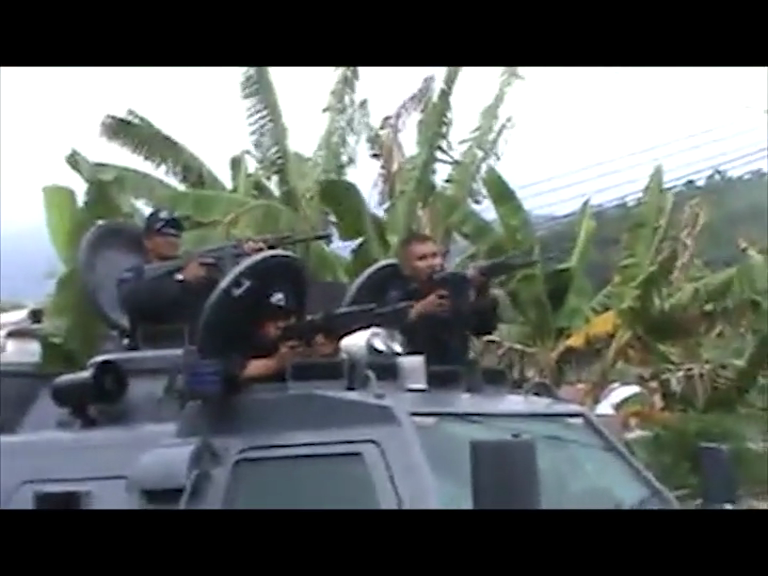
A photo provided to West Papua Media Alerts after the violence at the Abepura dormitory yesterday. Photo: West Papua Media Alerts

Wednesday, August 29, 2012

Item: 8075

AUCKLAND (Pacific Media Watch): Fresh allegations of human rights violations in West Papua implicating Australia on ABC’s 7:30 Report series this week have opened up multiple questions for leaders at the Pacific Islands Forum on Rarotonga.

As new reports have emerged from West Papua Media Alerts of new violence at a school dormitory in Abepura, the 7:30 Report series – screened on Monday and Tuesday nights – shone new lights on the ongoing accusation that the Australian government is responsible for the training and financing of the anti-terrorist group Detachment 88, or Densus 88, as it is known in Indonesia.

The group was originally trained to combat terrorism in Indonesia following the deadly bombing in Bali in October 2002, which claimed 88 Australian lives.

But in recent months media reports have spread, mainly from West Papua Media Alerts, that the anti-terrorist group was being deployed in the provinces of Papua and West Papua, supressing insurgents as well as peaceful demonstrators.

Presence confirmed
The ABC interviewed Constant Karma, who is the secretary of the province of Papua. He said: “I don’t really know about West Papua but in the Papuan Police (Polda Papua) there [is] also Detachment 88 on duty.”

Apart from the reports from within West Papua by reporters Hayden Cooper and Lisa Main, ABC presenter Leigh Sales put questions to Australia’s Foreign Minister Bob Carr, who confirmed the Australian government had raised its concerns with human rights abuses in the two West Papuan regional provinces as recently as earlier this month.

Senator Carr said the Australian training included training in respecting human rights, but the ABC reports featured a number of eye-witnesses to violence in West Papua at the hands of police as well as Detachment 88 troops, including in the recent killing of independence leader Mako Tabuni.

Senator Carr told the ABC: “We train Indonesians in counter-terrorism. We do that because it’s in Australia’s interest. We do it because we want the Indonesians to have a strong, a formidable, anti-terrorist capacity. It is absolutely in Australia’s interests that we have this relationship.

“But we don’t train them in counter-insurgency – it’s counter-terrorism.”

‘No distinction’
However, the ABC also sought comment from the Australian Federal Police, which made this admission in their responses:

“Detachment 88 is a specialist counter terrorism unit within the Indonesian National Police, however it should be noted that Indonesian law does not differentiate between terrorism, separatism and insurgency.”

In response to the reports, political parties and human rights groups have released statements urging leaders at the Pacific Islands Forum to take notice.

The West Papua National Coalition for Liberation, based in Vanuatu, said the violence was nothing new.

“Violence has always been Indonesia’s policy regarding the land of Papua over the past 49 years. Being an occupying power, violence is their only means of enforcing their authority in the Papuan society,” said spokespersons Rex Rumakiek, Dr John Ondowame and Andy Ayamiseba.

“For almost half a century since Indonesia annexed West Papua, our people have been subjected to terror and trauma.”

Political reaction
The Democratic Labor Party in Australia said the situation was “genocide happening on our doorstep”.

Senator John Madigan and Democratic Labor Party federal secretary Mark Farrell said: “Indonesia is not being transparent with the Australian people or the Australian government.

“It is difficult to understand how the government of a democratic country like Australia can ignore the oppressive behaviour of a neighbouring country.”

The Green Party of Australia also voiced their concern, with Senator Richard Di Natale drawing comparisons with East Timor.

“Australians are now becoming more aware of these atrocities being committed on their doorstep,” he said.

“They know what happened in East Timor under Indonesian rule and they know that we, as a nation, cannot sit idly by while it occurs again in West Papua.”

Joe Collins of the Australian West Papua Association said the PIF should take up the Indonesian government’s offer to encourage research and balanced journalism by sending a fact-finding mission from the Forum.

He also encouraged Pacific leaders to raise the matter with Australian Prime Minister Julia Gillard.

“The Leaders’ retreat is supposed to provide an opportunity for private and frank discussions at the highest level and we hope that the PIF leaders will question Julia Gillard on Australia’s involvement in the training of Detachment 88 which is accused of targeting West Papuan activists,” he said.

“We also hope that concern for the situation in West Papua will be mentioned in the official Forum communiqué”.

The Democratic Labor Party statement also argued for observers to visit.

“If Indonesia is seriously expecting us to believe it is not engaged in the oppression of the West Papuan people then they must allow human rights observers and international journalists in to the country.”

The West Papua National Coalition for Liberation is pushing for more, calling on the Melanesian Spearhead Group, the PIF, as well as the US, the UK, the European Union and others “to sponsor a resolution at the UNGA(United Nations General Assembly) to re-inscribe West Papua on the UN List for Decolonisation.

“We also call on MSG and PIF to admit the West Papuan Independence Movement as an observer of these bodies as a sure way of encouraging peaceful solution to the conflict.”

One confirmed dead
The violence in Abepura yesterday was confirmed by West Papua Media Alerts, who reported one student being killed, and others badly wounded.

The news agency said the violence was carried out at the Liborang Asrama (dormitory) by a joint force of Army (TNI) and Police.

“The students were allegedly targeted because they come from the same tribal group as many members of the West Papua National Committee (KNPB), who have been consistently engaging in peaceful civil resistance in protest at the increasing terror tactics of the Indonesian security forces, which has escalated significantly since May 2012.”

West Papua Media Alerts confirmed today that 35 people had been arrested and 11 remained in custody after being subjected to beatings and torture.

The Indonesian embassy in Canberra, in response to questions from the ABC said the government was taking action.

The statement said the loss of life “is regrettable and is receiving attention from the Indonesian people, the media, and the President of the Republic of Indonesia himself”.

“The Indonesian government has taken steps to restore law-enforcement in the Papuan provinces.”

Just how it is doing that is the focus of the media attention that West Papua is receiving, and as in previous years, the Pacific Islands Forum is so far remaining silent on the issue.

Police torture students after brutal attack on Abepura university dormitory

Scores beaten, arrested, tortured and injured in major raid by Indonesian Police, Army and allegedly Australian Funded counterterror unit Detachment 88 on Yakuhimo Dormitory at Cenderawasih University, Abepura.

by West Papua Media

August 28, 2012

URGENT CORRECTION: Despite robust processes of cross-checking, armed attacks by security forces on civilians sometimes creates confusion on casualty figures.  NEW information has come to hand in the clear light of day, and two confirming witnesses have retracted their confirmation early Wednesday morning.  Only 1 person, Yalli Walilo, is confirmed dead, and he died after being set upon by a group of men believed to be transmigrants or plain clothes intelligence.  The other two victims were part of the group that received significant torture at the hands of police, but it is now NOT independently confirmed if these people are dead or severely injured.  More info as it becomes available.  West Papua Media apologises for the distribution of erroneous information.

(Jayapura)  Brutal scenes occurred at a highland students dormitory in Abepura early on Sunday night (26 August) as a massive assault was carried out on  students from the Liborang Asrama (dormitory)  by a joint force of Army (TNI) and Police.

The students were allegedly targeted because they come from the same tribal group as many members of the West Papua National Committee (KNPB), who have been consistently engaging in peaceful civil resistance in protest at the increasing terror tactics of the Indonesian security forces, which has escalated significantly since May 2012..

1 person been independently confirmed by West Papua Media sources as killed, and at least two are believed but not confirmed to have died from torture wounds inflicted in custody by police, according to human rights sources.  35 people were arrested, and 11 people remain in custody at time of writing undergoing significant and brutal beatings, and acts of torture.

This slideshow requires JavaScript.

Independent human rights sources have alleged that the torture has been carried out by members of Detachment 88, the counter-terror unit funded, armed and trained by the Australian Government, however West Papua Media has not been able to verify this, although D88 has been present at every other dormitory raid this year.

According to credible witnesses the trouble began when a man named Yalli Walilo (26) was calling a friend in front of a shop and the Indonesian transmigrant owner of the shop came and angry him.  Walilo replied to  the colonist “what is my problem, i just want to buy (a) cigarette”.  He then sought refuge at the house of Ms. Nehemia Mabel, a member of the Majelis Rakyat Papua (Papuan People’s Assembly), 5 metres from the shop.  Walilo then tried to go home, when he was brutally set upon by a group of Indonesian transmigrants with one killing him, and more people again came to kick him until he was dead.

The exact circumstances of how police came to be involved is still unclear, but after Walilio’s killing, the Kepala Desa (neighbourhood chief) came and took his body to the Limborang dormitory.  Police were alerted by the Kepala Desa amid confusing allegations surround the death of an elderly man who died from a heart attack.  It is unconfirmed if these deaths were related.

At around 10 pm, Some of Walilo’s friends at the dormitory went to investigate the commotions at the shop, but were ambushed by the large group of transmigrants outside the shop.  The students retreated to their dormitory, known also as the Yakuhimo Asrama as large numbers of Yakuhimo highland students live there.

One hour later, Police and many troops arrived en masse at the dorm and attacked boarders without negotiations, and also severely beat of minors.  Independent witnesses have claimed that men in masks were also present.

Victor Yeimo, KNPB Chairman, told West Papua Media that many students in Asrama Liborang had “already been killed, intimidated and terrorised under Indonesian police troops yesterday (27/08). This morning, I have been in the place and I found how Indonesian police kill and intimidate them. I was there while some of them arrived from Papua Police in Jayapura and we have interview some victims and the chief (spokesperson) of the Students”.

According to Yeimo many police and troops began attacking the Asrama Liborang with tear gas and water cannon (fire hoses?)  inside at 11.00 PM on Sunday night.  Police stormed the building and smashed up facilities inside and arrested, and tormented the students, according to both Yeimo and other independent witnesses.

Yeimo alleged that the “Police talked to them and relate them (make threats to them) about the killing of Mako Tabuni (on June 14) . Police blamed them as being friends of Mako Tabuni.”

On Tuesday evening, Australian ABC television program “7.30 Report” aired an investigation into Mako Tabuni’s killing by Detachment 88, and the intensifying repression of peaceful political free expression by West Papuan activists seek an end to violence and impunity, and a referendum on the disputed territory’s future.  The Australian Foreign Minister, Bob Carr, has conceded Detachment 88 is being used on non-violent activists, and has claimed it is acting outside its mandate.

The victims names (at time of writing) are confirmed as:

1. Alex Sambom (Fractured Skull by police. Strangled around neck with metal chains. and repeatedly electrocuted in custody, in critical condition)
2. Usman Ambolon ( Killed after beatings in the head with lacerations and severe contusion)
3. Petru Lintamon ( Police kicked his eyes and head, shot dead with gun)
4. Yaton Lintamon ( Police beat him to death with rubber mallet)
5. Septinus Kabak (Fingernails removed with pliers at the police office)
6. Orgenes Kabak (Beaten severely in stomach, internal injuriess)
7. Awan Kabak (Police stabbed him with bayonets in the leg and thigh)
8. Other Victims to still be identified

More photos, video and information as it becomes processed/translated and available.

westpapuamedia

AMNESTY STATEMENT: Security forces block peaceful demonstration in Papua

AMNESTY INTERNATIONAL
PUBLIC STATEMENTIndex: ASA 21/031/2012
10 August 2012

Indonesia: Security forces block peaceful demonstration in Papua

Amnesty International calls for an independent and impartial investigation into reports that police used unnecessary and excessive force to disperse a peaceful demonstration in Papua province commemorating International Day of the World’s Indigenous People on 9 August 2012.

If the investigation finds that the security forces committed human rights violations, then those responsible, including persons with command responsibility, should be prosecuted in proceedings which meet international standards of fairness, and victims provided with reparations.

At least seven people were arbitrarily arrested during and after the demonstration and are being held at the Yapen District police station. They should be released immediately and unconditionally if they have been arrested solely for the peaceful exercise of their right to freedom of expression.

Police Mobile Brigade (Brimob) and military from the 1709 District Military Command (Kodim) led by the Yapen District Police Chief blocked hundreds of peaceful protesters as they marched on the morning of 9 August 2012 in Serui, Yapen Island.

According to local sources, the Indonesian security forces then fired their guns into the air to disperse the protesters, causing many to flee in fear. At least six protesters were arbitrarily arrested during the demonstration and some were reportedly beaten by security forces during their arrest. The police then travelled to Mantembu village to arrest one of the demonstration organizers, a local political activist. When they could not find him they arrested his wife, who is reportedly eight months pregnant.

The actions of the security forces fly in the face of statements made by President Susilo Bambang Yudhoyono in February 2012 that he wanted an end to repressive actions by the military and police in Papua.

The rights to freedom of expression and peaceful assembly are guaranteed in Articles 19 and 21 of the International Covenant on Civil and Political Rights (ICCPR), to which Indonesia is a state party. Moreover, these rights are protected under Indonesia’s Constitution. However, Amnesty International has documented dozens of other cases of arbitrary arrest and detention in past years of peaceful political activists in Papua.

Amnesty International continues to receive credible reports of human rights violations committed by the security forces in the provinces of Papua and West Papua, including torture and other ill-treatment, unnecessary and excessive use of force and firearms by the security forces and possible unlawful killings. Investigations into reports of human rights violations by the security forces are rare and only a few perpetrators have been brought to justice.

During a 2008 gathering to commemorate International Day of the World’s Indigenous People in Papua, peaceful demonstrator Opinus Tabuni was discovered dead with a bullet wound clearly visible in his chest, after police opened fire at the crowd. Despite a police investigation, to date no one has been held to account for his death.

Is Australia funding Indonesian Death Squads? Densus 88 in West Papua

Statement by the West Papua Project, Centre for Peace and Conflict Studies, University of Sydney, 16th July, 2012

Questions are being asked about the role that the partly Australian funded
and trained elite Indonesian police squad, Densus (Detachment) 88, has
played during the recent violence in West Papua. Set up in the wake of the
Bali terrorist bombings, Densus 88’s mandate was to tackle the rise of
domestic terrorism in Indonesia. Australian support might have been
motivated by revenge as well: 88 Australians were killed in the Bali attack.
While acclaimed for capturing or killing known and suspected terrorists,
Densus 88 also gained a reputation for extreme violence: many suspects being
killed rather than arrested. Now reports are suggesting that Densus 88 is
operating in West Papua, possibly clandestinely, and has been responsible
for the assassination-like killing of Papuan political activist, Mako
Tabuni, on June 14.

Detachment 88 troops firing live rounds at civilians during the brutal crackdown on the Third Papuan People’s Congress, October 19, 2011 (West Papua Media video still)

While Indonesian National Police spokesman, Saud Usman Nasution, has denied
Densus 88 is operating in West Papua he has left the door open for their
involvement, saying in the Jakarta Globe on June 27, “Densus will be
deployed if terrorism occurred there.” However other reports, for instance
from Kontras Papua, a local human rights organization, state that Densus 88
is already operating in West Papua “carrying out undercover activities”
(Cenderwasih Pos, June 23). Kontras Papua believes that Densus 88 was
involved in the Tabuni killing – where the victim is reported to have been
standing in the street eating betel nut when three unmarked cars pulled up
nearby. With no provocation a person emerged from one car and shot the
victim dead.

Police report that the victim had tried to snatch a weapon from the
plainclothes police involved and was killed in the resulting fracas. Police
also claim that Mako Tabuni was wanted for a series of shootings that had
occurred in Jayapura over the previous few weeks: a claim that seems
unlikely given his role as Deputy Director of KNPB (the West Papua National
Committee), which is a non-violent political organization. Tabuni had also
been publicly calling for an independent investigation into the recent
shootings of which he was accused. Nonetheless, any charges should have been
heard in court and given due legal process, now impossible with Tabuni’s
death. Other reports of Densus 88 activities in West Papua have come from
respected Papuan leaders. Reliable sources observed Densus 88 police arrest
KNPB member, Zakeus Hupla, in the lobby of the Dhanny Hotel, Entrop,
Jayapura, on the morning of June 23. Other reports indicate further arrests
of KNPB members by Densus 88 and their subsequent torture. According to
family members, no arrest warrants were issued by Indonesian police for
these arrests, and the Jayapura police deny that the KNPB members are in
their custody. Indeed it is unclear if these men have been arrested,
abducted or ‘disappeared.’

These events are of genuine interest and concern to Australia because
Australian taxpayers’ money is spent training and maintaining Densus 88.
This organization has a legitimate role to play in countering the rise of
terrorism, but it should act strictly within its organisational mandate. If
Australian taxpayers are indeed partially funding a clandestine force
involved in killings, abduction and torture of Papuan activists an
unacceptable situation has developed. These events and allegations must be
comprehensively investigated and all funding for Densus 88 frozen until
either the allegations have been disproved or the individual police officers
guilty of crimes arrested and tried in an open court. We call on the
Australian government to immediately halt the funding of Densus 88, to
investigate the claims of its misconduct, and to apologise to the Papuan
people if they are proven to be true.

Act of Terror perpetrated against the President of the Alliance of Baptist Churches

Report from Matius MuribAt around 7.30pm, on Thursday 6 July,  a group of four policemen from the elite force Brimob, Papua District, stopped the car in which the chairman of the Baptist Synod, Socrates Sofian Yoman was travelling, together with his wife and their three children, along with Matius Murib, the former deputy chairman of Komnas HAM-Papua. They were on their way home after attending prayers at Kota Raja Luar.The car door was forced open by someone, and another member of Brimob shone a torch.in the face of Revd Yoman.

Matius Murib said: ‘Why have you stopped here? Who are you? Who are you working for? If you aren’t happy about the police, dont behave like this.’

Murib later told the media that apparently they had been followed since they were driving past the town library. The police who had been travelling in a truck pointed their torch at Yoman.

In response to this unacceptable behaviour, he said: ‘I’m sorry. It wasn’t deliberate.’  But within five minutes, the police started pushing the body of this man who is  a well-known church leader, while shouting at him.

Matius Murib  thought that the  police didn’t realise that they were  talking to the President of the Synod of the Baptist Church, Revd Socrares Sofian Yoman.

At this point, a senior police officer arrived at the scene to caution the police who were terrorising the President of the Synod. They subsequently withdrew and returned to their barracks.

Matius said that this incident would be reported to the deputy police chief in Papua. ‘Go ahead and report. We aren’t afraid ‘  the four policemen replied. They then withdrew  from the scene and left, going in the direction of the police command office in  Abepura.

Matius Murib said that he hoped that  the chief of police would investigate this case and call to account the four police officers who had behaved so arrogantly  towards a well known leader of the Papuan people. The action they had taken was a deliberate act of provocation intended to arouse the feelings of the Papuan people.

‘We call for an end to such acts of terror and violence perpetrated against the indigenous Papuan people.The Papuan people will continue to press for peaceful dialogue  between Jakarta and Papua.’

Matius Murib, Director

[Translated by TAPOL]

Create a website or blog at WordPress.com

Up ↑