Victor Yeimo and others arrested as police crackdown on December 1 protests in Jayapura

By West Papua Media, with Victor Mambor at TabloidJubi.com, and Julian Howay at SuaraPapua.com

December 2, 2012

UPDATED DECEMBER 3, 2012

Three leaders of the West Papua National Committee (KNPB) who were detained at a West Papuan independence rally on December 1 have been allegedly disappeared by Indonesian security forces, prompting fears of ill treatment at the hands of police.

As reported earlier by Tabloid Jubi and West Papua Media, Victor Yeimo, Alius Asso and Usman Yogobi were arrested by Police while leading a long march enroute to a planned mass rally commemorating the West Papuan “Day of Independence” of December 1st  at the tomb of Theys Eluay. All three were arrested for allegedly being responsible for these demonstrations, according to Police who spoke with Jubi.
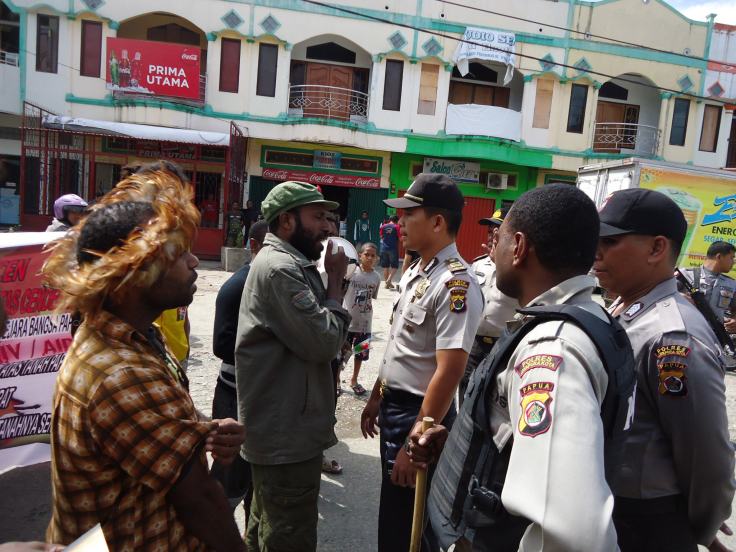
Victor Yeimo, Chairman of KNPB, negotiating with Kalpores Alfred Papare moments before his arrest, December 1, 2012, Abepura (Photo: WK, KNPB)
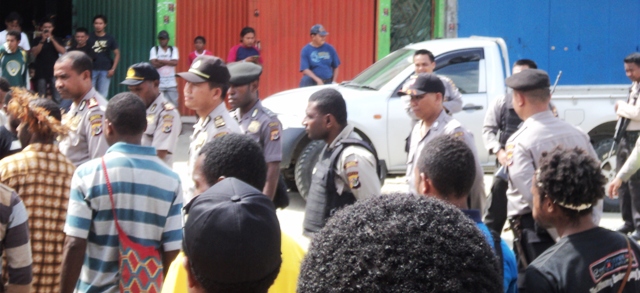
Indonesian police prevent KNPB demo; arrests of Victor Yeimo (Photos: West Papua Media stringers)

This slideshow requires JavaScript.

KNPB members and human rights lawyers are currently trying to confirm his whereabouts and legal status, however Indonesian police have claimed to West Papua Media that all detainees being held at the Police headquarters.  Legal access has not been allowed at time of writing and human rights observers hold grave fears for the safety of the detainees.

Yeimo-ditangkapVictor Yeimo, KNPB Chairman, has been on a wanted list (Daftar Pencarian Orang or DPO) and has up to now evaded a massive Papua-wide manhunt by the Australian trained Detachment 88 counter-terror unit, allegedly on treason charges imposed after his appearance on the Australian ABC 7.30 Report where he presented evidence of the Densus 88 assassination of his predecessor Mako Tabuni.

However, after the arrests, the whereabouts of Victor Yeimo, Alius Asso and Usman Yogobi remain unknown until time of writing, with no indications if they still being detained or have been released by police.

“Yes. There are journalists who say that Victor (Yeimo) was released earlier. But we do not know where he is. KNPB members are still trying to find him. Their mobile phone (three KNPB’s members were arrested) was (switched) off.” Sebby Sambom, a Human Rights Activist, told tabloidjubi.com on Saturday afternoon (1/12).

Some human rights lawyers who commonly accompany Papuan activists also still looking for them (Victor Yeimo, Alius Asso and Usman Yogobi). Because when they checked into the both of Police Office (Polda and Polresta), human rights lawyers was told by police that no one was arrested after rally this morning.

“We had been to the police office, Polda and Polresta, but they (Victor Yeimo, Alius Asso and Usman Yogobi) were not there. Police said no one was arrested there (Police and Police),” said Olga Hamadi, a Papuan human rights lawyer.

Papua Police Head of Public Relations, Chief I Gede Sumerta Jaya confirmed to tabloidjubi.com, mention that the three activists will be released after the investigation at the Police Sector office of Abepura.

“After being interrogated in Abepura police station, according to the police chief, three of them will be released as they could not to do any further investigation.” said I Gede Jaya Sumerta.
However, West Papua Media twice contacted the Police Sector (Polsek) headquarters in Abepura this (Sunday) morning, where an officer named Mas Arbi claimed that Yeimo and the other prisoners were still in custody.   Officers immediately volunteered further information on the second phone call that “none of the prisoners have been tortured,” despite West Papua Media having not yet asked that question.  WPM has not been able to independently verify the claims of police, as legal representation is still barred from seeing Yeimo.

Massive security presence

The December 1 commemorations in Jayapura were amongst national mobilisations in most centres across Papua, and solidarity gatherings internationally.

Reports from Abepura early in the morning described a massive security presence to prevent West Papua people from engaging in peaceful acts of free expression, and from engaging in flagraisings of the Morning Star flag, the Indonesia-banned West Papuan independence flag.

Unknown persons had blockaded the entrance to the Cenderawasih University (UNCEN)  by welding iron crossbars and erecting a 2 metre high steel fence around the university in anticipation of events.

From 7.30 on Saturday morning, students and activists with KNPB leaders (including Yeimo) gathered in small numbers by the site of former KNPB head Mako Tabuni’s murder, in front of the Perunmans 3 Housing Complex in Waena, where many highland students are domiciled.

Intelligence officers and plain-clothed Densus 88 personnel posing as ojek (motorcycle taxi drivers) become more aggressive towards participants converging prior to the long march, according to West Papua Media stringers and SuaraPapua.com.

At 0845 three platoons of heavily armed Dalmas riot police arrived on site, followed by Jayapura police chief Adjunct Senior Commissioner Alfred Papare and his men.   Papare began negotiations with Yeimo on the route and plan of action for the day, which was to make speeches and a prayer service at the tomb of slain Papuan leader Chief Theys Eluay, to commemorate December 1 and also World AIDS Day.

Participants carried many banners also demanding that the Indonesian government do more to combat HIV/AIDS, which is taking a heavy toll on Papuan society, in a situation that many Papuans believe is a deliberate policy by Jakarta of neglect and genocide.

Kapolres Papare asked the students to not go to Eluay’s tomb as he “could not be held responsible for anything that happened outside his Jayapura jurisdiction”, according to our stringers.  Having heard the explanations and assurances from the students who accompanied Victor Yeimo (KNPB Chairman), police chief Papare then left the scene and ordered the Jayapura Police Dalmas riot police officers to leave the Perumnas 3. After negotiation, the students resumed speeches for the next 1 hour.

The march began slowly from Waena, passing an Indonesian army (TNI) post about 50 meters from the housing complex, which was packed with military personnel moonlighting as taxi drivers, and several platoons of heavily armed TNI on guard, who rang a warning bell as students ran past.

According to reports from Suara Papua, the march was blocked by dozens of police officers from Jayapura Police at the corner near Dian Harapan Hospital (RSDH) in Waena. forming a three layer formation blockade. The first layer is riot police, while the second and third layers are heavily armed police, who were supported by large numbers of plainclothes police who parked their motorcycles and cars nearby.

Yeimo’s Arrest

Yeimo told police through a megaphone that more students were joining them to continue the journey to Sentani.  The Police Head of Operations AKP Kiki Kurnia ordered participants to  disperse, but students refused the order to move on.  Kiki Kurnia then advanced toward Victor Yeimo and seized him violently.  Yeimo did not resist as Kurnia gave the command to capture him and a large number police descended on Yeimo, violently immobilising him as Yeimo, Julian Douw and Usman Pahabol were thrown into the Dalmas truck and taken away, according to witnesses.

According to an Australian counter-terrorism source operating in Indonesia, who securely contacted West Papua Media on December 3 on condition of anonymity, the “gentleman holding Yeimo’s left arm” during his arrest, “is a Densus 88 officer”.
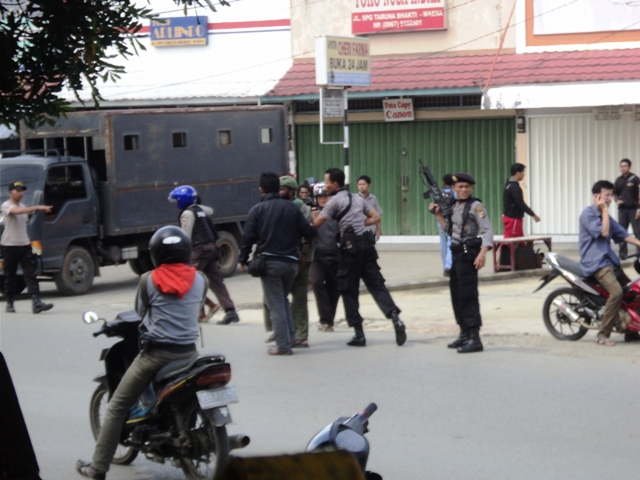
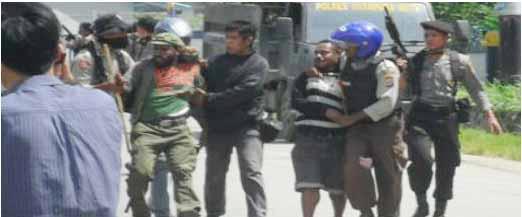
Victor Yeimo's arrest on December 1 (Photo: West Papua Media/KNPB)
Victor Yeimo’s arrest on December 1 (Photo: West Papua Media/KNPB)

Yeimo-ditangkap

The source elaborated that this individual received training from the Australian Federal Police run Joint Centre for Law Enforcement Co-operation in Jakarta.  West Papua Media has been unable to independently verify the source’s claims with police in Jayapura, nor with Australian Federal Police, before updating this story.

Just as the three were taken away, at about 11 am outside Dian Harapan Hospital (RSDH). police violently dispersed the remaining group of students to disperse them, firing tear gas and six live warning shots into the air. A number of students were also beaten by police, according to witnesses.

Soldiers from the TNI post also joined in the pursuit of students who were forced to flee via alleyways between homes, most running back in the direction of the Perumnas 3 dormitories, and all the armed police began raids again.

According to reports from Suara Papua, dozens of students desperately sought shelter inside the UNCEN Campus, where they were funneled into a dead end by police, back at the locked front gate, though they managed to escape for the time being.  KNPB sources have reported that several students sustained injuries from beating, but this has yet to be independently verified.

However, unconfirmed reports to West Papua Media overnight have said that the police, allegedly backed by Densus 88 personnel, have been conducting brutal raids on student dormitories and highlander’s residences across Jayapura.

It is confirmed that at 1235 local time Densus 88 raid occurred on the KNPB office in Sentani an hour later, seizing laptops, Morning Star flags and the United Nations flag.  No reports of injuries or arrests were received during that raid.

More to come.

West Papua Media

A History of the Morning Star Flag of West Papua

by Leonie Tanggahma for West Papua Media

Historical Analysis

December 1, 2012

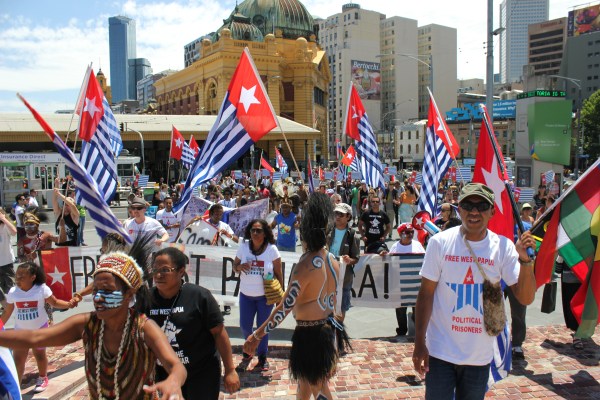
West Papuan Morning Star flags flying at Federation Square, Melbourne (Australia), December 1, 2012.  (Photo: West Papua Media)
West Papuan Morning Star flags flying at Federation Square, Melbourne (Australia), December 1, 2012. (Photo: West Papua Media)

For more than 50 years, the Morning Star Flag has been the symbol of West Papua’s unity and its quest for Freedom and Justice. Thousands have been inspired by it, as it became the main icon embodying the struggle for Independence. And this flag, just like any other flag of any other country, has a history, a proud history.

5 April 1961: Inauguration of the New Guinea Council

On 5 April 1961, a representative body for the then Dutch colony of Netherlands New Guinea was inaugurated: the New Guinea Council or Nieuw Guinea Raad[1] [1]. It was the task of the Council to make the wishes of the Papuan people known on the issue of self-determination, within a year. However, news came that the United States of America and Indonesia were putting pressure on the Dutch  to convince them to transfer its colony to the United Nations, and then to the Indonesian administration. The members of the New Guinea Council immediately gathered for an emergency session and appointed a National Committee to draft a Manifesto expressing the wishes of the Papuans which would include national symbols for the upcoming State.

19 October 1961: Flag and other national symbols officially adopted by way of Manifesto

Committee members Bonay, Jouwe, Tanggahma and Torey were asked to submit designs for the flag and arms. Mr. Torey withdrew and a choice had to be made between the designs of Messrs. Bonay, Jouwe and Tanggahma. The designs of Mr. Jouwe were accepted by 14 votes to 17 as national symbols.  After the national symbols were officially adopted, everyone was visibly moved and proud. According to official testimonies: “Then, all those present rose from their seat and while the emotion was clearly overtaking all those present the manifesto was read by the Chair of the National Committee, Mr. Willem Inury; it was subsequently unanimously accepted and signed by the National Committee. The attendees were then invited to also sign the manifesto … The national flag consists of a red vertical band along the hoist side, with a white [five-pointed] star in the center. Adjacent to the red band, is a series of [consecutive] blue and white lines, with a total of seven blue and six white lines.”[2]

This manifesto dated 19 October 1961 stated that: “in accordance with the ardent desire and the yearning of our people for our own independence, through the National Committee and our parliament, the New Guinea Council, insist with the Government of Netherlands New Guinea and the Netherlands Government that as of 1 November 1961,

a) our flag be hoisted beside the Netherlands flag;

b) our national anthem (“Hai Tanahku Papua”) be sung and played in addition to the Netherlands national anthem;

c) our country bear the name of Papua Barat (West Papua), and

d) our people be called: the Papuan people.”[3]

he Manifesto of 1961 may not have been an independence Proclamation, but its wording was strong and clear in relation to the will of the Papuan people to become independent, it was a declaration of intent, as it also stated that: “On that basis, we, the Papuan people, demand to get our place in the midst of other independent nations and peoples. In addition, we, the Papuan people, make our contribution to the preservation of peace and freedom around the world.”[4]

1 December 1961: Official inauguration of the flag as a territorial flag

The Dutch accepted most of the terms of the Manifesto except for the date of installation and the denomination of the flag: the inauguration of the flag happened on 1 December and not on 1 November as requested by the Papuans. The General Assembly of the UN was to hold a meeting in late November on the issue, and recognition by the Dutch of the symbols could have been interpreted as an endorsement of an independent West Papua by the Dutch Government. The Dutch did not want to provoke the Indonesians, even if it meant that the demand of the Papuans would not be heard. In terms of the denomination, the Dutch authorities recognized the new flag as a territorial flag (landsvlag) and not as national flag.

All the specifications concerning the flag and other Papuan symbols can be found in the so-called “Territorial Flag Ordinance” (or “Landsvlagordonnantie”) Number 68 of 1961. This Ordinance specifies among others that: “(1) The territorial flag of Netherlands New Guinea shall be a rectangle consisting of a vertical wide red striped at the hoist and seven horizontal blue stripes separated by six white stripes. In the centre of the vertical red stripe is a white five-pointed star, with one point pointing vertically upwards. The five points of the star shall each form an angle of 36 degrees. (2) The height and length of the flag shall bear to each other the proportion of 2 to 3. The width of the red stripe shall be two fifth of the height of the flag. The blue and white stripes shall be equal in height. The diameter of the circumscribed circle of the star shall be seven eighths of the width of the red stripe.” [5]  Another ordinance (Number 69 of 1961) provided for a national anthem for Netherlands New Guinea. Ordinance Number 70 of 1961, also called the “Administrative Order for the implementation of Section 2 of the Territorial Flag Ordinance”, stipulates the terms and conditions under which the flag is to be raised. And Section 5 states: “This Order, which may be cited as Flag Order, shall come into operation on December 1, 1961.”[6]

And so on 1 December it happened, for the first time, our Morning Star flag was raised, next to the Dutch flag; our national anthem (”Hai Tanahku Papua”) was played and sung together with the Dutch national anthem; our country was given the name of Papua Barat (West Papua), and our people were given a name: the Papuan people.

Nine years of international Fraud and Deception led by greed, racism and the total disrespect for human life

Just 18 days after the installation of the Papuan symbols, on 19 December 1961, the President of Indonesia, Soekarno, made his call for the infamous Tri Komando Rakyat (or TRIKORA), the People’s Threefold Command. On that day he called for a total mobilization of the people of Indonesia, (1) to destroy what he considered a Dutch-promoted Papuan State; (2) to fly the Indonesian flag over the territory of West Papua, which he erroneously called West Irian; (3) to prepare for war over what he called West Irian. For Indonesians this represented the so-called liberation of the territory from the Dutch. For Papuans the TRIKORA was the call for an illegal military aggression from a country which did not recognize its sovereignty. Military aggression was followed by legal deception as the Dutch and the Indonesians signed the New York Agreement of 15 August 1962, an agreement regarding the future of the Papuans but they themselves were never consulted. The Papuans were betrayed by those who signed this agreement which regulated the transfer of the administration of New Guinea to the United Nations. This administration lasted from 1 October 1962 to 1 May 1963. Then it was to be handed over to Indonesia for a period of six or seven years, after which the Papuans were supposed to freely choose, through a referendum, whether to join Indonesia or become an independent nation. Legal deception was followed by political fraud. In August 1969 the so-called “Act of Free Choice” was organized. At the time, West Papua had been under Indonesian rule for over six years: every expression of Papuan nationalism was systematically bloodily suppressed, possible opponents were arrested and tortured, punitive expeditions were carried out across the country and bombings and rocket attacks were conducted by the Indonesian army. The so-called “Act of Free Choice” itself was pure deception, fraud and deceit, a stage-managed play in which Indonesian officials selected 1026 Papuan electors who voted on behalf of 800,000 Papuans at the time. The electors were all carefully prepared for the Musyawarah: an Indonesian system of decision-making where there is unanimous agreement: 1025 Papuans finally decided unanimously that they wanted to belong to the Republic of Indonesia (one was sick that day). The normal one-man/one-vote principle usually applied for a referendum had not been respected as the Indonesians argued that Papuans were too primitive!

1 July 1971: the territorial flag becomes a national flag

In protest against the failure of the implementation of the “Act of Free Choice” the Free Papua Movement (OPM) proclaimed the independence of the Republic of West Papua on 1 July 1971.  Under Article 2 of UN resolution 1514: “All peoples have the right of self-determination. By virtue of that right they freely determine their political status and freely pursue their economic, social and cultural development.”  Another UN resolution, Resolution 1541, explains that exercising your right to self-determination means that you are allowed to choose between independence, autonomy or integration within an existing state. Since the beginning, the Papuans chose for independence; and they opted for that same option time and time again.

The Manifesto of 1961 was a declaration of intent; the Proclamation of 1971 was the realization of that intent. The proclamation stated: “With the help and blessing of God Almighty, we take this opportunity to declare to you all that today, 1 July 1971, the land and people of Papua have been proclaimed to be free and independent (de facto and de jure)”.

On 1 July 1971, the Papuans chose to take the Morning Star Flag which had been recognized by the Dutch as a territorial symbol. The Papuans decided to proclaim it a NATIONAL symbol; they did the same with the national anthem (Hai Tanahku Papua).


[1] Newspaper report. Sydney Morning Herald, 6 April 1961.

[2] Official government magazine Pengantara of 21 October 1961.

[3] Official government magazine Pengantara of 21 October 1961

[4] Official government magazine Pengantara of 21 October 1961

[5] Bulletin of Ordinances and Decrees of the Government of Netherlands New Guinea, 1961, No. 68, issued on 20 November 1961.

[6] Bulletin of Ordinances and Decrees of the Government of Netherlands New Guinea, 1961, No. 70, issued on 20 November 1961

Police chief calls on Papuans to ‘remain calm’ as 1 December approaches

Morning Star Moon Landing
Ironic Morning Star Moon Landing (Artwork: AK Rockefeller)


Tabloid JUBI

28 November, 2012

The police chief  of the district of Mimika, Jeremias Runtini has called on the people to ‘remain calm’ as1 December approaches. He said that people should act together to safeguard security and public order and should avoid getting involved in activities that tend towards subversion such as flying the Morning Star flag.

He said that to mark its anniversary, the OPM, Organisasi Papua Merdeka, the Papuan Freedom Movement, usually flies the Morning Star flag and other people join in this as well.

‘There is nothing special about 1 December,’ he said, adding that the police and the military will be patrolling the area, after mustering their men on Timika Indah Square,’ he told journalists, as 1 December approached.

He said that in anticipation of people flying the Morning Star flag, his men will be mounting patrols throughout the region of Mimika. ‘I very much hope that people will not get involved in activities that are in violation of the laws in force in the Unitary State of the Republic of Indonesia, ‘especially bearing in mind that flying the Morning Star flag is regarded as an act of subversion and is therefore against the law.’

Repeating his call for people to ‘remain calm’ and avoid doing anything that is against the law,  he called on people to support all the development activities that are being undertaken. ‘Let us join together and get involved in these development activities; I am ready to be a partner in these joint endeavours.’

He told journalists that during the three days approaching 1 December, the police will be at the top level of readiness during these three days.

‘All of us must think positively and refrain from doing anything that is in violation of the law, so as not to disrupt peace and tranquillity.’

[Translated by TAPOL]

(WPM NOTE: West Papua Media will be providing monitoring services for international media for December 1 events.  Please contact the editorial team to assist or report.  Donations are required to enable effective monitoring.)

KNPPB A Rival Organization Created By Indonesia To Compete With KNPB

by wedaumamo at KNPB News
November 17, 2012
Analysis / Opinion

Jayapura, KNPBnews – In their continuous efforts to destroy the legitimate movement of the people of West Papua who are fighting for their rights, Indonesian counter-intelligence operations have now created a rival organization called the West Papua Youth National Committee (Komite Nasional Pemuda Papua Barat, or KNPPB). The organization claims itself to be a forerunner of a self-claimed Republic of West Papua under the leadership of Yance Hembring, an agent of the Indonesian Republic.

The KNPPB, an acronym which bears a striking resemblance with KNPB, was created by Indonesia to further strike a blow at the genuine struggle for Papuan rights, led by the KNPB. The fact that Indonesia would instigate further attacks towards the good image of the political struggle of the people of West Papua was to be expected and it was also predicted. It was only a matter of time before journalists of the newspaper Bintang Papua, a number of which are mere agents of Indonesia, calculatedly published the news item concerning the establishment of this rival organ, based on information passed on by sources who are nothing more than the minions of the Unitary Republic of Indonesia (NKRI), and who have been paid to discredit the struggle of the people of West Papua, a struggle led by the KNPB and the people of West Papua.

Active monitoring of the online media shows that Yance Hembring’s group constitutes a faction of the OPM which has already surrendered to the Republic of Indonesia and which is now being used by Indonesia to influence and destroy the bases of the OPM. This faction is now also being used by Indonesia to recruit young people to destroy the KNPB by setting up the rival organ called KNPPB, in exchange for money.

The release today of this deceit by the newspaper Bintang Papua (issues numbers 14 and 15) has as main purpose to blacken the good image of the KNPB and to diminish the sympathy of the people of West Papua for the KNPB. Wim Metlama, KNPB’s National Spokesperson, said that Indonesia was resorting to the old ways of paying Papuans and Papuan newspapers in order to play their dirty political games and soiling the good image of the struggle of West Papua.

“Treacherous moves like these are not something new. These are old tricks that Indonesia has been using, but it has always been to no avail. And we are convinced that the people of West Papua are wise enough to recognise these dreadful tricks played by the colonisers. Even more so, this deceit only proves once again to the people of West Papua that Indonesia is in the habit of manipulating the truth and lying to the people, and precisely for that reason will they realise that the NKRI is truly an occupying colonial force in West Papua”, said Wim.

The newspaper Media Papua is unfortunately contributing to the spreading of the lie, by publishing the news item and disseminating the deceitful information into the public in West Papua. According to our monitoring, a month ago, Papua police chief Tito Karnavian had approached the board of editors of the newspaper Bintang Papua and he had asked them for their support for his colonial agenda. Soon, if not already, many agents of the printed media and other reporters in West Papua will be offered money in return for services to support the colonial program as Tito Karnavian has recently requested.

[Translated by LT]


LP3BH-Manokwari calls for dialogue between Papua and Indonesia

COMMENT by Yan Christian Warinussy
Executive-Director of LP3BH, Manokwari
November 14, 2012In the concluding months of 2012, there have been many more acts of violence in Papua and West Papua which reflects very badly on the government of Susilo Bambang Yudhoyono (SBY) at a time when development, good governance and security  are essential in the Land of Papua as an integral part of the Republic of Indonesia (NKRI). This is happening as a time when many countries  which are members of the UN Human Rights Council are closely watching the situation, following the  Universal Periodic Review  in May 2012, which made  180 recommendations, thirty of which were rejected by the Indonesian government.

One of the recommendations that was rejected was that arrests and detentions on the basis of Articles 106 and 110 for treason should stop. This means that the state will continue to take firm measures, possibly including the use of firearms, against peaceful actions by members of civil society who give expression to their opinions and political views which are opposed to the views of the government. Several activists of the  National Committee of West Papua (KNPB)  have been summoned and interrogated and are likely to be charged for treason. One of these activists is Alexander Nekenem, chairman of the DWP, the local parliament, who was recently summoned  by the police in Manokwari.

The Indonesian government has also rejected the recommendation regarding freedom of expression for persons who have been detained merely for taking peaceful actions, a recommendation that was made by the USA and Canada. What this means is that Filep Kara, Forkorus Yaboisembut, Edison Waromi, Selpius Bobii, Sananay Karma and Dominikus Sorabut  will continue to be deprived of their lawful right to freedom of expression.

Another very bad thing for the Papuan people is that the Indonesian government has rejected the recommendation by the Japanese government which called on Indonesia to end all violation of  human rights  by the security forces (TNI and Polri, the army and the police), because the Indonesian government claims that this is not relevant for Papua because it is not in accord with the facts, whatever they mean by the facts. In my opinion, the Indonesian government’s rejection of this means that there will continue to be an intensification of violence and hence systematic abuses of basic human rights which will continue to occur into the future in the Land of Papua.

In view of all this, as Executive Director of the LP3BH and a defender of human rights in the Land of Papua, I urge the SBY government  to open up space for dialogue  between Papua and Indonesia before the end of 2012. The SBY government should appoint a team of people to meet Father Dr. Neles Tebay, co-ordinator of the Papuan Peace Network, in order to discuss  the format of this dialogue. This would mean that by early 2013,  preparations could be started for a dialogue between the Indonesian government and the Papuan people.

In my opinion, dialogue is the best path to take, in the interests of justice, peace and dignity on both sides, as the way, according to universal standards, to resolve  the conflicting political views which have existed for such a long time, causing the deep frustration  that has borne down both on the Papuan people and the Indonesian government to this very day.

In this way, the Indonesian government would  win the respect of the international community for  having accepted that the political conflict that has lasted for such a long time should be resolved b means of dialogue.

[Translated by TAPOL]


Create a website or blog at WordPress.com

Up ↑