AHRC (INDONESIA): Delayed Criminal Code reform prolongs institutional use of torture

FROM ASIAN HUMAN RIGHTS COMMISSION

FOR IMMEDIATE RELEASE
AHRC-STM-083-2011
June 24, 2011

A Statement by the Asian Human Rights Commission on the Occasion of the International Day in Support of Victims of Torture, June 26, 2011

INDONESIA: Delayed Criminal Code reform prolongs institutional use of torture

Has the video showing military torture in Indonesia in October last year created any serious concern for torture in that country? In the video, members of the Indonesian military tortured two indigenous Papuans to obtain information about alleged separatist activities. While some of the perpetrators got a few months of imprisonment for disobeying the orders of their superior, nobody was punished for the torture committed, nor did the victims receive any compensation or medical treatment. The extreme practices shown in the video shocked the public even though numerous cases of torture had been documented by NGOs and the National Human Rights Commission for years.

Torture is frequently used by the Police and the Military to force confessions, intimidate or to obtain information. The infliction of severe pain by public officials for the above and certain other purposes is prohibited in the UN Convention against Torture and Other Cruel, Inhuman or Degrading Treatment or Punishment (full text in English, Bahasa Indonesia). This definition of torture and its prohibition also applies to Indonesia. Experts in and outside the country have repeatedly pointed out the neglect for institutional reform that the government has shown so far to effectively end this medieval practice.

Indonesia decided to ratify the Convention in 1998 and make it thus fully applicable into its legal and institutional system. While this may have appeared as a dedicated choice towards human rights, this promise from 1998 has never been kept. After 13 years, the government and parliament have failed to take even the basic key steps to end torture. As a result, torture continues to be applied.

What are the next steps to end torture? To make torture a crime! Amending the Criminal Code to make an act as defined in the international Convention punishable by law is a minimum requirement. Instead of fulfilling this requirement the government makes reference to maltreatment articles that actually only cover some parts of the problem as well as conduct guidelines for the police, which are neither promoted nor effectively enforced within the service.

Torture can be a convenient methodology for unprofessional members of the police force or the national military to “get things done”. Obtaining confessions, intimidating protesters, threatening minorities, producing quick case reports or to increase the income through bribes. Many dedicated staff in the national police, the national police commission and other related bodies have made considerable efforts to end this practice in their institutions but to support their efforts, more needs to be done.

Moreover, many see the use of torture as a legitimate and necessary mean to deal effectively with any wrongs ranging from petty crimes like theft up to organised terrorism. “Tough crimes need tough responses”, some may respond while forgetting that punishment is not part of the role of the police and military. Punishment for crimes is to be applied after a judicial process has established the guilt of the perpetrator and may then include imprisonment or other forms of non-violent punishments. But leaving an entire justice process in the hands of a police officer cannot be further away from fair trial and a just society.

Sunday June 26, 2011 is the International Day in Support of Victims of Torture. Indonesia has thousands of victims, probably more. Many of them have not committed any crime and the majority of them is poor or from marginalised groups. Persons undergoing serious torture often suffer from the post traumatic stress disorder syndrome, cannot sleep well, relate personally to society and are violated and broken in their heart and soul. Decades of medical research have shown how tremendous and long lasting the impact of torture for the body and mind are for the victims and often also for the perpetrator.

Justice does not need torture as the eradication of the practice proofs in other countries. In fact as long as torture continues in a society, violence prevails. This practice can end if the use of torture is effectively punished and fully prohibited. To fulfil the promise Indonesia made in 1998 to the Indonesian people the Criminal Code needs to be reformed immediately. The victims of torture need our support.

# # #

About AHRC: The Asian Human Rights Commission is a regional non-governmental organisation that monitors human rights in Asia, documents violations and advocates for justice and institutional reform to ensure the protection and promotion of these rights. The Hong Kong-based group was founded in 1984.

Moanemani incident under investigation, say police

JUBI: 22 June, 2011
The chief of police of Nabire, AKBP Mohammad Rois said that the Moanemani
incident that occurred in the district of Dogiyai i s now under
investigation and was soon to be taken to court.

”Those of my men who were involved in that incident are being
questioned, and if there is evidence against them, firm action will be
taken.,’ he said.

The chief of police was responding to accusations made by the
Association of Students from the Central Highlands along with the
families of the victims that the legal process was under wraps with
regard to this incident when there were shootings and sweepings in
Dogiyai, as reported by the tabloid newspaper JUBI.

He declared that the police was firmly committed to investigate this
incident. which involved the burning down of people’s homes, the
beating of the police chief and the shooting of a number of civilians,
as well as the ‘togel’ (gambling) case.’We are handling them all,’ he said.

He denied that the case was being neglected and said that action would
certainly be taken against those of his men who were guilty. ‘This also
includes civilians who may have committed crimes; they too would be
brought to justice.’

He insisted that no one is this country is immune from justice.

Two civilians died in the Moanemani incident while three others were
seriously wounded. In addition, local people had burned down the office
of the chief of police as well as other places and were also trying to
burn down a place of worship.

WHAT DO WE KNOW ABOUT HOW MUCH FREEPORT PRODUCES?

JUBI, 22 June, 2011
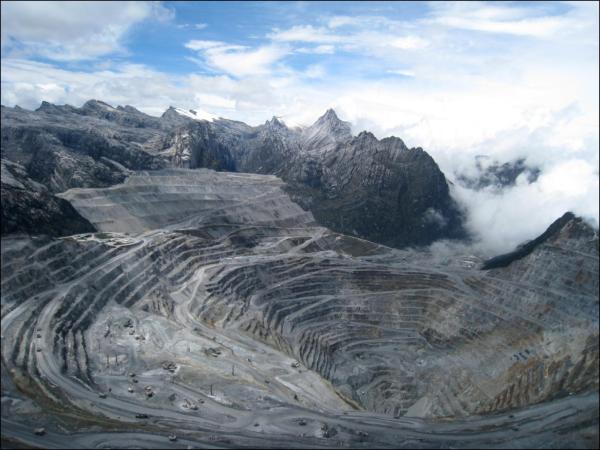
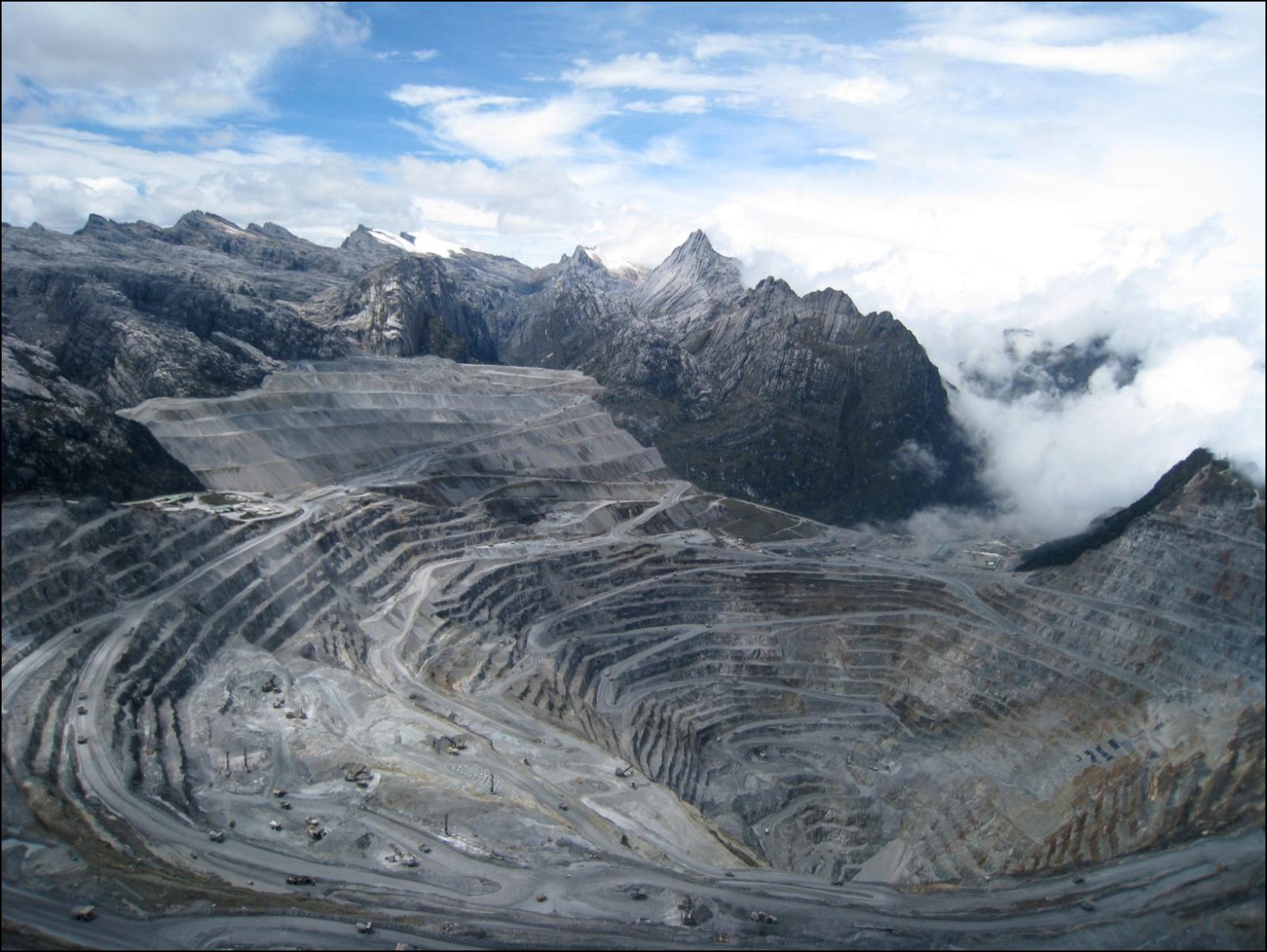
It is still very difficult for the Mimika district administration to get information about the quantity of gold and copper produced by Freeport-Indonesia and how much is exported via Portsite, Amamapare.
Freeport's Grasberg mine - Earth's biggest hole in the ground

The head  of the mining, energy and minerals department of the Mimika administration, said:

‘We don’t know anything about the quantity of gold, copper and other minerals produced daily by Freeport and this is because  we do not have free access to the company to be able to control the level of production every day.’

He said that the administration did once charge two of its employees to oversee export activity in Amamapare, but after we had given them the task, the two men were unfortunately shifted other posts.’  [Could this have been a deliberate action.]

This is a big problem. Anyone charged with scrutinising exports and imports  would have to be a specialist. They would need to have a special certificate for controlling goods and services for both exports and imports..

All this has an impact on obtaining clarification about the quantity of minerals produced every year. How can this possibly be synchronised with the information received by the authorities in Jakarta? It’s all just a game because the people at the centre get data about gold and copper production which comes directly from the company, PTFI.

The department of mines in Jakarta only gets information from one side. ‘This doesn’t lead to any accuracy. Anyone with bad intentions can easily manipulate the data.  Although lots of stuff is exported, they report a very low figure.’

So the question is: who else but the company can know anything about the quantity of material it produces every year? Only the PTFI.

[COMMENT: This once again highlights the extraordinary powers that the US company has been given to keep a tight control over how much it exploits of Papua’s abundant natural resources, with the  Papuan people not only left in the dark but also left living in poverty while Freeport makes a fortune from its investments in West Papua. TAPOL]

Bomb planted outside Law and Human Rights office, no suspects

Westpapuamedia.info

Local media and witnesses in Abepura, near Jayapura West Papua, have reported the discovery of an explosive device planted on Wednesday evening (local time) outside the offices of the Department of Law and Human Rights (KumHAM) office in Kotaraja.

Armed officers from Brimob Gegana, a specialised motorbike based paramilitary bomb squad, reportedly defused and secured the bomb and made it safe.  No injuries were reported.

The bomb had been lying at the front of the office all day, but no-one had thought to report the suspicious package.  Finally in the evening, the Brimob were called by KumHAM staff members.

According to a report by Bintang Papua, two men were seen leaving the sports bag earlier in the day, and then getting on a motorbike and speeding away.

The Department has frequently come under threat for its mandated work in occasional prosecutions of human rights abuses, and most recently was subject to a series of threatening letters and homemade bombs.

According to an SMS sent to West Papua Media by the Serui Regional Police Chief who was in Jayapura at the time (At police HQ), the bomb “was from the Dutch era”.  He did not elaborate on how a Dutch Era bomb came to be planted outside the KumHAM  building.

Bomb threats are frequently the subject of much speculation in Papua, with incidents usually occuring during times of political upheaval by nonviolence forces.  It is usually believed they are the work of Special Forces or Intelligence agencies keen to discredit the anti-violence movement, despite the fact that the independence movement has publicly disavowed itself of such tactics for many years.

During the 2010 Presidential Elections in Indonesia, many bombs exploded in remote areas of Papua, or at police stations or polling booths, and were never sufficiently investigated by Police.

Large rally against torture held Serui; Police confiscate rally equipment, then apologise to organisers

by Nick Chesterfield, Ronny Kareni; local sources for West Papua Media team

Serui, Thursday, June 23, 2011

Indonesian police in Serui, off the north coast of West Papua, this morning have forcefully confiscated banners, Morning Star flags, amplifiers and other rally paraphernalia from West Papuan protestors, before allowing a major rally against torture to go ahead. Despite providing police with significant notice, organisers of today’s rallies have met with inconsistent police policy in allowing legitimate peaceful expression to occur.

The rallies are being held by the West Papua National Authority (WPNA) to express opposition to institutionalised Indonesian security force torture and maltreatment of West Papuan people, and against the continuing criminalisation of legitimate peaceful dissent.  It is also to support efforts in Washington DC for West Papua by Torture Abolition and Survivors Support Coalition (TASSC) including seminars, a Vigil to End Torture in front of the White House, and Congressional Briefings on Capitol Hill.  The rally had been planned to conduct a traditional long march or “jigjog” to the offices of the DPRD, the Papuan Provincial Parliament.

Police in Serui conducted security sweeps of the area from 8 to 10 pm last night.  “This is a usual sweeping that security forces do for security measures prior to an event”. said Pak Eddy, the head of intelligence for the police (KAINTEL POLRES) in Serui said via phone to West Papua Media.

At 8am this morning, rally organisers were visited by two uniformed Papuan police officers, who told WPNA Serui Governor David Abon to cancel the long march from Wombai Park to the DPRD office. Instead, they instructed Abon to drop people with trucks to the office, but stated firmly that Police “will not provide security for the protesters, nor guarantee their safety”.

Rally organisers expressed fears that this would be a prelude for police standing down in the face of militia or military violence, and were perturbed that the police would abrogate its State Responsibility for providing security for civilians engaging in legitimate peaceful expression.   The Indonesian police has a long and regular history of standing to one side while military or military controlled civilian groups conduct serious acts of violence against political or religious opposition, such as with East Timor, in West Papua, and more recently against the Ahmadiyah.  However, neither the WPNA nor Police have shared any specific intelligence about pro-Jakarta militia mobilisations, despite the local presence of both the Laskar Merah Putih, and the newly formed Euricio Guterres / Bas Suebu militia, ASWAIN.

Over 1000 people had begun to gather at Wombai Park, Serui, on Thursday morning in preparation for the long march and listen to speeches and music.  At 10:00am, as people were meeting to discuss security situation and day’s plans, one company (150 police) of local Police present at Wombai confiscated with force a truck, Morning Star flags and material (like bags and beanies), amplifiers, and four banners. Due to the speed and force used, people at the park were subject to mounting fear, and were uncertain for their safety.

KAINTEL Eddy told the crowd,  “Don’t bring flags or banners to the rally, but rally can still go ahead”.  This action was is contravention to the rights of people to engage in free cultural expression.

The crowd then dispersed peacefully from Wombai and made its way to the DPRD office.  Over 200 armed Gegana paramilitary motorbike police are in attendance, as are two companies of normal police.

WPNA Security is still on high alert against agents provocateur, and has clear line of communication open to prevent escalation with both Pak Eddy and the KAPOLRES (Regency level Chief of Police, currently in Jayapura).

In Mantembu at midday, prior to that march joining with the main rally, Police attempted to shut down the march, and again seized banners that displayed the Morning Star symbol.  An intense vocal confrontation between WPNA and Police ensued, but negotiations with Police successfully agreed the rally to be continued until 4pm.

” We will provide the safety and security of all the participants”, said Terrianus Israel Yoku, National Congress President of WPNA.   “We want to freely exercise our rights to freedom of assembly, and we ask for security forces to respect the rights of West Papuans to voice our concerns”, said Yoku.

“Even though the security forces stop trucks and confiscate morning star flags, banners and amplifiers, it wont stop us marching in peace” said David Abon, govenor of Yapen Waropen.

The Kapolres and KAINTEL POLRES apologised to Reverend Yoku, WPNA, for the confiscation of items and the force that was used against demonstrators this morning.

Participants from Wombai joined with the 500 Mantembu marchers, who then joined over 3000 people already gathered at DPRD.  Delegations also came from Sorong, Manokwari, Jayapura, Fak Fak, Bintuni, Waropen, and Mamberamo.  Over 5000 people stayed upon the steps of the DPRD office listening to speeches and music.

“A Salute to everyone who made the decision to participate in this long march for peace and justice in West Papua. This is an act of working together in support of what is happening in Australia and Washington to speak out on the ongoing torture and issues towards indigenous West Papuans”,  said Jacob Rumbiak, WPNA Foreign Affairs Coordinator, in Australia.

“Today, the international advocates are monitoring the situation in West Papua, especially in Serui, and we ask the Indonesian security forces to respect the rally and allow every West Papuans to freely exercise their freedom of expression and freedom assembly”, said Terry Bukorpioper, WPNA’s designated spokesperson to the UN.

At time of writing,  close to 5000 people joined on the steps of DPRD in a closing prayer with Reverend Phil Ayeni to peacefully end the rally.

West Papua Media will continue to monitor the situation closely, and provide timely updates.

Create a website or blog at WordPress.com

Up ↑