West Papuan leader urges peaceful defiance in the lead-up to December 1st

Papuan Leaders take a sit in floor of Papuan Police Prison. From left to right each of them; Edsison Waromi SH (Prime Minister), Forkorus Yaboisembut S.Pd ( President Republic Federal State of West Papua), Dominikus Surabut ( Aktivist)), Gad Wenda (Aktivist ), Agus Senandy Kraar (Aktivist ) and Selpius Bobii (Chair of Orginizing Commettee of Third National Papua Congress). (Photo: West Papua Media)

30 November 2011

Exclusive interview by Alex Rayfield (New Matilda) with West Papua Media

The President of the Federal Republic of West Papua may be behind bars, he may have been savagely beaten by the Indonesian police, but he has not been silenced. From his 5×4 meter cell in the bowels of the Jayapura Police Station – quarters he shares with five other Papuans also charged with rebellion against the Indonesian state – Forkorus Yaboisembut recently issued a rousing call to action smuggled out of prison.

“To all the Papuan people” Yaboisembut writes, “don’t be afraid to celebrate December 1st, whether you do so simply, or as part of large gatherings. Do not be afraid because we, the Papuan people, do not intend to destroy any country; we only wish to defend our political rights.”

Our interview, the first – clandestine – interview with Western media, may be constrained by time and space, but I can picture the tribal elder from previous meetings. He is a quietly spoken man, late in years but strong and alert. He walks tall, sits up straight and dresses neatly in long dark pants; polished slip-on shoes and patterned but subdued crisply ironed business shirts. His short hair and longish grey beard gives him the look of an Old Testament prophet, grandfatherly if you like.

It is painful to think that he when he was arrested on October 19 he was tortured so badly that he could barely sit down – or stand. Dominikus Surabut, from the West Papua Council of Customary Tribal Chiefs, who was detained with the man who is now the President of the Federal Republic of West Papua and who was also badly tortured, tells me that when Mr Yaboisembut was arrested the Police beat him mercilessly with a rifle butt, raining blows down on his head and crashing their weapons into his solar plexus. In a widely published Indonesian language account of the arrest, a religious leader said that an Indonesian soldier was ready to shot him dead but was urged not to by a policeman.

West Papuan’s political rights, Mr Yaboisembut says, are inalienable. “Whether you take the United Nations founding document, the International Covenant on Civil and Political Rights, the International Covenant on Economic, Social and Political Rights or even the Indonesian Constitution as your starting point, Papuans have the right to self-determination.”
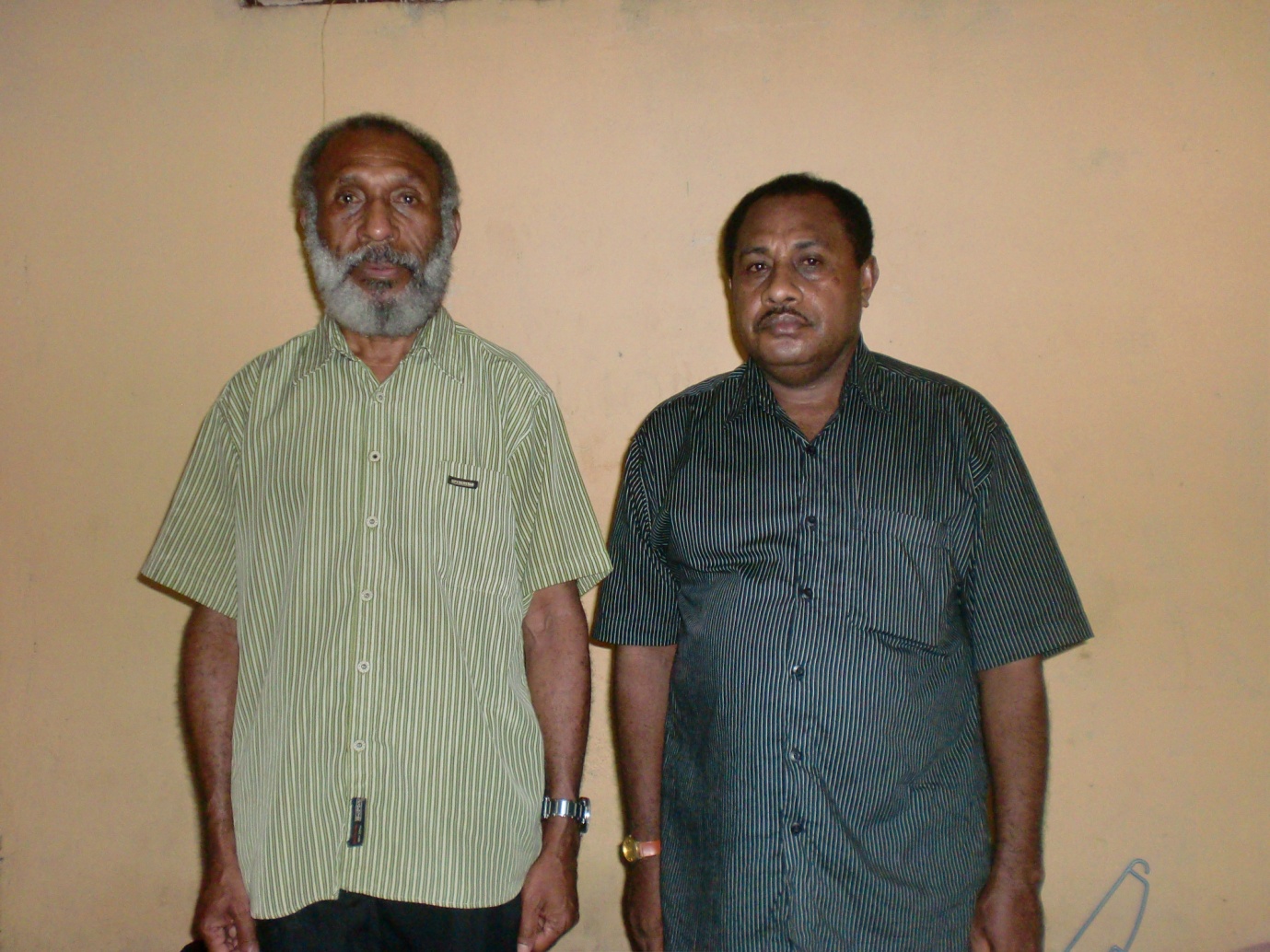
Forkorus Yaboisembut S.Pd and , Edison Waromi,SH

“The preamble to the 1945 Indonesian Constitution mentions expressly, that independence is the right of all Nations, and because of this colonialism must be swept away, it is consistent with the principles of justice and humanity. Consequently, the people of Papua cannot be blamed in accordance with any law for wanting to celebrate their national day.”

These ideas, the same ideas that inspired Indonesians to liberate themselves from Dutch rule, are igniting the imagination of entire generation who yearn to be free. What makes Mr Yaboisembut’s ideas even more extraordinary is that he is urging an insurrection that grounded in what he calls “human dignity”.

“December the first 2011, is the fiftieth anniversary of when Papuans first raised the Morning Star flag. It is our golden anniversary, the year of God’s liberation” he says evoking the images of the ancient Jewish custom of Jubilee – of freeing captives and erasing debts. “It must be celebrated in an atmosphere of peace, safety and calm”.

“To Papuans, I therefore say, do not carry out acts of terror, intimidation or commit violence of any kind towards anyone, for whatever reason, whether they are Papuan or migrants.

“Do not be afraid,” Mr Yaboisembut repeats, “God is with us.”

Papuan leaders are standing infront; Forkorus Yaboisembut S.Pd, Edsison Waromi SH .behind Dominikus Surabut, Gad Wenda, Agus Senandy Kraar and Selpius Bobii (Photos: West Papua Media)

“The roots of our oppression is political” says Mr Selphius Bobii, Chair of the Committee of the Third Papuan Congress, who also shares a cell with Mr Yaboisembut and Surabut. “The annexation of our country by Indonesia and the acquiescence of the international community has resulted in state sanctioned human rights violations and creeping genocide.”

Those arrested on October 19 in the wake of the Third Papuan Congress are not backing down from the declaration of independence. “We are committed to using people power, diplomacy and the law to achieve our rights” Bobii tells me.

Dominikus Surabut says that he and the other prisoners are refusing to sign police statements charging them with “rebellion” (makar) under sections 106 and 110 of the Indonesian Criminal Code.

“We have done nothing wrong” Surabut says. “We have a political right to declare independence. We do not seek to destroy Indonesia or any other country. On the contrary, it is the Indonesia state that has attacked us.”

How can it be, they rhetorically ask, that the Indonesian police get written warnings for killing Papuans when Papuan activists nonviolently exercising their rights to freedom of expression are beaten and jailed?

Is this the same country that Obama and Gillard lauded for being a beacon of democracy?

In a widely published letter in support of Papuan political prisoners Human Rights Watch says that the articles under which the six Papuan political prisoners arrested after the Third Papuan Congress have been charged “are a legacy from the Dutch colonial era”. Charging nonviolent activists with rebellion is “in violation of the Indonesian Constitution, Articles 28(e) and 28(f) which respectively afford “the right to the freedom of association and expression of opinion,” and “the right to communicate and obtain information for the development of his/her personal life and his/her social environment, and shall have the right to seek, acquire, possess, keep, process and convey information by using all available channels.”

The charge of rebellion is also inconsistent with Indonesia’s international obligations under the International Covenant on Civil and Political Rights (ICCPR) which Indonesia ratified in 2006, a point which the jailed Papuan leaders make repeatedly to me. Besides, the Papuan leaders sigh, we have been left with no other option. “Special Autonomy has totally failed and even the MRP, a state institution convened a meeting which came up with eleven recommendations, one of which was to hold the Third Papuan Congress.”

Outside their police cell, in the streets of the cities and towns of West Papua, in the cloud covered mountains and on the coconut palm fringed coasts a new political consensus is emerging. This consensus has been forged not through endless meetings of the Diaspora, nor in stillborn discussions with political elites in Jakarta, nor in the conference halls of NGO deliberations, but in the furnace of political action. It is simply this: that West Papua must be free.

After the Congress three overlapping political groupings have emerged: the Papuan Peace Network who is calling for political dialogue, the West Papua National Committee who demands a referendum, and the Papua Congress leaders (supported by a loose alliance made up of the West Papua National Authority, the Council of Customary Papuan Chiefs, the Presidium Dewan Papua, and the West Papua National Coalition for Liberation).

The killings of nonviolent Papuans by the Indonesian police and military on October 19 have divided ordinary Indonesians, flushing out ultra-nationalists and their racist discourse, and outraging political moderates longing for a different kind of future than the one left to them by former dictator Suharto.

Inside Papua the massacre appears to be having a unifying effect, although Papuan politics remains complex affair. The West Papua National Committee who opposed the Congress later marched in support of the six political prisoners. Father Neles Tebay, respected intellectual and leader of the Papua Peace Network has intensified the demand for political dialogue. It is a call that has been supported by Yaboisembut and others. “All Papuans, wherever they are must respect the dialogue process democratically initiated through the Papuan Peace Conference and the Papuan Peace Network” wrote Mr Yaboisembut in a message smuggled out of prison.

Whether the Indonesian police and military act in a similarly dignified manner, or not, remains to be seen.

As I write this a long-term Papuan human rights activist sends me this message: “there’s an increase of military patrol of soldiers around Jayapura Township.” Some put the numbers as high as forty thousand. Reports are filtering in of troop surges in Sorong, Paniai (where gunshots have been heard), the border region and Jayapura.

“The atmosphere here is quiet but eerie” my friend writes. We are all waiting to see what December 1 will bring.

UN Declares Indonesia’s Detention Of Filep Karma A Violation Of International Law, Calls For Immediate Release

In response to a petition filed by Freedom Now and Hogan Lovells LLP, the United Nations Working Group on Arbitrary Detention has issued its opinion that the Government of Indonesia is in violation of international law by detaining Filep Karma. The Working Group calls on the Government of Indonesia to immediately release the human rights advocate.

Mr. Karma is a prominent Papuan human rights advocate and former civil servant arrested on December 1, 2004 for raising the Papuan Morning Star flag at a political rally in commemoration of Papuan independence from Dutch rule. Although Mr. Karma has explicitly denounced the use of violence, he was convicted for crimes of hostility against the state and sedition in a trial that fell far below international standards of due process. He now languishes in prison serving a fifteen-year sentence, despite health concerns and calls for his release by numerous NGOs and government officials. In August, 2011, 26 members of the U.S. Congress urged President Yudhoyono to release Mr. Karma. Forty members of Congress signed a similar letter in 2008. This week, President Obama will be in Indonesia attending the 2011 ASEAN Summit—which takes place November 17-19 in Bali—where many hope such human rights discussions will take place.

Freedom Now Executive Director Maran Turner stated: “The United Nations Working Group on Arbitrary Detention has found Indonesia’s actions a clear violation of international law. Mr. Karma is a nonviolent advocate who was arrested for his views and convicted in a trial marred by judicial bias, denial of appeal without reason, and intimidation tactics. I urge President Obama to raise Filep Karma’s case with President Yudhoyono and to call for Indonesia’s compliance with the UN opinion by releasing Filep Karma.”

The United Nations Working Group determined that Mr. Karma’s arrest was due to his exercise of the fundamental rights of freedom of expression, peaceful assembly, and association. According to the UN, provisions used to convict and detain Mr. Karma—including declaring “feelings of hate”—were “drafted in such general and vague terms that they can be used arbitrarily to restrict the freedoms of opinion, expression, assembly and association.” Such a detention violates the International Covenant on Civil and Political Rights, a multi-party treaty by which Indonesia is bound, as well as the Universal Declaration of Human Rights. The Working Group also censured the Government of Indonesia for violating Mr. Karma’s right to a fair trial.

The opinion concluded by calling the Government’s attention to broader human rights violations in Indonesia, for which Filep Karma’s situation is emblematic, stating, “The Working Group will remind The Republic of Indonesia of its duties to comply with international human rights obligations not to detain arbitrarily, to release persons who are arbitrarily detained, and to provide compensation to them.”

Freedom Now, a non-profit, non-partisan organization that works to free prisoners of conscience, and Hogan Lovells LLP, an international law firm, welcome the UN’s decision. They call on the Indonesian government to uphold its commitments under international law and immediately release Mr. Karma.

Source: Freedom Now

NZ Media ‘blindfolded’ over West Papua crisis, say critics

from our partners at the Pacific Media Centre

Forkorus Yoboisembut … elected West Papuan “president” at the last week’s Papuan People’s Congress and arrested by Indonesian forces. Photo: EngageMedia

Friday, October 28, 2011

Item: 7692

AUCKLAND(Pacific Media Watch): As tensions escalate in the Indonesian-occupied Melanesian region of West Papua, there is growing criticism over the lack of information in the mainstream New Zealand media about the troubled area.

Last week, the third Papuan People’s Congress was held in Abepura, on the outskirts of Jayapura. It was a peaceful rally of thousands of West Papuans who had gathered to celebrate their culture, hold talks and elect their representatives.

When the Morning Star flag was raised and cries of “merdeka” (independence) were heard by the strong Indonesian military presence, gunshots rang out and violencefollowed.

Deaths and mass arrests
The newly-elected “president” Forkorus Yoboisembut, chairman of the Papuan Customary Council (DAP), was arrested along with hundreds of others and reports emerged of up to six deaths.

On Monday, Indonesian police chief Adj. Comr. Dominggus Awes was gunned downon the tarmac of Mulia Airport. The People’s Liberation Army of West Papua or OPM, were accused of being involved but have since denied it.

And on a completely separate event, at least seven people have died over the past few weeks during the controversial strike over low wages at the US-owned Freeport McMoRan mine.

So far, only the public broadcaster, Radio New Zealand International, and independent media outlets such as Pacific Scoop have paid any attention. In the international pages of the main newspapers, Europe and other parts of the world have featured, but nothing about our own region.

NZ ‘not part of Pacific’
Dr Steven Ratuva, senior lecturer in Pacific studies at the University of Auckland, says New Zealand likes to consider itself a Pacific country, but can’t, as its interests lie elsewhere.

“There is nothing in terms of media coverage that gives the impression that New Zealand is part of the Pacific,” he says.

“It’s a dilemma that New Zealand is facing – on one level it claims to be a Pacific country but the New Zealand Herald has only one Pacific reporter, and TVNZ the same.”

Dr Ratuva sources his information from places such as West Papua from blogs as well as “internet sources outside the mainstream media”.

He says the main reason is politics.

“The [Pacific Islands] Forum, at the last meeting didn’t want to touch it. Indonesia is a significant player in the region and has links with Australia and New Zealand,” he says.

“Papua New Guinea doesn’t want to acknowledge it, even though it shares a border with West Papua, due to its fears of Indonesia.”

Dr Teresia Teaiwa, senior lecturer in Pacific studies, at Va’aomanu Pasifika Victoria University of Wellington, says mainstream print and television media leave a lot to be desired.

‘Inanely insular’
“If it’s not a major crisis or related to a major crisis, don’t expect it to be covered,” she says.

“I’ve stopped reading mainstream newspapers because of how inanely insular they are.

“I was surprised at how little coverage the Occupy Wall Street movement got in theDominion Post a couple of weeks ago. If a significant first world movement isn’t getting any serious attention in our newspapers, how can we expect informed and engaged journalism on issues in the Pacific Islands from New Zealand media?”

Dr Heather Devere from the National Centre for Peace and Conflict Studies says New Zealand is inward-looking.

“I do think we are more insular here,” she says.

“I’m not sure that it is so much a concerted effort to ignore rather than a genuine ignorance.”

Journalism education
While others say it is mostly economic pressures on newsrooms, Dr Devere says the issue with media goes back to the education of journalists.

“So many students seem to be attracted to the communication discipline as a chance to be a celebrity rather than an investigative journalist,” she says.

“There is very little content in the training so journalists do not have knowledge about the situations on which they have to report.”

Director of the Pacific Media Centre and journalism educator Dr David Robie is even more critical of the current New Zealand media role in informing the public about events in the region.

He says local media rely too much on international and digital syndications and few journalists dedicated to tailoring international news for a New Zealand perspective.

News judgment ‘parochial’
“There are very few genuine international affairs editors in New Zealand media organisations, specialists in global news who have either done the hard yards themselves as foreign correspondents or have expert background knowledge,” he says.

“So news judgment is often weak and parochial.”

He said it is a shame that New Zealand is shown up by other media organisations abroad.

“It’s extremely embarrassing and it makes a mockery of our claim to be part of the Pacific,” he says. “We really need to up our game.

“When a Middle East-based global news service like Al Jazeera find it important enough to send teams to cover New Caledonia and West Papua, for example, it is an indictment of our own coverage and news values that we fail to match this. I cannot recall the last time that I saw an in-depth TV report in New Zealand on the French Pacific.”

Melanesia loses out
Dr Robie says that most Pacific news published in mainstream New Zealand media is from the Polynesia, while Melanesia and Micronesia are largely ignored.

“It is very rare to see good, in-depth coverage of Melanesian and Micronesian affairs in New Zealand media, with the brave and committed exceptions of Pacific specialists such as Barbara Dreaver on TVNZ,” he says. He also praised Radio NZ International coverage.

“Yet two Melanesian nations are the economic ‘superpowers’ in the region – Papua New Guinea and Fiji. Since the fourth coup in December 2006, there has hardly been any serious journalism about Fiji any more other than extraordinarily biased polemics masquerading as journalism about the regime.

“The country’s censorship law and an inflexible regime don’t make it easy, but far better reporting could still be done in spite of the problems.

“In this context, West Papua barely exists. If even neighbouring Papua New Guinea falls below the radar then there is little hope for West Papua getting fair and informed coverage.”

Australia fares better
In the Australian media, Fairfax’s Sydney Morning Herald has been following the West Papua issue over the last few weeks.

Its coverage has compared with Radio Australia’s Pacific Beat programme. Yet here in New Zealand, no mainstream media has taken it up apart from Radio NZ International.

“I think we are extremely fortunate that there are still a few state-owned broadcasting outfits like RNZI in this country and ABC in Australia that have dedicated Pacific programmes,” says Dr Teaiwa.

“And I’m not sure whether to celebrate or lament this. But often some of the most illuminating stories come from student journalists who have not yet learned to surrender to the wider industry’s demands and values.”

Maire Leadbeater, from the Auckland-based Indonesia Human Rights Committee, and a campaigner for human rights in West Papua, wrote an article in a 2008 edition ofPacific Journalism Review about what she argued was New Zealand’s biggest media blind spot.

If we are unsure that very little has changed in the past three years, perhaps the New ZealandHerald’s approach to West Papua during the Rugby World Cup could clarify the situation:

West Papua‘s moment’

CupShorts took CupShorts jnr to Pt Chevalier playground where we bumped into an off-duty Green Party MP. “Why is the media so obsessed with the World Cup?” she asked. “Big issues are being missed. We just had a delegation here from West Papua and there was no press coverage on them at all.”

A fair point. And one that we’re only too happy to remedy. So, for the record, West Papua is currently part of Indonesia (no IRB ranking). However, if they got independence they might someday hope to rival neighbouring Papua New Guinea (rated 46th in the IRB rankings). Good luck to them.”

PMC

Third Papuan People’s Congress opens

Bintang Papua, 18 October 2011The Third Papuan People’s Congress opened on Monday according to plan at Lapangan Zakeus [in the open air]. However, the  plan for it to be opened by the general director for regional autonomy of the interior ministry was not realised so instead it was opened by the collective Papuan leadership and marked by the beating of a tifa drum.

Speaking on this occasion, Forkorus Yaboisembut said the objective of the congress was to discuss the basic rights of the indigenous Papuan people and not to destroy the NKRI.

‘Although we will be discussing political rights, we respect the Indonesian government because our intention is not to destroy NKRI. This is a matter of principle,’ he said, speaking to journalists after opening the congress.

‘What we are doing is to struggle for the rights of the indigenous Papuan people. This includes our basic right as a nation.’  Speaking as part of the collective leadership as well as chairman of Dewan Adat Papua  [Papuan Traditional Council], he said he had no personal agenda. ‘But the people have their aspirations and the Indonesian state and other states should respect this.’

He went on to say: ‘If all parties  uphold democracy, basic human rights and international law, the Third Papuan People’s Congress should not be regarded as being illegal. If everyone in the world is committed, the activities  taking place here in Papua should not been seen as being illegal or against the law. Law is relative,’ he said.

The congress was opened with a prayer and the blowing of the sangkakala trumpet. Forkorus led the prayers together with the leaders of seven regions. The national anthem ‘Hai Tanahku Papua‘ was sung, the only song to be sung as part of the congress agenda.

The Morning Star flag which was flown was quite big and was unfurled twice on a wooden pole while musicians accompanied women dancers who were wearing shirts made of the flag.

The chairman of the congress committee, Selfius Bobii, in his opening address, called on all who were present to be of one heart and determined to bring about change.

‘Past history is realised in what happens today, and the future depends  on what happens now,’ he said, speaking with great feeling. Although his address was interrupted because of the sound system, he gave an account of Papuan history. In the days before  the arrival of people from outside, Papua was a paradise on earth..  ‘During the Dutch colonial era  and the Indonesian colonial era, this paradise on earth turned in a hell on earth.’ Papua’s paradise which existed before the arrival of outsiders is what we are longing for.’

Third Congress: Forward to Peace.

Congress regulations for the proceedings were read out, which included things that the participants should not do and were agreed by everyone present.

After the regulations had been read out, the congress continued with each group from home and abroad presenting their political views. The first person to speak was Frans Kapisa, chairman of the WPNA.  He was followed by a statement from a representative of TPN/OPM from Kasuari Manokwari which was read out by Yakop Dimara (commander). This was followed by a political statement by a representative of TPN/OPM from the mountains who did not want his name  to be reported in the press.

The statement from TPN/OPM marked the conclusion of expressions of political opinions yesterday while others will make their statements tomorrow (ie today) starting as 8am. These political presentations expressed love for a peaceful struggle, although at the start there was some talk about the use of violence.

[Translated by TAPOL]

West Papua ‘biggest threat’ to Pacific media freedom, says Pacific Journalism Review report


13 October 2011

West Papua ‘biggest threat’ to Pacific media freedom, says PJR report

The killing and abduction of journalists in Indonesian-occupied West Papua has been highlighted in a special new report on Pacific media freedom over the past year by Pacific Journalism Review.

http://www.pmc.aut.ac.nz/research/pacific-media-freedom-2011-status-report

“By far the most serious case of media freedom violations in the Pacific is in West Papuafar from international scrutiny,” says the journal in an editorial.

The 39-page report on the state of media freedom in the Pacific in 2011 notes that in August, in particular, “sustained repression has also hit the news media and journalists”.

At least two journalists have been killed in West Papua, five abducted and 18 assaulted in the past year.

West Papua has replaced Fiji as the most urgent media freedom issue in the region, says the journal. The report has been published just as regional protests have been voiced over the brutal suppression of a strike at the giant Freeport copper mine in the past week in which at least one person was reported shot dead.

Ten West Papuan activists were arrested by Indonesian authorities in Jayapura last week for being in possession of material that featured the banned West Papuan Morning Star flag of independence.

Poengky Indarti, executive director of the Indonesian human rightsmonitor Imparsial, said recently: “Freedoms of expression, association and assembly are routinely violated in Papua, which seriously fuels tensions. Besides, gross human rights abuses, such as acts of torture, remain unaccounted for.”

This free media research report, compiled by Pacific Media Watch contributing editor Alex Perrottet and Pacific Media Centre director Dr David Robie with a team of contributors, including West Papua Media editor Nick Chesterfield, is the most comprehensive and robust media freedom dossier on the region published in recent years

“The state of Pacific media freedom is fragile in the wake of serious setbacks, notably in Fiji, with sustained pressure from a military backed regime, and in Vanuatu, where blatant intimidation has continued with near impunity,” says the report.

“Apart from Fiji, which has a systemic and targeted regime of censorship, most other countries are attempting to free themselves from stifling restrictions on the press.

“Coupled with governments that are sluggish to introduce freedom of the information legislation and ensure region-wide constitutional rights to free speech are protected, there are limited media councils and advocacy bodies with few resources to effectively lobby their governments.

In New Zealand, another major threat to media freedom has been the consolidation of contemporary transnational corporate ownership patterns.

Researchers Merja Myllylahti and Dr Wayne Hope demonstrate in another special report on global capital and media communication ownership that NZ media corporations treat news as a commodity and news organisations as revenue generators.

This is the third in a series of media ownership papers published in PJR and initiated by Bill Rosenberg’s mapping of media ownership (2007, 2009). This ongoing project has now been adopted by AUT University.
The report authors point to the closure of the 20-year-old influential business and politics newspaper The Independent and the phasing out of the 130-year-old cooperative news agency New Zealand Press Association (NZPA) as key symptoms of the malaise: ‘Consequently, public media space is shrinking as the practice of journalism declines.’

This edition of PJR is themed on “Media, cultural diversity and community”, and includes articles on Australia’s Reporting Diversity Project, the Yumi Piksa community television project in Papua New Guinea, a study of the use of te reo Māori by Fairfax-owned Suburban Newspapers in New Zealand by the Te Rōpu Whariki research team, reporting of Islam in Australia, the Australian country press, and the development of a cross-cultural communications degree in Oman by a New Zealand university.

Book reviews include investigative journalist Nicky Hager’s Other People’s Wars: New Zealand in Afghanistan, Iraq and the war on terror.

This edition, published in partnership with the Australian Centre for Independent Journalism in Sydney is being published next week on October 20.

Edition editors: Professor Wendy Bacon, Dr Catriona Bonfiglioli and Associate Professor David Robie.
More information on the Pacific Media Centre website: www.pmc.aut.ac.nz


Contacts: Dr David Robie (Pacific Media Centre) + 64 9 921 9999 x7834

Alex Perrottet (Pacific Media Watch) + 64 9 921 9388
Email:
pmc@aut.ac.nz


Create a website or blog at WordPress.com

Up ↑

