Combatting HIV/AIDS is not proceeding well in parts of Papua

Tabloid JUBI

17 August 2013Efforts to deal with the spread of HIV/AIDS are clearly being made in many cities and districts in the Province of Papua. However, in the sub-district of Dogiyai, local people are concerned that the local government is not seriously dealing with this deadly virus.

A youth leader, Laurensius Tebay, said this week that dealing with this disease must be top priority, which means “more testing centers available for everyone – near you and near me (STD clinics)“. It is essential to spread information to the people that this virus is deadly and incurable. ‘We very much hope that the local government will deal with this problem with the seriousness that it merits,’ he said.

He said that as yet there have been no activities to inform people about the danger of the spread of HIV and AIDS, adding that this was the case in ten local areas. ‘We are very disappointed that the local authorities are failing to deal with AIDS with the necessary urgency.’

He said that spreading information and examining people with regard to HIV/AIDS has been proceeding well in the District of Paniai during the past month and this should be done in all the other areas, including the sub-district of Dogiyai. ‘While  this is not something that should be made compulsory, the authorities should do everything possible to persuade people about how important it is to be examined.’

These views were confirmed in  remarks made by the head of the Department to Combat HIV/AIDS, Kristianus Tebai who admitted that dealing with AIDS is a critically important part of the work of the health authorities. ‘Since I was recently appointed to this job, I have discovered that there are many issues that are not being dealt with properly. We are doing everything we can to improve work on this programme,’ he told JUBI. He said that combating the disease was going well in some sub-districts but not yet in the sub-district of Dogiyai.’

[Translated by TAPOL]
 

Women traders losing out in Papua

Tabloid JUBI
 
August 6, 2013
 
Jayapura: Papuan indigenous traders are very worried about the fact that they are not able to compete economically because of the arrival in Papua of immigrants  who are ‘taking over’ the trade in many simple commodities which has for a long time been where Papuan women  (mama-mama) are conducting their business activities.

‘If nothing is done about this, we can be sure that within the next ten years, the mama-mama will not be able to compete in the markets. Many shopping malls, shops, agricultural product businesses, self-service shops and hypermarkets  will be selling these commodities, with the help of lorries  which are transporting the commodities  everywhere, even along alleyways,’ said Robert Jitman, an activist in SOLPAP (Indigenous Papuan Traders Solidarity).

He said that he was seeking the help of the MRP (Majelis Rakyat Papua) to play a more active role with regard to building markets for the mama-mama to ensure that they can carry out their business activities.  He also said that he was seeking support from the MRP with regard to what happened to some mama-mama who were recently evicted from Jalan Irian.

Robert Jitman  stressed the importance of these markets in ensuring a self-supporting economy and said it is necessary for the government to take action as quickly as possible. He said that he wrote last month to the Governor of Papua, Lukas Enembe, to seek information about the fact that a permanent market  where the mama-mama can trade has not yet been built in one of the main roads in Papua, Jalan Percetakan Negara.

SOLPAP is also seeking an audit from the BPK (?) with regard to the allocation of funds for building the market for the mama-mama, which was allocated as long ago as 2009. He was also seeking to ensure the inclusion in SOLPAP of church leaders, NGOs, students and the press (Alliance of Independent Journalists).

The letter to Governor Enembe also suggested that there should be a special regional regulation (perdasus)  to protect and assist the mama-mama in conducting their trade in certain commodities and also suggested that a team be set up to ensure that the special market for the mama-mama is built.

[Translated by TAPOL}


Papuan mama-mama should attend the Papua Expo in Jakarta

JUBI,
2 March 2013
The director of the Ecology Papua Instutute, Titus Christoforus announced that a Papuan exhibition will be held at the Convention Centre in Jakarta from 3 April. He said that it should give priority to ensuring the attendance of Papuan mama-mama who use the noken (traditional string bag).He said: ‘I hope that the Papuan Provincial Government will give priority to the mama-mama and their noken at this exhibition.’

He went on to say that the exhibition would involve the Regional Work Units and Event Organisers from Jakarta. This means that in the weeks before the exhibition, special attention should be given to the involvement of the mama-mama.

He also said that this OTSUS exhibition should pay special attention  to the workmanship of people like the mama-mama who lack capital but are very eager to produce their handicrafts. He pointed out that the noken was identified by UNESCO.as a cultural object at a meeting in Paris on 4 December 2012. ‘This makes it all the more important that the mama-mama together with their noken should be involved in the exhibition,’ he said.

Such handiwork depends greatly on how we encourage it, which means that the mama-mama should be involved in the exhibition in Jakarta, he said.

He also said that the noken has become much better known and popular, and it should be presented to the public as a symbol of the identity of the Papuan people.

In conclusion he said: ‘I hope that this exhibition will provide the mama-mama with the maximum motivation and that they should be provided with the necessary facilities for the advancement of their craft.’

[Slightly abridged translation by TAPOL]

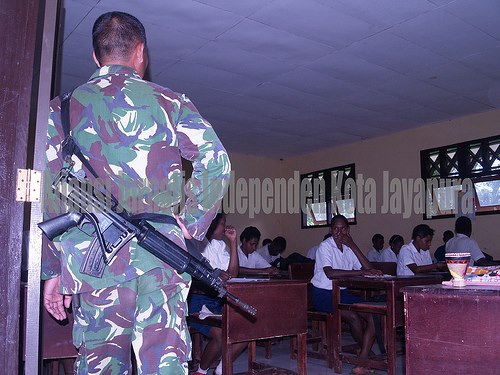
No primary schools in over a thousand kampungs in Papua

JUBI,

28 November 2012

Jayapura: The head of  the Education, Youth and Sports Service in the province of Papua, James Modouw, said that there are at least one thousand kampungs (villages) spread across the province where there is no primary school.

‘Of the more than four thousand kampungs in Papua,’ he said, ‘ it is thought that around 1,047 do not have a primary school. It is also the case that throughout the district of Suru-Suru in the Regency of Asmat, there are eight kampungs, none of which has a primary school. This does not include the regency of Yahukimo about which no data has yet been received.’

He said that the kampungs without a primary school are mainly in the mountainous regions of Papua. ‘In the whole of the Bintang Highland Regency, there is not a single primary school,’ he said. The same is true throughout the regencies of Lany Jaya, Puncak Jaya and Nduga. ‘This is a matter that requires the attention of the local governments in these areas,’ he said.

He said that the problem of the lack of availability of primary education in Papua should be resolved. ‘We call on the local and municipal  administrations to  insist that adequate funds are made available for primary schools everywhere in the 2013 budget.so as to deal with the lack of schools and the widespread illiteracy among the Papuan people. He said that is calculated that thirty percent of Papuan children get no education at all.

[Translated by TAPOL]

[COMMENT: Over the years, we have read so many reports about the non-availability of teachers as well as healthcare workers in so many parts of West Papua. This is clearly an extremely serious matter indeed, a situation that clearly has not improved since the enactment of the Special  Autonomy Law in 2001, more than eleven years ago. No wonder Papuans are being thrust aside as more and more better-educated migrants from other parts of the country outnumber Papuans and take control of the territory’s economy and administration. As is so often the case, Papuans are frequently described as being ‘terbelakang’ or ‘backward’. So whose fault is that?! TAPOL]


South Sorong police drive away Papuan women traders

JUBI, 17 May 2012Teminabuan,  South Sorong:

The local administration in South Sorong, Papua, along with the police have destroyed a market run by Papuan women  who are known as  mama-mama.  Their tables, chairs and the goods for sale were all destroyed . And then the mama-mama were forcibly removed  These actions commenced on Friday 11 May  and have continued until now,

This was reported by Sarce Safles, one of the women who is responsible for the trading activities of the mama-mama, in a message sent to Jubi.

She said that beforehand the local government had called a meeting with some of the traders, while others had not been invited.

She said that at the meeting which she had attended, the women who were present  explained about what happened to them. ‘We said that the mama-mama should be allowed to continue with their trading business at the usual location because conditions there very busy and good for business.There are many people living in the area which means that there any many people who will purchase goods on sale. Besides this, the location is regarded as sacred.

The local government people ignored all these points made by the women, On 10 May, the assistant secretary of the local administration along with members of the local police descended on the location, smashed up everything  and forced the women to leave. These acts of destruction continue on the following day and on then on Friday, other marketing places were smashed up and the traders were told to move to another location.

But there is no one is living at this new place, which means that there is no one there to buy anything, yet even so the local government continued their destructive activities.

To this day, these activities are still going on and traders are still being forced to find somewhere else. to carry on with their business.

However the mama-mama are determined to remain at their old place for three reasons. First of all, they have been trading there for a long time already., secondly it is a very convenient place for these activities and thirdly, it is a sacred location.

For all these reasons, the mama-mama have decided to stand their ground but the government’s response was to mobilise the police, destroy the market.and smash up their tables and chairs.

The women did try to returned to their old market in Ampera  because the new location was a very great distance away, it was difficult to access and without anyone around who would buy anything. It is about three kms away and neither cycles nor motor cars cannot approach the new market place. Yet even so, the local government is forcing the women to move there.

An activist in Jayapura who confirmed all this information said: ‘The mama-mama traders have every right to insist on staying at that place and the local government should not behave in this way. They have no right to force the women to do anything.’ In her opinion, the local government should be facilitating the traders  and should be responsible for providing profitable market places for the women.

Slightly abridged translation by TAPOL

Create a website or blog at WordPress.com

Up ↑
