Violence and intimidation of journalists in Papua in 2012

27 December 2012
The Alliance of Independent Journalists (AJI) has recorded twelve cases of violence and intimidation against journalists Papua  during 2012,which is a significant increase as compared with 2011, when there were seven cases.
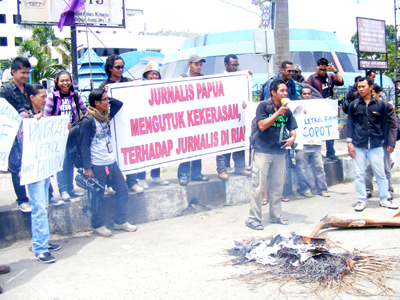
Journalists in Jayapura hold Demo to Reject Violence Against Journalists. (Jubi / Arjuna)

The first case was violence and intimidation against journalists in Papua and West Papua wanting to cover the trial of Forkorus Yaboisembut and his colleagues at the district court in Jayapura on 8 February when they were  physically intimidated, pulled and pushed as they were entering the courtroom. Those responsible were members of the police force in Jayapura. The victims were: Katerina Litha of Radio KBR 68 H  Jakarta. Robert Vanwi of  Suara Pemnaharuan, Jakarta, Josrul Sattuan of TV One, Irfan of Bintang Papua, and Cunding Levi of Tempo.

The second case was against Radang Sorong, a journalist with Cahaja Papua  and Paskalis  of Media Papua, from February until May in West Papua by the police chief of Manokwari, who were preventing journalists from reporting expressions of support for dialogue and a referendum in Papua. Three local journalists said that they had been  under pressure while writing critical reports about political matters, law and human rights violations and political prisoners. One of the journalists from Manokwari was instructed to restrict his reporting about political, legal matters and human rights violations.

The third case was in Abepura on 20 March when Josrul from TV One, Marcel from Media Indonesia, Irfan from Bintang Papua and Andi Irfan of Radio KBR 68 H Jakarta were attacked by members of KNPB, the National Committee of West Papua who were involved in an action outside the Post Office in Abepura. On a separate occasion, outside Polimak, Jayapura, Timbar Gultom of  Papua Pos was ordered to identify himself. When he replied that he  was from Papua Pos,  the people did not believe him and started chasing him. He was able to hide in a house nearby.

The fifth case  was when three journalists in the district of Jayapura, Yance of Radio Kenambai Ombar, Putu of KBR 68 H Jakarta and Suparti of Cenderawasih Pos were verbally intimidated and chased  by some members of the KNPB.on 20 March.

The sixth case was when a journalist from TV One, Josrul Sattuan was beaten by an unidentified person when he was trying to report on the situation in Jayapura following a series of  violent incidents and shooting incidents that occurred in various in places in Jayapura. The physical attack occurred at Abepura Circle on Thursday evening on 7th June.

The seventh case was when a journalist from Metro TV, Abdul Muin who was in Manokwari was attacked by someone from the Fishing Service in who intimidated him with an air gun.The victim told JUBI that the incident started when a member of the Fishing Service sent him a brief message on 8th June asking him and other journalists to cover an incident  of bombing a hoard of fish by a group of  people who were being held in the Manokwari Prison.

The eighth case occurred in Timika on 20 September.The victim was Mohammad Yamin, a contributor to  RCTI, Simson Sambuari of Metro TV, Husyen Opa of Salam Papua and the photographer for Antara News Agency, and David Lalang of Salam Papua.They were prevented from recording some events in the Pamako Harbour.

The ninth case involved Oktavianus  Pogau of suarapua.com and stringer for Jakarta Globe.  This occurred in Manokwari on 22 October. Okto were beaten up by several members of the police force, some in uniforms and others  not wearing their uniforms, who were battling with members of the KNPB in Manokwari.  The victims was thought to be part of a crowd of people involved in a demonstration, even though they had clearly identified themselves.

The tenth case was  when Sayied Syech Boften of Papua Barat Pos was attacked on 1 November by a person who identified himself as a member of the local legislative assembly, Hendrik G. Wairara. The victim was threatened and intimidated among others things by phone. The victim was warned to stop reporting about corruption in a project  involving the extension of the electrification system  and the maintenance of BBM machinery in Raja Ampat District. On the same day, the assistant of the chairman of the the local DPRD flew into a rage while he was at the editorial office of Papua Barat Pos.

The eleventh case occurred on 8 November when Esau Miram of Cenderawasih Pos  was intimidated as he was reporting on a gathering at the office of the Commander of the   XVII Nilitary Command and all the heads of departments in Papua.They were accused of being terrorists even though Esau had shown his  identity card as a journalist.

The twelfth case occurred on 1 December  when Benny Mawel of JUBI was interrogated by members of the police force  near Abepura Circle  for reporting about a large crowd of people who were carrying banners while marching from Abepura to Waena. Benny showed his journalist identity card, but a group of around ten people accused him of not being a journalist. As he was travelling on his motorbike  towards a repair centre, he was followed by some people there who starting asking whether he knew where Benny was.

Victor Mambor added the following: AJI reported two cases, the shooting of a Twin Otter  plane belonging to Trigana Air by an unidantified person in Mulia Airfield, Puncak Jaya on 8th April which killed Leiron Kogoya  who was first said to be a journalist of Papua Pos, Nabire and then the arrest and deportation of a Czech man, Petra Zamencnik who identified himself as a journalist with finecentrum.com. On 9 February, there was inconsistently about the status of the victim, whether he was a journalist or not, or whether he was involved in journalistic activities.

Suroso also confirmed that when the identity of Leiron  was checked, it turns out that  he was not at the time engaged in journalistic activities.but had gone to Mulia for personal reasons. Leiron had not registered himself as a journalist of  Papua Pos Nabire.  As regards Petr Zamencnik. he was unable to prove that he was a journalist. AJI Jayapura  sought confirmation with finecentrum.com about his status  and he was described as being the editor for financial affairs in the Czech Republic.

[Translated by TAPOL]

Soldier arrested as seven Papuan fisherman shot by the TNI

Bintang Papua,
28 December 2012
Seven Papuan fisherman were shot by members of the TNI (Indonesian army) near Pulau Papan district, Misol Perairan Raja Apat, West Papua. It is not clear why they were shot, but one TNI soldier is now being questioned by POM, the military police in Puncak Rafidin.The commander of 1704/Sorong, Lieut-Col. Rachman Zulkarnain refused to make any comment about the incident but he did not deny that a TNI solider was being interrogated by the military police. They were still trying to find out more about those responsible for the shooting. ‘I want the process to continue , until we can decide who should be charged for the incident,’ said Zulkarnain.

A spokesman for  the Cenderawasih XVII military command  also said that a member of the army is being interrogated intensively by POM.  The matter must be handled through legal channels, he said. He said that the commander would ensure that the person responsible would be firmly dealt with.

The spokesman also said that  the person who did the shooting was thought to be a member of Babinsa Koramil (low level military command personnel ) and one of those responsible has been identified as Praka BJ.

Head of public relations of the military command, I Gede Sumerta Jaja told the press that the case was still being investigated, while attention was at present concentrated on finding one of the victims.

One of the victims is at present being treated at Sorong Hospital  but he is not yet fit enough to be asked to make a statement. ‘We must respect his rights and not try to force him to make a statement,’ he said.

The bodies of four of the victims were discovered in a state of decomposition on Wednesday, La Nuni, 55, La Jaka, 30, La Edi, 20 and La Diri, 20. A fifth victim , La Ful, 13 is still being sought by a TNI/Police unit. The bodies were under water for almost a week but officials were able to identify them when they were  found.

Two other fisherman have also been found alive and are now being treated in hospital.

A representative of the military police met the families of the victims  and members of South Sulawesi  Families Association to continue with the process of identifying all the victims to finalise the process of identification and then moving them away from the area. The Association has called on the military command to make a statement, following information that indicated that the military and police were responsible for the shooting but the military have as yet failed to clarify the case. A spokesman of the Association said that they were still trying find other victims of the shooting.

Translated by TAPOL

Four killed in OTK shooting in Raja Ampat

English: Map (rough) of Raja Ampat islands, In...
English: Map of Raja Ampat islands, Papua (Photo credit: Wikipedia)


Tabloid Jubi


December 23, 2012


 Jayapura (23/12) – “Unknown Persons” (OTK) returned to action in the Land of Papua. This time the victims were seven fishermen in the district of Raja Ampat, West Papua. Four people were reportedly killed and three others injured by shooting from unknown assailants.
The Papua Police Head of Public Relations, Chief Sumerta I Gede Jaya, said the incident occurred on Thursday (20/12) at around 18:00 local time. However, Police only received a report on Sunday (23/12) because the shooting incident took place in a remote area, approximately 4 to 5 hour drive from Raja Ampat.
“I received a report from the Chief of Police Raja Ampat where, on Thursday (20/12) and then around 18:00 CEST, there has been a shooting incident on Papan Island, Waigama, Northern District of Misool in the Raja Ampat, on the north west tip of West Papua.   The victim is believed to be an artisan explosive fishermen. In addition to distance, the scene is also very remote, “said I Gede Sumerta Jaya, on Sunday (23/12).
According to Jaya, four people are reportedly killed and three others suffered gunshot wounds due to the shooting.  “The four people dead are La Tula (13), La Nuni (55), La Jake (30) and La Edi (20). While the three victims of gunshot wounds is La Amu (20), La Udin (30) and La Self (20),”  the police chief explained.
He added that until now the police are still investigating the shooter. “The  shooting perpetrator is still under investigation. Currently, police and military are working together to uncover the culprit, “said I Gede Sumerta Jaya.
He Amu, one of the victims, said while they were looking for fish around the Papan island, another boat suddenly opened fire on them with a rifle.    A barrage of bullets targeted their boats, on one of them was a small child. He Amu could not identify who issued the shot, but she said she saw four people in the boat who issued these shots.
At time of writing, the two fishermen who survived were undergoing treatment at the Intensive Care Unit at Sorong Hospital.  Both has sustained gunshot wounds in the hands and feet, and their condition remained unstable, weak, and scared. (Jubi / Arjuna)


Ruben Magay : KNPB is not a terrorist group

Tabloid Jubi

December 20, 2012

Jayapura (20/12) – Ruben Magay, Chairman of Committee A of the Papuan Legislative Council (DPRP), strongly insisted that it is not correct for certain parties to link the activities of the West Papua National Committee (KNPB) to terrorism.

“For quite some time now, some parties have referred to the KNPB as a terrorist organization but I wish to reiterate that KNPB is not a terrorist group.  On the contrary they are an organization which promotes democracy in Papua and that is part of the controlling function and the ability to evaluate the performance of the government in the region,” said Ruben Magay on Thursday (20/12).

According to him, if so far, for some reason, weapons, ammunition and explosives have been found in Papua, the task of the intelligence is to uncover and find out the origin and the source of this material.

“We question the efforts put into this matter by the intelligence. Where did they obtain those guns? It is really the task of the police and the intelligence to answer that question.  At the governmental and institutional levels we need to make sure that we clearly define the status of terrorist groups and prove with strong evidence how such groups plan and carry out their actions,” he said.

According to Chairman Ruben, enforcing anti-terrorism laws in Papua, as envisaged by the Indonesian National Police (Polri), is also unnecessary.

“I believe such measures should not be deemed as necessary. If it is said that there are terrorists in Papua, I think we should turn our attention to the level of performance of the security apparatus.  It would be wrong to address one issue with another issue.  There are terrorists that are known to be implicated in explosions. The question is now: to what extent is the police able to ascertain them and subsequently how many further threats can be identified. This is what is important,” he said.

He went on to say that it is not the people who talk about democracy that should be called terrorists; certainly not the people who were shot and whose actions were then put in such a scenario that later on it was stated that they were the terrorists. “No, that should absolutely not be the case.  For example, weapons and ammunition are being discovered in all kinds of places lately.  My question is: where did these guns come from?  It’s not as if we are talking about gold that can be panned by the local communities from underground.  So it would not be appropriate to apply these so-called anti-terrorism laws to Papua.  Let’s tackle this problem together in a responsible way and straighten out the issue of clarifying who the real owners are of these arms, ammunitions and explosives that were found in Papua.  It is obvious that the material was brought in from outside, so a first step would be to take measures to heighten the safety and tighten security checks at ports and airports.  That’s what is important,” said Ruben Magay. (Jubi/Arjuna/LT)


ELSHAM: Reverting to the DOM era: Papua back to being a Zone of Military Operations

PRESS RELEASE FROM ELSHAM PAPUA

December 19, 2012

ELSHAM PAPUA
Lembaga Studi dan Advokasi Hak Asasi Manusia
(Institute for Human Ri ghts Study and Advocacy of Papua)

Reverting to the DOM era: Papua back to being a Zone of Military Operations

There was a significant increase in the intensity of the conflicts and violence in Papua between August 2011 and December 2012. ELSHAM Papua reported on several incidents that had resulted in serious casualties and although the growing severity of the incidents was disturbing, these did not prompt the Government to react.  These events include the overwhelming offensive called “Operasi Aman Matoa I 2011”, terror actions and shootings by unidentified perpetrators (OTK), cases of internal displacements,  as well as cases of extrajudicial killing of civilians by the police.

“Operasi Aman Matoa I 2011” is the designation for an armed crime prevention operation that was set up in the areas of Puncak Jaya and Paniai. This operation was under direct command  of the Chief of Police, and was run by the Operations Task Force (Satgas Ops) through police telegram letter No. STR/687/VIII/2011 dated 27 August 2011.

The Operations Task Force for Operasi Aman Matoa I 2011 was led by Drs. Leo Bona Lubis, the Commissioner of Police. During the execution of Operasi Aman Matoa I 2011 in the Paniai Regency, a number of grave human rights violations were perpetrated, which include:

(a) the taking of the lives of two civilians, Salmon Yogi (20) and Yustinus Agapa (30) who died as a direct result of the armed conflict,
(b) the inflicting of injuries to at least four civilians: Yulian Kudiai (22), Melkias Yeimo (35), Yohanis Yogi (25) and Paskalis Kudiai (21), who became victim as a result of the armed conflict,
(c) great material loss due to the armed conflict in Eduda District which includes 78 houses that were burnt by the Operations Task Force; educational activities at 8 elementary school (SD) and 2 Junior High School (SMP) that had to be halted; religious and worship services could no longer be ensured in eight Catholic churches, seven Kingmi churches and four GKII churches; hundreds of machetes, knives, saws, hammers, bows and arrows were confiscated;
(d) villagers no longer felt secure in their own homes and they fled. As many as 37 people perished while in displacement: 13 toddlers, 5 children, 17 adults and 2 elders;
(e) communities from the Districts of Komopa, Keneugida, Bibida, East Paniai and Kebo have endured material loss due to their displacement.  The villagers were forbidden from going to their gardens by the members of the Operations Task Force. As a result, this primary source of livelihood for the communities was left neglected and unattended. Prior to the evacuation, 1581 heads of livestock were forcibly slaughtered, including  as many as 478 pigs, 3 cows, 11 goats, 132 rabbits, 381 ducks, and 576 chickens. After returning to their homes and villages, the residents experienced severe food shortage. Members of the Operations Task Force had also damaged the fences built by the residents, as they used those as firewood.

Violent acts committed by the security forces, both the military and the police, are still common and they are in flagrant violation of a number of international humanitarian standards and principles. Some of the cases that we note are as follows:

a. The heavy-handed assault carried out by the police against Persipura fans at Mandala Stadium on 13 May 2012, which led to 18 people suffering from respiratory problems due to tear gas that had been fired indiscriminately and six others being detained arbitrarily.
b. The shooting of four people in Degeuwo by the police on 15 May 2012, by which one person was killed and the other three were seriously wounded.
c. The assault against civilians in Honai Lama Wamena on 6 June 2012, by members of the Indonesian army (TNI) Battalion 756 Wimane Sili, which resulted in one person dead and 14 others seriously injured.
d. The arbitrary arrest and torture by the police of 10 people in the town of Serui, as they were commemorating the International Day for Indigenous People on 9 August 2012.
e. The forced disbanding by the police of a KNPB-led demonstration that was about to start in front of the campus of the State University of Papua in Manokwari on 23 October  2012. A total of 15 people were detained by the police, nine of them were tortured, and 2 others suffered gunshot wounds.

Summary executions by the police of pro-democracy activists who are active within the West Papua National Committee (KNPB) continue to occur. The extrajudicial shooting of Mako Tabuni (34), First Chairman of the KNPB on 14 June 2012, is clear evidence of acts of police brutality against civilians. A similar killing occurred in Wamena on 16 December 2012, when the police shot dead Hubertus Mabel (30), militant KNPB Chairman for the Baliem region.

Other violent acts such as terror acts and shootings by unknown assailants increased, both in 2011 and 2012. From 5 July to 6 September 2011, there were 28 shooting incidents where 13 people were killed and at least 32 people were wounded. Meanwhile, throughout 2012, there were 45 attacks by unknown assailants, killing 34 people, injuring 35 people and causing severe trauma to 2 people.

One of the worrisome events that received very little attention from the Government was the crisis which lasted from July to November 2012 in the Keerom where villagers fled their homes as they no longer felt secure because of activities conducted by the security forces. A joint effort between ELSHAM Papua and the Keerom Catholic Church enabled the return to their homes of 38 internally displaced people (IDPs) who had fled into the jungle.

Various cases of violence and human rights violations that occurred in Papua totally escaped the attention of the central Government and that of local Papuans. Conditions such as these indicate that the status of Papua as an autonomous region has turned into a status of “Special Operations Region”, similar to what was experienced in the decades between 1970 and 2000 when Papua was designated as a Military Operations Area (DOM). Legal impunity for the perpetrators of the violence becomes flagrantly visible as the perpetrators of such violence are practically never brought to justice, nor do they receive fitting sentences.

Prohibiting international humanitarian organizations, international journalists and foreign researchers from accessing the Papuan region inevitably gives way to the increasing acts of violence by security forces in that region. Elite units, such as Anti-Terror Special Detachment 88, are conducting activities that are contrary to their mandate as they themselves are the ones creating terror against activists of the pro-democracy movement in Papua.

Bearing in mind the socio-political conditions faced by Papuans today, ELSHAM Papua is calling for:

1. the Indonesian Government, to open access to international humanitarian agencies, international journalists and foreign researchers to the region so they can freely visit and monitor the human rights situation in Papua;
2. the police of the Republic of Indonesia, to immediately reveal to the public the identity of those responsible for the numerous attacks and mysterious shootings that have occurred lately in Papua;
3. the Indonesian Government and groups opposing the Government, to choose dialogue as a way to end the conflict and the ongoing violence in Papua;
4. the military and the police, to uphold and respect the universal principles of human rights that have been ratified by the Government of the Republic of Indonesia.


Create a website or blog at WordPress.com

Up ↑
