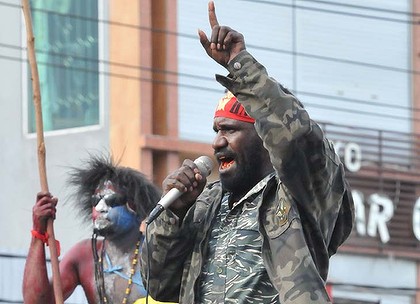
Law student says that Papuans don’t feel safe anywhere

JUBI, 21 June, 2012

A Papuan who is currently studying law in Jayapura said that because of all the vertical and horizontal (conflict) problems, the Papuan people cannot feel safe anywhere in their homeland which is now under Indonesian control.Sani Dominggus said : There is nowhere here where Papuans can feel safe, whether they are intellectuals or wealthy people, they are always regarded with suspicion.’

He said that the fact is that the security forces in Papua always treat Papuan people without the slightest sense of humanity and always handle them with the use of their firearms. ‘None of the personnel of the security forces behave towards Papuan people along ethical lines. All they do is shoot people.’

He said that this system of extreme repression has resulted in Papuan people never feeling safe. ‘How do they think we can live like this? Even when I just want to go for  a walk,  I dont feel that it is safe to do so There is always the feeling of being under threat.’

A clear example of this is that Mako Tabuni was unaccountably shot by the police. ‘How can the police say that he resisted the police? There were no plans to hold a demonstration, so why was he shot?’

‘If Mako Tabuni was regarded as a threat to the Indonesian state, the government should have used legal procedures. This would mean that he is sent a summons, then a second summons, and then a third one.But none of this happened. This means that when the police shot him dead, this was a gross violation.  of human rights.’

He went on to say that the arrest of Buchtar Tabuni did not occurr in conformity with legal procedures. The way the police behave has nothing to do with ethics, all they know is how act with brutality.towards everything that happens in Papua.’

He said that this will never help to solve the Papuan problem. ‘Everything that the government does only reinforces the independence aspirations of the Papuan people.’

‘The murder of Mako will only result in the emergence of more Makos,’ he said. He also said that the government should be putting into  practice the provisions of the Law on Special Autonomy for Papua such as for instance Article 2 which provides for regional symbols and for the existence of local political parties.’

[Translated by TAPOL]

Australia must show leadership on West Papua: Speech by Senator Richard Di Natale in Australian Parliament

From the Hansard, 20 June 2012. 

MATTERS OF PUBLIC INTEREST – West Papua

Senator DI NATALE (Victoria) (13:17): I rise today to express my grave concerns about a tragic situation that is unfolding on Australia’s doorstep at this very moment. I speak of the issue of West Papua, where alarming abuses of human and democratic rights are occurring. It appears that there has been a significant escalation in politically motivated violence over the past month. So it is timely to reflect on what is happening in a place that is one of our closest neighbours and the role we can play in ending the conflict and protecting the rights of the people who live there.

West Papua presents a challenge for Australian diplomacy and for the global community. It is a challenge that this nation and indeed the world is yet to meet. Although it is the world’s second largest island, New Guinea is a part of the world that rarely makes the nightly news. The western half of the island is West Papua. The situation faced by its people is something that deserves our urgent attention.

West Papua was one of the last parts of Asia to be decolonised. The Dutch retained control of the region when Indonesia gained its independence in 1949. The Netherlands took steps to prepare the territory for independence, which included the development of a national anthem and a national flag, called the Morning Star. Sadly, this independence was not to be. Indonesia had always claimed the province, and conflict between the Netherlands and Indonesia over West Papua resulted in armed conflict in 1961. In 1963 the New York agreement passed administration of West Papua over to Indonesia. West Papua was formally annexed to Indonesia in 1969, following what was then called the Act of Free Choice. Papuans call this the ‘Act of No Choice’. A true act of self-determination should have occurred, but it did not. The Papuans were denied their chance to vote on their future. Instead, there was an atmosphere of violence and intimidation, with 1,022 hand-picked Papuans assembled, cajoled, bribed and threatened into voting to become part of the Republic of Indonesia.

I am sorry to say that the people of West Papua have been waiting ever since for the chance to express their desires to chart their own future. Self-determination, a right belonging to all people, was denied to them. Indonesia fought long and hard for its own independence, so the Indonesians do understand the desire for self-determination. Indeed, they would consider themselves as the liberators of West Papua from colonial rule, which in my view is a sad irony, when we consider what has happened there since 1969.

The people of West Papua are Melanesian. They are ethnically, linguistically and culturally distinct from the majority of Indonesians. They are ruled from Jakarta by a government that often seems more interested in their resources and in what can be gained from the region than in their welfare. They have had to endure a new form of colonisation, and Melanesian Papuans are already a minority in some parts of West Papua. In fact, they may soon be a minority in the province as a whole if current trends continue. Papuans now face the outrage of being discriminated against in their own land, with the public service, business elites and security forces now dominated by non-indigenous Papuans.

The Papuans must watch powerlessly as their land is exploited. The Grasberg gold and copper mine, the world’s largest, is an environmental disaster but provides very few benefits to the people of West Papua. The Papuans have to watch as their land is patrolled by the Indonesian army. They are nominally Indonesian citizens, yet the army is not there to defend their rights—in fact, in many cases quite the opposite occurs. The results are as predictable as they are tragic. Tension grows daily, ethnic division is rife, oppression leads to violence and the Papuan desire for the right to choose their own future has never been stronger.

In October last year, the Third Papuan People’s Congress was held in Jayapura. Five thousand Papuans attended to have a say on their future, and it was a peaceful gathering. The right to gather and discuss their future is guaranteed by the Indonesian constitution, yet the meeting was disrupted by a military crackdown. At least three people were killed. Five leaders were arrested and have since been jailed for three years. There was not a word of protest from the Australian government.

Since then, the situation has worsened. In the past two to three weeks, there have been shootings, killings and military violence in Jayapura. There have been a number of separate attacks, with several people having been shot or stabbed. The accounts filtering through indicate that no arrests have been made. Police and the military blame Papuan separatists, but human rights defenders in Papua point the finger squarely at Indonesian security forces. The perpetrators of this violence must be identified through a transparent process.

We have also heard reports of Indonesian security forces sweeping the Papuan highland town of Wamena. They have caused at least two deaths, injured at least 11 people and torched at least 70 houses. This was apparently retaliatory action—police were retaliating for the killing of one of their officers by Papuans. The killing of the police officer, however, was prompted by his killing, on his motorbike, of a Papuan child. Unless those inflicting violence are held accountable, this cycle of violence will continue and worsen.

We have now heard news of Papuan leader Mako Tabuni being shot and killed by police on Thursday last week. He was walking on the street near a housing complex in a suburb of Jayapura. Mako Tabuni was the deputy of the KNPB, a group which has called for a referendum on Papuan self-determination and a movement which has publicly identified itself as a peaceful one. The Australian Greens are deeply saddened to hear of the killing of Mako Tabuni. We extend our condolences to Mako Tabuni’s family and we confirm our solidarity with the people of West Papua whose human and democratic rights continue to be violated.

Police say Mako Tabuni was resisting arrest and armed with a weapon he had taken from his arresters, but eyewitness accounts say that Tabuni, as he walked by alone, was suddenly and unexpectedly shot by a gunman in one of several cars on the street. Tabuni’s killing prompted angry scenes in Jayapura as Papuans protested his death. All of this has been taking place while many Papuans languish as political prisoners in Indonesian prisons, charged with treason for raising their flag, singing their traditional songs or expressing their political views. One example is Filep Karma, who has been in prison for over a decade for doing nothing more than peacefully protesting. I again call on the government to urge our Indonesian neighbours to take action to ensure that democracy and human rights are upheld in this region.

It has been a bloody few weeks in West Papua, adding to the horror experienced by the West Papuan people over many decades of Indonesian rule over their lands. Australians are now becoming more aware of these atrocities being committed on their doorstep. They know what happened in East Timor under Indonesian rule and they know that we, as a nation, cannot sit idly by while it occurs again in West Papua.

There is a petition due to be tabled next week in the House of Representatives, brought to the parliament by a community activist group based in my home state of Victoria and signed by more than 3,000 Australians. It calls on the Australian government to request that the United Nations review the New York agreement of 1962 and the 1969 Act of Free Choice and conduct a genuine, UN monitored referendum on self-determination in which all adult West Papuans are allowed to vote without duress. The petition also calls on the House of Representatives to stop all Australian financial support to and training of Indonesian military and security personnel until human rights abuses by military and security personnel in West Papua cease. It asks elected representatives to request the Indonesian government to remove the media blockade and allow international journalists free access to West Papua.

I have spoken before in the parliament about the desire of the Greens to see West Papuans free to express their political views without fear of persecution. But this freedom will not be realised until there is more international scrutiny. It is absolutely paramount that the region is opened up to journalists, who must be free to visit and report on the situation on the ground. The story of the West Papuans must be told. The truth must be told. Human rights organisations must also be allowed into the region. Until this scrutiny is applied, all we have to assure us that illegal acts are not occurring are the assertions of local authorities. It would not be wise, given the history, to take these assertions at face value.

I will continue to advocate for the human rights of one of our nearest neighbours until we see this important change. People should never feel the threat of violence or death simply for expressing their political views. We must advocate for a new dialogue between the Indonesian government and the representatives of the Papuan people. While in theory West Papua has special autonomy, this has failed the West Papuan people. It is time to start discussions afresh.

It is worth noting that Indonesia recently underwent its UN periodic review, a human rights review which occurs for UN member states every four years. This was an opportunity for fellow UN member states to make observations and recommendations about the human rights record of Indonesia. The review was held on 23 May and the Indonesian government accepted 180 recommendations from 74 countries. Indonesia adopted 144 of these, with the remainder to be brought back to Indonesia to be considered and decided upon in September 2012 during the 21st session of the UN Human Rights Council. Of the recommendations yet to be adopted, it remains to be seen whether Indonesia will address those relating to the protection of human rights defenders. It has been called on to free those people detained for peaceful political protests. It is unacceptable that someone like Filep Karma be detained for decades simply for expressing a right that all of us should be granted.

Among the remaining items that Indonesia has taken home to discuss, it has also recommended that they address issues of impunity and immediately take action on reports of human rights violations committed by the military and by police, particularly in Papua. I will be watching those responses with interest.

Beyond the UN periodic review, the world will be watching West Papua. There is new scrutiny on this region, with new technologies now enabling Papuans to convey messages, photos and video to the outside world. They are sharing their experiences of brutality and conflict despite the restrictions that prevent outside journalists from reporting in the region.

Here in Australia a group of young West Papuan activists are using online media and music to create awareness of the oppression their families are experiencing back home. I have met with many members of this group. In fact, I enjoyed their music. A group called the Rize of the Morning Star deserve to be commended for their advocacy and activism on this hugely important issue. It is a project that is capturing the hearts and minds of many Australians through music, telling the traditional stories of West Papua and asking us all to sit up and listen to what is happening in the region.

The petition that will be tabled next week is a notice to this parliament that thousands of Australians are outraged at the human rights abuses occurring in West Papua. I urge the foreign minister, Minister Carr, to take the concerns of these Australians to his Indonesian counterpart. I am also pleased that with several of my colleagues I will be inviting all members of this 43rd Parliament to join us in establishing a parliamentary friends of West Papua group. It will be an opportunity for us to collaborate across party lines on the complex issues facing our neighbours.

West Papua is a chance for Australia to show real leadership. It is a chance for us to show that we will stand up for the values of peace and democracy we so readily espouse. We can argue for a peaceful and optimistic future for Papua and remain a good friend of Indonesia. But it starts with facing the truth. We must face this truth before more blood is spilt.

Papuans allege Australian trained D88 personnel shot dead Mako Tabuni

Breaking News

West Papua Media

 21:00 (WPB) 14 June 2012

As tensions across West Papua ratchet up in the wake of the execution of KNPB leader Mako Tabuni, senior Papuan leaders accuse Australian and U.S trained Detachment 88 of being behind the slaying.

Domi Surabut, a senior Papuan Tribal Council leader from the Central Highlands sent West Papua Media the following message by sms at 21:35 tonight (AEST): “Mako Musa Tabuni was shot dead by Densus 88 with three bullets. Twice in the thigh and once in the stomach. His corpse is still being held at the Bhayangkara Police Hospital. His death will cause blood to flow. Please pray and urge peaceful intervention in Papua.”

As of 21:30 tonight the Indonesian police are still refusing to release his body to Tabuni’s family saying that they will bury him themselves.

As outrage builds church, tribal and independence leaders from the nonviolent movement are urging their followers to maintain discipline fearing that a violent reaction will give the TNI and Indonesian police all the justification they need to crush the independence movement.

In a text circulating around activist circles Selphius Bobii, a political prisoner writes “The killing of Tabuni is part of a scenario to destroy the Papuan struggle’s commitment to a peaceful path and push Papuans towards violence. So let’s control ourselves. Don’t get caught in this scenario which will only weaken our peaceful struggle that right now is echoing across our country and up to the UN.”

As armoured personnel carriers, water cannons and heavily armed troops position themselves around the streets of Jayapura tonight that commitment will be sorely tested.

WPM 22:00 (AEST) 14 June 2012

KNPB leader Mako Tabuni shot dead by Aust-funded Indonesian Detachment 88 troops; riots in Jayapura

Breaking News
West Papua Media

June 14, 2012

Angry scenes have reportedly erupted in Jayapura and across West Papua after officers from the Australian- funded and trained Detachment 88 counter-terror troops shot dead the secretary-general of the West Papua National Committee (KNPB), Mako Tabuni, during a botched arrest attempt while he was chewing betel nut at a kiosk in Abepura, West Papua early on Thursday morning.

According to credible independent church human rights sources in Jayapura that spoke to witnesses in Waena, Mako Tabuni was shot and wounded by heavily armed Indonesian police as they stormed

image
Mako Tabuni as he lie dying in Jayapura (KNPB/ westpapuamedia)

the area outside the student dormitories at the Cenderawasih University Abepura.

Mako Tabuni.

Senior members of KNPB have told West Papua Media that Tabuni had been walking with friends to buy and eat Betel Nut from a kiosk near the university.  After he separated from his friends, they heard gunshots. and  they saw a white Avanza car drive up and ambush Tabuni, according to his friends.  Tabuni was shot at least six times, according to both witnesses and journalists in Jayapura.

image
Mako Tabuni as he lie dying in Jayapura (KNPB/ westpapuamedia)

Police took Tabuni to the police hospital in Jayapura, where he reportedly died from his wounds soon after arrival.  The Kapolres (police chief) has told media outlets including West Papua Media via SMS that Tabuni was killed because he resisted arrest and attempted to seize the weapons from the Detachment 88 troops.   According to the It has been confirmed independently that the Australian-funded and trained Detachment 88 troops were in command of the arrest operation.  Tabuni was unarmed at the time of his arrest, which is a violation of the United Nations Basic Principles on the Use of Force and Firearms by Law Enforcement Officials.

KNPB contacts report that a combined team of military and POLRI, BRIMOB, Detachment 88, and Intelligence officers are raiding dormitories of Papuan students in Abepura, chiefly those of highland origin students who are the traditional support base of the KNPB.    In this sweep, security forces have confiscated books, bags, clothing, computers, phones, and cameras.  Security forces are also conducting searches across Abepura, Jayapura, Kotaraja, Waena, Sentani and several other places.  Many students have been severely beaten and arrested in dormitories in Waena and Asrama by over six companies of Indonesian army (TNI) and Police. KNPB sources have expressed fear that the students, already beaten severely and taken to Rusunawa police centre, will be tortured and possibly killed by occupation forces.

Supporters of Tabuni have reacted angrily and have taken to the streets and are allegedly burning houses belonging to military and police in the Ruko, Waena and Abepura areas, in an eerie reversal of the June 4 rampage by Indonesian soldiers in Wamena.

Security forces are reportedly on the streets with orders to shoot rioters dead on sight, and the situation is described as extremely tense.  It is not clear if those who have caused property damage are in fact  members of the pro-independence movement, or are undercover Indonesian intelligence officers.

A senior highland human rights activist in Jayapura, whom West Papua Media cannot identify for safety reasons, told West Papua Media that the entire Papuan population is living in a state of constant trauma and fear due to the escalation of Indonesian repression.

“Pro-Independence activists and Papua human rights workers have become the operating target of the (ongoing)shootings, not to mention all the KNPB activists the security apparatus are seeking,” said the source.

“Finally, I spoke with three of our members hiding in the suburbs.  If the Indonesian security forces are still after us, then they would not want or like it if we had entered the woods and hid,” he said.

” To step into the forest is for avoiding premature death.”

Papuan activists are calling for urgent international attention to the rapidly deteriorating humans rights crisis in West Papua.  A senior KNPB activist has begged: “In this case our nation is pleading for UN Intervention to be done now, because Indonesia is planning to kill all us Papuans.”

More to come

Yapen TPN HQ raided by Kopassus as state repression intensifies across remote island

by West Papua Media

May 31, 2012

NEWS

Intensification of Indonesian security force repression on Papuan non-violent activists and ordinary villagers is allegedly occurring across Yapen Island, in response to escalating demands for freedom from violence, according to credible human rights sources on the island.

A massive raid has also been carried out by Australian-trained Detachment 88 and Kopassus special forces of the Indonesian National Army (TNI) early on May 29 on the jungle headquarters of the Yapen branch of the pro-independence National Liberation Army (TPN-OPM) near the village of Wadapi, Angkaisera district, Yapen.

Yapen Island – in yellow

Local human rights workers have told West Papua Media that many houses had been set on fire after the midnight raids and
weapons were discharged repeatedly by the combined Indonesian military and police force under the command of the Head of
Police (Kapolres) in Serui, Royce Harry Langie S.IK MH, and the District Military Commander (DANDIM), Letkol Inf Tornado.  No confirmed reports of any shooting victims have come to light thus far, however West Papua Media has received credible claims that civilians who fled from the raids into the night may have sustained gunshot injuries from Indonesian troops firing into
houses, though this cannot be confirmed independently.

Reports that local police and military commanders have begun to call in major military reinforcements from across Indonesia are increasing fears of an imminent military assault on local villagers, causing many civilians to flee to forest for safety, human rights sources have told West Papua Media.

Forces from the pro-independence National Liberation Army (TPN-OPM) on Yapen have responded to fears of “all out war” between pro-independence and Indonesian occupation forces and have called for calm, ordering all TPN-OPM taskforces active in the area to not respond with violence to Indonesian brutality, citing concerns for the safety of local villagers, according to local independent local media source Warta Papua.

Local human rights sources have reported to West Papua Media that troops from the Police special forces Brimob and Detachment 88, backed up by Kopassus and Kostrad (Strategic Reserve) troops from Citanjung (Kopassus headquarters in Jakarta) and from Cenderawasih Battalion in Jayapura.

Additionally, Kopassus and Kostrad troops from the notorious Kapuas district, Kalimantan battalion of Kopassus have been deployed with the other units in many villages, in Wadapi, Wanampompi & Sasawalast and several other unnamed villages in the Angkaisera district. “We are very worried, as the addition of troops from Borneo… are known as army troops who are very sadistic in torturing civilians,” a local human rights worker told West Papua Media via SMS.

The joint taskforce troops have claimed to the TNI-owned Cenderawasih Post that they have broken a major TPN guerrilla base, however the only weapons seized were a traditional hunting poison blowpipe, a handful of traditional hunting spears, bows and arrows, two parang knives (used for preparing food), and two banned Papuan Morning Star flags.  These items can be found in almost any rural dwelling in Papua, especially where residents have to supplement their food with animals from the forest.

Several other items were also seized, including cooking and farming equipment, and two 15 year old broken computer printers, which the TNI claimed was proof of a TPN headquarters.

Two men have been arrested and are currently being interrogated by Kopassus and D88 intelligence officers, with the TNI boasting that they are being intensively processed at the Yapen Police HQ in Serui.  Local human rights sources have expressed grave fears for the safety of the detained men, amid credible fears that they will be subjected to harsh interrogation techniques and torture by the Australian trained and funded Kopassus and D88 officers.  At this stage no legal representation has been afforded to the detainees, with one identified as Wanampompi man John Nuntian.  There is also believed to be an unkown number of ordinary villagers who have been detained, and their whereabouts and status is currently unknown.

As the raids were occurring, several hundred TPN/OPM fighters have taken to the forests, and the TNI Dandim, LtKol Tornado, has told Cenderawasih Post that the campaign is intensifying to eradicate all those who are resisting the Indonesian military.  He says that the estimated 230 fighters will be hunted down and the his forces will remain to conduct lightning sweeps on any village that gets named in intelligence investigations.  These sweeps have traditionally subjected all its targeted villages to collective punishment, including mass burnings of houses and collective detention, acts clearly defined as war crimes.

Local sources have been unable to get a precise number of Indonesian combat troops occupying Papuan villages in Yapen, but credibly estimate to be upwards of two battalions of active combat personnel spread across twelve villages (at least 3000 combat personnel from standard battalion strengths – WPM), including specialists from Detachment 88.

Detachment 88 is fully funded by the Australian Federal Police, but the Australian government claims it is not funded to conduct operations against “separatist” or pro-independence forces, despite many documented cases of this occurring repeatedly in Papua. The Australian government has so far refused to make any sanction against the use of these forces in human rights abuses in Papua, instead increasing the budget and equipment it provides to D88.

Telephone communications with sources on the island have been sporadic, raising fears that security forces are restricting the phone network ahead of a major assault, making these reports difficult to verify independently by West Papua Media.  However this activity is consistent with a more aggressive approach taken by Indonesian occupation forces against Papuan independence sentiment.

Indonesian police on Yapen have come under fire for their consistently brutal policies toward Papuan people.  On May 1, thousands took to the streets to call for the expulsion of the Kapolres, Royce Harry Langie, and DANDIM, Letkol Inf Tornado, for atrocious behaviour, human rights violations, and violations of the Code of Conduct with the Indonesian military and police regulations.

westpapuamedia

Create a website or blog at WordPress.com

Up ↑