AMNESTY STATEMENT: Security forces block peaceful demonstration in Papua

AMNESTY INTERNATIONAL
PUBLIC STATEMENTIndex: ASA 21/031/2012
10 August 2012

Indonesia: Security forces block peaceful demonstration in Papua

Amnesty International calls for an independent and impartial investigation into reports that police used unnecessary and excessive force to disperse a peaceful demonstration in Papua province commemorating International Day of the World’s Indigenous People on 9 August 2012.

If the investigation finds that the security forces committed human rights violations, then those responsible, including persons with command responsibility, should be prosecuted in proceedings which meet international standards of fairness, and victims provided with reparations.

At least seven people were arbitrarily arrested during and after the demonstration and are being held at the Yapen District police station. They should be released immediately and unconditionally if they have been arrested solely for the peaceful exercise of their right to freedom of expression.

Police Mobile Brigade (Brimob) and military from the 1709 District Military Command (Kodim) led by the Yapen District Police Chief blocked hundreds of peaceful protesters as they marched on the morning of 9 August 2012 in Serui, Yapen Island.

According to local sources, the Indonesian security forces then fired their guns into the air to disperse the protesters, causing many to flee in fear. At least six protesters were arbitrarily arrested during the demonstration and some were reportedly beaten by security forces during their arrest. The police then travelled to Mantembu village to arrest one of the demonstration organizers, a local political activist. When they could not find him they arrested his wife, who is reportedly eight months pregnant.

The actions of the security forces fly in the face of statements made by President Susilo Bambang Yudhoyono in February 2012 that he wanted an end to repressive actions by the military and police in Papua.

The rights to freedom of expression and peaceful assembly are guaranteed in Articles 19 and 21 of the International Covenant on Civil and Political Rights (ICCPR), to which Indonesia is a state party. Moreover, these rights are protected under Indonesia’s Constitution. However, Amnesty International has documented dozens of other cases of arbitrary arrest and detention in past years of peaceful political activists in Papua.

Amnesty International continues to receive credible reports of human rights violations committed by the security forces in the provinces of Papua and West Papua, including torture and other ill-treatment, unnecessary and excessive use of force and firearms by the security forces and possible unlawful killings. Investigations into reports of human rights violations by the security forces are rare and only a few perpetrators have been brought to justice.

During a 2008 gathering to commemorate International Day of the World’s Indigenous People in Papua, peaceful demonstrator Opinus Tabuni was discovered dead with a bullet wound clearly visible in his chest, after police opened fire at the crowd. Despite a police investigation, to date no one has been held to account for his death.

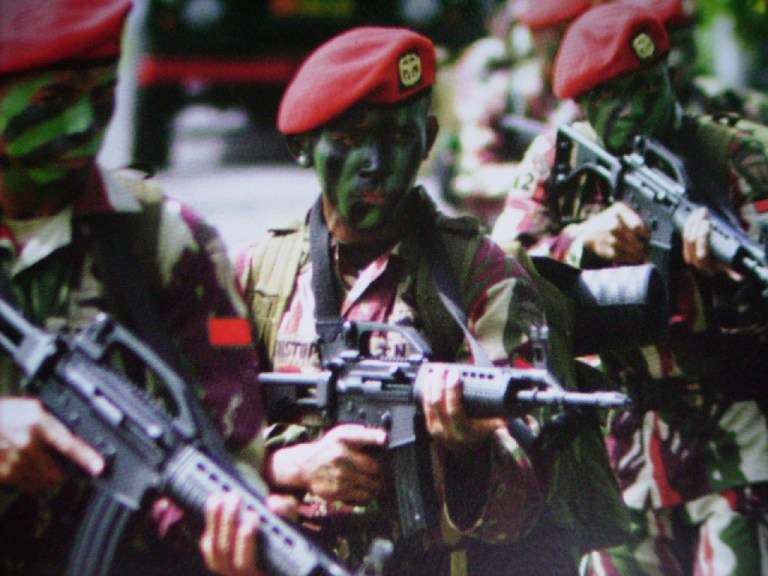
Kopassus claims to be pursuing ‘persuasive’ approach

The “persuasive” approach used by Kopassus
Bintang Papua, 4 July 2012
The commander of Kopassus, the elite strike force of the Indonesian army, Major-General Wisnu Bawa Tenaya declared during a joint training investigation with  China’s People’s Liberation Army in Shandong, China, that his men will continue to pursue the persuasive approach in its handling of the security disturbances in West Papua.He was quoted as saying: ‘We cannot the kind of actions that we would like to take but must act cautiously because in addition to security problems, other issues in West Papua need to be attended to, such as the welfare of the people.’

He also said that Kopassus forces plan to conduct expeditions in various parts of in West Papua to investigate the what is going on there and what it is that the people there actually want.’

Earlier on,  a representative of Kontras,  Indria Fernida, the chairperson of the Synod of the Kingmi Church, Revd Benny Giay and the secretary of the Working Group of NGOs in Papua, Septer Manufandu made it clear the military approach is still being prioritized in West Papua.

Moreover, the welfare approach that has for so long been proclaimed by the authorities was far from being pursued to any meaningful extent or in any way to the satisfaction of the aspirations of the Papuan people.

[Abridged in translation by TAPOL]

Gillard must raise West Papua with SBY in Darwin visit: AWPA

Australia West Papua Association (Sydney)
PO Box 28, Spit Junction, NSW 2088
Media release 1  July 2012

Aust PM to meet Ind President in Darwin. Should raise West Papua

Background 

1st Indonesia-Australia Annual Leaders’ Meeting – Joint Communique

http://www.pm.gov.au/press-office/1st-indonesia-australia-annual-leaders-meeting-joint-communique


————————————–


Australia West Papua Association (Sydney)

PO Box 28, Spit Junction, Sydney, Australia 2088

The Hon Julia Gillard MP

Prime Minister

Parliament House

Canberra

ACT 2600


1 July 2012

Dear Prime Minister,

On behalf of the Australia West Papua Association (AWPA) in Sydney, I am writing to you concerning the deteriorating  human rights situation in West Papua.

In the past two months there has been a large number of shooting incidents in West Papua by unknown assailants. The Indonesian security forces have tried to blame the attacks on the Free Papua Movement (OPM) however, the OPM has denied involvement in the attacks.

What is not in doubt is the attack on the village of Honai Lama, a sub-district of Wamena in the Baliem Valley by the  Indonesian security forces in which one person has been reported killed and up to 17 wounded and a large number of houses set on fire. There have also been reports that the military and police on Yapen Island have conducted military operations in villages looking for  peaceful political activists which the security forces  claim are so-called separatists. These military operations are creating a population living in fear from the security forces.

The security forces in West Papua have been targeting peaceful activists including members of the West Papua National Committee (KNPB). In one horrific incident the security forces killed Mako Tabuni, deputy chairman of the KNPB. The police claimed he was armed and resisting arrest but witnesses said he was not armed and shot by men in plain clothes from a passing car. 
 Some media reports have also said the Australian trained Detachment 88 was also involved in the killing.

As you will be meeting with President Susilo Bambang Yudhoyono at the 2nd Indonesia-Australia Annual Leaders` Meeting in Darwin in the next few days, we urge you to raise our concerns about the attacks against the civilian population by the Indonesian security forces in West Papua.

We note that in the official communiqué from the inaugural Indonesia-Australia Annual Leaders’ Meeting in Bali in November 2011, the statement that the two countries would work together on

“the promotion of democracy, good governance, human rights, the rule of law and capacity building”.

and on the defence relationship

“Reinforcing our comprehensive security cooperation, both leaders directed senior officials of both countries under the Security Cooperation Consultation Group to review existing cooperation, and to coordinate and set priorities under the Plan of Action of the Lombok Treaty.  Both leaders also further encouraged the finalisation of the Defense Arrangement as a basis for an enhanced defence cooperation between the two countries”.

In the wake of increased violence in Papua it would appear that the Indonesian Government is failing in its attempts to bring democracy, good governance, human rights and the rule of law to the territory.

As Australia helps train the Indonesian military and in particular Detachment 88, we have to accept some responsibility for the Indonesian security forces behavior in West Papua.

I urge you to raise the human rights situation in West Papua with the Indonesian President asking that he control the security forces in West Papua and urging him to order the security forces to return to their barracks as a way of avoiding further escalation of an already tense situation.

Yours sincerely

Joe Collins

AWPA (Sydney)

Human Rights Workers: Those who shot Tabuni must be brought to justice

Mako Tabuni Shot Dead
Mako Tabuni Shot Dead (Photo credit: AK Rockefeller)

JUBI, 25 June 2012

According to the Network for Law Enforcement and Human Rights in the central highlands, JAPHPT, the Criminal Code requires that those who were responsible for shooting Mako Tabuni should be brought to justice.

If the police believed that Tabuni was the mastermind of all the shootings, they should have arrested him and produced evidence of this. The chairman of the JAPHPT,  Theo Hesegem, said that the way the police had handled the arrest, along with the shooting of Tabuni, had eliminated any evidence  they might have had about what Tabuni was carrying.

They have also, in the process, demonised the Papuan people and damaged Indonesia’s reputation in the international community.

Indonesia is a state that recognises the rule of law and should act in accordance with the Criminal Code regarding the person who shot Tabuni.

Meanwhile, the chief of police  of Jayapura City, AKB Alfred Papare now admits that its reputation has been damaged by the shooting of Tabuni. He went on to say however that the police  had acted in accordance with police procedures because of reports that the victim was in possession of a firearm.

Translated by TAPOL

Police urged to publicise the photo of Mako Tabuni’s bag

JUBI,  26 June 2012

The Papuan people are still very concerned about the shooting of Mako Tabuni on 14 June. Alius Asso, chairman of the Nayak Asrama  in Abepura, has called on the police to publicise the photo they took of Mako Tabuni at the time of the killing, which shows the bag that he was carrying at the time.

‘We want the security forces to show us the photo of the bag he was carrying. This is very crucial because the police have alleged that Tabuni had a pistol and bullets in his bag.’

The photo was taken as Tabuni was standing eating a snack at Perumnas III Waena, Asso said: ‘This is very strange  How would he have got hold of a  pistol and bullets? It is up to the police to prove this,’ he said.

He also denied that Mako Tabuniwas was in any way responsible for the shooting of a German at Base G and for the series of shootings that occurred at the time. ‘What proof do the police have of this? They should have arrested Tabuni and questioned him instead of shooting him dead.’

Asso went on to say that Mako Tabuni was not a terrorist. On the contrary he was involved in the struggle of the Papuan people.

It should be recalled that the police told journalists that they had been forced to shoot Tabuni because he was trying to resist as they arrested him. They also alleged that they found sixteen .38 calibre bullets in his bag.


Translated by TAPOL

Create a website or blog at WordPress.com

Up ↑
