New Matilda: Australia Is Policing Separatism

from our friends at NewMatilda.com

NM INVESTIGATES

5 Mar 2012

By Marni Cordell

densus

Indonesia’s counter-terror unit Detachment 88 is funded and trained by Australia. Why are we so involved with a unit whose work includes counter-separatist activities? Marni Cordell reports from Jakarta

When politicians in Australia hail the success of Indonesia’s counter-terror forces in catching, charging — and often killing — the country’s top terror operatives, it’s Detachment 88’s work they are talking about.

Detachment 88 is an elite counter-terror unit within the Indonesian National Police that was formed in the aftermath of the 2002 Bali Bombings. It is funded and trained by Australia, and enjoys close co-operation with the Australian Federal Police.

Noordin Top, Dulmatin, Abu Bakar Bashir, Umar Patek have all been apprehended since the force became operational in 2003. Jakarta-based terror expert Sidney Jones calls them “the top of the top” — and Australia’s training and money have been instrumental in their success in disarming Indonesia’s significant terror network. According to DFAT, Indonesian authorities have convicted over 470 terrorists and their accomplices since 2000.

But there are growing concerns about what else they are using that deadly efficiency for — and although we train and fund them, we exercise little control over their operations.

When Detachment 88 was accused in 2010 of torturing independence activists in the Indonesian province of Maluku, the AFP and Australian Government said they were concerned about the allegations but had “no mandate to investigate the conduct of foreign police within another country”.

But the incident was not an isolated one — now, activists in West Papua claim Detachment 88 is being deployed to hunt down not only armed resistance fighters, but also civilians with ties to the independence movement, in what appears to be a growing campaign of intimidation.

I met Eric Sonindemi, a participant in last October’s Third Papuan People’s Congress, in a cafe in Jakarta. He told me that soon after their arrival from Jakarta, a surge of Detachment 88 personnel was involved in the deadly attack on Congress, in which six people were killed and many others wounded.

“Most of the security forces were in plain clothes, but they weren’t really concealing their weapons — they were sort of showing off,” Sonindemi told NM. “Detachment 88 was there,” he said, explaining that he “saw their equipment and riots shields”.

On the last day of Congress, Sonindemi was as surprised as other participants when the police and military opened fire because the gathering had been peaceful. “Everyone thought it was going to be safe because the event ended peacefully and [Congress leader] Forkorus Yaboisembut thanked the police and Indonesia for their support. People went home thinking they were safe,” he said.

But then security forces began firing indiscriminately into the dwindling crowd.

“I was in a nearby monastery when the shooting started — which wasn’t until about 30-45 minutes after the Congress had ended,” Sonindemi said.

“I hid in one of the brothers’ rooms and put on one of his robes, pretending to be a student. Soon the fully armed police and military arrived. They used tear gas and threatened to ransack the place before taking away a number of people, who were all told to squat and crawl toward the sports field.”

“Hundreds of people were detained that night and many of them were beaten in detention. I spoke to one person who had a gash in his head, a broken nose and bruises on his face. He had been beaten with the butt of a rifle by a policeman.”

“He was subsequently released and never charged with any crime.”

Sonindemi explains that the security situation in Papua has “really been heating up” since August last year. “Before August, the police and military would not come in big numbers if there was a public rally. That has changed now,” he told New Matilda.

According to Jakarta Globe journalist Nivell Rayda, who has been investigating Detachment 88, there has been a marked shift by the force in recent months toward policing “separatism” — rather than terrorism.

When I spoke to Rayda last week in the Jakarta Globe newsroom he said he believes this is because Indonesia has not had a major terror attack since the second JW Marriott bombing in 2009 — and says he noticed a similar trend between 2005 and 2009, when there was also a period of relative calm.

“Detachment 88 being somewhat of an elite unit, being funded and trained by foreign countries… they just lay dormant — their resources, their equipment and their tactical abilities, and investigation techniques just laying dormant for years,” he told NM. It was during this period that the unit was involved in the torture of local independence activists in Maluku.

“In 2009 we had another major attack, but since then we’ve arrested nearly all the major players and terrorism suspects … there haven’t really been any major terrorism events taking shape, and it looks like the pattern seems to repeat itself: Detachment 88 has been engaging once more in non-terrorism issues, including [counter] separatism,” he said.

Rayda agrees that Detachment 88 is not only pursuing armed resistance fighters, and cites a case in August last year in Nafri, Papua, in which two young girls were detained among a group of 15 people after a fatal shooting attack on a public minivan.

The OPM was blamed but denied involvement and Detachment 88 was dispatched to help local police with the investigation. Nivell told New Matilda, “After Detachment 88 stepped in, they arrested 15 people — including a 7- and an 8-year-old girl. These 15 people were beaten, they were tortured, they were arbitrarily detained and treated inhumanely.

“But the following day, they released 13 of them. So only two of them were responsible for the shooting, and the other 13 were innocent — but they were beaten as well.”

Eric Sonindemi said mass arrests are a common tactic used by police in Papua to intimidate people and weed out the perpetrators.

A Jakarta-based security analyst who asked not to be named admitted when I met with them last week that they held concerns about Detachment 88’s loose definition of terrorism — but claimed the force was “moving away from [policing separatism] now”.

“Detachment 88 has been sent to Papua in certain cases where the local police don’t have investigative skills, but it’s more to help in the investigations than to engage in raids,” the analyst told NM.

“The exception to that was the… death of [OPM leader] Kelly Kwalik in December 2010, which did involve Detachment 88.”

But Rayda disagrees. In fact when he asked the Indonesian National Police why Detachment 88 were involved in raids against OPM members that displaced thousands of villagers in Papua’s Paniai in December last year, he says the police were quite up front about the fact that they believe “terrorism is not only limited to bombings and militants and stuff like that. It also extends to separatism”.

An Australian funded and trained elite counter-separatist force? This was not the Australian government’s intention when it began pouring millions of dollars into the Indonesian counter-terror effort after the Bali bombings. Both the 2002 MoU with Indonesia on combating international terrorism, and the MoU on police co-operation between our two countries, focus firmly on transnational, not local, crime — and the AFP says Detachment 88 has not sought assistance from Australia in any investigations or operations to counter internal separatist movements.

However, the Australians do admit to working very closely with the Indonesian National Police at Jakarta headquarters, where Detachment 88 is now controlled.

New Matilda asked the AFP how much they know about Detachment 88’s operations before they take place. We also asked the minister for Home Affairs, Jason Clare, whether Australia condoned a definition of terrorism that included peaceful expressions of dissent.

We did not receive a response by the time of publication.

Detachment 88 has a distinctive owl logo but Nivell Rayda say locals recognise their presence because, unlike the local police, they carry foreign-made weapons and wear balaclava-like masks. Curiously, Detachment 88 officers are commonly issued with Steyr assault rifles — an unusual rifle to be used by Indonesian forces. The Steyr is standard issue to Australian troops and is manufactured by Australian Defence Industries in Lithgow NSW.

Rayda has spoken to a number of activists in Papua and Indonesia’s other trouble spots who have noticed officers from the elite unit at rallies and during raids.

Sonindemi agreed when I met with him that, “The understanding that Detachment 88 are in Papua now is quite widespread”, and told me he was deeply concerned about the situation.

“Usually in Papua conflicts emerge because of increased troop deployment. It’s usually the source of the problem.”

This is the first article in an ongoing NM investigation of Detachment 88 and Australia’s role in the Indonesian counter-terror effort.

Lawyers urge Australian Government to speak out over Papuan treason trials

Media Release

Human Rights Law Centre and

International Lawyers for West Papua

1 February 2012

The Australian Government’s silence on human rights abuses in the region has once again been put in the spotlight, with the Human Rights Law Centre (HRLC) and International Lawyers for West Papua (ILWP) urging the Foreign Minister to speak up in defence of basic rights such as freedom of expression and assembly.

Criminal trials have commenced this week in Jayapura, against five Papuan political activists charged with criminal offenses following their involvement in last year’s peaceful assembly at the Third Papuan People’s Congress. The activists were among the hundreds of people arrested after Indonesian police and military forcibly shut down the gathering, killing at least three people and injuring approximately 90 others.

HRLC spokesperson, Tom Clarke, said the fundamental rights of all persons to freedom of expression, peaceful assembly and association are protected by International Covenant on Civil and Political Rights – which Indonesia ratified in 2006.

“These fundamental human rights must be recognised and respected by Indonesia. The exercise of such democratic rights and freedoms must be protected by law, not criminalised.

“Australia’s UN Security Council bid pitches us as a ‘principled advocate of human rights for all’. This is a prime opportunity for the Foreign Minister to take a principled stand against human rights abuses on our doorstep,” Mr Clarke said.

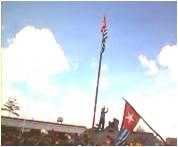
The Papuan activists, Forkorus Yaboisembut, Edison Waromi, August Makbrowen Senay, Dominikus Sorabut and Selpius Bobii, are facing charges of treason in a region where people may be imprisoned for simply raising the West Papuan ‘Morning Star’ flag.

ILWP’s Jennifer Robinson called on the Australian Government to use its unique relationship with Indonesia to encourage the authorities to demonstrate their respect for human rights by dropping charges against the five activists.

“These trials should stop immediately, and Australia should do everything it can to help that happen. The prosecution of activists for peacefully expressing their political views has no place in a modern democracy. The Australian Foreign Minister, his department and embassy staff in Indonesia should make it very clear that the Australian Government firmly supports human rights and freedom of expression in the region,” Ms Robinson said.

Ms Robinson also called on the Australian Government to deploy embassy staff to observe the legal proceedings for the purpose of ensuring that the protesters receive a fair trial.

The trial is scheduled to resume on Wednesday 8 February.

For further comments:

please contact West Papua Media +61450079106 for contacts

West Papua- December 1 2011 – Breaking the Media Blackout

50 years ago on the 1st of December 1961, West Papuans flew their flag for the first time in preparation for their independence from the Dutch.

In 2011, despite ongoing repression, the Morning Star flag was once again flown across the country. The non-violent demonstrations and gatherings, as well as the military crackdown against them, were reported to the world via a network of citizen media journalists, breaking through the media blackout of West Papua.

This short wrap-up shows how the West Papuan people would not let outrageous threats of Indonesian state violence suppress their desire to declare their independence.

[vimeo http://vimeo.com/34163958]

Time to change Australia’s involvement in West Papua offensive

PRESS RELEASE: ACT FOR PEACE

Act For Peace
http://www.actforpeace.org.au/Be_Informed/Latest_News/Time_to_change_Australia_s_involvement_in_West_Papua_offens.aspx?cat=West%20Papua

23/12/2011 11:03:39 AM

Reports are emerging this week that the helicopters from which 17 West Papuans were recently shot are those of an Australian-owned mining company, Paniai Gold. Further, this ongoing Indonesian offensive involves counter-terrorism unit Detachment 88, which has been trained by Australia.

This Indonesian joint military-police offensive reportedly also burned down the villages of Toko, Badawo, Dogouto, Obayoweta, Dey, and Wamanik, with 20,000 people now displaced. Images reported in Australian and international media show more troops being deployed to West Papua.

Act for Peace is calling on the Australian Government to urgently request that the Indonesian authorities cease any attacks impacting civilians, and that Indonesia and Paniai Gold account for their alleged actions relating to the civilian deaths and forced displacement.

Media is strictly controlled in the region, making the need to pursue a full account more important. The large-scale offensive is in retaliation to the killing of two Indonesian police by Papuan guerrillas in Paniai.

Prior to this operation, in October six unarmed protesters were reportedly killed and many more injured at the Third Papuan People’s Congress.

Act for Peace, the international aid agency of the National Council of Churches in Australia, is also concerned at the targeting of church leaders and communities and the occupation of church buildings, in particular the Kingmi Theological College in Paniai, harassment of Kingmi Church of Papua Moderator the Rev. Benny Giay, and the attack on staff, students and destruction of property at the Catholic Church’s Fajar Timur Theological College in Abepura by the Indonesian police and military on October 19.

We also call on the international community to ensure the Indonesian authorities allow church and Congress leaders in West Papua freedom of expression of their views and rights without fear of persecution.

Act for Peace has supported programs in West Papua including training young community leaders, raising awareness of and helping to prevent the spread of HIV/AIDS and growing small businesses to help strengthen the West Papuan economy.

West Papua is the western half of the island of New Guinea, with an indigenous Melanesian population. December 1, 2011 marks the 50th anniversary of the declaration of West Papuan independence from Holland. It was forcibly taken over by Indonesia a year later.

Reports show more than 100,000 Papuans are estimated to have died from military operations since Indonesia took control. State-sponsored migration from other parts of Indonesia has now left the indigenous Melanesians a minority in West Papua.

It is time Australia, as a good international citizen concerned about the protection of civilians, did more to ensure the safety of our neighbours.

Alistair Gee
Executive Director, Act for Peace

Update on military operations in Paniai and Australian involvement

Alex Rayfield

22 December 2011

Human rights defenders in Paniai report that searches were recently carried out in the Badauwo, Geko and Kinouv area of East Paniai. Shooting was also heard in the vicinity of Mt Wege.

Local human rights defenders remain adamant that Australian and U.S trained and funded Detachment 88 police and military counter terrorism troops are still involved in the search for John Yogi, the Paniai based commander of the West Papuan Liberation Army (or TPN as it is known in Indonesian).

On Tuesday 20 December in Nabire the Head of Police (Kapolres) in Paniai, Mr Siregar urged John and Salmon Yogi to give themselves up. A local Brimob commander also told local press and community leaders gathered at the Nabire police station that Salmon Yogi had been wounded.

According to a source present at the meeting the Brimob commander said that military operations “would continue until John and Salmon Yogi and the men under their command either surrendered, were arrested or were shot dead”. The police commander also told people not to be scared; that the police would protect them and that they would be still be able to celebrate Christmas.

The Office for Justice and Peace in Paniai reports that Yogi has six men under his control and a total of two firearms. It also believed that the men’s wives and children are also with them.

The town of Enarotali is also not safe. Church leaders report that there has been shooting in Enarotali. The latest gunshots occurred on Tuesday 20 December at 6pm and again on Wednesday 21 December at 1am and 5am. A local church leader told West Papua Media that “local people are scared and in a state of panic”.  A woman whose family lives in Enarotali told West Papua Media that her uncle went to the toilet at night and was shot and wounded by a sniper.

Despite the ongoing military operations human rights defenders, church, tribal and community leaders in Paniai are publicly calling for the Indonesian military and police to cease operations.

In relation to the alleged involvement of the Australian mining company Paniai Gold, it has now come to light that there are two gold mining companies operating in the area. Komopa (or Haji ARI – the exact name is still unclear) is believed to be an Indonesian owned company located in the vicinity of the Degeuwo River. Paniai Gold, a wholly owned Australian subsidiary of West Wits, is based on Derewo River.

According to local sources at 2pm on Tuesday 21 December the police again hired a commercial helicopter to carry out military operations. In a report provided to West Papua Media it is stated that the helicopter used on the 21 December was owned by the Haji ARI Company. In the same report it is alleged that the military and police flew over a camp (a blue tent) in the forest and proceeded to shot into the camp from the helicopter.

It is not clear to what extent the two companies share the use of the helicopters used in recent military operations against the TPN, given they allegedly share the same base in Nabire.

There are many unanswered questions about the military operations and extent of Australia’s involvement.

A key question concerns whether Indonesian military and police (including Brimob) providing security services to Paniai Gold were involved in the large-scale military operations against the West Papuan Liberation Army based at Eduda, and to what extent the Australian embassy helped facilitate Paniai Gold’s operations.

And despite Canberra’s denials that Australian and U.S. trained and funded D88 troops are involved in hunting down so-called separatists, there is mounting evidence that this is exactly what D88 are doing in West Papua. Papuan human rights defenders and their supporters continue to argue that Australian and U.S. support for the Indonesian military only help “create more efficient human rights abusers”. Despite this, the Australian government conducts no independent monitoring and evaluation of Australian taxpayer’s money provided to the Indonesian military.

There are also concerns about the role of the local and central government. Papuans are asking questions about who is funding the military operation. What is the role of the local Bupati and local government? Why won’t the Indonesian President, Susilo Bambang Yudhuyono cease operations when it is clear that ordinary villagers are dying as a result and that Yogi and his men have only two modern weapons between them?

West Papua Media, an independent media outlet working with a local network of citizen journalists, will continue to monitor the situation.

Create a website or blog at WordPress.com

Up ↑