Yusak Pakage: ‘I was arrested for being a former tapol.’

by OKTOVIANUS POGAU of SuaraPapua.com
5 December 2012Jayapura: ‘I was arrested because of my having once been held as a political prisoner (tapol),’ said Yusak Pakage, a Papuan activist. who said that the charge against him was a frame-up, alleging that he was dangerous just because he was carrying a knife.

He made this statement to suarapapua.com on 4 December, following a hearing at the Class 1A district court in Jayapura  He said that as soon as he was arrested on 27 July this year, he was taken to a police command post and questioned about his behaviour towards a court official, Sefnat Fonataba.

‘Soon after, Fonataba came to the police station and told the police there that there was no problem with me and apologised to me for what he had done.’  The policeman asked Pakage to write a statement  saying that there was no problem between him and the policeman which is what he did.

When he was about to sign the statement, the chief of police in Abepura came along and said that he had other instructions about how to handle this case.

‘Shortly afterwards, I was taken to the police station where I was interrogated for quite a long time about the knife. I said that it was a very cheap knife, the kind of knife that you can find in any traditional market in Jayapura. It is just something I carry about with me for my everyday needs. I didn’t buy it in order to do something criminal, as the security people seemed to think.’

‘ I have never  heard anything about needing a special permit to carry an ordinary knife.The law in Indonesia is very confusing and I don’t know about any rule governing the carrying of a knife.  The chief of police said that he didn’t know who I was and wanted the case to be handled in the usual way.’ But according to Pakage, the police officer knows very well who he is and that he had previously been held as a tapol. ‘He was lying,’ said Pakage.’He just wanted it to be known that I had formerly been held as a tapol, when I was arrested along with Filep Karma in 2004 for carrying the  Morning Star flag.’

‘I frequently make statements about the human rights situation in Papua and take a leading part in many demonstrations, so of course he knows very well who I am.’

Pakage also said that during his interrogation, all his personal belongings were taken away, even including his ballpoint, and none of these things  have been returned to him.

On 19 August, he was transferred to the prison in Abepura and he is now waiting for his case to be completed and to hear the verdict of the judge.

Pakage used this occasion to warn his activist friends to be very careful and keep control of their feelings when they are doing anything to struggle for the rights of the Papuan people.

‘I tell them not to get too emotional and to learn from my own experiences which show that I can be arrested for something very trivial.’

Siman Pattiradjawane, the lawyer who is defending Pakage told reporters that the verdict in the case will be announced on 11th December.

Lanny Jaya KNPB leader arrested and maltreated

4 December 2012 Local KNPB activist arrested and maltreated

KNPBNews

Another activist of the KNPB (National Committee of West Papua) has been arrested by Indonesian Police. This time, it was the secretary-general of the Lanny Jaya branch of the KNPB.Athys Wenda was arrested while sitting in the waiting room of Wamena Airport. He was arrested at 7am on 1 December.  He was seized by the police,  taken to the police station in Lanny Jaya and maltreated there.

Dules Wamimbo, the chairman of the KNPB in the district of Lanny Jaya, said that Athys was also badly mistreated while in a cell of the local police command in Jayawijaya.

In a short message, Dules said  that while being held by the Wamena police, Athys  ‘was beaten until he was black and blue all over.’

Athys had been trying to peacefully mediate a conflict among the people of Lanny Jaya.

Athys and several of his KNPB colleagues  are being closely watched by Densus88 (Detachment 88, the Australian, US, And UK funded elite counter-terror unit that is being used against peaceful political activists outside its funding mandate).  Dules said that when an armed conflict broke out between the TPN (the military wing of the OPM) and the Indonesian military, KNPB activists tried to mediate this conflict but they were treated as if they were the military.

Dules said: ‘ We very much hope that the police will stop arbitrarily arresting people without clear evidence.’

[Translated by TAPOL]


“Victor, we are ready to wreak havoc and clash with all of you” : Reflections by an unrepentant leader

by Victor Yeimo

Witness: Participant Analysis

December 3, 2012

Police Captain Kiki Kurnia: “We’re Ready To Clash.”

“Victor, we are ready to wreak havoc and clash with all of you.”

Those are the words spat out by police captain Kiki Kurnia, who yesterday (December 1) led hundreds of fully-armed police officers to put a stop to the Long March of students and the people. I was very sad to hear these words so righteously issued by the police, who present themselves as being on the side of safety. Do the police want safety, or do they not?Yeimo-ditangkap
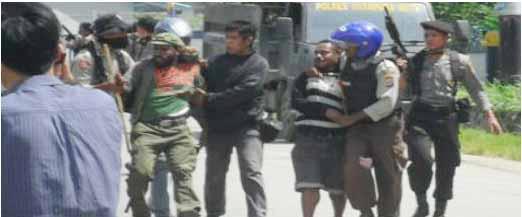
When I was the leader of the Long March headed for Expo Waena on December 1 in Sentani, police backed by the Indonesian military had already closed off access to the people of West Papua who would pray. Since the late afternoon (30/11), Theys H. Eluay field, which is the field of (great significance and sacredness to) the West Papuan national struggle, had been controlled by the military and by the national police, although all the civil society organizations had long since said that their prayers and celebrations would take place there.

On November 19, police entered a prayer room in Aula STAKIN in Sentani and tried to stop me as I was giving a reception after prayers, and then yesterday on December 1 the people wanted to worship and eat at the Theys H. Eluay field but were prohibited, blockaded and arrested by the full force of the military. The question is, why did the military and the police force deliberately take control of the field and then shamelessly hold a traditional stone cooking event (a Indonesian-appropriated Papuan Custom) with a handful of residents who were offered money?

If the police are tasked with security, why exactly is that security so insecure when facing inhabitants who are conducting prayers peacefully? Is the Theys H. Eluay field, owned by the traditional people of West Papua, only permitted for use by the Indonesian military and the police force? If the law is just, why wasn’t police captain Kiki Kurnia charged with incitement to violence? As he himself clearly  (attempted) incited the mass action I led to commit violence on the streets in front of Dian Harapan Hospital yesterday.

If the police prohibit students from campaigning to put a stop to AIDS on West Papua’s Independence Day, why must it be prohibited? Do the police not want HIV/AIDS awareness campaigns to take place? Isn’t his proof that the police are ensuring and championing ethnic cleansing in West Papua? Why do the police prevent worship on West Papua’s Independence Day? Why do the police see more political and economic motivations than the goodwill and intentions of the people who want to interpret December 1, 2012 as World AIDS Day, the opening of Christmas festivities and the Independence Day of West Papua?

I lead my people safely and with restraint. I have personally guaranteed that I will be arrested or shot if there is a criminal act committed by people, but why in the safe Long March were we forcibly dispersed and captured like animals? Actually, who was it that committed the crime? Was it the people, or the police?

The police did not only incite the violence that happened, but yesterday (1/12) the police, through (Adjunct Senior Commissioner) Alfred Papare, publicly lied. Myself and the masses did not throw rocks at the police, however it was covered by several media sources that the police chief said we did so. In an era of openness such as this, why is there a need for mutual deceit when everybody saw yesterday that the police had no reason to blockade, arrest and attack people with tear gas? After I “escaped” from Abepura Sub-District Command, I had not received a call from the Jayapura Chief of Police, the aforementioned Alfred Papare, as stated by Wakapolda Papua, Paulus Waterpau, to Tabloid Jubi.

Better for the Police to become the Social Services

The idea of Papua’s Chief of Police, Tito Karnavian, to give out groceries and distribute help the mountain people of Papua in Jayapura and the Jayapura municipality makes me wonder a little. Has the police chief already switched functions from a chief of police who must preserve security, only to become the head of the Department of Social Services who must give social support to the people? Is this country unhealthy? Money for providing support to the people is redirected into the Police Department and the Police Department takes over the functions of the Department of Social Services.

For me, the efforts of the police department to muffle and destroy the basis of the Papua Independence conflict are obviously speculative, as well as inappropriate. Go ahead, if the police department and the Republic of Indonesia believe that our ideology can be bought off with money. Tens to hundreds of millions have been redirected to the Asrama Rusnawa Uncen, since becoming the basis for conflict, and the police are very hopeful that students will regard them as righteous people, as kind people. Well, again, it is better that the Police Institution in Jayapura be renamed as the Department of Social Security or the Department of Education, so that matters concerning the improvement of the Asrama Rusnawa Uncen and student welfare can just be taken over by the police.

Does Indonesia believe that money can silence the aspiration and ideology of independence for the people of West Papua? I am convinced the people of Papua that are given money and material aid from the police are only making use of them, because within the individual West Papuan person there is a flesh-and-blood desire for Papuan Independence, however difficult it is. So, go ahead, half-dead police and a waste of money to the people of Papua. Go ahead and pan the sympathy and dreams of the people who have hated the occupation of this land. Almost half a century practicing the policies of the Republic of Indonesia, and all models of development cannot turn the people of West Papua into people of Indonesia. Papua will rise and awaken by itself alone.

Idea of Separatists and Terrorists is a project of the TNI and Police 

There are no separatists and terrorists in West Papua; only those who demand the right to self-determination as legally protected under international law. The idea of separatists and terrorists is created by the state to disgrace the legal struggle of the West Papuan people, and created by the Indonesian military and the police with a view to expanding their territory, and their wealth. For the sake of money alone, the circumvention of the state apparatus and the deception of the state apparatus, alias “bullshitting a lot” (direct translation).

My organization, the National Committee of West Papua (KNPB), struggles in peace and does not want to create chaos that will strengthen the funds of the military and the police force. Consequently, the national police force does not like peaceful action, because in a situation that is safe and peaceful, the military and the police force will be poverty-stricken. Many security institutions in Indonesia have hundreds of troops that must be paid by the state. Moreover in Papua, there are now many civilian militias formed by the state; thousands have been recruited, and must be paid. All are created with the objective of “stripping bare” the security responsibility from the Indonesian government in West Papua that fall under the name of “eradicating separatists and terrorists.”

Forgive me; my group and I will not accept food from the military or the police, so there is no need to criminalise or drop that bomb on the National Committee of West Papua to stigmatise us, so that the project money can be maintained. These ways have become commonplace, and we are bored of them. The people are smart, and getting smarter: they have already been taught these ruses by the colonialists. Ways such as this will finally tarnish the image of the Republic of Indonesia in West Papua. So it is best not to try to painstakingly search for such an image. Oh, and yesterday in Guyana, Member of Parliament told Benny Wenda: “Oppression alone will burn the spirit of the independence struggle.”

Why not kill me, or imprison me? Why was I released? Oh, it is certainly not because I cheated. I will see this for what it truly is. There are demonstrations in the streets. Now that I have planted the seeds of resistance here and the invaders sow these seeds with their own actions. I must thank the colonialists for continuously teaching us to aspire to true humanity by means of rebellion.

Victor Yeimo wrote this article immediately upon his release from police custody on Monday December 3. 

Translated by West Papua Media volunteer translators

Indonesia cannot kill our spirit for freedom: West Papuan leader

21 October 2012

Alex Rayfield

West Papuan independence organisation, the West Papua National Committee (known by its Indonesian acronym KNPB) continues to defy the Indonesian security after a series of arrests and attacks on the group in Wamena, Timika and Jayapura.

Speaking from a safe house KNPB Chairman, Viktor Yeimo told West Papua Media that the police were vigorously repressing the group’s right to freedom to organise and right to nonviolently express their political opinion.

“I am in hiding but I have to try and keep organizing. KNPB have plans for peaceful demonstrations in Sorong, Manokwari and Jayapura. The police won’t allow us to make a peaceful action but we will still have a peaceful action.”

Early on Friday morning officers from the Indonesian police and Australian and U.S aided counter-terrorist group Detachment 88 raided KNPB’s Timika headquarters. Four Papuans, Steven Itlay, Chairman of the Timika region, Romario Yatipai, vice-president of KNPB’s parallel parliamentary structure the West Papua National Parliament, Marten Kalolik, and Denias Tekege were arrested. Laptops and cameras were also seized. The arrests in Timika follow raids and arrests of ten activists in Wamena, raids on villages and an attack on a student dormitory in Jayapura last Tuesday. Some of those arrested are teenagers. Others like Simson, a student activist from Jayapura were beaten by the police to extract information.

Virtually the entire KNPB leadership has now gone underground. In addition to Viktor Yeimo, Fanny Kogoya, ex-member of the KNPB central committee who resigned from KNPB after being elected Director of the Papua Desk of Friends of the Earth Indonesia, and Simeon Dabi chairman of the Wamena branch of KNPB are all on the run. Their faces are pasted in the streets of Wamena and Jayapura under the ominous heading, “Daftar Pencarian Orang”, the list of wanted persons. In Fanny Kogoya’s case her only ‘crime’ is that she was a close friend of Mako Tabuni, the KNPB activist killed by Detachment 88 in June.

Indonesian police accuse KNPB of being behind a series of shootings and bombings in West Papua that have rocked the country in recent months. It is an allegation that Yeimo vigorously denies.

“All this evidence is planted so they can justify their attacks. We never had any plan or any program to make acts of terror. We are not a military movement. If we were a military movement we would be the TPN (West Papua National Army) but we are a civilian movement. The Indonesians fear our movement, they want to make a public opinion that we are terrorists so they can kill us.”

Yeimo pauses.

“But they won’t succeed” he tells me quietly. “Indonesia won’t success to stop our movements for the right. Indonesia cannot kill our spirit for freedom.”

AHRC: Police arbitrarily arrested five Papuan activists and copy documents related to their political activities

ASIAN HUMAN RIGHTS COMMISSION – URGENT APPEALS PROGRAMME
Urgent Appeal Case: AHRC-UAC-185-2012
The Asian Human Rights Commission (AHRC) has received the information regarding the arbitrary arrest of five Papuan activists in Jayapura, Papua on 12 October 2012. The five activists were arrested on the allegation of involvement in importing or distributing explosive materials. The police did not have any evidence to arrest and detain them and they were later released. The police, however, copied several documents belonging to the activists related to their political movement.
CASE NARRATIVE:
According to the information we obtained from Yasons Sambom himself, he and his friends Denny Hisage, Anike Kogoya, Feliks Bahabol and Linus Bahabol were on their way to Nabire by the Lapobar ship when the police arrested them at around 9.20pm. They were initially put under the custody of the Sea Harbour Security Execution Unit (KP3 Laut) Jayapura before being moved to the Papua Regional Police Station at around 11-12pm for interrogation. The interrogation of some of the activists started at 1am on the next day and lasted until 4am whereas the remainder were questioned from 2.30am until 6am. It is not until 11 on 13 October 2012 that the five activists were released. None of the activists were given the opportunity to contact any legal counsel to accompany them during the questioning
The five activists were arrested for allegedly violating Article 187bis of the Penal Code concerning their alleged involvement in importing explosive materials to Indonesia territory. Several weeks before the arrest, two bombs were found at the secretariat of the West Papuan National Committee (Komite Nasional Papua Barat, KNPB) in Wamena and the police suspected Yasons along with his friends to be linked to it. The allegation, however, could not be proven and the police later released the activists after their 24 hours of arrest. According to the transcript of the police interview with the arrested persons, the police considered Yasons as the suspect of the bomb case in Wamena, Denny is merely a witness, whereas the status of the rest three is still unclear.
Yasons Sambom and Denny Hisage are well known for their activities in favour of Papuan independence, whereas the three other arrested people are university students. There is an allegation that their arrest was actually more likely to have been caused by their political activities instead of the suspicion that they were involved in the import of explosive materials. On the day of the arrest, the police seized several belongings of the activists which contained confidential and important information regarding their political activities. Those belongings include a laptop, four USB flash disks and one CD containing several documents – none are related to the import of illegal explosive materials which was the crime the activists were alleged to be involved in. Although the police returned all of these items to Denny Hisage and his friends, they managed to copy the documents before releasing the activists.

ADDITIONAL INFORMATION:

Prosecution, trial and punishment of activists in Papua are ongoing human rights issues taking place in the region. The use of articles concerning treason or treason-related activities (Article 106, 110 and 160) against the activists is typical that it has been a concern of several states involved in the UN Universal Periodic Review (UPR) on Indonesia last May. Leaders and members of pro-independence groups or those who are in favour of the independence movement had also been prosecuted with other criminal provisions which in many cases they had not breached. In the past, Yason himself was arrested twice. He was firstly arrested in 2009 due to his involvement in a peaceful protest asking the government to stop the violence and abuses in Papua. Later in May 2011 he was arrested without a clear charge and several documents on his political activities saved on his laptop were also copied by the police.

Victims of fabricated charges might seek compensation to the court once the legal proceedings against them prove they are not guilty. Yet the officers responsible for such abuse are unlikely to be criminally punished due to the absence of a law provision criminalising the fabrication of charges by law enforcement officials. The only specific prohibition on fabrication of charges is found in Article 6 letter (k) of Government Regulation No. 2 Year 2003 concerning the Discipline Rule for Members of Indonesian National Police whose one of articles sets out ‘in exercising their duties, the members of the Indonesian National Police are prohibited to manipulate cases’.

A complain to the Security and Profession Division (Propam), an internal oversight mechanism of the police, may be lodged by the victims yet the sanctions to be imposed will only be disciplinary. The similar government regulation sets out that any police officers who has manipulated a case may be sentenced to a maximum of 21 days of isolation which in some cases may be extended up to a further seven days.

The Criminal Procedure Code gives authority to the police to seize goods as well as to perform document checks. Goods to be seized and documents to be checked, however, have to be related to the crimes allegedly committed by the suspects. Article 39 of the Code sets out five general categories of seize-able goods: those which are products of a crime, used for a crime, used for halting the investigation of a crime, created specifically for a crime, and other goods that are directly related to the crime.

SUGGESTED ACTION:

Please write to the listed authorities below asking them to ensure investigation on the arbitrary arrest, seizure and fabrication of charges of the five Papuan activists to take place.
The AHRC is writing a separate letter to the UN Special Rapporteur on the promotion and protection of the right of opinion and expression as well as the UN Special Rapporteur on the rights to freedom of peaceful assembly and of association.

To support this appeal, please click here: 
SAMPLE LETTER:
Dear ___________,
INDONESIA: Police arbitrarily arrested five Papuan activists and copied documents related to their political activities
Name of victim: Denny Hisage (26 year old), Yasons Sambom (22 year old), Anike Kogoya (24 year old), Feliks Bahabol (23 year old), Linus Bahabol (23 year old)
Names of alleged perpetrators: Papua Regional Police officers
Date of incident: 12 October 2012
Place of incident: Jayapura, Papua
I am writing to voice my concern over the arbitrary arrest of five Papuan activists in Jayapura harbour on 12 October 2012. I was told that Yasons Sambom, Denny Hisage, Anike Kogoya, Feliks Bahabol and Linus Bahabol were on their way to Nabire by the Lapobar ship when the police arrested them on the allegation of their involvement in the import of explosive materials as prohibited under Article 187bis of the Indonesian Penal Code. The police suspected Yasons and his friends are somehow related to two bombs found at the secretariat of West Papua National Committee (Komite Nasional Papua Barat, KNPB) in Wamena last month. After being put under custody and questioned for 24 hours, Yasons Sambom and his friends were released by the police due to lack of evidence. There is a possibility, however, that the police have not changed Yasons’s status of suspect. The police seized several belongings of the activists which include a unit of laptop, four USB flash disks and one CD containing several documents.
This case has been my particular concern as I allege the politicisation of the criminal proceeding here. Yasons Sambom and Denny Hisage are well known in Papua, for their activities in favour of the independence of the region. As proved by the release of the five activists, the police did not actually have any evidence or basis to arrest them for illegal import of explosive materials. The police suspected them, mainly Yasons and Denny, to be responsible for the bombs found in Wamena due to their political activities. The political nuance in this case can also be concluded from the fact that the police did not seize any belongings related to the alleged crime but, instead, those related to Yasons Sambom and friends’ political activities.
I am concerned with the ongoing prosecution and punishment of individuals in Papua who are in favour of the independence of the region. I wish to emphasise that one’s political view is protected under the freedom of opinion and their activities to express such view is guaranteed by the notion of freedom of expression. Criminal proceeding against individuals for their dissenting opinion with the government is therefore unacceptable and in violation of those rights which are protected both in Indonesian 1945 Constitution as well as in the International Covenant on Civil and Political Rights to which Indonesia is a state party.
In this opportunity, I would also like to express my concern regarding the absence of law provision criminalising fabrication of charges by law enforcement officials in Indonesia. I am aware that a victim of arbitrary or false arrest, detention, prosecution or trial may initiate legal proceeding to district court to seek compensation. When the false arrest or detention was committed by the police, it is also possible for the victim to lodge a complaint to the internal oversight mechanism within the police, the Security and Profession Division. The punishment to be given to the police officers if they were convicted, however, is only those with disciplinary and not criminally nature. I therefore call you to make framing or fabrication of charges a crime falling under the jurisdiction of civilian courts.
In addition to the halt of prosecution and persecution towards Papuan activists as well as the criminalisation of charges, I request you to provide compensation to Denny Hisage, Yasons Sambom, Anike Kogoya, Feliks Bahabol and Linus Bahabol. Independent investigations towards the allegation of the fabrication of charges should also take place.
I look forward to your swift and positive response in this matter.
Yours sincerely,
—————-
PLEASE SEND YOUR LETTERS TO:
1. Mr. Susilo Bambang Yudhoyono
President of Republic of Indonesia
Jl. Veteran No. 16
Jakarta Pusat
INDONESIA
Tel: +62 21 345 8595
Fax: +62 21 3483 4759
E-mail: presiden@ri.go.id
2. Ms. Harkristuti Harkrisnowo
General Director of Human Rights
Ministry of Law and Human Rights
Jl. HR Rasuna Said Kav. 6-7
Kuningan, Jakarta 12940
INDONESIA
Tel: +62 21 525 3006, 525 3889
Fax: +62 21 525 3095
3. Marzuki Alie
Speaker of the Indonesian House of Representatives
Gedung Nusantara III DPR RI
Jl. Jend. Gatot Subroto
Jakarta 10270
INDONESIA
Tel: +62 21 575 5048, 575 6041, 575 6059
Fax: +62 21 575 6379
E-mail: set_tu_ketua@dpr.go.id, baleg@dpr.go.id
4. Gen. Timur Pradopo
Chief of the Indonesian National Police
Jl. Trunojoyo No. 3
Kebayoran Baru, Jakarta Selatan 12110
INDONESIA
Tel: +62 21 384 8537, 726 0306
Fax: +62 21 7220 669
E-mail: info@polri.go.id
5. Insp. General Pol. Tito Karnavian
Chief of the Papua Regional Police
Jl. Dr. Samratulangi No. 8 Jayapura
INDONESIA
Tel: +62 967 531 014, 533 396
Fax: +62 967 533 763
6. Mr. Ifdhal Kasim
Chairman of the National Human Rights Commission
Jl. Latuharhary No. 4-B
Jakarta 10310
INDONESIA
Tel: +62 21 392 5227
Fax: +62 21 392 5227
E-mail: info@komnasham.go.id

Thank you.
Urgent Appeals Programme
Asian Human Rights Commission (ua@ahrc.asia)


Create a website or blog at WordPress.com

Up ↑
