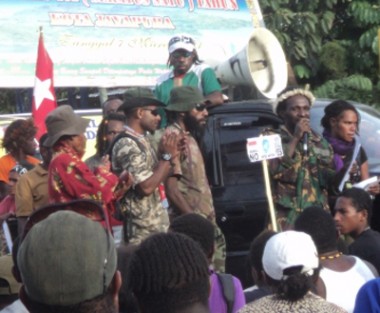
Photo Report: Mass ralllies show Papuans refuse to accept Indonesian Occupation

by Westpapuamedia.info sources

Social Media across West Papua is abuzz with declarations of relief and pride for the successful and peaceful mass mobilisations called by the West Papua National Committee (KNPB) to support the “West Papua: Road to Freedom” conference in in Oxford UK, on August 2.   The Photo Galleries below demonstrate unequivocally the scale of Papuan opposition to Indonesian rule.

Despite threats of heavy-handed Indonesian security force actions preventing free expression, attempts by the army to blocakade demonstrators, and unexplained act of violence suspected by many to be the work of Special Forces prior to mobilsations, tens of thousands of people across Papua took to the streets to demand their universal human rights to self -determination and a Referendum on the future of Papua.  Though vibrant and very loud, the rallies across Papua reportedly proceeded without any violence or provocations from security forces or proxies.

Bukhtar Tabuni, Chairman of KNPB, said “My appeal to all West Papuans living in jungle, in prison, in various parts of Papua and those living in exile that today all West Papuans must show their solidarity to support the KTT ILWP in Oxford. This event is important because it will conclude whether “Act of Free Choice” in 1969 was illegal and because the UN involved in the transfer of West Papua, it is an international issue.”
Terrianus Yoku, President National Congress West Papua National Authority said, “WPNA fully supports the rally organised by KNPB and appeal for international advocacy to monitor the current situation because it’s very volatile and unsafe.”
In Jayapura, the Rally coordinator from KNPB, Bernard Tabuni, explained that by mid afternoon the marchers paralysed Abepura, with traffic jammed, shops and schools closed and the marchers stretching for well over a kilometre with around 15,000 demonstrators.  The marchers were painted with mud on their body and also painted with stylised depictions of the banned Morning Star flag, thereby upholding the agreement with security forces that no flags would be flown.  The marchers were exuberantly singing and chanting, playing traditional instruments along the route, joined in the Long March by over 30 trucks, 20 station wagons, 17 Kijangs, 400 motorbikes of people joined the long march.”
With its roots in ancient Papuan traditions, demonstrators had planned several marches, called Long Marches, to converge on the DPRP – the focal point for the day’s events.  Troops from the TNI and Brimob riot police attempted to blockade one Abepura-bound Long March at Waena, but demonstrators outwitted the security forces by getting into vehicles and driving around them.  Exuberant scenes of yelling and singing greeted the procession of vehicles as they joined the main body at Abepura.
Daniel Wenda, secretary of KNPB, mentioned that four TNI truckloads of red and white uniformed Barisan Merah Putih (Pro-Indonesian militia) also organised a rally outside DPRD office in Jayapura.   Slogans on the banners stated “Reject the ILWP Summit” (KTT ILWP),  “Don’t lie to the people”, “Detain all corruptors.” and also “anti-Corruptor”.  Observers i Papua have taken the BMP slogans with mirth and irony given that their chief, Ramses Ohee, is regularly the beneficiary of corrupt dealings, has extensive illegal business interests, and receives significant funding from the notoriously corrupt Kopassus special forces.
“This demonstration is aimed to attract attention and counter our main rally but we will not be provoked”, said Daniel Wenda.
Bernard Tabuni reported that undercover military intelligence officers were amongst the demonstrators, and four truckloads of fully armed security forces were following behind the marchers.  TNI and Kopassus were also amongst the bystanders with cameras recording every movement.
A screening of a live internet stream from the Road to Freedom conference in Oxford was planned to be held at the grave of Theys Eluay on Tuesday night, but there are conflicting reports on the success of this.
A carload of armed BMP members appeared at the KNPB Secretariat in Waena late on Tuesday evening.  According to Daniel Wenda, the militiamen – a mix of Javanese and older Papuan men – attempted to gain entry, allegedly to abduct Mako Tabuni, KNPB Vice Chairman.  Tabuni was quickly bundled by KNPB security to a safe location.

In Wamena in the Baliem Valley, almost 17,000 people to a mass gathering that saw scenes of exuberance, singing and dancing.  After several hours of speeches and music, demonstrators peacefully dispersed.

In Sarmi, Yakuhimo and Keerom, reports are filtering out that flagraising ceremonies were held successfully without incident.

The slideshow below shows the August 2 actions in (in this order) Abepura, Waena and Wamena; and also those of  the weak counter-demonstration of Barisan Merah Putih militias funded by the Indonesian special forces, Kopassus, that was held close to the DPRP, or (Papua Province People’s Representative Council).

This slideshow requires JavaScript.

‘West Papua – The Road to Freedom’ conference, Oxford, UK, Aug 2

from International Lawyers for West Papua

Next Tuesday 2nd August, international lawyers, politicians, tribal leaders, a UN committee member & a witness to the 1969 Act of Free Choice will gather for the Road To Freedom conference in Oxford, UK.

Chaired by British MP Andrew Smith, the conference will present the strongest case to date that the people of West Papua have the right to self-determination under international law.

People across West Papua will be following the conference and will use its outcomes to further their campaign for freedom.

List of speakers include:

  • Andrew Smith – British politician
  • Jennifer Robinson – International human rights lawyer
  • Powes Parkop – Governor of Port Moresby and the National Capital District, PNG
  • Benny Wenda – West Papua independence leader, UK
  • Frances Raday – Expert Member of the UN Committee for the Elimination of Discrimination Against Women
  • John Saltford –  Expert on the 1969 Act of Free Choice
  • Clement Ronawery – Witness to the 1969 Act of Free Choice
  • Ralph Regenvanu – Vanuatu Justice Minister
  • Charles Foster – co-founder of the International Lawyers for West Papua

As a sign of support for the conference and in solidarity with the Papuan peoples struggle for freedom, the Mayor of Oxford has agreed to fly the Morning Star flag above Oxford Town Hall on the day of the conference.

The conference is taking place at Oxford University’s East School of the Examination Schools, 75-81 High Street, Oxford, OX1 4BG. It will commence at 2pm

Those wishing to attend are required to register by emailing conference@ilwp.org

Urgent need for Truth and Reconciliation Commission and Human Rights Court in Papua

Press Release from LP3BHLaw 21/2001 on Special Autonomy for Papua as amended by Law 35/2008 states the following in article 46, para (1): ‘In order to strengthen unity of the people in the province of Papua, a Truth and Reconciliation Commission should be set up while Article 46 reads as follows: ‘ Within the framework of strengthening unity and unanimity, a Trth and Reconciliation shall be set up.’

‘The task of the Commission (KKR) shall be (a) to reach a clarification of Papuan history to solidify unity and unanimity of the nation within the Unitary State of the Republic of Indonesia and (b) to draft measures towards reconciliation.’

In further elucidation of Article 46, it states the need for reconciliation which shall include the acknowledgement of errors, the need for apology, the offer of forgiveness, peace, the rule of law, amnesty, rehabilitation or other alternatives  necessary to upholding the sense of justice with the community in order to uphold unity and unanimity.

In the opinion of LP3BH-Manokwari, the Association for Research, Advocacy and Development of Legal Aid,  a Commission for Truth and Reconciliation is an integral  part of the implementation of special autonomy that should as a matter of urgency be implemented the Indonesian Government and the regional government in the Land of Papua, namely the governments of Papua and West Papua.

The formation of the KKR is very urgent. There are four issues that need to be dealt with: first, the marginalisation and effective discrimination against the indigenous Papua people as a result of economic developments; political conflicts; and the mass in-migration into Papua since the 1970s.Affirmative action needs to be taken in order to empower the indigenous Papuan people.

The second problem is the failure of development, especially in education, health and economic empowerment. This requires  new paradigms directed towards development that is focussed on improving public services so as to advance the welfare of indigenous Papuans living in the kampungs.

The third issue is the contradiction between the history and political identities of Papua and Indonesia. This problem can only be resolved by means of dialogue such such happened in Aceh.

The fourth issue is the responsibility for state violence committed against Indonesian citizens in Papua. This needs reconciliation between  a human rights court and the truth; to uphold the rule of law and justice for the victims, their families and all Indonesian citizens now living in Papua.

The way to resolve the third and fourth issues  means, according LP3BH, the formation of a truth and reconciliation commission and the setting up of a human rights court in Papua. This is very urgent and pressing and requires the support both of the Indonesian Government and and the governments of the provinces of Papua and West Papua and the various legislative assemblies (DPRP and DRP PB) Why is this so? Because the  historic contradictions and the political identities between Papua and Jakarta all too frequently become the trigger for social-political conflicts  in the Land of Papua. It frequently happens that  when Papuans take action to express their political aspirations in the form of peaceful demonstrations or events held to mark the anniversary of Papuan independence day on 1 December or the anniversary of  the independence of the West Melanesian Republic on 14 December, these incidents become politicised by the state and treaed as criminal acts by the security forces (POLRI) with the arrest of activists of peaceful demonstrators who are then accused of MAKAR or of disturbing the public order and treated as a criminal act in accordance with the criminal code (KUHP).

The security forces frequently use violence amounting to human rights abuses  towards victims either in the form of physical violence or violation of their rights as guaranteed in the KUHAP – the criminal procedural code.

On the other hand, ever since the Act of Free Choice (PEPERA), gross violations of human rights  have been committed by the military against Papuan civilians who are killed, tortured or forcibly disappeared.  Anything between 500 and 1,000 Papuan civilians have been murdered, tortured, forcibly disappeared, and subjected to other forms of violence by members f the military forces (TNI) in virtually all the towns and cities  such as Jayapura, Merauke, Fakfak, Sorong, Manokwari and Biak. In Biak, a number of Papuans who work in the civil service as teachers, nurses, as well as people working for private enterprises, as well as those who worked during the Dutch period  in Serui, Nabire and Biak have been arrested and imprisoned for more than two years at the TNI naval base in Biak.

In addition, properties have been unlawfully and forcibly seized from homes and shops belonging to Chinese inhabitants by members of the armed forces, it being alleged that  they are assets owned by the OPM, which is used as justification. The civilian community in the Land of Papua have themselves felt how  the Indonesian military security forces  entered people’s homes and seized people’s belongings such as transistor radios, tinned food and drinks from The Netherlands All these things were confiscated by the Indonesian military apparatus in 1969 and taken off to Java.

All this has left feelings of bitterness and hatred among the civilian population in the Land of Papua going back many years, which are still being felt today. This is what the Rev. Benny Giay calls Memoria Pasionis.

According to the LP3BH, these matters should have been settled many years ago in accordace with international standards and basic human rights principles.

The LP3BH therefore makes the following demands:

1.    The Indonesian Government should pay attention to the political need to immediately set up a Commission of Truth and Reconciliation in implementation of Law 21/2001, as well as set up a human rights court in Papua.

2.   The provincial governments in Papua and West Papua  should immediately introduce regulations with regard to  the creation of the KKR, its composition, location, and its mode of operation as well as its funding.

3. The DPRP and the DPR PB should take the initiative and play a key role in efforts to set up the KKR and the human rights court in Papua as the  way to solve the social-political conflicts which have continued to persist  from 1969 up to the present day., which should be continued into the future but which have until now been regarded as matters of no importance, and about which nothing has at yet been done to comply with universal legal standards  and basic human rights.

Manokwari, 27 May 2011

LP3BH,
Yan Christian Warinussy, SH

The hope for Papua’s freedom: ‘Go International’

image

Apologies for delay in posting

Tuesday, 03 May 2011 19:58

Editor : Markus

Tabloid JUBI — The struggle of the native people of Papua for freedom from all the evils they have suffered since their annexation into the Unitary Republic of Indonesia on 3rd May 1963, still echo to this day, not only on the local and national scene, but already internationally.

“At this time, our hopes for freedom for the People of West Papua depend on the support of the world. Privately and through our own organisations we are struggling, but now we have the help and sympathy of all the countries of the world,” said the Head of the National Committee of West Papua, Mako Tabuni, on Tuesday 3rd May 2011.

Support from the international world is growing and becoming stronger,for example from Israel.  This is a long campaign, and this is the way to do it – by gaining friends. “The problems of West Papua are also world problems, and Indonesia has to open itself up to recognise the truths of its history, of what happened some decades ago,” said Mako.

The formation of  two  bodies called International Lawyers for West Papua (ILWP) and International Parliamentarians for West Papua (IPWP), said Mako, came about as a result of the world’s notice and support for West Papua. ‘We are being well supported by the ILWP and the IPWP, which are fighting for the fate of West Papua.”

He said this as on the day after Monday 2nd May, when thousands of people had marched peacefully to assemble at the Post Office in Abepura, Jayapura.

The KNPB (National Committee) had emphasised several important points which are tied to our history, status and the sad fate of the people of Papua.

Firstly, the people of West Papua have not, did not nor ever will give their consent to join the Unitary Republic of Indonesia (NKRI) to become a part of their republic, West Papua.

Secondly, the process of making West Papua part of the NKRI, beginning in 1963 and finishing in 1969, organised jointly by Indonesia, United States of America, the Netherlands and the United Nations, was engineered as a false process, not following the Principles of international justice. The owners of the area of West  Papua were never involved in the process, and the international talks and arrangements took no account of their wishes.

Thirdly, the agreement called “The New York Agreement” was not supervised by the whole of the United Nations, resulting in the “referendum” of 1969, where the people of West Papua were not given their political right to vote on the basis of “one person, one vote”; this “vote” consisted of only 1025 people chosen by Indonesia to “represent” West Papua. This is a violation against the political rights of the people of West Papua.

Fourthly, NKRI has killed and destroyed many of the native citizens of West Papua since they began their DOM (Local Military Operation) to take up possession of the land of West Papua in 1963.

Fifthly, NKRI has pursued, intimidated, terrorised and killed many of the citizens of WP since this operation began.

Sixthly, Special Autonomy was offered as a solution to these problems. This policy was never really implemented as promised and published as policy by Indonesia.

Seventh, the only thing which is supporting Special Autonomy, which is the one thing the NKRI is offering, is part of their colonisation of Papua which nullifies the political rights of the native people of Papua, because the foremost problem for them is their right to determine their own future for themselves, which has been suppressed and undermined by the unilateral annexation of Papua through the so-called Act of Free Choice of 1969.

“We do not recognise the right of the Government of Indonesia, and all the institutions of that country, to stand in the nation of West Papua,” said Mako Tabuni, reading from a petition which had been signed by the whole assembly which had attended the march.

What we, the KNPB, are demanding is, firstly: that Indonesia stop all political manoeuvres using the Special Autonomy, formation of the MRP and the UP$B program in the land of West Papua.

Secondly, Indonesia and West Papua be the subject of an international legal process so that the political status of West Papua can be brought to the table at the International Cpurt, to determine a just policy about the validity of Indonesia’s annexation of the land of West Papua, and a justice for the people of West Papua.

Thirdly, in order to determine the will of the people of West Papua, a Referendum be held in a democratic way by the United Nations, to find a final solution to the political conflict in West Papua.

To find a framework to support this process to end the problems in West Papua via an international legal and political process, the KNPB puts forward the name of  Ms. Melinda Janki as Head of the ILWP, Mr. Charles Foster and all the members of the ILWP.

Also,  Mr. Andrew Smith as Head of the IPWP, Mr. Caroline Lucas together with all members of the IPWP to support the political process to bring the matter before an  internasional forum, together with the support of a free Papua. Also, the Government of the Republic of Vanuatu, as a member of the United Nations, also gives a similar mandate  to determine the legal status of West Papua through an international legal process at the International Court of Justice.

At the same time, the Spokesperson of the International KNPB, Victor Yeimo, can be a representative and coordinator to express the hopes and expectations of the people of West Papua. For this to happen, we need to form a representative body: a National Council of West Papua.

“It is not just anyone, it is the people of Papua alone who can bring about freedom. So, let us, the people of this land, come together and work and struggle,” said Yeimo.

About twenty Papuan representatives who addressed the assembly signed a petition before the demonstration ended at about 6 pm.

 (Markus)

SONAMPMA: Photo Report of Show of Support by Papuan people for Referendum

Port Numbay,  Papua.

from National Organisation for Student Solidarity of Papua.

 Peace and Freedom !

 We are reporting on the  Demonstration of the People of Papua demanding a Referendum about Self-determination on May 2, 2011 ; for the people of Papua to have the right to determine their own fate. The demonstration took place at the Post Office in Abepura, Jayapura, as shown below :

 – The Show of Support by the people of Papua was coordinated by the National Committee of West Papua, made up by the following organisations :  Organisation of Students and Youth, DAP, Women, Religions, Intellectuals of Papua, and the whole people of Papua from this area. They marched from Sentani, through Waena and Abepura, towards Jayapura (Imbi Park), starting at 8 am.

This slideshow requires JavaScript.

While waiting for the people to arrive from Sentani, there were political speeches from the coordinating body, and from several support organisations , all carrying street banners, leaflets and pamphlets, attracting the close  attention of the security forces, there to  « keep the peace », also tried to obscure some of the pictures.  Some of the banners  were saying :  Some of the leaflets said « Papua, Yes ; Indonesia No. », with each of their flags illustrated. Others said « Referendum » and « Papua Merdeka ».

 –          At another coordination point (the campus of USTP) that morning a group began to gather in front of the campus gateway fronting onto Jalan Raya, Sentani, while others came from the campus of UnCen-Abepura. They had banners saying REFERENDUM. There were speeches and the people began to move towards the main square of the campus.

 –          A large group of people assembled at Imbi Park in the early morning, not to avoid observation, because there were thousands of people already assembled there.

 –          About 5 or 6 detachments of Police from Jayapura were there and 3 units of Brimob (mobile police), observing the demonstration with some bodyguards, using 7 or 8 trucks and other vehicles, some of them equipped with weapo

–          Speeches went ahead until about noon, with 600 people who had arrived from Sentani began to assemble at Expo Waena. The whole procession gathered there were about 1000 people, preparing for the Long March to the Post Office at Abepura.

 –          The Long March began at 1 pm, and proceeded towards Abepura.  At the TNI  post at SIPUR, the demonstrators were surprised by an escort of Mobile Ambulance, together with a group of TNI (Army), fully armed, who accompanied the demonstration.

 –         Mass action continued its long march to the Central (shopping) centre , Post Office-Abepura escorted by security parties mentioned above.

–          There were speeches, which were answered by cries of « Referendum » and « Papua Merdeka ».  They stopped at the traffic lights at the Post Office at Abepura and began to sit on the road. All other activities in the town were halted and the town closed down early.

–          The total number of people eventually numbered about 2000 to 2,500. At about 2.15, the procession from Jayapura began to arrived and gathered together with the others at the Post Office.  The numbers swelled even more. The demonstrators stayed at this place, and listened to speeches from some of the leaders of the different groups representing the protestors.

– This demonstration was carried out peacefully until 6 pm, helped by vehicles which helped to keep the peace,   dispersing the people peacefully,  after which they resumed normal economic activities on the streets.

– The demonstration today, after marching well with vehicles and on foot, went off well and peacefully without any violence.

This report that we have made is completed by the Organising Committee for the Demonstration, 2nd May 2011, with great care, and we thank you for reading it.

SONAMAPA

Create a website or blog at WordPress.com

Up ↑
