7.30 Report (ABC): West Papua arrests highlight Australian Detachment 88 links

Australian Broadcasting Corporation

Broadcast: 04/10/2012

Reporter: Hayden Cooper

An Australian-funded police unit in West Papua has again been implicated in a crackdown on the region’s independence movement.

(Note:  Syndicated here as this story was produced by ABC with the assistance of West Papua Media, after we originally broke this story at https://westpapuamedia.info/2012/10/01/wamena-arrests-as-australian-funded-anti-terror-troops-conduct-raid-amid-increasing-repression-on-knpb-political-activists/ )
Transcript

LEIGH SALES, PRESENTER: An Australian funded counter-terrorism unit in West Papua is facing new accusations of abusing its power in the troubled Indonesian province.

The notorious squad known as Detachment 88 has launched a fresh crackdown on independence activists, in the wake of an expose by this program in August.

Eight men have been detained and accused of bomb-making.

Separatist leaders claim the explosives were planted and they’ve been framed to justify the squad’s activities.

Hayden Cooper has this report.

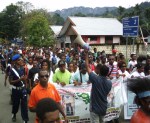
HAYDEN COOPER, REPORTER: Jayapura, West Papua is a city marred by violence and tension, where independence leaders have been arrested, beaten, killed. And where police have been confronted by unruly and angry demonstrations.

When 7.30 travelled to the province in August, the crackdown on the independence movement was already severe, resulting in several deaths, including of this man, independence leader Mako Tabuni, shot in this street, witnesses say, by the Australian trained and funded police unit Detachment 88.

ERSON WENDA, RELATIVE (last month, voiceover translation): Clearly, it was them who killed him because we saw them shoot him and take him to their hospital.

HAYDEN COOPER: Since then, the crackdown has worsened. Victor Yeimo succeeded Tabuni as leader of the West Papuan National Committee, KNPB. This week, he sent this video to 7.30.

VICTOR YEIMO, CHAIRMAN, KNPB: We are the non-violent activists in West Papua. We will fight for our right of freedom according to the peaceful means in West Papua. We demand our right of self-determination to a referendum to be held in West Papua by UN peacefully and democratically.

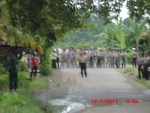
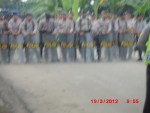
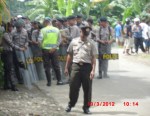
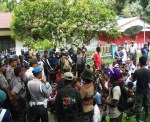
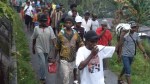
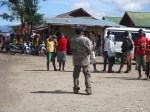
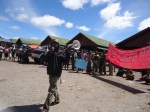
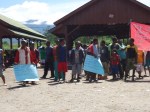
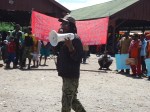
HAYDEN COOPER: But the Indonesian authorities don’t believe his claim of non-violence and they’re pursuing KMPB like never before. In June, Indonesian soldiers went on a rampage in the highlands town and KNPB stronghold of Wamena, and now in a new development, police have raided the homes and offices of KNPB members in the area. Last weekend eight were arrested and witnesses say once again Detachment 88 was involved.

VICTOR YEIMO: When they arrest the KNPB brothers in Wamena, we saw Detachment 88 with one car, and another car with police, joined in by TNI.

HAYDEN COOPER: Indonesian police accuse the eight KNPB members arrested of making bombs and claim to have found explosives during the raid. Victor Yeimo rejects that and says his group is being framed as terrorists to justify Detachment 88’s presence.

VICTOR YEIMO: This is how Indonesia is now making a scenario with the terrorist issue in West Papua. As you know that in West Papua we never know how to make a bomb, how to create bomb.

HAYDEN COOPER: Some international observers and West Papuan advocates back that view

CAMMI WEBB-GANNON, SYDNEY UNI: I don’t think that the KNPB has any reason to be making bombs because they believe in a peaceful approach to pursuing independence. They want a referendum on independence in West Papua.

HAYDEN COOPER: In West Papua the Institute for Human Rights Advocacy, known as ELSHAM, has studied the arrests and suspects the explosives recovered by police were part of an elaborate set-up.

CAMMI WEBB-GANNON: They don’t have the capacity to gain the materials, so ELSHAM has actually said that the materials were probably planted in the KMPB members’ houses where they found the explosives and that’s not an unusual thing for security forces to do.

HAYDEN COOPER: The weekend raids follow the appointment of a new police chief in Papua, Brigadier General Tito Karnavian. His background as the former head of Detachment 88 generates serious unease among some Papuans, despite his assurances of a new inclusive approach.

CAMMI WEBB-GANNON: They will be opposed to his former role as the head of Densus 88, and as a police chief this just – it doesn’t seem to mesh with his new approach of working – to win the hearts and minds of Papuans.

RONNY KARENI, WEST PAPUAN EXPATRIATE: I have no doubt there’ll be definitely more crackdowns on KNPB members and those who are very active and very vocal in pursuing and calling for independence for West Papua, and that is for sure, that that’s one thing that Jakarta is aiming to shutting down political activists in West Papua.

HAYDEN COOPER: Ronny Kareni is one of many West Papuans living in Australia. He uses music to promote the independence cause on behalf of his friends at home.

RONNY KARENI: Every day, like, I got SMS coming through my phone and then the information is that their lives are under intimidation and they always live in state of fear and they’re being followed and it’s sad, but this is the reality in West Papua.

HAYDEN COOPER: 7.30 put several questions to the Indonesian Government but received no reply. Attempts to contact the new Papuan police chief were also unsuccessful.

As for Victor Yeimo, he is pushing for the release of the eight activists arrested on the weekend, and with his supporters here, he’s pressuring Australia to rethink its funding for Detachment 88.

RONNY KARENI: The Papuans will be pretty much living like prisoners in our own land where our movement, what we do, will be censored, will be monitored, will be followed, and as I said, there’s no room for democracy at all.

LEIGH SALES: Hayden Cooper reporting.

Original URL http://www.abc.net.au/7.30/content/2012/s3604232.htm

Videos and latest figures from Wamena provide evidence of Indonesian army rampage

June 8, 2012
(updated June 10)
West Papua Media
Credible and trusted West Papua Media sources have provided video clips (below) that show the extent of destruction caused by the rampage of soldiers from the Indonesian Army (TNI) Battalion 756 in Wamena on June 6.
The soldiers, who ran amok in retaliation for the fatal beating by Wamena residents of two soldiers that killed a small Papuan boy in a motor incident, left a trail of destruction and violence across Wamena after a night of brutal and indiscriminate shootings, beatings and arson that has left at least 9 dead, 19 seriously injured, thousands homeless, and caused thousands of residents to flee to the relative safety of surrounding mountains.
According to local independent human rights activist Roni Lokbere, soldiers were firing indiscriminately at any Papuan they saw.  “Anyone in sight of police and soldiers who have the black and curly hair, it is not forgiving – just automatic firing action,” said Lokbere in a message with videos sent to West Papua Media.

“We make these reports based on true facts, the actions of the TNI and police officers who are arrogant and abusive, that ignore the principles of humanity and justice,” said Lokbere.

Human rights workers in Wamena have identified a number of victims so far, but they report there are still many victims to be identified, with military and police personnel blockading the hospital to prevent relatives access to those who sustained injuries.  This policy is causing great concern from local people that Indonesian security forces are committing further human rights abuses at the hospital in Wamena on survivors of the rampage.

According to fresh but separate unconfirmed reports received by West Papua Media, medical staff are being threatened by heavily armed military officers at the hospital, and soldiers and police including Australian-funded Detachment 88 counter-terror officers are directly interfering in the provision of treatment.

This information was provided at great risk by paramedics to Papuan human rights activists,  describing the scenes of terror and intimidation still occurring at the hospital in Wamena.

At time of writing only members of the local Nduga tribal clan had been formally identified as dead, with several other tribes including Susa people, represented amongst an unknown number of total casualties.  Many of those injured received significant wounds, and with the deliberate interference to medical treatment of the wounded by security forces, the number of dead is expected to rise.

Those formally identified are:
  1. Jairus Lokbere, Nduga tribe, an unarmed member of Battalion 34/ TPN (Tentara Pembebasan Nasional/ National Liberation Army) Komadan Inije Kodap;
  2. Kisiurt Kurungga, 21, villager;
  3. Metiuspus Telenggen, 26, villager;
  4. Elianus Bugiangge, 45, villager;
  5. Pianus Tabuni, Nduga tribe, Civil Servant
  6. Enus Lokbere, Nduga tribe,  Local legislator of DPRD;
  7. 2 children aged 12 and 13 in local school “holiday village” (boarders staying in school “village” during holidays as their families cannot afford return to rural homes)
  8. A man who died in the hospital who was not identified due to extent of facial injuries from beating with rifle butts.
In addition, over 20 Lani tribespeople have sustained serious injuries from gunshots and beatings during the rampage, though their condition is not yet known at time of publishing.  The names above are only those being treated in hospitals in Wamena and all are people from Nduga tribe.
Due to the evolving situation and ongoing repression of local people and human rights investigators by Indonesian security forces , it must be stressed that these names are not fully confirmed, however West Papua Media has received this information from trusted sources,
More information as it becomes available
Westpapuamedia

Video Report: Thousands in Jayapura demonstrate in support of “New Guinea Council: First Steps” conference in Netherlands

Benny Wenda at the IPWP launch Русский: Бенни ...
Benny Wenda at the IPWP launch

from West Papua Media sources

Demonstrations were held in Jayapura on April 5 in support of a groundbreaking conference held in The Hague, The Netherlands, to examine  pathways to the reinstatement of the New Guinea Council or Nieuw-Guinea Raad, the original Parliament of West Papua from 1961 until Indonesia’s invasion.

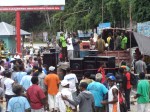
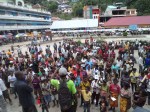
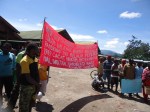
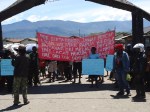
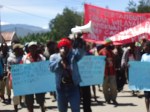
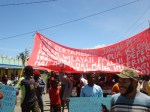
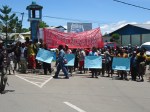
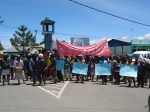
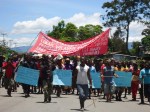
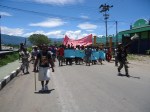
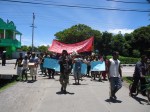
Jayapura was again brought to a standstill by the demonstration organised by the West Papua National Committee (KNPB), where several thousand people gathered hear speeches and to voice their solidarity with the “Nieuw-Guinea Raad: the First Steps” Conference.

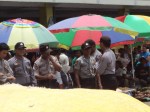
Indonesian security forces were in attendance in large numbers at the rally, but no act of violence or provocation were reported by rally organisers.

In The Hague, speakers at the conference organised by the International Parliamentarians for West Papua (IPWP) and held at the Dutch Parliament, included exiled UK-based independence figure Benny Wenda, Dutch Parliamentarians including Harry van Bommel, Cees van der Staaij, and Wim Kortenoeven.  International Lawyers for West Papua (IPWP) Co-ordinator and international human rights lawyer Jennifer Robinson also spoke, demanding The Netherlands honour its “sacred trust” of its promise of independence for the West Papuan people, and assist West Papuan to fulfil their human right to self-determination.

The New Guinea Council (Nieuw-Guinea Raad) was established on April 5 1961 whilst under Dutch administration as the concept of a more democratic mode of administration started to develop, as a body that was to be the basis for a independent West Papuan parliament.  According to the International Parliamentarians for West Papua, “The establishment of regional councils came from the requirement that the Charter of the United Nations imposed on the Netherlands: that the interests of the inhabitants of Dutch New Guinea had to be paramount.”
“The Netherlands was to respect the right to self-rule and had to take the political aspirations of the indigenous people into account. They were also meant to support the Papuan people with the gradual development of their own political institutions.  There are documents. We are not speaking of vague promises, but we are speaking of real firm commitments for the independence of the West Papuan people,” explained a spokesperson for IPWP.

“Unfortunately by signing the New York Agreement (1962) the Dutch governments abandoned the West Papuan people,” the spokesperson said.

Footage from the demonstrations in Papua:

This slideshow requires JavaScript.

Presentations at the conference in The Netherlands:

Thousands across Papua demand UN step up to protect Papuan people: PHOTO AND VIDEO REPORT

Ban Ki-moon with Indonesia President Susilo Ba...
Ban Ki-moon with Indonesia President Susilo Bambang Yudhoyono (Photo credit: Wikipedia)

PHOTO AND VIDEO REPORT

from the West Papua Media Editorial team, and local sources across Papua

March 21, 2012

Rallies held across West Papua, Indonesia, and Australia have drawn tens of thousands of people on to the streets calling on UN Secretary-General Ban Ki-Moon to do more to protect West Papuans to Indonesian state violence, and to allow them exercise their universal human rights to self-determination.

Despite significant threats of violence prior to the rallies by Indonesian security forces against peaceful unarmed protestors, the mass mobilisations across West Papua significantly outnumbered security forces and were peaceful.  In some centres, the police only sent a handful of undercover intelligence agents to monitor the situation.

Security forces blocking access to Jayapura (photo Matias Murib)

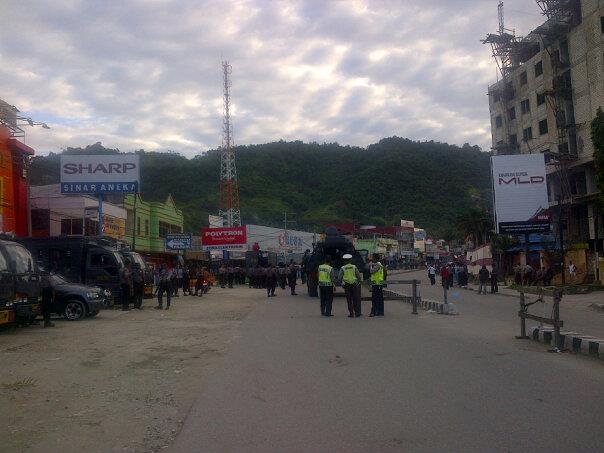
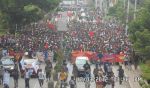
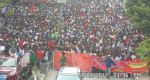
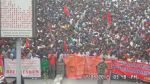
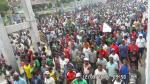
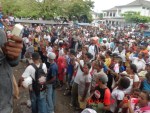
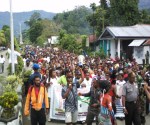
In Jayapura, over 5000 demonstrators marched from Taman Imbi and joined with a long march of several thousand people.  Security forces blocked access to the centre of Jayapura with heavy weaponry, but the rallies avoided provocation.  Jayapura was reported to be a ghost town as the rallies paralysed normal business and movement.

[youtube http://youtu.be/1Y0jMhuygXE] [youtube http://youtu.be/Zjz3Vj4Mv3A] [youtube http://youtu.be/xNgwCGiqB6E] [youtube http://youtu.be/lStemYrVRIo] [youtube http://youtu.be/IcoGo4fXRBY]

Speakers in Jayapura demanded that the UN Secretary-General listen to the people of West Papua and tabled seven key demand on the UN.  Buchtar Tabuni, from the West Papua National Committee (KNPB) told the crowd that the UN must take responsibility for its role in the sham 1969 Act of Free Choice handover of West Papua to Indonesia, actions that violated international law.

“Ban Ki-Moon and SBY have to know the wishes of the sovereign independence of Papua on the land itself.  KNPB will mediate the West Papuan people so they can determine their political choices through a mechanism that is democratic, peaceful, dignified and final in accordance with the principles and standards of international law”, said  Tabuni.

Jayapura

Herman Wainggai, a West Papuan  the West Papuan independence advocate based in the United States explained at the solidarity rally in Melbourne, Australia, “Our troubles began in New York in 1962, and I hope they will end there soon. We ask the United Nations to host talks between the Indonesian Republic and the Federated Republic of West Papua, just as the UN did between the Indonesians and the Dutch”

Ban Ki-Moon was visiting Indonesia to participate in  The Jakarta International Defence Dialogue, hosted by the Indonesian Ministry of Defence on 21 March 2012, a move widely seen by human rights observers as giving legitimacy to Indonesian militarist objectives over West Papua and beyond.

West Papuan activists called on Mr Ban to use the opportunity to press Indonesia on human rights in Papua and its consistent denial of basic freedoms and rights to West Papuan people, including rights to life and of freedom of expression, and freedom from arbitrary detention.

“We would like Mr Ban Ki-moon to attend to our defence while he’s in Jakarta” said Herman Wainggai,

“The Universal Declaration of Human Rights establishes the right of all individuals to freedom of opinion and expression and the right to peaceful assembly and association. Also,  Indonesia is a signatory to International Covenant on Civil and Political Rights (ICCPR), which guarantees the rights to freedom of expression and peaceful assembly and Indonesia’s constitution also protects these rights,” Wainggai told West Papua Media.

“So,  it would be appropriate for the Secretary-General to negotiate the release of all political prisoners in Indonesia while he is visiting the new ‘Peacekeeping’ Centre in West Java,” said Wainggai.

Widespread Mass Actions

The rallies across Papua drew tens of thousands of people in total in Wamena, Biak, Serui, Yapen, Sorong, Nabire, Jayapura and Fak-Fak.  Security forces engaged in their standard procedures of intimidation and disruption at all rallies, but protesters maintained non-violence discipline at each area.

On Yapen island, close to 6000 people in total held two long marches to support the demands of the day, all under threat of arrest.  Local police had refused to issue a permit for the rallies to go ahead, claiming the rallies would upset the security and integrity of Indonesia.  After a week of pamphleteering and socialising the rallies, police had no choice but to allow the rally to go ahead.  The rally began in the village of Mantembu, where former political prisoner Yawen Wayeni was brutally disembowelled and filmed by Brimob police in a video leaked on Youtube in 2010.

Mantembu, Yapen Island

The same Brimob unit on Monday attempted to block the long march from leaving Mantembu, using over 50 police to block the narrow road, and attempted to seize all Morning Star flags.  Negotiations ensued, led by Reverend Jhon Pairire and FRWP Doberay Governor David Abon, who got agreement from police for the rally to continue to Serui city.  Police continued to intimidate Papuans all day, but Morning Star flags still appeared throughout the day despite Police.

Serui, Yapen Island

Manokwari saw more than 7000 people from across Papuan society and resistance raise the Morning Star flag and conduct long marches all over town after prayer, eventually settling down to listen to orations from a wide range of speakers.  Speakers called for the freeing of all political prisoners in Papua in Indonesian prisons, including the President and the Prime Minister of the Federal Republic of West Papua.  Brimob officers tried to seize the Morning Star flags early unsuccessfully, but soon stood aback training their weapons on the crowd, who studiously ignored the provocative intimidation according to stringers for West Papua Media.

Manokwari

In Sorong, our stringers reported that almost 1000 people took to the streets in a festive atmosphere.  Organisers claimed that few security forces turned up other than about ten plain clothes intelligence agents.  “It is clear that this drastically changed the atmosphere, it must be because of international pressure,” said our stringer by SMS.

On the West Coast in Fak-Fak, almost 1000 people took part in prayers and listened to speeches in the main market square, with little interference by security forces present.

Fak-Fak

In Jayapura, stringers for West Papua Media reported a wide range of colourful, festive and dramatic demonstrations for Papuan aspirations, including the release of almost 300 balloons painted with banned Morning Star flags and the UN flag, which drifted across town and out to sea.  This tactic has been used repeatedly as a tactic for distributed symbolic resistance in both Papua and Maluku for years.  Isolated gunfire was heard when the balloons passed over military barracks, according to local sources, believed to be Indonesian soldiers attempting to shoot down the balloons.

And in Wamena, in the Baliem Valley, a thousand people joined in a rally and march to support the call for the UN to take action by sending peacekeeping force to protect Papuan people against Indonesian security forces.  Stringers for West Papua Media report that few security forces were in overt attendance, but there was an understanding that troops were close by at all times.  The Baliem Valley and West Papuan highland people have borne the brunt of Indonesian violence since the occupation began, with sweeps against civilians by the Australian funded Detachment 88 counter terrorism group and Indonesian army still ongoing in Tingginambut, Mulia and the outer areas of the Baliem Valley.

Wamena

More demonstrations are planned in coming weeks.

westpapuamedia

West Papua- December 1 2011 – Breaking the Media Blackout

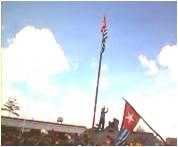
50 years ago on the 1st of December 1961, West Papuans flew their flag for the first time in preparation for their independence from the Dutch.

In 2011, despite ongoing repression, the Morning Star flag was once again flown across the country. The non-violent demonstrations and gatherings, as well as the military crackdown against them, were reported to the world via a network of citizen media journalists, breaking through the media blackout of West Papua.

This short wrap-up shows how the West Papuan people would not let outrageous threats of Indonesian state violence suppress their desire to declare their independence.

[vimeo http://vimeo.com/34163958]

Create a website or blog at WordPress.com

Up ↑